Showing posts with label fran wilde. Show all posts

Friday, 7 August 2020

Riverland by Fran Wilde

Riverland by Fran Wilde is a portal fantasy book for children (aka middle grade). I first encountered it during a reading by the author at Dublin WorldCon last year. This year, I finally got around to picking up Riverland after it was shortlisted for the not-a-Hugo Lodestar Award and hence was included in the Hugo voter's packet.

When things go bad at home, sisters Eleanor and Mike hide in a secret place under Eleanor’s bed, telling monster stories. Often, it seems those stories and their mother’s house magic are all that keep them safe from both busybodies and their dad’s temper. But when their father breaks a family heirloom, a glass witch ball, a river suddenly appears beneath the bed, and Eleanor and Mike fall into a world where dreams are born, nightmares struggle to break into the real world, and secrets have big consequences. Full of both adventure and heart, Riverland is a story about the bond between two sisters and how they must make their own magic to protect each other and save the ones they love.

Riverland is not exactly an easy and relaxing read. It follows twelve-year-old Eleanor and her younger sister Mike, as they deal with an abusive family situation and periodically fall into a fantastical fantasy world made of the river and dreams. The abusive father is the hard part to read, of course, but there is not very much physical violence on the page. Wilde captures the fear, confusion and instability of an emotionally abusive household excellently. I absolutely felt Eleanor's stress as she strived to keep everything just right to avoid bad things happening, and I felt the way she was always kept off-balance by the house rules changing without warning.

The fantastical river world under her bed was where dreams come from and was also caught in a battle to maintain the delicate balance between dreams and nightmares. As well as Eleanor's responsibilities at home — to always do the right thing, to look after her sister and keep her parents happy — she finds herself tasked with fixing the leaks in Riverland; yet another burden. We watch Eleanor try to juggle more balls than a twelve-year-old should ever be expected to, and Wilde transfers some of her fear and tension to the reader.

So as I said, it wasn't a fun, light read, but it was interesting. I liked the fantasy world and I liked the fact that it was somewhere the girls kept revisiting rather than a place they went to and stayed in to have adventures, à la Narnia. And for all that I've emphasised the difficult parts of the book, there were also plenty of hopeful moments, though I don't want to spoil them. The ending was also a good one (though, again, not spoiling).

I highly recommend Riverland to anyone looking for a crunchy children's fantasy book I would probably hand it to slightly older children, because it does deal with some heavy issues. But I expect younger children in similar situation may benefit seeing themselves in the narrative.

4.5 / 5 stars

First published: 2019, Amulet Books
Series: No
Format read: PDF
Source: Hugo Voter Packet

Sunday, 21 June 2020

Short Stories #6–10, mostly Hugo shortlisted

I have not "officially" read very many short stories this year. As I think I mentioned in my last short story post, this is in large part because of reading submissions for Rebuilding Tomorrow, my new anthology, coming out by the end of the year if no more apocalypses hit. Since I, of course, can't mention those on the blog, my other reading has been rather slow. This latest batch were partly inspired by the Hugo short list, except for the first one, which just jumped out at me for being a cool story.

I plan to do some proper Hugo round ups when I've read all the relevant things, but for now, here are some of them, in the random order I read them in:


Little Free Library by Naomi Kritzer — A very cute story about a woman who built a tiny community library. It has a nice mystery and a compelling ending. I liked it a lot and I won’t be surprised if it makes next year’s Hugo ballot. Source: https://www.tor.com/2020/04/08/little-free-library-naomi-kritzer/

A Catalogue of Storms by Fran Wilde — A surreal but sweet/sad (sort of) story set in a world where storms have some degrees of sentience and certain people become incorporeal to fight them. I enjoyed it. It felt quite poetic. Source: https://uncannymagazine.com/article/a-catalog-of-storms/

Ten Excerpts from an Annotated Bibliography on the Cannibal Women of Ratnabar Island by Nibedita Sen — An interesting story told in snippets from the points of view of a variety of people. It explores colonialism, diaspora and a few other issues, with an additional off-putting layer of cannibalism. I generally find stories told through snippets interesting, but I’m not sure I can easily like them as much as traditional narratives. Source: http://www.nightmare-magazine.com/fiction/ten-excerpts-from-an-annotated-bibliography-on-the-cannibal-women-of-ratnabar-island/

And Now His Lordship Is Laughing by Shiv Ramdas — A satisfying story of revenge against colonisers, after a detailed description of some of their atrocities. I was not a fan of the narration from the Strange Horizons podcast. Source: http://strangehorizons.com/fiction/and-now-his-lordship-is-laughing/

Away With the Wolves by Sarah Gailey — An engaging enough story about a werewolf who suffers from chronic pain when human. The story was more or less about the idea that one need not torture oneself just to find acceptance in the community. I found it got a little preachy at the very end, but overall it was fine. Source: https://uncannymagazine.com/article/away-with-the-wolves


Friday, 17 May 2019

#ReadShortStories and travel in mind as well as body (66–70)

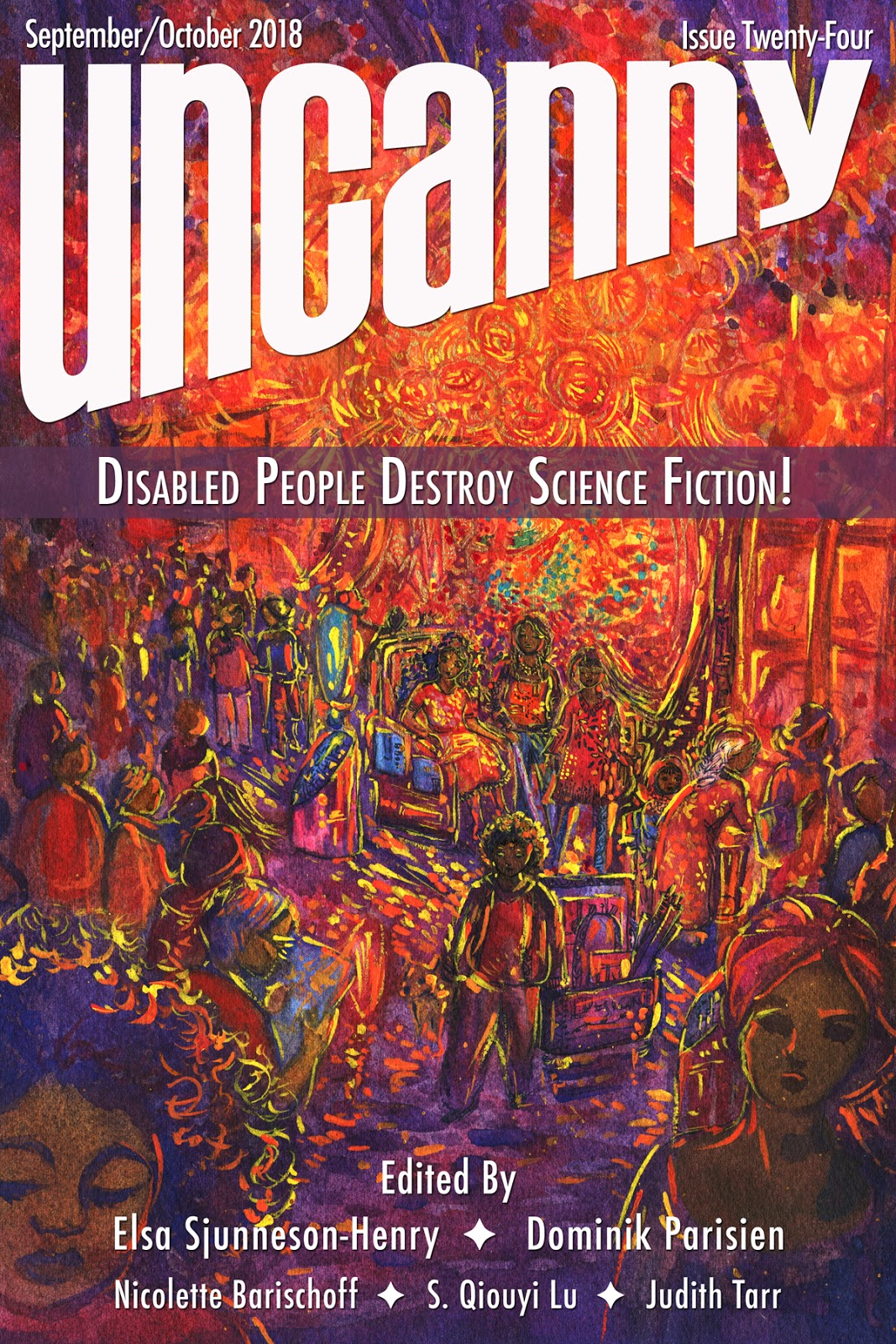
As I mentioned in the last batch, I decided to make a concerted effort to finish New Suns after having neglected it for a little while. Once I did that (the last few stories were enjoyable, I had just stalled after one or two stories I didn't enjoy in the middle-ish of the anthology), I moved on to making my way through Uncanny's special issue Disabled People Destroy Science Fiction. That's where the latter stories in this batch have come from.

One Easy Trick by Hiromi Goto — A cute story about a woman, her belly fat, and a forest. I quite enjoyed it and found it a bit unexpected, in a good way.  Source: New Suns edited by Nisi Shawl

Harvest by Rebecca Roanhorse — A kind of creepy story. I found aspects of the ending a little too ambiguous but, nevertheless, it was well written. Source: New Suns edited by Nisi Shawl

Kelsey and the Burdened Breath by Darcie Little Badger — A bit of a mystery but mostly a ghost story. I enjoyed the mythology of it and wouldn’t have minded a longer/meatier story. Source: New Suns edited by Nisi Shawl

Abigail Dreams of Weather by Stu West — Cancer kids (or similar) living on a space station during a meteor shower. A cool scene-setting story, although there wasn’t very much to it beyond the worldbuilding. Also opened with a lot of vomit, which I could have lived without.  Source: https://uncannymagazine.com/article/abigail-dreams-of-weather/

Disconnect by Fran Wilde — This story was about a woman with wandering joints (literally they seem to disappear and reappear in space) who is also a physics lecturer (well, adjunct, since it’s set in the US). Since I have stupid joints and am an astrophysicist, it seemed like I should have enjoyed this story. Alas, instead I got the very strong feeling that the author only had a passing knowledge of physics at best, which was very frustrating. Ultimately, this story did not work for me at all.  Source: https://uncannymagazine.com/article/disconnect/


Thursday, 5 July 2018

#ReadShortStories and a poem (111 to 115)


I've been making my way through Uncanny Issue Twenty-One, which is where all of this batch's stories are from. I'm not a fan of how the ePub issues have all the short stories, then the essays, then the poems, rather than mixing them up a bit. So I decided to do some mixing myself and threw in a poem (and some non-fiction, which I'm not reviewing) out of order. 

Unfortunately, since the new issue of Uncanny dropped a couple of days ago, being almost finished with this one isn't bringing me significantly closer to being up to date.

And Yet by A. T. Greenblatt — A haunted house as a portal to parallel universes — a pretty logical idea, really. Interestingly told in second person, which works well for it. Source: https://uncannymagazine.com/article/and-yet/

Like a River Loves the Sky by Emma Törzs — A lovely, if somewhat sad, story about friendship, family and loss. And dogs and taxidermy. A nice read. I liked it.  Source: https://uncannymagazine.com/article/like-river-loves-sky/

The Testimony of Dragon’s Teeth by Sarah Monette — A story about ill-will and small malicious magic. Not a bad read, though not a favourite either. Source: https://uncannymagazine.com/article/testimony-dragons-teeth/

Pistol Grip by Vina Jie-Min Prasad — A bit graphics for my tastes, this is a short story about super soldiers who have drawn the short straw in life. Source: https://uncannymagazine.com/article/pistol-grip/

Editorial comment: I am a little disappointed by how aggressively not my thing "Pistol Grip" is since otherwise Vina Jie-Min Prasad has become one of my favourite short story writers. (I'm still going to keep reading her stories, of course, but my expectations for this one were probably too high.)

The Sea Never Says It Loves You by Fran Wilde — I really liked this poem, despite not usually being much of a fan of Wilde’s writing. It’s a somewhat story-driven about how unsatisfying loving the sea is (as the title says). Source: https://uncannymagazine.com/article/sea-never-says-loves/


Friday, 20 April 2018

#ReadShortStories (65 to 70)

It's been slower short story reading of late, for me, since I've gotten myself hooked on a few novels. This batch, among other things, finishes off my Hugo short story reading. I will do a separate post soon focussing on just that shortlist and talking about how I would vote. I also started reading the novella anthology The Underwater Ballroom Society and it's first fairytale rock opera rock star and fairyland story.


Clearly Lettered in a Mostly Steady Hand by Fran Wilde — Not a terrible story but not to my taste. (I say this in light of it’s Hugo nomination.) It had an interesting vibe and the second person narration worked well but I didn’t think the end came with sufficient pay-off (for a Hugo nomination...). Source: https://uncannymagazine.com/article/clearly-lettered-mostly-steady-hand/

Welcome to Your Authentic Indian Experience™ by Rebecca Roanhorse — An eerie story that starts out as one type of science fiction, exploring (Native American) race through a commercialised lens... then turns into a different sort of horrific story. I enjoyed it and didn’t see the second half coming from the vantage point of the first half. Certainly an interesting read and I can see why it made the Hugo shortlist. Source: https://www.apex-magazine.com/welcome-to-your-authentic-indian-experience/

The Queen of Life by Ysabeau S Wilce — A novella about rockstars and fairyland, death and fame. I found the opening a little too slow, as it took a while to set the scene and establish sufficient backstory so that what felt like the “real” story could start. When that came, it was an interesting journey into fairyland filled with deception, glamour and a corgi steed (sort of). I enjoyed the second half of it more than the first. Source: The Underwater Ballroom Society edited by Stephanie Burgis and Tiffany Trent

Sun, Moon, Dust by Ursula Vernon — A cute story about a man who inherits a magic sword from his warrior grandmother, inhabited by spirits that can train him to fight. But all he wants to do is farm potatoes. I enjoyed the subversion of the magic sword trope, the goat and the tentative queer love story. Source: https://uncannymagazine.com/article/sun-moon-dust/

Carnival Nine by Caroline M. Yoachim — A lovely story about mechanical toy people who live out their lives based on the number of “turns” they get. A metaphor for energy and disability/chronic illness that, I suppose, makes more sense than spoon theory — and in fact for that very reason I’d actually heard of this story before I got to reading it. The main character has more turns than average and the story follows her life from childhood through adulthood, partnering up, and having a child. And focuses on how many turns the people around her have or don’t have. Source: http://www.beneath-ceaseless-skies.com/stories/carnival-nine/

Wednesday, 31 May 2017

Hugo Novelette Reading

Reading the novelette category of the Hugo shortlist is a little bit less simple than reading the novellas because two of the stories are not available for free online (the Stix Hiscock and the Fran Wilde). I'm going to wait until the Hugo packet comes out for the Wilde and I'm not sure that I'll get through/bother with all of the Hiscock when it comes. I'll probably glance at the opening. We'll see.

Luckily the Hugo packet arrived promptly. The stories below are listed in the order I read them.


“The Art of Space Travel”, by Nina Allan (Tor.com, July 2016)

This story is about a woman who works in a hotel near Heathrow, which happens to be the hotel the group of astronauts going to Mars will stay at before departing. The bulk of the story deals with her feelings surrounding space travel, which is inextricably tied up with her family history, especially her mother. The major emotional journeys for the protagonist, Emily, are her search for her father — whose identity she doesn't know — and her mother's illness, caused by proximity to space travel.

It's not a bad story, but nothing very much happens in it. We get a bit of a sense for a future in which a large mission is being attempted for the second time, but not much else about the future world is revealed. Emily's emotional journey isn't boring, but neither is it thrilling. The most interesting bits, for me, were about what happened to her mother. Mind you, part of the point there is that no one really understands her illness in full, so it's not really a plot thread with a resolution. I enjoyed "The Art of Space Travel", but I didn't love it. I am hoping that I will enjoy some of the other novelettes more.


The Jewel and Her Lapidary, by Fran Wilde (Tor.com, May 2016)

My first impress of of this novelette was that it had too much world building for a relatively short story. In retrospect, if someone had told me up front that it was a novella, I probably would not have felt that way. This is a story about the fall of a royal family and the gem-based magic they used to keep their people safe and maintain peace. The story opens with a coup and mass murder, which should have been exciting but was bogged down a little with the explanation of how the gems worn by the Jewels and controlled by lapidaries works. I found myself rereading part of the opening, trying to get it straight.

That said, "The Jewel and Her Lapidary" wasn't bad, but it didn't grab me very strongly and it didn't wow me. I did feel affected by the ending, but it took me several days to read this not very long story, a sign of my generally lukewarm interest. I expect that others might feel differently (and obviously enough people loved this story to nominate it), so your mileage may vary.


“You’ll Surely Drown Here If You Stay”, by Alyssa Wong (Uncanny Magazine, May 2016)

This was a gothic western, I think is the best way to describe it. In terms of feel, it reminded me of the Pretty Deadly comics, although the actual story is quite different. "You'll..." is about a darkly magical orphan boy, his best friend, and the crappy situation the both of them live in. And death and the desert.

It's written in second person, but not jarringly so. I am, however, curious as to why the author made that choice — it didn't seem integral to the story like the use of second person does in John Chu's "Selected Afterimages of the Fading" (in Defying Doomsday), for example. Westerns aren't really my thing, but this story didn't bore me or feel like it was dragging, so I expect it will ultimately rank well on my ballot.


“The Tomato Thief”, by Ursula Vernon (Apex Magazine, January 2016)

This is another story set in the American west, which is really very coincidental of my reading order. The protagonist of this one is an old lady, not entirely human or unmagical, who is very keen on her tomato plants. And then someone steals her nice tomatoes and she acquires a mission.

"The Tomato Thief" is much more plainly written than the other Hugo stories I've read so far. I wasn't a huge fan of the style, but it didn't grate or offend me either. The story itself wasn't bad but, as with all the novelettes so far, I didn't love it either. My guess is it will rank in the middle somewhere for me.


“Touring with the Alien”, by Carolyn Ives Gilman (Clarkesworld Magazine, April 2016)

Another disappointing story. It had promise, from the first few sentences, but the main premise is no longer that original (except, why did the aliens only visit the US? This fact is stated but never addressed) and the secondary premise was interesting but not explored in enough depth. A shockingly egregious quarantine violation near the end really annoyed me and wasn't even used to show something interesting about character, like I half-expected.

The story wasn't badly written aside from the lack of depth mentioned above. But it clearly annoyed me too much for me to vote it very highly. Alas. I suspect I was also disappointed that the tour with the alien took place on Earth rather than in space.


Alien Stripper Boned From Behind By The T-Rex, by Stix Hiscock (self-published)

Pass, after some indecision.

~

A disappointing novelette shortlist, all in all. The short stories were a stronger category. I didn't hate any of these either, and actually I found them all to be of similar quality which does make ranking harder. That said, “You’ll Surely Drown Here If You Stay” was my top contender since it was well-written and so forth, even if I didn't love the subject matter. Then it's close between "The Art of Space Travel" and "The Tomato Thief", followed by "The Jewel and Her Lapidary", then "Touring with the Alien". But this category really did feel like much of a muchness.