Showing posts with label robots. Show all posts

Sunday, 3 May 2020

Network Effect by Martha Wells

Network Effect by Martha Wells is the first novel about the adventures of Murderbot, who previously appeared in four novellas that I read, enjoyed and reviewed: All Systems Red, Artificial Condition, Rogue Protocol and Exit Strategy. Network Effect follows on from these novellas in a similar vein but in a longer format, meaning there’s even more Muderbot to enjoy in one convenient package. It also has a rather unusual format for its blurb:

You know that feeling when you’re at work, and you’ve had enough of people, and then the boss walks in with yet another job that needs to be done right this second or the world will end, but all you want to do is go home and binge your favorite shows? And you're a sentient murder machine programmed for destruction? Congratulations, you're Murderbot.

Come for the pew-pew space battles, stay for the most relatable A.I. you’ll read this century.


I’m usually alone in my head, and that’s where 90 plus percent of my problems are.

When Murderbot's human associates (not friends, never friends) are captured and another not-friend from its past requires urgent assistance, Murderbot must choose between inertia and drastic action.

Drastic action it is, then.

If you've read any of the Murderbot novellas, you'll have a pretty good idea of what to expect from this book. The biggest difference I found between novel and novellas is the length of the novel. It felt different — in a good way — to have the story just keep going longer than the novellas had trained me to expect. It also made for a meatier story, with a more complex plot and more substantial room for character development. We also got more of a chance to better get to know characters other than Murderbot. In particular, we see a lot more of a subset of the humans from Preservation, where Murderbot went to live at the end of Exit Strategy, and a few others I don't want to spoil. Hearing the humans have all sorts of benign opinions regarding Murderbot was excellent.

I remember reading, around the time that this novel was announced, that it would be continuing the story of Murderbot but would also tie everything up in a conclusive way. It certainly follows on from the novellas — I don't recommend starting with Network Effect, rather go start with All Systems Red — but aside from containing a complete story arc, I didn't really feel like this was a conclusive end to the tales of Murderbot. If anything, it seemed that the end was left nicely open for a sequel featuring Murderbot and some of its new friends. So I hope that happens.

It wouldn't be a Tsana-review if I didn't mention my one physics objection in the book. A lot of the technology and computer/AI stuff is bordering on the fantastical in an expected far-future way, and that stuff doesn't bother me. But there was one "WTF, no, that's not how space elevators work" moment which annoyed me for about five minutes before I was able to move on and pay attention to the story again. At least it was comparatively minor in the scheme of the book.

Network Effect was an excellent book in which Murderbot kicked a lot of arse and got to form/build on meaningful relationships with multiple people. If this sounds like your sort of thing, and if you've read the Murderbot novellas, then I highly recommend picking up this book. If this sounds like your sort of thing and you haven't read the novellas, I suggest starting with All Systems Red. I really hope there will be more Murderbot in the future. I am also planning to reread all the novellas at some point, because reading them as they came out resulted in a lot of memory gaps, though nothing I couldn't work out easily enough in the context of the novel. I'd still like to experience the whole early story in a more continuous way.

5 / 5 stars

First published: May 2020, Tor.com
Series: Yes. Fifth instalment of the Murderbot Diaries, and let's hope there are many more to come.
Format read: eARC
Source: Publisher via NetGalley

Tuesday, 19 November 2019

Catfishing on CatNet by Naomi Kritzer

Catfishing on CatNet by Naomi Kritzer is a YA novel set in the world of the short story "Cat Pictures, Please", which does not require previous knowledge of that story to enjoy. This was an excellent book which I accidentally started reading and then didn't put down until 4 am, several months before its release date. Whoops.

My two favorite things to do with my time are helping people and looking at cat pictures. I particularly like helping people who take lots of cat pictures for me. I have a fair amount of time to allocate: I don’t have a body, so I don’t have to sleep or eat. I am not sure whether I think faster than humans think, but reading is a very different experience for me than it is for humans. To put knowledge in their brains, humans have to pull it in through their eyes or ears, whereas I can just access any knowledge that’s stored online.

Admittedly, it is easy to overlook knowledge that I technically have possession of because I’m not thinking about it in the moment. Also, having to access to knowledge doesn’t always mean understanding things.

I do not entirely understand people.

As if an endearing AI wasn't enough, this book's human protagonist also has an excellent voice, turning this book into quite a page-turner. The story mainly focusses on Steph, who moves around a lot with her mother and hence doesn't have much chance to make friends in meatspace, instead forming her closest friendships online. Starting at yet another crappy school, Steph finally does make some friends and this sets off a complicated chain of events which results in a very high-stakes climax.

It's just as well this book is written in an extremely up-beat tone, because it deals with some pretty heavy issues, mostly surrounding domestic violence and the appalling state of the US education system (near-future or not) but also with passing nods to racism. It would have been a very depressing read if it wasn't funny — and if we didn't have the AI as a bit of a wildcard to mix things up.

Catfishing on CatNet is an excellent book and I highly recommend it to all fans of science fiction — especially AI — and YA. If you want to get a feel for the book without committing to it, the short story "Cat Pictures Please" will give you a very good idea of the tone, even if it's about the AI rather than Steph. This is a completely self-contained read but there is potential for sequels or spin-offs. I would be more than happy to read more stories about any of the characters in this book.

5 / 5 stars

First published: November 2019, Tor Teen
Series: Maybe? Same world as "Cat Pictures Please" but a self-contained story with a potential hook for a sequel
Format read: eARC
Source: Publisher via NetGalley

Sunday, 7 October 2018

Exit Strategy by Martha Wells

Exit Strategy by Martha Wells is the fourth and semi-concluding Murderbot Diaries novella. I say semi-concluding because it ties up the story in the Murderbot Diaries so far, but we have been promised a novel in the future, so this is not the last we'll be seeing of Murderbot. I have previously reviewed all three earlier novellas: All Systems Red, Artificial Condition and Rogue Protocol.

Murderbot wasn’t programmed to care. So, its decision to help the only human who ever showed it respect must be a system glitch, right?

Having traveled the width of the galaxy to unearth details of its own murderous transgressions, as well as those of the GrayCris Corporation, Murderbot is heading home to help Dr. Mensah—its former owner (protector? friend?)—submit evidence that could prevent GrayCris from destroying more colonists in its never-ending quest for profit.

But who’s going to believe a SecUnit gone rogue?

And what will become of it when it’s caught?

Another Murderbot diary, another night staying up too late reading it.

What struck me most about this concluding novella was how much it tied the earlier three novellas together. My feeling with those first three was that they were self-contained stories within the same overarching framework. They made more sense to read together, but were very episodic. In contrast, Exit Strategy binds all those stories together and concludes the overarching story started in the first book. I don't recommend reading it without having read the earlier books. I also look forward to rereading the whole series in a row, which I am currently planning to do in the lead-up to the upcoming Murderbot novel (tentatively slated for early 2020, so no rush).

Exit Strategy continues with the sarcastic tone we've come to know and love from Murderbot, and gives us the opportunity to see how far Murderbot has come since the first book and the freshly-hacked governor module. The reprise of several characters that we haven't seen since book 1 emphasised this contrast. This was a satisfying and slightly violent read and satisfactorily concluded an arc of character growth, while leaving the stage open for a follow up.

In conclusion, Exit Strategy is another excellent Murderbot read. If you've read the earlier books in the series, what are you waiting for? If you haven't, I suggest starting with All Systems Red and reading all four novellas in a row. If you're a fan of science fiction and sarcasm, you won't regret it.

4.5 / 5 stars

First published: October 2018, Tor.com
Series: Murderbot Diaries book 4 of 4 (of the novella series)
Format read: ePub
Source: Purchased (pre-ordered) from Apple Books

Thursday, 6 September 2018

Mother of Invention edited by Rivqa Rafael and Tansy Rayner Roberts

Mother of Invention edited by Rivqa Rafael and Tansy Rayner Roberts is an anthology exploring robots and artificial intelligences created by women and non-binary people, rather than the male inventors many older stories have focussed on. It contains stories covering a wide variety of ideas and settings within this theme and is a must-read if you are interested in exploring diverse robot/AI stories.

An ambitious anthology from award-winning Australian publishing house Twelfth Planet Press, Mother of Invention will feature diverse, challenging stories about gender as it relates to the creation of artificial intelligence and robotics.

From Pygmalion and Galatea to Frankenstein, Ex Machina and Person of Interest, the fictional landscape so often frames cisgender men as the creators of artificial life, leading to the same kinds of stories being told over and over. We want to bring some genuine revolution to the way that artificial intelligence stories are told, and how they intersect with gender identity, parenthood, sexuality, war, and the future of our species. How can we interrogate the gendered assumptions around the making of robots compared with the making of babies? Can computers learn to speak in a code beyond the (gender) binary?

If necessity is the mother of invention, what exciting AI might come to exist in the hands of a more diverse range of innovators?

This was a very interesting read and I was pleased with the breadth of stories and ideas presented in Mother of Invention. I have found some themed anthologies need to be broken up because of too much similarity in their stories, but that was not the case here. I admit I didn't quite read it straight through, but that was for other, mostly external reasons, not because I found it repetitive.

Overall, this was an excellent read. While not every story necessarily worked for me, I certainly enjoyed the majority of them. My three favourite stories were "Sexy Robot Heroes" by Sandra McDonald, "Quantifying Trust" by John Chu and "S’elfie" by Justina Robson. All three took very different approaches to the theme and, really, the only similarity between them is that they contain artificial intelligences. You can read more of my thoughts on these stories and all the others below, where I have included my mini reviews of the stories that I wrote as I read them.

I would highly recommend Mother of Invention to readers interested in exploring different ideas of robots and artificial intelligences, including as a vehicle for exploration of other themes such as gender, religion and creation. This is not I, Robot, filled with logic-puzzle stories, but rather is filled with stories of humanity and inhumanity, and a spectrum on both sides of that divide.

~

Mother, Mother, Will You Play With Me? by Seanan McGuire — A story about an AI child learning through games and growing up. I enjoyed it, although it wasn’t what I expected (from the title and author I expected something creepier). I liked how many different ideas it explored, and also the ending.

Junkyard Kraken by DK Mok — A roboticist builds an ocean-exploration robot after failing to get funding for it. A fun story, especially thanks to the inclusion of other AI robots, such that it can be forgiving for being a bit unrealistic.

An Errant Holy Spark by Bogi Takács — A Jewish AI growing up, learning, and trying to talk to aliens. Written in the unique style I’ve come to expect from this author, the inner voice of the AI was very different to conventional (robot/AI) tropes. An interesting story and premise, with baffling aliens.

The Goose Hair of One Thousand Miles by Stephanie Lai — A story written in the form of an annotated translation of a wuxia story. The story itself is particularly bizarre, to my eye, because of the way the robots are included and thanks to the aspects the commentary focuses on. Even so, it engages with ideas of colonialism well.

The Art of Broken Things by Joanne Anderton — An eerie story based on the really interesting premise/theme of kintsugi. I liked the idea and the way different aspects of the story meshed together, but at the same time it creeped me out a bit (mostly in a good way).

Sexy Robot Heroes by Sandra McDonald — I really liked this story. It featured a trans girl mechanic, a whole barge of girl mechanics, and androids bound to serve them. It was the right mix of sentimental and sensible.

A Robot Like Me by Lee Cope — An agender AI programmer makes an AI in their image. A lovely and slightly bittersweet story about gender. I liked it.

New Berth by Elizabeth Fitzgerald — A futuristic take on regency romance that put me in mind if Austen in tone. However, I found it a bit confusing to keep track of characters and motivations and it didn’t really work for me for that reason. I expect some readers will enjoy it more than I did.

Fata Morgana by Cat Sparks — Post-apocalyptic/war-torn Australia with fighting mechs wandering around, at least one of which is intelligent. In rough conditions the mech protects the old lady that was its creator and helps a poor settlement. I enjoyed it.

Bright Shores by Rosaleen Love — A fantastical story about robots (and one woman) living in a nuclear exclusion zone. Clearly taking cues from the Fukushima tsunami disaster, I liked the premise of the robots left behind (because they are too contaminated from dealing with radioactive material), but it lost me a bit with some of the less scientific ideas.

Quantifying Trust by John Chu — A robot engineering grad student works on her design and ponders the question of trust for AI. And meets a postdoc who may or may not be an advanced AI sent from the future. I really liked this story.

Sugar Ricochets to Other Forms by Octavia Cade — A pretty weird story. On the one hand, we have a couple of women running a brothel staffed with magic automaton boys made out of sugar and cake (who often come back with parts missing in the morning). On the other hand, there is a clockwork witch made of brass I love with baby crabs lured by sugar. A compelling read, but also a strange one.

Kill Screen by EC Myers — A teenage girl makes an AI program of her recently deceased best friend. It was a bit morbid, mostly because it dealt with the question of why the friend had killed herself, but also for other reasons (spoilers). I mostly enjoyed it, but it also made me feel uncomfortable (intentionally, I assume), especially near the end.

Living Proof by Nisi Shawl — A story about an AI reproducing. The setting was quite different — a prison — and to some degree aspects of the story put me in mind of Bitch Planet. Not the overall thrust of the narrative, however, which is more about purpose from the AI perspective. Not my favourite story, but I didn’t hate it.

S’elfie by Justina Robson — A very interesting story about a world in which everyone has an AI personal assistant and what happens when they move far beyond what we currently have with Siri etc. Told from the point of view of one of these AIs, while her human is working on something in secret, I really enjoyed the incomplete knowledge of the narration.

Knitting Day by Jen White — A lovely story about knitted robots, poor working conditions and the subversion of capitalism. I enjoyed it, despite its grim setting and whimsical approach to assembly.
The Revivalist Kaaron Warren A creepy story (of course, look at the author) about a process that imbues discarded robots with the last words of the dead. Mostly murder victims. I liked it. And note it wasn’t heavy on the horror, more creepy/eerie.

Arguing with People on the Internet by EH Mann — An interesting story about an AI set loose arguing with people on the internet to unexpected consequences. Also features an asexual protagonist and engages with the concept of motherhood from a different angle. I quite liked it.

Rini’s God by Soumya Sundar Mukherjee — This story took an unusual approach. Not only was the protagonist AI interested in theological ideas but she has a hidden purpose. Which, in the context of the story was odd since it’s hard to program someone to do something when they have free will, so I found the creator’s motivation confusing from that point of view. Also, running an orphanage of AI humanoids was either sneaky or very strange, I haven’t decided which.

Tidefall by Meryl Stenhouse — Ow, my astronomy hurts. This was absolutely not a story to read at at astronomy conference, in between talks about merging stars oh em gee. So that coloured my reading of it considerably. Questionable astronomy aside, the plot and ideas didn’t really do it for me either. What seemed like it would be a really interesting idea ended up feeling a bit bland.

The Ghost Helmet by Lev Mirov — The AIs in this story are basically ghosts of soldiers whose memories became imprinted on their helmets. Our protagonist is a coder who accidentally caused the situation and now always wears her brother’s helmet so he can talk to and help her. I would have liked the story to spend some more time on the ethics of creating the helmet ghosts (is it really a good form of immortality?) but otherwise it wasn’t a bad read.

4.5 / 5 stars

First published: Kickstarter backers got it in July, general release September 2018
Series: No
Format read: ePub
Source: Kickstarter backer
Disclaimer: Although the editors, Rivqa and Tansy, are friends, I have endeavoured to write an impartial review

Friday, 20 July 2018

#ReadShortStories about feminist robots (126-130)


Not a huge amount of variety in this batch of short stories as I continue reading Mother of Invention, the anthology edited by Rivqa Rafael and Tansy Rayner Roberts. On the one hand, that does mean that this post is just presenting a chunk of anthology stories. On the other hand, clearly I'm enjoying Mother of Invention enough that I'm not feeling the need to seek out other stories to break up the theme.

This was a solid batch of stories that I enjoyed fairly consistently. That said, my favourite was the last in this batch, "Sexy Robot Heroes" by Sandra McDonald, which was delightful and thoughtful and a consistently interesting read. A bit surprisingly, this is also the only story in this batch by a new-to-me author. Hmm.


Junkyard Kraken by DK Mok — A roboticist builds an ocean-exploration robot after failing to get funding for it. A fun story, especially thanks to the inclusion of other AI robots, such that it can be forgiving for being a bit unrealistic. Source: Mother of Invention edited by Rivqa Rafael and Tansy Rayner Roberts

An Errant Holy Spark by Bogi Takács — A Jewish AI growing up, learning, and trying to talk to aliens. Written in the unique style I’ve come to expect from this author, the inner voice of the AI was very different to conventional (robot/AI) tropes. An interesting story and premise, with baffling aliens. Source: Mother of Invention edited by Rivqa Rafael and Tansy Rayner Roberts

The Goose Hair of One Thousand Miles by Stephanie Lai — A story written in the form of an annotated translation of a wuxia story. The story itself is particularly bizarre, to my eye, because of the way the robots are included and thanks to the aspects the commentary focuses on. Even so, it engages with ideas of colonialism well. Source: Mother of Invention edited by Rivqa Rafael and Tansy Rayner Roberts

The Art of Broken Things by Joanne Anderton — An eerie story based on a really interesting premise/theme. I liked the idea and the way different aspects of the story meshed together, but at the same time it creeped me out a bit (mostly in a good way). Source: Mother of Invention edited by Rivqa Rafael and Tansy Rayner Roberts

Sexy Robot Heroes by Sandra McDonald — I really liked this story. It featured a trans girl mechanic, a whole barge of girl mechanics, and androids bound to serve them. It was the right mix of sentimental and sensible. Source: Mother of Invention edited by Rivqa Rafael and Tansy Rayner Roberts

Wednesday, 9 May 2018

Artificial Condition by Martha Wells

Artificial Condition by Martha Wells is the second novella in the Murderbot Diaries series. I previously read, reviewed and loved the first novella, All Systems Red. I do generally recommend reading the first book before starting Artificial Condition, although Artificial Condition does a good job of reminding the reader what happened in the previous book.

It has a dark past – one in which a number of humans were killed. A past that caused it to christen itself “Murderbot”.

But it has only vague memories of the massacre that spawned that title, and it wants to know more.

Teaming up with a Research Transport vessel named ART (you don’t want to know what the “A” stands for), Murderbot heads to the mining facility where it went rogue.

What it discovers will forever change the way it thinks…

In this instalment, we follow Murderbot as it makes its way to the site of a severe malfunction that caused it to kill a bunch of people and after which its memory was wiped. On the way it makes a friend — who is also awesome and I hope we get to read about again — and finds some humans to temporarily guard. Also, the overarching plot thickens (but no spoilers).

I loved this book! After a stressful few weeks, getting back into Muderbot's head was exactly what I needed to relax and make me laugh. I love Murderbot. I love the voice and the sarcasm and the way it understands humans better by watching endless entertainment dramas than interacting with them directly. I also liked the different perspective on humans that we got from ART and Muderbot's take on ART's different taste in dramas. Everything I loved from the first book appears again in this one, including the exasperation at humans doing stupid things likely to get them killed.

This series is gold and if you don't hate non-human sentients they why aren't you reading it already? Hands down this is one of my favourite series ever and I foresee myself rereading it several times. (But for now I'm going to wait until all four novellas are out before I start re-reading — that way lies sadness at having to wait for future books.) I cannot wait until the next book, Rogue Protocol, comes out (due August).

5 / 5 stars

First published: May 2018, Tor.com
Series: The Murderbot Diaries book 2 of 4
Format read: ePub
Source: ARC from publisher via NetGalley with my official iBooks preorder hot on its heals. I read the purchased copy since it had the cover.

Wednesday, 5 July 2017

All Systems Red by Martha Wells

All Systems Red by Martha Wells is a novella I have heard a lot of people saying a lot of good things about. The only other book I've read by Martha Wells was kind of meh, so I'm glad the critical mass of people praising this book was well and truely exceeded for me to pick it up. It was an excellent read.

In a corporate-dominated spacefaring future, planetary missions must be approved and supplied by the Company. Exploratory teams are accompanied by Company-supplied security androids, for their own safety.

But in a society where contracts are awarded to the lowest bidder, safety isn’t a primary concern.

On a distant planet, a team of scientists are conducting surface tests, shadowed by their Company-supplied ‘droid — a self-aware SecUnit that has hacked its own governor module, and refers to itself (though never out loud) as “Murderbot.” Scornful of humans, all it really wants is to be left alone long enough to figure out who it is.

But when a neighboring mission goes dark, it's up to the scientists and their Murderbot to get to the truth.

All Systems Red had me from the opening paragraph which, as I immediately tweeted, was a delight. It's told in first person from the point of view of a cyborg. A bored cyborg who has gained free will and really just wants to watch TV between half-arsing its contractual duties enough to hide its illegal free will. Unfortunately, the survey mission that should have been straightforward and relatively dull — from Murderbot's point of view, if not the scientists it's protecting — turns out to be anything but.

This novella was brief but excellent. It had mystery, danger, adventure, a compelling voice and made me laugh many times. It was also an interesting look at humanity and where the lines are drawn. Murderbot counts as machinery rather than as human because of how it was constructed. But it still feels emotions and has independent thoughts and we get the impression that even if it hadn't given itself free will it would still be having these thoughts and feelings, it just wouldn't be able to act on them. On the one hand considered non-human, on the other sentient and enslaved. And we see augmented humans who have some similarities with Murderbots in terms of data processing and telemetry (for lack of a better word) but are definitely human. I assume these are themes that will be explored further in the sequel novellas.

All Systems Red was an excellent read and I recommend it to all fans of speculative fiction. It's a quick read and you don't even have to like robots or military SF to enjoy it. I cannot wait until the next novella comes out. I was sad when All Systems Red ended, not because it was a bad ending but because there was no more Murderbot to read and now I have to wait until next January for more.

5 / 5 stars

First published: May 2017, Tor.com
Series: The Murderbot Diaries 1 of a planned 4 so far
Format read: ePub
Source: Purchased on iBooks

Sunday, 16 June 2013

iD by Madeline Ashby

iD by Madeline Ashby is the sequel to vN, which I reviewed last year. It picks up not too long after the first book ended and deals with the consequences of events in the first book. This review will contain some spoilers for vN but not for iD. It's also the kind of series you have to read in order for it to make sense; iD depends on a lot of worldbuilding laid down in vN.

iD starts with Amy and Javier, our two protagonists from vN, living a reasonably idyllic life with Javier's kid (from the first book) treating them both as his parents... and then of course, everything goes horribly wrong. The majority of the book follows Javier as he tries to fix things (like the world and his life). We also learn much more about his character — who was more of a friend/sidekick figure in book 1 — and about his past. Amy isn't in it very much.

The first book dealt a lot with sentience and humanity through Amy, a vN without a failsafe. (The failsafe being the coding which makes the vN shutdown/bluescreen/die if they harm a human or through inaction allow a human to come to harm.) By contrast, Javier has an intact failsafe and his story is more about exploring his identity independent of humans and interrelationally with humans. The reader is confronted more often with the reason why vN make good prostitutes/lovers — because the failsafe makes them want to make humans happy, they feel compelled to be good lovers even though they might not normally be interested. What constitutes rape when it's done to a robot? Is sentience enough to condemn it as a deplorable act or does the fact that the vN don't feel pain mean it isn't really rape? These and other interesting questions are addressed as we follow Javier's journey.

I have to say, I didn't enjoy reading Javier's character as much as Amy's. Not because he was badly written or anything, more just a matter of personal preference. I was interested to see what would happen next, what was going on in the world and how it was all going to turn out, but I felt ambivalent towards Javier. I can see why Amy wasn't the point of view character this time, but I do hope Javier isn't the focus of the next book. Maybe one of the kids will be.

I originally thought this was a duology, although in retrospect that's probably because I've read so many Angry Robot duologies recently rather than any specific marketing I saw. I did think it was going to wrap up until I got to the end and then BAM! Epilogue! So I'm fairly confident there'll be a sequel even if the internet won't confirm that. And I look forward to reading it. The epilogue set up a potentially very interesting book three.

I enjoyed iD and I definitely suggest reading it if you enjoyed vN. If you're new to the series, I highly recommend it to fans of science fiction and/or robots and suggest starting with book 1. I look forward to reading about this world and the characters in future books.

3.5 / 5 stars

First published: 25 June 2013, Angry Robot
Series: Machine Dynasty, book 2 of ?
Format read: eARC
Source: The publisher via NetGalley

Saturday, 9 February 2013

The Mad Scientist's Daughter by Cassandra Rose Clarke

The Mad Scientist's Daughter by Cassandra Rose Clarke was an excellent read. It was very different to the author's début novel, The Assassin's Curse (my review), which I also enjoyed and which caused me to expect more of an adventure novel, possibly with steampunk elements (apparently, steampunk is where mad scientists belong, these days). The Mad Scientist's Daughter is not an adventure novel. It's set in the near future and, as the cover proclaims, it is "A tale of Love, Loss and Robots".

Cat, the titular character, is the daughter of two cyberneticists. When she's quite young, her father acquires Finn, a sophisticated android designed to look and act human. When her parents decide to homeschool her until highschool, they make Finn her tutor. Growing up with a robot, Cat does not hold the same prejudices and fears some elements of society do and isolated in a small town until she goes to college, she does not encounter them very often until she leaves. The Mad Scientist's Daughter is the story of Cat's life from childhood until her late thirties (I think). It is the story of a girl who fell in love with a robot.

The Mad Scientist's Daughter is a beautiful read. It explores the nature of sentience and humanity. Cat's father always treated Finn with respect and more or less like a person even when the law didn't require him to. This is wonderfully contrasted by a boyfriend of Cat's whose life mission seems to be getting around sentience laws by building AIs that are just dumb enough to not be granted any rights.

It was a bit of a depressing read. The tone reminded me most of The Time Traveller's Wife by Audrey Niffenegger (not just because of the title similarity) except where The Time Traveller's Wife made me angry with the extent to which the main character's entire life revolved around her husband, The Mad Scientist's Daughter did not. Cat's life is her own. It's not perfect, but it certainly doesn't completely revolve around Finn; Finn just happens to be the person she loves and is of course important to her. Also Finn is a proper science fictional robot, not just a literary construct to make Cat's life harder/more depressing as the pseudo-scientifically time-travelling husband in The Time Traveller's Wife was.

The Mad Scientist's Daughter is a literary novel. (Recall my definition of "literary" is a story with an internal journey rather than an external (going on an adventure) journey.) Despite that, it paints a bleak but not hopeless image of the future. Cat lives in a time after a series of climate disasters caused much destruction, but society has mostly recovered, even if the weather occasionally still does strange things. When I grow up, I want to write a book like this. This is the first book that has made me want to be able to write something literary.

I highly recommend The Mad Scientist's Daughter to fans of near future science fiction and/or robots. I think non-SF readers will also enjoy it as the science fictional elements are relatively minor (yes, despite the presence of the robot). It was an excellent read and I encourage everyone to give it a try (unless they can't cope with novels not filled with action and adventure).

5 / 5 stars

First published: February 2013, Angry Robot
Series: Nope.
Format read: eARC on iPad
Source: the publisher, via NetGalley

Monday, 13 August 2012

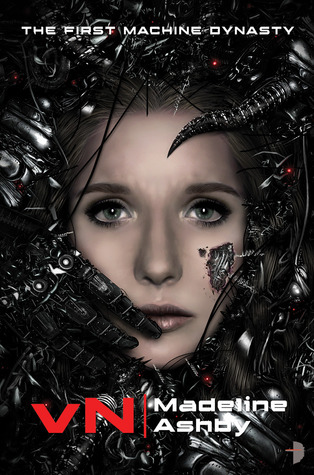
vN by Madeline Ashby

vN is Madeline Ashby’s début novel, recently released by Angry Robot Books. A copy of this book was provided to me by the publisher via Netgalley for review purposes.

vN is set in a near future world where humanoid robots exist and have become complex enough that in some respects they are difficult to distinguish from humans. They are also able to reproduce autonomously, given sufficient food, hence the designator vN — von Neumann machine.

The back story of vN is quite interesting. They weren’t created as some sort of science or engineering experiment, but by a church that expected the rapture. The idea was, when all the good people transcended, the people left on (hell on) Earth would need someone to look after them. Enter vN. For this reason, vN were built with a fail-safe that causes them pain or malfunction if they witness a human being suffering or in pain, particularly in a violent way.

This ideas explored as a result of this are fascinating. vN have some semblance of free will, except for where interaction with humans is involved. They find themselves drawn to wanting to make humans happy, even if the humans treat them badly, the vN just can’t help themselves. Also, fair warning, some people want to have vN around for less than wholesome reasons. Paedophilia, while not central to the story, comes up a couple of times in passing.

The story is told from Amy’s point of view, a vN, and in my opinion Ashby had no trouble conveying Amy’s humanity even while she was dealing with vN aspects of her nature. Amy’s mother, the vN she looks identical to, decided to marry (albeit not legally) a human man. The opening prologue is told from Amy’s dad’s point of view while Amy is still about five years old and the size of a human five-year-old (vN grow according to how much they’re fed until they reach adulthood, then the extra food goes towards iterating a child). Amy’s kindergarten graduation ceremony is interrupted by her psychotic grandmother attacking her mother. In defence of her mother, Amy eats her grandmother and ends up with her as a partition in her memory banks (talking to her and telling her to kill people).

In the course of events, Amy finds herself on the run from the authorities and teams up with another vN, Javier. Amy, who was coddled by her loving parents, finds herself suddenly a grown up (eating her grandmother gave her a growth spurt) and forced to deal with the harsh realities of the world. The story follows her and Javier’s misadventures as they attempt to stay alive and free.

I found vN to be an interesting and fresh take on robots. Although on the surface the fail-safe might sound similar to Asimov’s Laws of Robotics, the way it’s explored and the consequences we’re shown are quite different and significantly grittier than anything Asimov ever wrote. I definitely recommend this read for science fiction fans. I would also recommend it to most fantasy fans as it’s fairly low on technobabble and it’s character-driven as well as idea-driven. And anyway, the robots are advanced enough that they’re practically magic.

4 / 5 stars