Showing posts with label space opera. Show all posts

Tuesday, 2 March 2021

A Desolation Called Peace by Arkady Martine

A Desolation Called Peace
by Arkady Martine is the sequel to A Memory Called Empire, which I previously read and reviewed and which was last year's Hugo Award-winning novel. While I enjoyed the first book, I enjoyed the sequel even more.

An alien armada lurks on the edges of Teixcalaanli space. No one can communicate with it, no one can destroy it, and Fleet Captain Nine Hibiscus is running out of options. 

In a desperate attempt at diplomacy with the mysterious invaders, the fleet captain has sent for a diplomatic envoy. Now Mahit Dzmare and Three Seagrass—still reeling from the recent upheaval in the Empire—face the impossible task of trying to communicate with a hostile entity. 

Whether they succeed or fail could change the fate of Teixcalaan forever.

The central plot point is the war brewing between the Empire and mysterious aliens, only a few jump gates from Lsel Station. Our protagonists from the first book drag themselves into the thick of things and find themselves face to face with the aliens. Meanwhile, we are also introduced to two new characters — the senior fleet commander on thee front and the eleven-year-old imperial heir — who are both also excellent. I really enjoyed following all their stories and the way they ended up tying together when it came with dealing with an existential threat to human life.

After having done a lot of the heavy lifting with regards to worldbuilding in A Memory Called Empire, Martine is free, in A Desolation Called Peace, to explore other aspects of the world and characters. Some new concepts are introduced, but more of the focus is on characters and events. And while this book does follow some of the key characters from the first book and hinges on events that were set in motion in book one, both books are complete story arcs. You probably shouldn't read them out of order, but the first didn't leave us on a cliffhanger and the second had a lot more peril and a lot less poetry in it.

I really enjoyed A Desolation Called Peace, even more than A Memory Called Empire and I really hope Martine brings us more stories set in this world, even if no novel-length sequels are currently planned. I highly recommend this book to fans of space opera and space intrigue/diplomacy more generally. If you found the first book a bit slow, I think you'll enjoy this instalment more.

5 / 5 stars 

First published: March 2021, Tor Books
Series: Teixcalaan book 2 of 2 (for now)
Format read: eARC
Source: Publisher via NetGalley

A Desolation Called Peace by Arkady Martine

A Desolation Called Peace
by Arkady Martine is the sequel to A Memory Called Empire, which I previously read and reviewed and which was last year's Hugo Award-winning novel. While I enjoyed the first book, I enjoyed the sequel even more.

An alien armada lurks on the edges of Teixcalaanli space. No one can communicate with it, no one can destroy it, and Fleet Captain Nine Hibiscus is running out of options.

In a desperate attempt at diplomacy with the mysterious invaders, the fleet captain has sent for a diplomatic envoy. Now Mahit Dzmare and Three Seagrass—still reeling from the recent upheaval in the Empire—face the impossible task of trying to communicate with a hostile entity.

Whether they succeed or fail could change the fate of Teixcalaan forever.

The central plot point is the war brewing between the Empire and mysterious aliens, only a few jump gates from Lsel Station. Our protagonists from the first book drag themselves into the thick of things and find themselves face to face with the aliens. Meanwhile, we are also introduced to two new characters — the senior fleet commander on thee front and the eleven-year-old imperial heir — who are both also excellent. I really enjoyed following all their stories and the way they ended up tying together when it came with dealing with an existential threat to human life.

After having done a lot of the heavy lifting with regards to worldbuilding in A Memory Called Empire, Martine is free, in A Desolation Called Peace, to explore other aspects of the world and characters. Some new concepts are introduced, but more of the focus is on characters and events. And while this book does follow some of the key characters from the first book and hinges on events that were set in motion in book one, both books are complete story arcs. You probably shouldn't read them out of order, but the first didn't leave us on a cliffhanger and the second had a lot more peril and a lot less poetry in it.

I really enjoyed A Desolation Called Peace, even more than A Memory Called Empire and I really hope Martine brings us more stories set in this world, even if no novel-length sequels are currently planned. I highly recommend this book to fans of space opera and space intrigue/diplomacy more generally. If you found the first book a bit slow, I think you'll enjoy this instalment more.

5 / 5 stars

First published: March 2021, Tor Books
Series: Teixcalaan book 2 of 2 (for now)
Format read: eARC
Source: Publisher via NetGalley

Wednesday, 13 March 2019

A Memory Called Empire by Arkady Martine

A Memory Called Empire by Arkady Martine is a story of galactic empire and the author’s debut. I was drawn to it by two blurbs: the summary from the publisher and the recommendation from Ann Leckie. Combined they gave the impression that the book would appeal to fans of the latter, and I don’t think that impression was wrong.

Ambassador Mahit Dzmare arrives in the center of the multi-system Teixcalaanli Empire only to discover that her predecessor, the previous ambassador from their small but fiercely independent mining Station, has died. But no one will admit that his death wasn't an accident--or that Mahit might be next to die, during a time of political instability in the highest echelons of the imperial court.

Now, Mahit must discover who is behind the murder, rescue herself, and save her Station from Teixcalaan's unceasing expansion--all while navigating an alien culture that is all too seductive, engaging in intrigues of her own, and hiding a deadly technological secret--one that might spell the end of her Station and her way of life--or rescue it from annihilation.

The story in A Memory Called Empire follows the Ambassador from a small space station colony and she begins her placement in the grand galactic empire. Her people, the Lsel, use brain recorders to preserve knowledge and before Mahit leaves she receives the memories of the previous ambassador. Except they’re fifteen years out of date and no one knows what actually happened to the previous ambassador. Finding out is her main motivation.

On the one hand, this is the story of someone alone in a foreign planet. On the other hand, she’s not entirely alone, since she has Yskander, the previous ambassador, in her head, and it’s not entirely a foreign world since she’s been studying their language and in love with their culture for a long time. Of course, things are not so clear cut, which is also the source of much of the tension in the book. That and a series of events entirely out of Mahit’s purview.

I found this to be an interesting and entertaining read. At times it would drag for a minute, but then there’d be a funny quip or a dramatic event and the story would pick up again. That aspect did emphasise how long this book was, which I hadn’t entirely expected, but since it was enjoyable, I also didn’t mind.

A Memory Called Empire explores empire and dominant culture. How to resist it and the extent to which that isn’t entirely possible. The more we learn about Mahit’s predecessor’s approach to his job, and the more more we see of the citizenry’s reactions to Mahit, the more dominant the empire seems. The political intrigue aspect of the plot was well done also (and I always like political intrigue in my stories), and included some unexpected turns.

I highly recommend this book to all fans of space opera, interstellar empires and politics seen from a person and outsider perspective. While the general style of the book has some similarities to Ann Leckie’s works, I feel most comfortable comparing it with Provenance rather than Ancillary Justice for the tone evoked. A Memory Called Empire is the first of a series but it tells a self-contained story. I want to know more of this world and how certain events develop, but we, the readers are not left in the lurch to wait for a sequel.

4.5 / 5 stars

First published: March 2019, Tor
Series: Teixcalaan book 1 of 2 announced
Format read: eARC
Source: Publisher via NetGalley

Tuesday, 7 August 2018

Record of a Spaceborn Few by Becky Chambers

Record of a Spaceborn Few by Becky Chambers is another standalone novel set in the Wayfarers universe, along with Long Way To A Small Angry Planet and A Closed And Common Orbit both of which I've previously reviewed and enjoyed. Although it continues the trend of gorgeous covers, I didn't quite enjoy this one as much as the other two Wayfarers books.

From the ground, we stand. From our ship, we live. By the stars, we hope

Centuries after the last humans left Earth, the Exodus Fleet is a living relic, a place many are from but few outsiders have seen. Humanity has finally been accepted into the galactic community, but while this has opened doors for many, those who have not yet left for alien cities fear that their carefully cultivated way of life is under threat.

Tessa chose to stay home when her brother Ashby left for the stars, but has to question that decision when her position in the Fleet is threatened.

Kip, a reluctant young apprentice, itches for change but doesn't know where to find it.

Sawyer, a lost and lonely newcomer, is just looking for a place to belong.

When a disaster rocks this already fragile community, those Exodans who still call the Fleet their home can no longer avoid the inescapable question:

What is the purpose of a ship that has reached its destination?

The title of this novel pretty literally describes the story. The book is about a fleet of generation ships that left Earth in search of better worlds after it had been completely ruined. Some time after that, the Exodan fleet encountered the Galactic Commons which is a conglomeration of alien with much better technology than what the Exodans left home with. So the Exodan fleet, a few generations after first contact, find themselves in a position to merge with the rest of galactic civilisation (including the humans left behind on Mars and around the Solar System), and some use the opportunity of new technology to head for planets. But some are used to the way of life on the ships and, with a few technological improvements and the gift of a sun no one else was using, continue to live life their ancestors did. This is a story about some of those people.

It's quite a philosophical premise and makes for a fairly philosophical and very character-driven story. The characters are set up to show us different aspects of life among the Fleet and how Exodan values clash and mesh with the outside world. We get a very good idea of how life works for the Exodans — the foil of a visiting alien was very useful on that front — and the problems faced with integrating with the rest of the galaxy; down to the fact that Exodans don't have a currency but rather a barter system, and speak a different language to Martians.

The reason I didn't enjoy Record of a Spaceborn Few as much as the earlier stories is mainly because there were so many characters that I kept getting some of them confused for a pretty large chunk of the book. I'm not great with remembering character names, so even though each chapter was headed by the relevant PoV character's name, I was still getting a bit lost and losing track of things for a bit more than half the book. I had it sorted in my mind by the end but the frustration had already taken place by then. (I was tempted to go back and reread the prologue again to see if it had a bigger impact, but didn't.)

The issue, for me, was that the female characters, of which there were three, had quite distinct work lives but their home lives were not that obviously connected to their work. My brain just struggled to link character at home A with character at work A. I'm not even sure that it was because I was especially tired when I was reading... I had less trouble with the male characters because they were kind of less multifaceted; one was clearly distinguished as The Foreigner, while the other was The Teenager.

By the time I got to the end of this book I was properly enjoying it but I think it's a pity that it took me so long to get to that point. All of Chambers' work has been quite character-driven but this is the first time it didn't really work for me (there were parts of A Closed and Common Orbit that I found a bit dull, but they were interspersed with the parts I was more invested in, making up for it). While I didn't dislike any of the characters, I also wasn't solidly invested in any of them — probably thanks to getting them confused earlier on. This isn't the ideal situation for a character-driven story, alas.

Anyway, if you enjoyed the earlier Wayfarers books and you have a penchant for character-driven stories, then I definitely recommend Record of a Spaceborn Few. If the premise and the concepts I mentioned interest you, then I also suggest giving this book a go. I think it would be interesting to reread Long Way to a Small Angry Planet and then this one to get the full impact of the worldbuilding of different areas across both books... but it's definitely not necessary to have read any other Chambers books before starting this one.

3.5 / 5 stars

First published: July 2018, Hachette Australia
Series: Wayfarers book 3 of 3 so far, but they can be read in any order
Format read: eARC
Source: Publisher via NetGalley

Wednesday, 27 June 2018

Saga Volume Seven by Brian K Vaughan and Fiona Staples

Saga Volume Seven written by Brian K Vaughan and illustrated by Fiona Staples is the seventh volume in the ongoing comic series. As with the previous volumes, it tells the next chapter in the story, collecting issues #37–42.

From the worldwide bestselling team of FIONA STAPLES and BRIAN K. VAUGHAN, “The War for Phang” is an epic, self-contained SAGA event! Finally reunited with her ever-expanding family, Hazel travels to a war-torn comet that Wreath and Landfall have been battling over for ages. New friendships are forged and others are lost forever in this action-packed volume about families, combat, and the refugee experience.

I didn't actually read the blurb above before reading this volume, and, having read it, would not have called it an "event" in the traditional comic book sense. Marvel events completely disrupt series, which was not at all the case here. "The War for Phang" was more just a more coherent story arc in a series that often has a few different threads on the go at once. So if you have comic events, best to just not think of this book as an event book.

It is nice, actually, to have a more contained story arc in Saga. There was less trying to remember what those side characters had been doing (though still a bit of that) and more coherent narration by future Hazel across the whole volume. Of course it dealt with a lot of the same issues that earlier parts of the Saga narrative have delved into: racism/interracial relations, war, death. Tying it all together with most of the story set on Phang increased the impact of some of the emotional points. Speaking of emotional points, the ending was also powerful (no spoilers).

I definitely recommend this volume to anyone who has enjoyed the previous volumes of Saga. It's not an especially good place to pick up the story since it really is a long ongoing saga. I'm looking forward to reading the next volume, which will hopefully be soon since it's already out and in my possession.

4.5 / 5 stars

First published: 2017, Image Comics
Series: Saga ongoing series Volume 7 of at least 9
Format read: Trade paperback
Source: Some local comic book shop

Friday, 15 June 2018

Revenant Gun by Yoon Ha Lee

Revenant Gun by Yoon Ha Lee is the third and final book in The Machineries of Empire trilogy. I have previously read and reviewed Ninefox Gambit and Raven Stratagem. This is very much an overarching story told over three volumes and, even though each book introduces new point of view characters, the story depends very much on what went before. I do not recommend reading it out of order (start with Ninefox Gambit).

When Shuos Jedao wakes up for the first time, several things go wrong. His few memories tell him that he's a seventeen-year-old cadet--but his body belongs to a man decades older. Hexarch Nirai Kujen orders Jedao to reconquer the fractured hexarchate on his behalf even though Jedao has no memory of ever being a soldier, let alone a general. Surely a knack for video games doesn't qualify you to take charge of an army?

Soon Jedao learns the situation is even worse. The Kel soldiers under his command may be compelled to obey him, but they hate him thanks to a massacre he can't remember committing. Kujen's friendliness can't hide the fact that he's a tyrant. And what's worse, Jedao and Kujen are being hunted by an enemy who knows more about Jedao and his crimes than he does himself...

There are two main point of view characters in this final book: a servitor that spends a lot of time with the Cheris/Jedao that we've come to know and love over three books and a brand new Jedao constructed by Kujen and lacking most of his memories, which went with Cheris. Somewhat unexpectedly the book jumps forward nine years from the end of Raven Stratagem, which took a bit of getting used to. We do hear from Brezan but the mystery of what's going on with Cheris doesn't last nearly as long as it did in the previous book.

I really enjoyed getting to know more about the world of servitors and seeing further into their world. After the hints in the very first book that servitors would be important (when Cheris was the only one who bothered talking to them), I found this development very satisfying. Seeing the servitors from new!Jedao's perspective was also interesting since they didn't exist when he was human and he has no other memories of them. The other interesting piece of worldbuilding we get to see in more detail in Revenant Gun is the providence of their spaceships. I always thought it was cool that they were collectively called voidmoths (scoutmoths, needlemoths, etc) but now we finally learn that "moth" isn't just an affectation. The ships are bred and then modified. While living ships aren't exactly a unique idea, Lee does something new quite interesting with them that I won't spoil.

Revenant Gun was an excellent read. Being the last in a trilogy, of course this book brings the overarching plot to a close and, ends like any good dystopian series: with the overthrow of the oppressive regime. I enjoyed the whole series and I stand by the assessment I made in my review of Raven Stratagem: the first book has the steepest learning curve by far. The calendrical warfare stuff that took place near the start-ish of Ninefox Gambit was the hardest to get my head around and nothing in the later books really compares with that confusion. If you got through the first book and didn't like that aspect, but did like the characters, then I urge you to continue with the series.

Anyway, Revenant Gun was a satisfying conclusion to the trilogy and I look forward to seeing what Lee writes in the future. (And in the meantime, I still have a lot of his short stories to get to.)

4.5 / 5 stars

First published: June 2018, Solaris
Series: Machineries of Empire book 3 of 3
Format read: ePub/paperback
Source: ARCs from publisher

Saturday, 29 July 2017

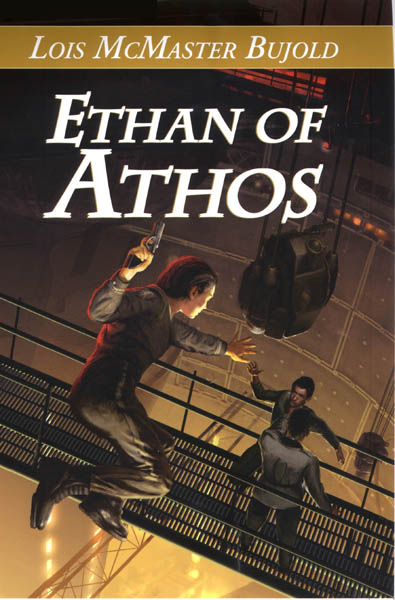
Ethan of Athos by Lois McMaster Bujold

Ethan of Athos by Lois McMaster Bujold continues by rereading of the Vorkosigan books in internal chronological order. The effect of privileging chronology over publication order is particularly interesting in this case since Ethan of Athos was published in the same year as Shards of Honour and The Warrior's Apprentice but is set after Cetaganda. It was a little weird to read about Cetagandan bad guys and genetics on a so much shallower level than what we got in Cetaganda. But, that said, I had forgotten a lot about Ethan of Athos since my first read of it sixish years ago. The first time around I think I dismissed it as "OK, but insufficient Miles". This second time around I enjoyed it more than I expected to.

The familiar old SF "planet of women" chestnut is reversed in the planet of Athos — an all-male planet made possible by the invention of the uterine replicator. Ethan, drawn out of his beloved Athos by a quest, finds himself an alien in more mainstream human society, and cannot help but find women disturbing aliens as well, especially the ultra-competent, ultra-beautiful Elli.

Ethan of Athos is Lois McMaster Bujold's third novel. It departs from the concerns of the Vorkosigan family to explore the ramifications of advanced biotechnology, turning many a cliché on its head along the way.

The basic premise, and the part I remembered most clearly, of Ethan of Athos is that Athos is a planet with only men living on it, who reproduce using science and uterine replicators. Their ovarian cultures, which they need to keep making more babies, are failing and the new shipment they ordered turns out to be rubbish so Ethan has to go procure a new one. I also remembered Ellie Quinn being around (who first appeared in Warrior's Apprentice) but had completely forgotten what she was up to until I read it again.

Overall this was a more enjoyable read than I remembered and I found the book more interesting than I expected. That said, this was still a book written in the 80s and a lot of the general society people who I would expect to be more progressive than modern society (because they're presumably modern society taken into the future), weren't. There was a general negative perception towards queer people (queer men specifically) among non-Athosians, which I was a bit disappointed by. Given the big deal made about how socially backwards Barrayar is compared with Galactics, I had higher expectations. (To be fair, a lot of the comparisons were specifically with Beta Colony, which seems to be especially progressive, but still.) So there were a few cringe-worthy moments but not too many.

I think this is an oft-overlooked entry in the Vorkosigan Saga but worth reading despite the lack of an actual Vorkosigan walking onto the page. Also, Ellie Quinn is great and I like that we get to know her better in this book than we did when we first met her in The Warrior's Apprentice. I recommend Ethan of Athos to fans of Bujold's other books but also to people who haven't read any other Vorkosigan books. Although a small number of amusing references will be lost, this is a pretty feasible place to start reading the series. I mean, it's not my top recommended starting place for the series, but it's a book that stands alone well and gives a bit of an introduction to the story universe. The only disappointment is that there is no sequel or follow up, so we are left to fill in the post-ending   story ourselves.

4.5 / 5 stars

First published: 1986, Baen
Series: Vorkosigan Saga, book 3 in publication order, book 7 in internal chronological order (more or less)
Format read: ePub as part of the Miles, Mystery & Mayhem omnibus
Source: Purchased several years ago direct from Baen

Friday, 2 June 2017

The Vor Game by Lois McMaster Bujold

The Vor Game by Lois McMaster Bujold is the fourth chronological about the Vorkosigan family, excluding novellas. I have recently been rereading these and my last two reviews were of The Warrior's Apprentice and Mountains of Mourning. There have also been a series of discussion posts, which you can find here. This review will contain some spoilers for the earlier books, but nothing too major since this is a series of standalones. The blurb below is a bit spoilery though. :-/

Miles Vorkosigan graduates from the Barrayaran Military Academy with expectations of ship command, so he is disappointed with the assignment of meteorologist to an arctic training camp. But his tenure in the snow-covered north is cut short when he narrowly averts a massacre between the trigger-happy base commander and mutinous recruits. Miles is reassigned to investigate a suspicious military buildup near a wormhole nexus. Reviving his undercover persona as mercenary Admiral Miles Naismith, he expands his routine information-gathering duty into a rescue mission when the Emperor of Barrayar disappears. Miles must use his negotiating skills to avoid a showdown between powers competing for control of the wormhole, while searching for the Emperor and watching his back for the arctic base commander seeking bloody vengeance.

This is a book very definitely divided into two parts. They are linked and they are not equal halves, but the tone and setting and many of the secondary characters are different between them. The first half of the book takes place at Camp Permafrost, a crappy arctic training base that Miles is assigned to after he graduates from the military academy. I started reading The Vor game needing a laugh and while the opening section isn't maudlin, it's also not laugh-out-loud funny. It was compelling nonetheless and set up the second part of the novel. I can see why it was also published as a standalone story before the book's publication (in the afterword Bujold talks about the welcome fee from selling it to Analog as "Weatherman", but I found myself wondering how the ending would have worked...).

The latter two thirds or so of the novel takes place in space after Miles is transferred to ImpSec, the more covert branch of the Barrayaran military. The theme of Miles's insubordination continues as a somewhat dull mission becomes more exciting after a chance encounter and with the return of Admiral Naismith. This second part of the book was much funnier, with a lot of the humour coming from the reader (and Miles) knowing more about various social contexts than the characters in them. Much hilarity ensued, especially near the end.

This book stands alone quite well and I wouldn't ban someone from reading it out of order. That said, it does build on what has come before it, especially The Warrior's Apprentice, which sets up the Dendarii mercenaries, so I recommend reading at least that book first. In fact, my copy of The Vor Game is nestled inside the Young Miles omnibus, containing The Warrior's Apprentice, the novella Mountains of Mourning and then The Vor Game and a sizeable afterword, a worthy edition if you don't already own the novels.

4.5 / 5 stars

First published: Baen, 1990
Series: Yes. The Vorkosigan Saga, sort of book 4. At any rate, read after The Warrior's Apprentice.
Format read: ePub in the Young Miles omnibus
Source: Purchased from Baen several years ago

Sunday, 21 May 2017

Saga Vol 6 by Brian K Vaughan and Fiona Staples

Saga Vol 6 written by Brian K Vaughan and illustrated Fiona Staples is the sixth volume in the ongoing space opera comic book series, Saga. I have reviewed all of the previous volumes: Volume OneVolume TwoVolume ThreeVolume Four and Volume Five. The story picks up more or less where the previous volume left off, with a bit of a jump forward in time (I think of a few years, but I'm not entirely sure).

After a dramatic time jump, the three-time Eisner Award winner for Best Continuing Series continues to evolve, as Hazel begins the most exciting adventure of her life: kindergarten. Meanwhile, her starcrossed family learns hard lessons of their own.

To be honest, after waiting more than a year and a half since reading Vol 5, my recollection of where the plot was up to was vague at best. And yet, I found it really easy to get back into the story. I was only slightly confused about some of the details, and that was more with regards to the secondary storylines.

Overall, I quite enjoyed reading this volume. However, since it's volume six in an ongoing series, I am again lost for what to say about it. It's not a self-contained story; it's a continuation of what's come before. Obviously, this isn't going to work very well as a standalone (I don't like it's odds for the Hugo for that reason). But if you've been reading and enjoying Saga, then definitely continue reading with this volume. If you haven't read any Saga before and the idea of a cross-species war-time love story space opera appeals to you, then go start with volume one and catch up to six (or seven, which is also out). Highly recommended.

4.5 / 5 stars

First published: 2016, Image Comics
Series: Saga, volume 6 out of 7 so far in the ongoing series, containing issues #31–36
Format read: Trade paperback
Source: A shop. I bought it last year and I don't remember in which country.

Friday, 5 May 2017

The Warrior's Apprentice - The Vorkosigan Saga Project


The Warrior’s Apprentice is the third book we are reading as part of the Vorkosigan Saga Project. It sequentially follows on from Barrayar and is the first book (chronologically and in publication order) about Miles Vorkosigan, published before Barrayar was in 1986. Miles is the son of Cordelia and Aral and we join him as he tries (and fails) to gain admittance to the Imperial Military Academy and has to turn to other ideas.


You can read Tsana’s review of The Warrior’s Apprentice here, and Katharine’s review here.


Tsana: When I first read the Vorkosigan saga, this was the first book I started with. It seemed like a good place to start at the time — it introduced Miles, who everyone talked about as the main character, and it was one of the first books written and published. I didn’t read the first two Cordelia books, Shards of Honour and Barrayar, until the very end, which meant that the impact of some of the references to the past in The Warrior’s Apprentice was completely lost on me. I am very glad to be rereading the books again in this order. What were your impressions of The Warrior’s Apprentice, having picked it up for the first time?


Katharine: I honestly wonder what I would have thought of Miles for the first section of the book, without having being brought to him via his parents. From this journey I’m already protective of him because we saw the struggles his parents had… without that, I think he would have won me over when he first uses his crazy schemes to save Mayhew… but before then, I might have found him a little too… what’s the word… Fervent?


Tsana: Hah, fervent is certainly the word to describe him (and you haven’t even seen half of it yet)! But that’s understandable just from knowing about his disability and desire to prove himself in the militaristic and ableist society of Barrayar. That said, there wasn’t as much ableism in the book as there could have been. Miles spends most of it off-world where other people just think he’s a bit weird instead of making the sign of the devil against him like we see Barrayarans do. What were your impressions of this?


Katharine: I found it interesting that as soon as he drew any ire it was the first thing they went to - calling him awful things about his (lack of) height or crookedness. But overall I think the novel did a good job at introducing the reader to him - we start the novel off with him not being successful in gaining entry into the Imperial Military Academy on Barrayar because of his disability, and then for the rest of the novel we see him, more or less, in situations where it doesn’t hold him back at all.


Tsana: I remember someone somewhere (I think it might have been on Galactic Suburbia) saying that in zero-G his disabilities didn’t matter anymore. But we don’t really see that in this book. What we know about Miles’s limitations are that he has very brittle bones — he breaks both his legs in the opening scene — and that he’s short with a crooked spine. We also briefly learn that he’s allergic to some medication, but that doesn’t feature too much. While none of those things stop him doing anything other than passing the Imperial Military Academy physical exam, he’s also not put into any equalising situations, not really. Galactics (ie non-Barrayarans) might not care so much that he’s different, but he still has to prove himself in a normal fashion without any sudden advantages. The only advantage he had in his life was more time to read and study growing up due to being unable to play outside as much. The rest of his advantage is all personality and intelligence (the latter having nothing to do with his disabilities).


Katharine: And all thanks to his parents - there’s several references that show he knows what they would do or think in a situation and he seems to take their way as gospel - he uses what his mother would think in a situation to reassure Elena, for example.


Tsana: Yes, it definitely helps that his parents are good role-models. He probably wouldn’t have gotten nearly so far with his crazy schemes if not for his father’s military and political strategy rubbing off on him.


Katharine: And his mother’s ability as a warrior - he wouldn’t have got nearly as far in his schemes without being able to see women are equal from the very start - something that threw a few of his adversaries off. Should we lift the spoiler zone so we can get into the nitty gritty?


<spoilers start here>

Thursday, 6 April 2017

Barrayar - The Vorkosigan Saga Project

Barrayar is the second book we are reading as part of the Vorkosigan Saga Project. It sequentially follows on from Shards of Honour, but was actually not published until 1991, five years and several other books later. It follows Cordelia as she grapples with having moved to Barrayar and the external events which make that even more difficult than it might have originally seemed.


Tsana: This was an interesting book to come back to. Certain events that happen later in the book are kind of burned into my brain from my first readthrough and I spent the entire first half or so (maybe it was less than that) anticipating the oncoming storm. I had forgotten how staid the opening was!

Katharine: From a new reader the first part of the book was quite nice - almost a little domestic, having the side-character’s romance as the biggest worry of our main characters… and then it starts having minor instances of things to worry about - which also made it even more realistic - they have all the intelligence and spies and such, in some books the action would just Happen Without Warning to be ‘dramatic’ whereas in this half the worry is because they know what is about to happen.

Tsana: Yep. And really, given Aral’s critical position in running the planet, it would have been really silly for there not to be any warning of things to come. But before we get to the really spoilery bits that we’re going to have to put behind a cut, let’s talk about some of the other elements, especially in the early parts of the book. When Cordelia came to Barrayar, she knew Aral was probably going to eventually become a Count but, as we saw at the end of Shards of Honour, he actually has a much larger role to play in Barrayaran politics, even before he was made Regent. I think Cordelia did a reasonable job of taking this in her stride. What do you think?

Katharine: I think she had her suspicions that neither of them were going to happily retire, and as we see in Shards of Honour she may not like it, but she also understands and is quite passionate about the fact he’s the best one for the job. Though at the same time, I was a little surprised at the instances she tells him regardless, he has to put his family first - which is interesting. Noble, of course, and good on her … just, not expected.

Tsana: I think she starts off seeing Barrayaran politics as a bit of a joke. Except also not since she was there for the war in the previous book and knows more about it than most. But the war is over, everything is fine and she can focus on being a Barrayaran Vor lady, even if there’s also suddenly this whole Regent Consort thing to deal with. Basically, no very high demands are placed on her near the start and she’s more or less left to focus on her pregnancy and impending motherhood. I think motherhood/pregnancy and the differences between Beta Colony and Barrayar are one of the key ways Bujold uses “backwards” Barrayar to shine a light on some of our real-world society’s faults, along with many other instances of misogyny/gender inequality and heteronormativity depicted in the book.

Katharine: Agreed, and yet Bujold is careful to not go over-the-top as I expect some others would do - it still feels quite accurate and believable. Although Barrayar feels quite advanced as far as weapons technology is and so on, it certainly doesn’t care about its people. I’d love to see more about Beta Colony and their tech - it all sounds fascinating! I also think it’s interesting that we see the majority of Barrayar’s way of thinking via Aral’s father, Piotr.

Tsana: Yes, and the animosity from Piotr towards Cordelia’s way of life pretty much only grows, despite all the good Cordelia manages to accomplish. Especially once baby Miles comes into the picture. I liked how certain ideas gradually become more prominent in the text. For example, we had some hints about ableism in Barrayaran culture in Shards of Honour, and in Barrayar we see Koudelka with his walking stick not coping too well with his new disability. But then we witness Cordelia sitting behind some chaps who call Koudelka “spastic” which is the first really blatant piece of ableism we are slapped with in the series. This foreshadows the ableist attitudes from Piotr and others towards baby Miles.

Katharine: At least they have the ability to seem abashed when Cordelia confronts them on it. I was actually really impressed with how charming Piotr could be when he was happy with the idea of getting a grandson, and then how instantly he turns all hackles raised and all. BUT, then, when the trouble really starts he does count his family first, and does good by Cordelia. Should we activate the spoiler shield now to get into the nitty gritty?

<spoilers start here>

Saturday, 25 March 2017

A Closed and Common Orbit by Becky Chambers

A Closed and Common Orbit by Becky Chambers is a companion novel to Long Way to a Small Angry Planet. It follows characters which appear in Long Way to a Small Angry Planet but covers events that happen both before and after the events in the earlier book. The two books can be read in any order, although the existence of one of the characters in A Closed and Common Orbit is a spoiler for one of the events in Long Way to a Small Angry Planet. Otherwise, there is very little overlap.

Lovelace was once merely a ship's artificial intelligence. When she wakes up in an new body, following a total system shut-down and reboot, she has no memory of what came before. As Lovelace learns to negotiate the universe and discover who she is, she makes friends with Pepper, an excitable engineer, who's determined to help her learn and grow.

Together, Pepper and Lovey will discover that no matter how vast space is, two people can fill it together.

The Long Way to a Small, Angry Planet introduced readers to the incredible world of Rosemary Harper, a young woman with a restless soul and secrets to keep. When she joined the crew of the Wayfarer, an intergalactic ship, she got more than she bargained for - and learned to live with, and love, her rag-tag collection of crewmates.

The environment and ensemble cast in A Closed and Common Orbit are quite different to those in Long Way to a Small Angry Planet  The book consists of alternating chapters from the points of view of two characters: an AI who has just been moved to a human-looking body, after having been a ship AI; and Pepper, the human woman helping the AI. The AI sections are set in the "present", having some temporal overlap with Long Way to a Small Angry Planet  whereas Pepper's sections recount her rather horrific childhood. Sidra, the AI, has relatively mundane concerns regarding learning how to function as a person, and fitting in so as not to be discovered (an AI pretending to be human is illegal). Pepper's childhood and teen years, however, are much starker than might normally be expected and I found her half of the story more gripping and emotive.

It was not immediately apparent how the two stories tied together — aside from the obvious part where Pepper features in Sidra's story — but this became clear at the end (and a bit earlier, if you were paying attention). Even so, I was more invested in (young) Pepper for the entire book. The ending was wonderfully touching, and Sidra was involved in that, but it was mainly touching because of what we had learnt about Pepper's life. Which is not to say that Sidra's story was boring — it certainly had its exciting moments — but my interest in it was more intellectual than emotional.

If you enjoyed Long Way to a Small Angry Planet, then I expect you will also enjoy A Closed and Common Orbit. However, if you didn't like the plot structure of Long Way to a Small Angry Planet  then, despite the dual storylines, A Closed and Common Orbit might not be for you. If you enjoy sociological SF about community and the meaning of personhood, then this is definitely the book for you. I am keen to see what else Chambers writes, whether or not it is set in the same universe as her first two books.

4.5 / 5 stars

First published: 2016, Hachette Australia
Series: Sort of. Wayfarers universe, second publication set in that world
Format read: eARC
Source: publisher via NetGalley

Saturday, 4 March 2017

Shards of Honour - The Vorkosigan Saga Project

Through 2017 and 2018 Tsana and Katharine are reading The Vorkosigan Saga (in more or less chronological order), starting with Shards of Honor all the way through to Gentleman Jole and the Red Queen, including novellas. Tsana is re-reading, and Katharine is brand new to the series and together they’ll be discussing themes, characters, worldbuilding, and anything else that sparks their interest.

The first book up for discussion is Shards of Honour, first published in 1986. You can read Katharine's review here and Tsana's review here.


Katharine: So I have to confess, I have read one other thing by Bujold and that was “Dreamweaver’s Dilemma”… back when I was serious about reading everything and then got overwhelmed by it all.

Tsana: I read that one too, but not close to when I read most of the other books. I felt a bit meh about it, from memory. I originally read all the books that existed at the time in 2011, starting from Warrior’s Apprentice and ending with the Cordelia books we decided to start with. Let me tell you, reading Shards of Honour first instead of second last was a very different (and superior) experience. Starting from Shards of Honour (and yes, I’m going to keep writing it with a u) gave me a better appreciation for both Cordelia and Aral as characters, unlike the first time around when I couldn’t get out of the mindset of seeing them primarily as Miles’s parents and through his eyes. It was easier to relate to them this way and I’m interested to see how that will effect my re-reading of the later books.

Katharine: I want to write it with a ‘u’! American spelling looks so mispronounced. I’m glad I’m getting the superior experience — usually I’m a hard and fast ‘publication’ order reader, but Alex had some strong feelings on the subject. Coming the series brand new, I’m loving starting off with main characters who aren’t spring chickens — Aral and Cordelia are excellent at what they do, and it’s believable because of their rank and experience.

Tsana: So we’ve discussed the characters a little bit. Before we get into some of the meatier topics, let’s chat about the setting. What did you think of Sergyar? Apparently I didn’t take it in at all the first time I read it. Gentleman Jole is set on the same planet and I noticed a lot more setting when I was reading that one. Coming back to Shards of Honour and discovering that actually the weird wildlife had been there from the start was a bit of a surprise.

Friday, 20 November 2015

Ancillary Mercy by Ann Leckie

Ancillary Mercy by Ann Leckie is the third and final book in the Imperial Radch trilogy. You can read my reviews of the first two books, Ancillary Justice and Ancillary Sword, at those links.

For a moment, things seem to be under control for the soldier known as Breq. Then a search of Atheok Station's slums turns up someone who shouldn't exist - someone who might be an ancillary from a ship that's been hiding beyond the empire's reach for three thousand years. Meanwhile, a messenger from the alien and mysterious Presger empire arrives, as does Breq's enemy, the divided and quite possibly insane Anaander Mianaai - ruler of an empire at war with itself.

Anaander is heavily armed and extremely unhappy with Breq. She could take her ship and crew and flee, but that would leave everyone at Athoek in terrible danger. Breq has a desperate plan. The odds aren't good, but that's never stopped her before.

When everyone was making a fuss about the pronouns in Ancillary Justice (in the main language there is only one gender and it is translated into English as "she") and decrying it as a feminist text, I was wondering what book they had read. The book I read did not have strong feminist themes and was mainly about colonialism. I have to admit I didn't think very much about themes in Ancillary Sword, but this final volume, Ancillary Mercy, deals very interestingly with ideas of sentience and personhood, particularly when it comes to AIs. Perhaps not a surprising development given the main character and first person narrator is/was a ship. But it is interesting that many of the questions raised took so long to come to the fore. Reading this book, I was thinking "yes, this makes perfect sense given what we know" and then being baffled when other characters didn't agree with me/Breq and friends.

Another strength of Ancillary Mercy comes from the very fact that it is the third book in the series. We know the key characters well, we already care about them and there aren't a huge number of new characters to have to remember. Leckie deals well with the character stuff, not letting the story be completely taken over by action and external events (something I have had issues with in other SF books). My favourite parts were small interactions between often minor characters, like the soldiers' protective feelings towards their lieutenants and Breq. As well as characterisation, the universe is very well developed. Leckie makes us care about tea sets! Plural!

Ancillary Mercy was a great conclusion to the series and I had trouble putting it down. I enjoyed it more than Ancillary Sword, which I gave 5 stars to already. They're not wildly different books (Ancillary Justice, which sets everything up and has a lot of flashbacks is the most different in structure to the other two) and I think Ancillary Mercy was my favourite mainly because the comic relief characters were funnier. Which is kind of an odd thing to say since this is hardly a comedy, but it is what distinguished Ancillary Mercy for me. (Although of the three I find Ancillary Justice the most iconic).

I highly recommend this series to all fans of space opera and hard SF. It's really excellent and showcases Leckie's writing talents and worldbuilding skills. This concluding volume was great and although it didn't tie up everything — the series ended up showing us a self-contained slice of a very large conflict — it was still satisfying. A must read! (But start with the first book.)

5 / 5 stars

First published: October 2015, Tor
Series: Imperial Radch book 3 of 3
Format read: ePub
Source: Google Play

Saturday, 19 September 2015

Saga Volume Five by Brian K Vaughan and Fiona Staples

Saga Volume Five written by Brian K Vaughan and illustrated by Fiona Staples is the fifth volume of collected comics in the ongoing Hugo Award-winning series. If you haven't been keeping up with the series, this is not the point to jump in at. I strongly recommend starting with the first trade collection.

Multiple storylines collide in this cosmos-spanning new volume. While Gwendolyn and Lying Cat risk everything to find a cure for The Will, Marko makes an uneasy alliance with Prince Robot IV to find their missing children, who are trapped on a strange world with terrifying new enemies.

Unsurprisingly, Volume Five picks up and continues the story from where we left off in Volume Four. The story continues incrementally, as it has been, with some progress from all the main character groups. I thought it was tied together particularly nicely by the main character's narration.

I'm honestly not sure what else to say that I haven't said in earlier. I love Ghüs and Lying Cat and the central stories are all a bit tragic. And there's the obligatory horrifying giant genitalia. Basically, if you've been enjoying Saga thus far, there's no reason not to pick up this next volume.

I'm looking forward to rereading the entire series when it's complete (whenever that is) and being able to post a meatier review. As it stands, I'm looking forward to the next instalment.

4 / 5 stars

First published: September 2015, Image Comics
Series: Volume 5 collecting issues #25–30 of the ongoing series
Format read: Paper! Trade paper! Back!
Source: A random comic book store while travelling

Thursday, 8 January 2015

Saga Volume Four by Brian K Vaughan and Fiona Staples

Saga Volume Four by Brian K Vaughan and Fiona Staples is the fourth volume of collected comic issues of the ongoing series Saga. It includes issues 19 to 24 inclusive. If you haven't already, you can read my reviews of Volumes One, Two and Three. This review is definitely going to contain some spoilers for the earlier volumes. Blurb from the back of my (paperback) edition, not Goodreads:
Saga is the sweeping tale of one young family fighting to find their place in the universe. As they visit a strange new world and encounter even more adversaries, baby Hazel finally becomes a toddler, while her star-crossed parents Marko and Alana struggle to stay on their feet.
I always find it hard to review these, because how much is there to say about such a short snippet of story. I can't imagine choosing to read them issue-by-issue. So this review will be brief.

The main new thing this volume brings — thrusts upon us with the opening page — is a baby born to the robot prince couple. What happens to the baby is a significant storyline that is followed throughout the volume. (Side note, if baby robots poop, how do they eat with screens for faces? Inquiring minds need to know.) Related to that, we also learn more about the Robot Kingdom and it's hierarchy. The Prince and Princess have sort of shiny fancy screen faces, as we've already seen, but peasants and other lower classes have crappier TV screens, like with knobs and/or in black and white. And we finally meet the Robot King, but I won't spoil his appearance. Suffice to say lol.

The story of the main family — Hazel, Marko and Alana, and co — jumps forward to Hazel's toddlerhood and the family eking out a relatively stable existence (for the time skipped, anyway). The cover art features Alana bringing home the bacon by acting in entertainment on "the Circuit". It may the source of some tensions. Other characters from earlier in the story also make brief appearances throughout the volume.

I think I enjoyed Volume Four more than some of the earlier ones (although they have blurred together a bit). Mainly, I suspect, because there's less squick factor. Or at least less of my personal squick factor, though I suspect others will beg to differ. Anyway, if you've been enjoying Saga thus far, why wouldn't you pick up the next volume? If you haven't read the series, I strongly suggest starting with Volume One, since the story is highly dependent on continuity.

4.5 / 5 stars

First published: January 2015, Image
Series: Saga Volume 4 of ongoing series (containing issues 19 to 24 inclusive)
Format read: Trade paperback
Source: Purchased from a real life bookshop's online preorder page ;-p

Tuesday, 19 August 2014

Angel Rising by Dirk Flinthart

Angel Rising by Dirk Flinthart is a short novella set in the New Ceres universe. It's actually only the second New Ceres story I've read — the first was in The Bride Price by Cat Sparks — although the New Ceres Nights anthology is waiting on my eTBR.
The New Ceres planetary charter forbids the use of all modern technology. Law confines the people to the ways of 18th Century Earth. But beneath the surface, rebellion and revolution simmer constantly.

Proctor George Gordon, a hidden protector of New Ceres, knows all too well how easily these can bubble over, but nothing can prepare him for interstellar warfare in his own technologically challenged backyard.

What odd coincidence brings him to the Sunrise Isles to be confronted by ninja and warrior nuns? Who is the strange but compelling amnesiac girl he finds in the convent, and what do the offworld nations want with her? And how can he really be sure who to trust?
This novella is action-heavy with some really cool fight scenes. The main character, George Gordon, has a fancy future-tech sword that can cut through almost anything and the proliferation of samurai and ninjas in the story gives him ample opportunity to demonstrate it's features.

But of course, the sword  and the fighting aren't the whole story. Gordon is called out on a job which proves to be a little mysterious both to him and to the reader. Also there are fighting nuns. (I thought that should be mentioned.)

I enjoyed Angel Rising and, although it was short, it was a pleasant way to pass an otherwise boring (and, frankly, chilly) train ride. It showed me a very different corner of the New Ceres world to the Cat Sparks story and I am curious to see what other authors have done with it.

Whether you're curious about the New Ceres world or just want to read a good story with space ninjas, samurai and nuns, I can highly recommend Angel Rising. It's certainly moved New Ceres Nights up in my TBR queue.

4 / 5 stars

First published: 2008, Twelfth Planet Press
Series: New Ceres universe (stand alone)
Format read: Paper!
Source: TPP stall at WorldCon (LonCon3)
Disclaimer: While I have endevoured to give an impartial review, I can't claim a neutral relationship with Twelfth Planet Press in general
Challenges: Australian Science Fiction Reading Challenge

Tuesday, 22 July 2014

Ancillary Justice by Ann Leckie

Ancillary Justice by Ann Leckie is the kind of début novel that one hears so much good stuff about, one regrets not requesting an early review copy when one had the chance. But the good (and first person) news is that once it was shortlisted for a Hugo, I had the perfect excuse (and attendant deadline) to buy myself a copy and read it. The fact that it also won a Nebula, an Arthur C Clarke Award and a British Science Fiction Award (among others) did little to dissuade me.
On a remote, icy planet, the soldier known as Breq is drawing closer to completing her quest.

Once, she was the Justice of Toren - a colossal starship with an artificial intelligence linking thousands of soldiers in the service of the Radch, the empire that conquered the galaxy.

Now, an act of treachery has ripped it all away, leaving her with one fragile human body, unanswered questions, and a burning desire for vengeance.
What I had heard about most before actually reading Ancillary Justice was "the gender thing". For those that haven't heard, one of the most talked about aspects of this book is the fact that because the main character is a ship AI and because her native language and culture don't use gendered pronouns or visual cues (like clothing, hair style, manner) that define gender, she has a lot of difficulty working out the genders of people in other languages (which do have gender pronouns). And, because the book is obviously written in English, this concept is "translated" by having everyone referred to using female terms except, occasionally, in dialogue spoken in other languages. (To be clearer, Radchaai is the language and culture that lacks gendering and it's spoken/practised in the Radch empire.)

Don't get me wrong, the gender thing is interesting and I like the way Leckie's done it — it makes me wonder why I never thought of doing something like that — but it was not, to me, the main point of the novel. Not by a long shot. Up until something like two thirds of the way in, the story is told in two time-lines. There's the present, where Breq, an isolated human component of an AI warship (called an ancillary), is on a self-imposed mission. And in alternating chapters we are shown the past (twenty years earlier), when the Breq ancillary was still part of the ship Justice of Torren. Both time-lines are told in first person, even though in one the person is indeed a single person, while in the other the person is a ship and hundreds of human-bodied ancillaries.

I think the way Leckie handled the point of view issues was really good. In the scenes with the Justice of Torren and its ancillaries, I really got the feeling that the ancillaries were just additional appendages of the ship. Like hands that could also see things.

The main thrust of the plot concerns Breq wanting to at least partially fix the spoilery events that led to her having to function as an isolated unit. These spoilery events involve a pretty monumental conspiracy theory (I don't mean that as a bad thing, it's good conspiracy theory) and are complicated by the fact that the book opens with Breq picking up a stray human. Although the start of the novel is slow action-wise, I found the gentle introduction to the culture helpful (because it is pretty different to what we're used to) and I found the worldbuilding information interesting enough to want to keep reading. Really, Leckie has built a fascinating culture. The pace increases as the story progresses, especially towards the end which became very exciting.

I was delighted when I got to the end and realised that Ancillary Justice was the first book in a "loose" trilogy. The story is fairly self-contained but there is obviously more to tell and I want to know what happens next. I've just checked and the second book is scheduled to come out in October, which strikes me as sufficiently far away that I might have caught up on my reading by then (or not...). Either way, I'm definitely looking forward to it.

I highly recommend Ancillary Justice to fans of science fiction and fantasy. Those put off by technobabble needn't fear; it's mostly absent. Or, more accurately, what confusing concepts are conveyed are more linguistic or philosophical than they are scientific, I found.

4.5 / 5 stars

First published: 2013, Orbit
Series: Imperial Radch, book 1 of 3
Format read: ePub
Source: Purchased from Google Play

Friday, 11 July 2014

Saga Volume Three by Brian K Vaughan and illustrated by Fiona Staples

Saga Volume Three, written by Brian K Vaughan and illustrated by Fiona Staples, is (obviously) the third volume of collected comic issues, comprising of issues 13 to 18.
Saga is the sweeping tale of one young family fighting to find their place in the universe. Searching for their literary hero, new parents Marko and Alana travel to a cosmic lighthouse on the planet Quietus, while the couple's multiple pursuers finally close in on their targets.
When I read the first two volumes (my reviews of Volume One and Volume Two), I was a little weary of the number of female characters. But as the story has progressed, it seems to have accreted more of them, which I appreciated. The cover art of this volume is a good example; neither of those two characters were proper characters when the story started.

Gwendolyn, the woman on the cover, while not wearing what I would call sensible clothes (but they could be worse), proves herself to be an interesting character. We first learn of her only through Marko, who was engaged to her before he went to war. She initially sounds relatively insignificant but when she shows up in person, we find out that, just as Marko changed when he went to war, so to did Gwendolyn when she stayed back.

One of my favourite characters, who's been around since Volume One but who I haven't mentioned, is Izabel. She's the ghost of a teenage girl who died stepping on a landmine. More accurately, the ghost of half a teenage girl. She's pretty great and not the kind of character I would have expected to see. (Even if we can see her intestines.) Also, she provides a counterpoint to everyone being wrapped up in the war. Although her parents were freedom fighters and despite the way she died, she's not invested at all.

We also get to know two new characters with their own story line: two reporters who have caught the trail of the story of Alana, Marko and their child. They run around trying to chase down leads and, in the process, we learn about their home world. Really, I think it's fair to say that the more we learn about each character, the more interesting they become.

I've been enjoying Saga and I'm sad that I now have to wait for an indeterminate time for the next volume. I also recommend starting from the start if this is the first review that you're reading.

4 / 5 stars

First published: March 2014, Image Comics
Series: Saga, Volume 3 of ongoing
Format read: Paper! Glossiness!
Source: Purchased from the Science Fiction Bookshop

Wednesday, 9 July 2014

Saga Volume Two by Brian K Vaughan and illustrated by Fiona Staples

Saga Volume Two, written by Brian K Vaughan and illustrated by Fiona Staples is the second volume of collected comic issues. It contains issues 7 to 12. It continues the story right where Volume One left off, telling us more about the background and history of Mako, the narrator's father.
SAGA is sweeping tale of one young family fighting to find their place in the universe. Thanks to her star-crossed parents Marko and Alana, newborn baby Hazel has already survived lethal assassins, rampaging armies, and horrific monsters, but in the cold vastness of outer space, the little girl encounters her strangest adventure yet... grandparents.

I didn't think about it that much when I was reading Volume One, but I quite like the style of the narration in Saga. The way it's included puts me in mind of voice overs in movies which take place over action-y scenes and that was exactly how I pictured it. It also means that, despite the narrator still being a baby in the comic (not much time has passed since it started), we can start to get to know her as an adult.

Volume Two introduces a few new characters — one in particular that I wasn't expecting to see so soon — and progresses the plot incrementally. That is one of the frustrating things about reviewing comic books; the nature of the medium makes them very brief and difficult to go into much depth over. (I say this before having listened to the Galactic Suburbia Spoileriffic episode; I'm sure they found plenty to talk about for almost two hours.) So I present a few random thoughts.

I was amused that the language written in blue letters is called Blue. I also checked what it was with Google Translate. I had suspected it was Esperanto, and turns out it is. It was an interesting choice to have a couple of pages of dialogue written entirely in Blue. That was the point at which I decided to check what the language was, but I ended up not translating all of it because it wasn't mysterious from the context (and also because lazy). Still, it was an interesting contrast to other scenes where only one person is speaking in Blue and the other doesn't necessarily understand them.

I was also really taken by the style of the historical vision art. (I would call it a flashback but it flashed to before the character's lifetime.) The way it sort of blurred was really cool. It was only used in one bit, but it was memorable.

Saga Volume Two is a recommended read for people who have read and enjoyed Volume One. I don't recommend starting at Volume Two because of plot continuity. I am definitely going to read the third volume.

4 / 5 stars

First published: 2013, Image Comics
Series: Saga, Volume Two of ongoing (? Three so far)
Format read: Paper!
Source: Purchased from the Science Fiction Bookshop