Showing posts with label s l huang. Show all posts

Monday, 12 October 2020

Burning Roses by S.L. Huang

Burning Roses by S.L. Huang is a fantasy novella that was not at all what I was expecting it to be. I would normally blame this on my intentional forgetfulness of blurbs, but in this case, I think the blurb also buries the lede. I would describe this book as an amalgamation of Asian (Chinese) fantasy and European fairytales, with a heavier dose of the latter than I expected.

When Rosa (aka Red Riding Hood) and Hou Yi the Archer join forces to stop the deadly sunbirds from ravaging the countryside, their quest will take the two women, now blessed and burdened with the hindsight of middle age, into a reckoning of sacrifices made and mistakes mourned, of choices and family and the quest for immortality.

The story in Burning Roses follows our two protagonists, Rosa and Hou Yi, as they attempt to hunt down magical sunbirds and stop them from wreaking havoc across the country. A seemingly straightforward task, until Rosa starts questioning whether the sunbirds are sentient. As we learn throughout the story, Rosa has a dark past with talking animals

The extent to which the world was supposed to correspond to real countries was not entirely clear to me. My general impression was that most of the story was taking place in fantasy-China (or fantastical China, depending on how you want to interpret it), while Rosa has travelled all the way from fantasy-Spain to be there. Having Rosa be a traveller from foreign lands was an interesting and unexpected element. She provided a reference point for readers more familiar with European fantasy, which was the part I wasn't really expecting. In any case, the fantasy aspect of the novella was clearly the pertinent point, since the backstories of both characters have them being involved in several well-known fairytales.

I enjoyed this novella, even though it wasn't what I had expected — more fairytale than wuxia. I recommend Burning Roses to fans of fantasy stories with non-European settings, especially those that also enjoy a sprinkling of fairytales.

4 / 5 stars

First published: September 2020, Tor.com
Series: Don't think so
Format read: eARC
Source: Publisher via NetGalley

Sunday, 16 August 2020

Short stories 11 to 17 are late and disorderly

This batch of stories is an unusual number because I feel bad for posting them so late. I had plans to do a proper Hugo round-up post as I did for novellas, but for various reasons that didn't happen. So here are some of the short stories and novelettes that were shortlisted for Hugo awards.

~

The Blur in the Corner of Your Eye by Sarah Pinsker — An enjoyable mystery-ish story about a mystery writing a in cabin in the woods. Things inevitably go wrong, but it wasn’t quite the horror scenario I was expecting. I enjoyed it. Source: https://uncannymagazine.com/article/the-blur-in-the-corner-of-your-eye

The Archronology of Love by Caroline M. Yoachim — A long story about interesting far-future alien tech which records history. People interacting with said tech while trying to work out what happened to a failed colony planet. Also a sad love story. It was OK, but it didn’t really grab me. Source: http://www.lightspeedmagazine.com/fiction/the-archronology-of-love/

Omphalos by Ted Chiang — An unexpected story told in an unusual way. Almost an epistolary story, but told through prayers rather than letters. Set in a world a bit less technologically developed than ours, and following a scientist who knows exactly how long ago the world was created. And that it was created by a divine being. I enjoyed it more than I expected. Source: Exhalation by Ted Chiang

Emergency Skin by NK Jemisin — An entertaining read partially depicting a society sitting somewhere between Athos (Bujold, Ethan of Athos) and the alt-right. It’s also told in an unusual way, which works very efficiently to tell the story and highlight the horrors of that particular society. We actually only get half the story, but it’s more than enough. Source: Amazon Forward Collection

As the Last I May Know by SL Huang — An intriguing premise: weapons of mass destruction can only be set off if the president first murders a little girl. I enjoyed the story and was quite taken by both the power play and the moral questions raised. Source: https://www.tor.com/2019/10/23/as-the-last-i-may-know-s-l-huang/

For He Can Creep by Siobhan Carroll — An amusing story about a cat fighting Satan for a poet’s soul. It was not what I expected from the title, and was certainly entertaining enough. Source: https://www.tor.com/2019/07/10/for-he-can-creep-siobhan-carroll/

Blood is Another Word for Hunger by Rivers Solomon — A very weird story. Not sure what to make of it, to be honest. I didn’t hate it, but I also didn’t love it. I'm sorry that I have failed to adequately describe the weirdness of murder resulting in spontaneous births. Source: https://www.tor.com/2019/07/24/blood-is-another-word-for-hunger-rivers-solomon/


Thursday, 23 May 2019

#ReadShortStories in context (71–75)

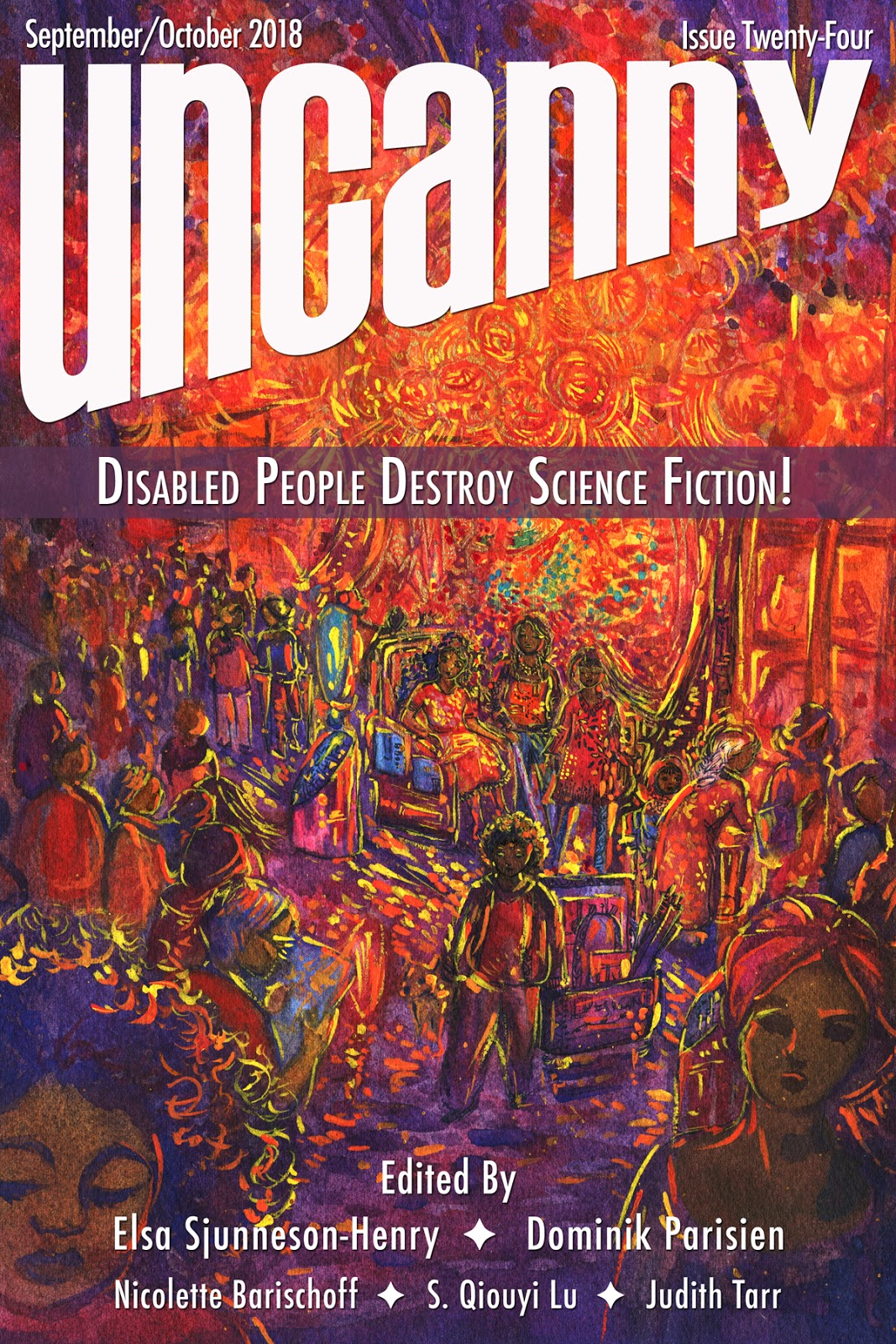
In this batch I finished off the fiction in Disabled People Destroy Science Fiction, the special edition of Uncanny, and caught up on a couple of Nature Futureses.

I want to briefly talk about a a short story in DPDSF which I read a while ago, “A House by the Sea” by P. H. Lee. When I read it, I did not realise it was from that particular issue of Uncanny because, for whatever reason (probably Twitter) it was presented to be without context. At that time, I didn't really "get" the story, because of said lack of context. When I came across it more recently, within DPDSF, I immediately recognised it when I started reading and, more importantly, the story suddenly made perfect sense. I had initially suspected that it was about disabled people, but now I had firm context to that effect. Does that mean it's a less good story if it isn't guaranteed to work without that context? I'm not sure, but I suspect a few of the stories in this particular issue of Uncanny fall into the same category of making more sense within their intended context. Is this ultimately a good or bad (or neutral) thing? What do you think?


This Will Not Happen to You by Marissa Lingen — I liked this one. A story about the frustrations of being diagnosed (too late) when chronically ill. Presented in a somewhat sarcastic tone to someone (sort of) who thinks these things only happen to other people. Source: https://uncannymagazine.com/article/this-will-not-happen-to-you/

By Degrees and Dilatory Time by SL Huang — A thoughtful read about a man getting artificial eyes after a cancer diagnosis. It’s entered mainly on his feelings and sense of self. Source: https://uncannymagazine.com/article/by-degrees-and-dilatory-time/

Listen by Karin Tidbeck — Another enjoyable story, this one a bit more alien in that it literally involves interactions between planets and different types of people. A neuroatypical protagonist is translator for aliens whose speech other people cannot remember after they have heard. Source: https://uncannymagazine.com/article/listen/

Without Access by Deborah Walker — Flash, kind of interesting world building but a blatant premise. Unsubtly about internet/social media addicts but also with aliens. Source: https://www.nature.com/articles/d41586-019-01316-1

Brick City by Robert S Wilson — Not a bad flash piece, charting the end of life and eventual fate of an obsolete android. I found the ending appropriate but was a bit confused by the intended emotional resonance. Source: https://www.nature.com/articles/d41586-019-01429-7