Showing posts with label harper voyager. Show all posts

Sunday, 16 September 2018

A Curse of Ash and Embers by Jo Spurrier

A Curse of Ash and Embers by Jo Spurrier is a novel in a new fantasy series by the author of the grimdark Children of the Black Sun trilogy (which started with Winter Be My Shield). That said, A Curse of Ash and Embers is being marketed as YA so at least you know it won't be quite as full of torture as the earlier series. Whether or not you consider the book to be YA is a matter of personal opinion; to me it's just a fantasy book, but I also wouldn't hesitate to give it to an interested teen.

A dead witch. A bitter curse. A battle of magic.

Some people knit socks by the fire at night. Gyssha Blackbone made monsters.

But the old witch is dead now, and somehow it's Elodie's job to clean up the mess.

When she was hired at Black Oak Cottage, Elodie had no idea she'd find herself working for a witch; and her acid-tongued new mistress, Aleida, was not expecting a housemaid to turn up on her doorstep.

Gyssha's final curse left Aleida practically dead on her feet, and now, with huge monsters roaming the woods, a demonic tree lurking in the orchard and an angry warlock demanding repayment of a debt, Aleida needs Elodie's help, whether she likes it or not.

And no matter what the old witch throws at her, to Elodie it's still better than going back home.

I really enjoyed A Curse of Ash and Embers and I can't wait to read the next book in the series. Elodie was a very believable and grounded character, who generally leaned towards doing the sensible thing. The world she lives in is a fairly standard pre-industrial European-ish fantasy world, but at the same time magic is an uncommon phenomenon and Elodie didn't really believe in it until she left home. I enjoyed watching Elodie finding her place in her new world. It was a satisfying mix of "well, someone has to cook and clean" and her trying to reconcile her own experiences of her new mistress with the stories told by the villagers she meets.

I haven't generally been very much in the mood for fantasy books recently, but once I started reading this one (which I thought was a novella for some reason — it is not) I was instantly hooked on the story. Spurrier's writing style continues to be gripping even in this narratively more straight-forward book (first person, single narrator) and I certainly would not hesitate to pick up any other books of hers.

The story put me slightly in mind of Pratchett's Witches books, but more because Elodie seemed like she would fit in as an apprentice witch in that world than any more obvious similarities in satire or style. That said, I also really liked one particular worldbuilding aspect in A Curse of Ash and Embers: that the witches wants are basically clubs studded with crystals. Unlike a traditional style (eg Harry Potter) wand, they were as well suited to bashing people as wielding magic...

As I said, A Curse of Ash and Embers was a great read and I highly recommend it to pretty much all fantasy fans. The next book is out in 2019 and I'm hoping that means it will be a relatively short wait (fingers crossed for less than a year) before we find out what happens next. I should note that A Curse of Ash and Embers does not end on a cliffhanger or anything — the story arc is fairly self-contained — but I still want to read more. Hopefully soon.

5 / 5 stars

First published: September 2018, HarperVoyager
Series: Yes. Tales of the Blackbone Witches book 1 of 3 (I think)
Format read: ePub ARC
Source: Publisher via NetGalley

Wednesday, 2 March 2016

The Lyre Thief by Jennifer Fallon

The Lyre Thief by Jennifer Fallon is the first book in a new series, The War of the Gods, set in the same world as the Hythrun Chronicles and the Demon Child Trilogy. It is set about ten years after the events in the Demon Child Trilogy and features many characters from both older series, as well as several new characters.

Her Serene Highness, Rakaia, Princess of Fardohnya, is off to Hythria, where her eldest sister is now the High Princess, to find herself a husband, and escape the inevitable bloodbath in the harem when her brother takes the throne.

Rakaia is not interested in marrying anyone, least of all some brute of a Hythrun Warlord she's never met, but she has a plan to save herself from that, too. If she can just convince her baseborn sister, Charisee, to play along, she might actually get away with it.

But there is trouble brewing across the continent. High Prince of Hythria, Damin Wolfblade, must head north to save the peace negotiated a decade ago between the Harshini, Hythria, Fardohnya, Medalon and Karien. He must leave behind an even more dangerous conflict brewing between his wife and his powerful mother, Princess Marla.

...And in far off Medalon, someone has stolen the music.

Their quest for the tiny stolen lyre containing the essence of the God of Music will eventually touch all their lives, threaten everything they hold dear and prove to be far more personal than any of them can imagine.

I have always been a fan of Fallon's books, since I first read the Second Sons trilogy, and my enjoyment of her writing has not wavered with this new addition. If you are familiar with the Hythrun Chronicles, that's the Fallon series this book most reminded me of. Furthermore, while this first book in a new series provides a reasonable jumping-on point, I don't particularly recommend starting here. It's not completely necessary, but I do recommend reading the Demon Child series and the Hythrun Chronicles to understand more about the recurring characters' back stories. About half the main point of view characters are recurring and half are new (this is out of I think five point of view characters, one of whom I don't think was very prominent in the earlier books.

Having said all that, it's been rather a while since I read the earlier two series. I think I last reread the Hythrun chronicles six or seven years ago, so my memory of the minutiae was hazy at best. While I had no trouble following the story in The Lyre Thief, giving this, I would have enjoyed it even more, I think, if the memory of "wait, who's that again? The name seems familiar" had been fresher in my mind.

As I said, there were five point of view characters in this book. There's Rakaia and Charisee, royal and baseborn sisters, respectively, whose shenanigans after Rakaia is promised to an old Hythrun lord attract the attention of the God of Liars. There's High Princess Adrina, sister of the aforementioned two and wife of Damin Wolfblade. There's an assassin, the Demon Child (which, actually, wasn't capitalised in the book, which kind of bothered me), a Fardohnyan seneschel... All of whom get entangled in interweaving plots and schemes.

One of the things I love about Fallon's work is how she writes intrigue with several characters having independent goals and schemes which just happen to overlap in entertaining ways. Most of the time, characters are just doing their thing without particularly considering how it might be affecting other people (especially when it's other people they don't even know well).

This is a long book with many characters, but one that I found difficult to put down. Aside from forgetting details from the earlier books about recurring minor characters, I had absolutely no trouble filling the story in The Lyre Thief. Even though there were long gaps between scenes for some of the characters (one in particular, but I don't want to spoil things), Fallon made everything memorable enough that I had no trouble remembering what they were up to.

I enjoyed The Lyre Thief a lot and the only disappointing thing is that I now have to wait a while for the next book! It didn't end on a huge cliffhanger or anything (well, maybe a small one? It was more of a hook for the next book. What constitutes a cliffhanger these days?) but most of the plot lines are unresolved and I want to know what happens next to all the characters! Very much looking forward to book two (which I think is still a year away :-/ ).

I highly recommend The Lyre Thief, especially to fans of The Hythrun Chronicles and The Demon Child Trilogy. You don't have to have read those two earlier series before you read this one, but I think that it would help. For those unfamiliar with Fallon's work, she writes excellent action and political intrigue focussed fantasy. Mostly the intrigue with many intertwining threads.

4.5 / 5 stars

First published: March 2016, Harper Voyager AU
Series: The War of the Gods book 1 of 3
Format read: ePub
Source: Purchased on iBooks
Challenges: Australian Women Writers Challenge

Friday, 27 June 2014

Bound by Alan Baxter

Bound by Alan Baxter is the first novel I've read by the author, although I have read short stories in the (recent) past. I have to admit I wasn't entirely sure what to expect from this book (aside from accurate fight scenes) and I don't think I could've predicted what I did get.
Alex Caine is a martial artist fighting in illegal cage matches. His powerful secret weapon is an unnatural vision that allows him to see his opponents’ moves before they know their intentions themselves.

An enigmatic Englishman, Patrick Welby, approaches Alex after a fight and reveals, ‘I know your secret.’ Welby shows Alex how to unleash a breathtaking realm of magic and power, drawing him into a mind-bending adventure beyond his control. And control is something Alex values above all else…

A cursed grimoire binds Alex to Uthentia, a chaotic Fey godling, who leads him towards chaos and murder, an urge Alex finds harder and harder to resist. Befriended by Silhouette, a monstrous Kin beauty, Alex sets out to recover the only things that will free him - the shards of the Darak. But that powerful stone also has the potential to unleash a catastrophe which could mean the end of the world as we know it.
Probably the simplest way to describe Bound is as an origin story for Alex. At least, that's how it felt when I got to the end. I'm probably getting ahead of myself saying that, though. Let me go back to the beginning.

Alex has a small talent for magic and is discovered by a more experienced magic user after using his magical intuition to win a cage match. After that, he picks up magic pretty quickly. Too quickly I thought, until the main thrust of the novel revealed itself. There were two really interesting aspects to the story, I thought. First, there's the effect the cursed grimoire has on him. Being cursed, it is inherently evil and its magic insinuates its way into Alex's mind. It doesn't exactly control him, but it has a negative influence. I found Alex's struggle with what's inside of him fascinating. He wonders, during the book, whether he is becoming evil himself and I found myself asking the same questions. I really wasn't sure how it was going to go, which made it a more exciting read.

I can't not mention the main antagonists (aside from the cursed grimoire, that is). We are exposed to the magic relic dealer, Hood, through the eyes of his PA, Sparks. Hood has no scruples and spends the book trying to get his hands on whatever it is that Alex and Silhouette have (he doesn't actually know). Sparks is a more difficult and interesting character. At first, I thought she was another of Hood's victims under some sort of spell. That may have been just misinterpretation on my part because later on it becomes clear that she does actually care about him and stays with him by choice. On the one hand, this did make the character feel a bit inconsistent, but on the other hand I quite liked reading about her (I won't go so far as to say I liked her as a person...). It's unclear whether she will appear in the next book (my guess is not, but who knows), but I certainly wouldn't object if she did make an appearance.

Until the end, I was expecting Hood and Sparks to be the antagonists in subsequent books, but it looks like their storyline has been resolved. That's part of what makes me say that I see Bound as an origin story for Alex. The other things is... I feel silly for not noticing until the very end that Hood and Sparks were named for certain friends of the author's. I wasn't sure whether to laugh or headdesk (or headiPad, as the case may have been), when I realised.

Bound was an action-packed and fast-paced read with elements of moral ambiguity and horror. You could also call it a dark urban fantasy, if you were so inclined. If you are looking for a darkish and violent read, then Bound is the book for you. It's also self-contained if sequels aren't your thing. Mind you, I think I remember reading that books 2 and 3 will be out soon (like months, rather than years, apart), so there won't be a long wait until we get more of Alex and Silhouette's story, if long waits aren't your thing. I have no idea where the story might go next, but I want to find out.

3.5 / 5 stars

First published: July 2014, Voyager AU
Series: Alex Cain book 1 of 3
Format read: eARC
Source: Publisher via NetGalley
Challenges: Australian Horror Reading Challenge

Sunday, 2 February 2014

Wall of Spears by Duncan Lay

Wall of Spears by Duncan Lay is the final book in the Empire of Bones trilogy. You can read my reviews of the previous books in the series Bridge of Swords and Valley of Shields. This is the kind of BFF (big fat fantasy) series that definitely needs to be read in order, so if you haven't read the first two books, then I suggest skipping this review and clicking on one of the earlier reviews.
It is time to decide who will rule the lands and control the magic. Will it be Forland, with its lust for bloody conquest? Will it be Dokuzen, with its dreams of a slave empire, or will it be Vales, armed only with Rhiannon and her magic - and the truth about why the rulers of Dokuzen claim to be elves? Into this mix comes Sendatsu. Rejected by his true love, hated by his father, hunted by his former best friend, he now burns with the desire to build a better world for his children. Betrayal follows lies which follows more betrayal as the true power behind the vicious struggle is revealed. The fate of all the lands rests on a sword's edge ...
In this concluding volume, the conflicts set up in the first two books — between the mighty Forlish army and everyone else, between the "elves" and the humans, between the Velsh and the Forlish and elves — all come to a head. With Sumiko, the evil magic-weaver, gaining more and more power among the elves, tensions are running high. Obviously the fact that she's continuing to try to kill the main characters adds to the conflict.

The level of intrigue and machinations was probably my second favourite thing in Wall of Spears. Everyone has hidden (to most of the other characters) motivations and everyone is lying to everyone else about them (well, the Velsh less so). It makes for a complex read and no dull moments.

My least favourite thing wasn't really a writing quality thing at all, but a decision one of the characters made. I really can't say what it was because spoilers (you'll know if you've read it), but the reasons for their choice made me feel a little bit icky. On the other hand, it was a relatively minor point in the end and did not ruin my enjoyment of the book in any way.
I'm sure I've mentioned in my earlier reviews that Duncan Lay writes the most epically cinematic fight scenes. Wall of Spears is no exception. The battles are visceral and described in elaborate detail — down to the blood spatter and the stench — without falling into the trap of too much description slowing down the action. Lay makes it easy to picture every move his characters make. There was also an epically awesome chase scene at one point. Easily the best chase scene I've ever read, with the same cinematic detail imbued in the fight scenes (and my favourite thing about the book).

Ultimately, if you've read the earlier books in the series you probably already know whether you're going to read the third book. (Basically, if you liked the earlier books you definitely should.) If you haven't read the earlier books in the series but still read through this review for whatever reason, then you should go and start with book 1, Bridge of Swords, particularly if you have any interest in BFF.

4.5 / 5 stars

First published: February 2014, Harper Voyager Australia
Series: Yes. Empire of Bones book 3 of 3
Format read: iBook
Source: Review copy courtesy of the publisher

Sunday, 6 October 2013

Reunion by Jennifer Fallon

Reunion by Jennifer Fallon is the third book in the Rift Runners trilogy. You can read my review of the second book, The Dark Divide, but unfortunately I read the first book, The Undivided, before I started blogging. This review, by the way, contains only minor spoilers for the earlier books.

Jennifer Fallon has long been one of my favourite authors, a fact that I was strongly reminded of as I read Reunion. There is a certain amount of snarky wit to her writing that I didn't realise I had missed until I came back to it. A small example:
 ...in prison, as in great literature, it is much more effective to show than tell.
Clearly, I should read Jennifer Fallon books more often; they used to be on my re-read rotation, before I moved to a different continent to most of my books and also became a book-blogger.

Whereas The Dark Divide picked up quite soon after The Undivided left of, Reunion starts after a three year gap. That and the real-world eighteen month gap since I read the previous book left me slightly disoriented at first, but I quickly remembered who everyone was and why, and was soon able to get on with enjoying the book.

The main thrust of the story in Reunion deals with Ren and friends trying to stop the Matrachaí from killing all the magical creatures in all the parallel dimensions and worse. Of course, as soon as they think they know how to fix everything, something else goes horribly wrong. It's hard to get more specific about the plot without spoilers, unfortunately.

One of the things I've always thought Fallon did quite well is write complexly motivated characters. Not only that, but the way she weaves their story lines together to form an intricate web is masterful. At every turn each character does the thing that absolutely seems most right to them in the situation but that has ramifications they could not have predicted. Generally rather entertaining ones.

The ending of Reunion was satisfying but left some threads open to follow on in a potential subsequent series (but not a cliff-hanger, fear not). I hope there will be more books at some point, but I don't mind waiting (especially since the next Fallon series coming is a sequel to the Demonchild Trilogy and Hythrun Chronicles).

In short, Reunion was an excellent read, as has been the entire Rift Runners series. It's not the kind of series you can read out of order, so if you haven't read the other books, I strongly suggest starting with The Undivided. To readers who have enjoyed the earlier books, this is a no brainer. Readers new to Fallon's work will find this series a less epic fantasy introduction to her works, since it's set partly in our world.

5 / 5 stars

First published: October 2013, Haper Voyager AU
Series: Rift Runners book 3 of 3 (for now...)
Format read: ePub
Source: Publisher thanks to the author
Challenges: Australian Women Writers Challenge

Monday, 8 July 2013

Black Sun Light My Way by Jo Spurrier

Black Sun Light My Way by Jo Spurrier is the sequel to Winter Be My Shield, which I absolutely loved when I read it last year. This review contains minor spoilers for book one.

Before I started writing this review, I went and read over my review of the first book and I was struck by something I hadn't realised when I was reading. Although the two books follow the same characters and are linked by a logical sequence of events, they actually explore very different themes. While the first book dealt a lot with ostracism, particularly of mages, the second book deals much more strongly with difficult choices and personal sacrifices.

The torture (of various characters at the hands of the evil Blood-Mage Kell) is also dealt with differently. It seemed to me that in the first book all the torture was near the start and used to establish that Kell was in fact pretty evil. Black Sun Light My Way does something similar with recently enslaved people being raped (well, threatened by rape, I don't think any of it took place on the actual page) and beaten by the invaders. But the most horrific (to me) bits were later on in the book when Kell's torture dungeon was revisited. I didn't think any of the violence was gratuitous but if affected me more than in the first book, partly because of elements of choice Spurrier incorporated into the story (I can't be more specific without spoilers). This is not a book for the faint of heart.

The next paragraph contains minor spoilers about a specific scene.

I also found Rasten's character much more interesting in Black Sun Light My Way than in the previous book. In Winter Be My Shield we saw him as the torture-conditioned and brain-washed apprentice to the Blood-Mage. In this book, we see a lot more of him and his point of view. The way he thinks in contrast with how Sierra (and, y'know, most saner people) thinks is often quite stark. There was a powerful moment when Sierra resists a particularly horrible punishment (easily the most sickening start to a scene) and Rasten can't understand why she wouldn't just submit and bide her time. It's impossible for the reader not to be on Sierra's side (I hope) and the whole scene was a stark and frustrating demonstration of just how much psychological damage Kell has inflicted on Rasten in four years.


On a cheerier note, Delphine, a mage from the invading country, becomes an interesting prominent character. Her role evolves significantly over the book and I found it most interesting when she was used to give an outsider's perspective on the characters we know and love. Spurrier uses her to great effect to highlight some of the differences between her culture and the other main characters', at the same time helping the reader understand how aspects of both cultures work. She was a character that at different times I cheered for and against, and that I could feel that way is a mark of Spurrier's excellent writing skills.

The last thing I want to mention is that I loved the ending. No details because spoilers, but it's not your usual book two ending. More got resolved than I expected, but there's no shortage of problems left for the characters to deal with in book three.

Black Sun Light My Way was an excellent read. I don't recommend skipping Winter Be My Shield, so if you haven't read the first book, do that first. In general, though, I highly recommend this series to all lovers of epic/high/big fat/whatever you want to call it fantasy. As I said earlier, it's not for the faint of heart, but on the other hand it's not significantly worse (in terms of ick and violence) than a lot of the genre.

4.5 / 5 stars

First published: June 2013, Harper Voyager AU
Series: Children of the Black Sun, book 2 of 3
Format read: Paper, gasp!
Source: Real life book shop
Challenges: Australian Women Writers Challenge

Thursday, 9 May 2013

Valley of Shields by Duncan Lay

Valley of Shields by Duncan Lay is the second book his Empire of Bones trilogy. Last year, I read and reviewed the first book, Bridge of Swords.

I had forgotten, when I first picked up Valley of Shields, just one much of a cliffhanger the first book had ended on. This second volume starts pretty much the same second the previous one ended, jumping straight into the action. As such, it was a very in medias res beginning, without any recapping. It took me a little while to remember everything that had been going on nine months previously when I read the first book. I suspect this is the kind of sequel that would be perfect to read straight after the first book. So if you haven't had the chance to pick up this series, now might be a good time (and Valley of Shields doesn't end on the same sort of cliffhanger).

Cast out from his homeland, Sendatsu has used his sword-fighting talents to survive in the foreign land of the Vales. With the assistance of Rhiannon – the first human to use magic in hundreds of years – Sendatsu has helped Huw and the Velsh defeat an invading army. Better still, Sendatsu now has the key to reclaim his children.

It will mean a return to Dokuzen – a city where deceit runs deep and Sendatsu expects an unwelcome reception. How will Sendatsu and his unlikely allies, Huw and Rhiannon, know who to trust when they can barely trust each other?

And when Dokuzen comes under fierce attack, Sendatsu’s fight to survive will need to be more desperate than ever. Especially when this attack reveals who the real enemy is …

Valley of Shields again follows Sendatsu, Huw and Rhiannon but this time a lot of the action takes place in Dokuzen, the Elfaren city. This brings a lot of different political struggles to the forefront and I think there was a bit more intrigue going on (those who know me know I'm a fan of intrigue) from all sides, including the main characters.

An interesting aspect which was present in the first book but is much more important in the second is the love triangle between Sendatsu, Asami and her husband, Gaibun. The thing that made it interesting for me is that it was seen predominantly from Sendtatsu's perspective (since he's the most central character), rather than from Asami's as is common, especially in YA (not that this is YA, of course). I also appreciated that while we saw the two men trying to undermine each other, we also got to see Asami being annoyed at being treated like a prize, which made me happy. And while everyone (especially the men) made fools of themselves, it struck me as a pretty realistic state of affairs. I am looking forward to seeing how the matter is resolved in the final volume.

As fans of Lay will have come to expect, battles and training for them are again central to this book. If you're the kind of reader who doesn't like graphic violence (I wouldn't call it at all gratuitous in this case), then I'm not sure this kind of fantasy novel (what I like to call BFF — Big Fat Fantasy) is for you. But for fantasy fans, I highly recommend Duncan Lay's books. I also strongly recommend starting with the first book in this series, Bridge of Swords.

I enjoyed Valley of Shields a great deal. After a long string of not BFF books, it was nice and comforting (yes, I may have issues on that front) to get back into a nice long fantasy novel. I look forward to February, when the concluding volume is scheduled for release.

4.5 / 5 stars

First published: April 2013, Harper Voyager Australia
Series: Empire of Bones, book 2 of 3
Format read: ebook on iThings
Source: purchased from iTunes store

Sunday, 3 February 2013

The Griffin's War by KJ Taylor

The Griffin's War by KJ Taylor is the final book in The Fallen Moon trilogy. That said, a sequel series in the process of being released (book two is due out in April). I have previously reviewed book one: The Dark Griffin and book two: The Griffin's Flight. This review contains some spoilers for those earlier books. Blurb from the Australian edition:

A man falls. A monster rises...

The dark griffin Skandar flies in search of his chosen human, while the wild woman Skade goes with him to find her lost love. And a young griffiner believes he can destroy his father's killer for good. But his plans for bloody vengeance may come full circle...

Huddled half-sane in a cell beneath Malvern, Arenadd Taranisäii must submit to the will of the Night God who has his soul, or be returned to the grave forever.

The Griffin's War picks up quite soon after book two left off and quickly resolves the issues left open by its prequel. Then, as expected, The Griffin's War is primarily about the war that's been brewing since book one. The stage has been set with the Southern followers of Gryphus the sun god on one side and the Northern followers of the Night God on the other. Arren, the protagonist of the series, left his mortal self behind completely in book two and is now definitely Arenadd, the Dark Lord, the Shadow That Walks, chosen one of the Night God. Erian, the chosen one of Gryphus still believes he is the one in the right and that he cannot fail to destroy his opponent.

Erian was less of a prat in this book than in the previous one. This time around, I didn't feel like he hogged too much page time but we got enough glimpses into his life and adventures to see how in another story he would be the hero not the somewhat benign antagonist. He's still a bit of an idiot though. Skade also was a more welcome edition in this book than the previous when she was introduced. She not only plays a more pivotal role, but I could see now why Arenadd cares about her, while in the previous volume it was a more a case of there not being any other options for most of the book.

My favourite thing about the series as a whole continues to be the way in which the hero's and villain's roles were swapped. I've mentioned many times that I like moral shades of grey in my stories and on that front Taylor definitely doesn't disappoint. Arenadd is fighting for freedom for his enslaved and oppressed people. Erian is fighting because Arenadd killed his father, because he believes Arenadd must be evil, and because of signs from his god. But the reader, having followed Arenadd all the way from book one, understands his motivations and can watch each driving influence evolve. We know that, despite being called "the Dark Lord" Arenadd is not a power-crazed evil villain. As one of the characters says of him (identity redacted to avoid spoilers):
"He acted as if he cared about me. He wasn't... he didn't act as if he was evil. He seemed... sad and lonely."

Although the Griffin's War concludes the trilogy well, tying up all the important loose ends, I can see which direction the sequel series might take, without reading the blurbs (and having glanced at one of them, I can see I guessed right). I look forward to reading more stories set in this world in the future.

A random aside I don't think I mentioned in my earlier reviews:  I like that although the Night God is female, she is still referred to as a god, not a goddess. Never is her gender used to demean her, not even by her opponent's followers. (I mean, they think she's evil and that they will win in their righteousness, but not because she presents as a woman.)

I highly recommend the entire Fallen Moon trilogy to fans of fantasy. In particular, I think readers who usually enjoy dragon books due to the presence of dragons will enjoy this series as the griffins are treated similarly. As I mentioned in reviews of the earlier books, the series also deals with issues of racism, slavery and oppression. And as you probably gathered from this review, it explores the ways in which we define good and evil and how even when things are literally light and dark, there is still plenty of moral middle ground. I don't recommend reading the Griffin's War without having read the earlier two books. It's definitely the kind of series which build crucially on the preceding volumes.

4.5 / 5 stars

First published: 2010, Harper Voyager Australia
Series: The Fallen Moon, book 3 of 3
Format read: Paperback, Australian edition
Source: Purchased from a real-life Aussie bookshop
Challenges: Australian Women Writers Challenge

Monday, 14 January 2013

The Griffin's Flight by KJ Taylor

The Griffin's Flight by KJ Taylor is the second book in the Fallen Moon series. You can read my review of the first book, The Dark Griffin, here. I can't discuss what The Griffin's Flight is about without mentioning spoilers for book one. So be warned, while this review doesn't contain spoilers for The Griffin's Flight, it does contain major spoilers for The Dark Griffin. Seriously, don't read on if you don't want key events at the end of book one spoiled.

At the end of book one, our main character, Arren, dies and is magically revived with a caveat: he talks, he breathes, he heals, but his heart does not beat. It's an interesting choice for a main character since, generally speaking, bringing the dead back to life is seen as evil. He's kind of a thinking zombie and while the few people who are aware of the situation agree that whatever necromancy brought him back is evil, I like that Taylor didn't use it as an excuse for more people to hate him. (Not that lots of people don't have other reasons to hate him.)

The other major character is Erian, the bastard son of Rannagon, who Arren killed in book one. In another novel, Erian might have been the hero and Arren the villain. Instead, Erian is annoying and a bit of an idiot with an overbearing, ambitious and controlling griffin dictating to him. The reader is very much set up to sympathise with Arren. Although Erian seeks revenge for his father, much like Arren sought revenge earlier, I didn't feel very much sympathy for him at all. Mostly, I thought he got a bit more page-time than entirely necessary. However, I'm quite into the idea of swapping the roles of hero and villain as Taylor has done. I've always been a big fan of moral shades of grey.

A new character, Skade, is introduced. I didn't hate her, but I suspect her potential wasn't entirely realised in this book and will hopefully come to fruition in the concluding volume. I was also a bit disappointed that Arren's friends from book one didn't feature very much. Bran and Flell feature only in the opening and the ending, however I'm confident they will play a bigger part in The Griffin's War, so I'm looking forward to that.

The Griffin's Flight moves away from the exploration of racism that was The Dark Griffin; it's still there, but it's much less the main theme. In fact, thematically there isn't a single overarching theme tying everything together in The Griffin's Flight, which partly makes it feel a little middle-book-syndrome-y. Which isn't to say I found it boring or pointless, just that it was linking two disparate parts of the story: Arren's life as it falls apart in the first book, and the coming titular war of book three (The Griffin's War).

I very much enjoyed the continuation of Arren's story in The Griffin's Flight. I recommend the series to all fans of "big fat fantasy" books. I don't recommend reading book two without having read book one, however. It's definitely the kind of story that should be enjoyed sequentially.

4.5 / 5 stars

First published: 2010, Harper Voyager AU
Series: The Fallen Moon, book two of three
Format read: paperback
Source: a real-life Australian book shop
Challenges: Australian Women Writers Challenge 2013

Saturday, 12 January 2013

The Dark Griffin by KJ Taylor

The Dark Griffin by KJ Taylor is an excellent fantasy book, which came out a few years ago and which I can't believe I've only just read. A slightly pedantic note about the cover before I get on with my review. The cover image available just about everywhere online, including on Harper Collins' website, is slightly different to the actual published cover, with a different border and the series text in a different spot. The only proper cover images I could find were too small, so I took a photo of my own book. Which is why it's a bit crooked — sorry about that but I hate having the wrong cover.

Anyway, The Dark Griffin is a story about a griffin and a human. The griffin has an unfortunately difficult life, fighting to survive from the time it's born. I was a bit surprised when I started reading, actually, that the first two chapters are told entirely from the point of view of griffins with humans barely featuring on the periphery. Taylor pulled it off, however. In a section that had the potential to feel like a drawn-out prologue, I was captivated the entire time.

In Taylor's world, griffins are as intelligent as humans, have varying magical powers and can talk. The humans that ride them are called griffiners and learn to speak the language of the griffins. Arren is a griffiner, despite being of Northern descent. His people were, until recently, slaves in his city and he looks a bit different to the Southerners he lives among. The only reason he's allowed to be a griffiner is because his griffin bonded to him when they were both and there was nothing to be done about it.

Arren's story is very much one of racism and ostracism. Once Arren's position in society becomes slightly less assured, he quickly finds out how thin the veneer protecting him was. A lot of bad things happen to Arren and almost all of them are thanks to racism against his people. After a comfortable life as a respected citizen with some status, denying his heritage out of shame, it all comes as a bit of a shock to him when he loses (ostensibly only some of) that status. Suddenly people no longer respect him and constantly use dismissive language against him ("Oh, but he's only a member of the slave-race"). (Possibly not a book to read if you're particularly sensitive of/triggered by racism and oppression generally.) In the end, Arren's actions, taken out of a desperation the reader can entirely understand, appear to be increasingly erratic to the people around him, giving them more ammunition to use against him. There were some gut-wrenchingly tragic moments.

I also liked how the racism was not based on skin colour. The small world Taylor created was based loosely on Britain and so there wasn't room, geographically, for wildly different ethnic characteristics. It's nice to be reminded that an ethnic group doesn't have to look completely different to be oppressed. And of course, the themes of racism/oppression explored in the novel are widely relevant to modern culture.

The Dark Griffin is a compelling novel. Both the griffin and Arren suffer due to unfair circumstances they cannot be blamed for, and their parallel stories intertwine to powerful effect. Another brilliant fantasy read by a brilliant Australian author. I have read few run-of-the-mill fantasy novels (particularly BFF — big fat fantasy) by Australians, and The Dark Griffin certainly doesn't buck that trend.

I highly recommend The Dark Griffin to all fantasy fans. In particular fans of any or some of Jennifer Fallon, Glenda Larke, Rowena Cory Daniells or Naomi Novik's Temeraire books will probably probably enjoy this book. Having foreseen a burning desire to read the whole series, I already have the rest of the trilogy on my TBR shelf and intend to pick up book two straight away.

5 / 5 stars

First published: 2009, Harper Voyager AU
Series: The Fallen Moon, book one of three
Format read: paperback
Source: a real-life Australian book shop
Challenges: Australian Women Writers Challenge 2013

Monday, 28 May 2012

Winter Be My Shield by Jo Spurrier

Winter Be My Shield is Jo Spurrier’s debut novel and the first book of Children of the Black Sun trilogy. I was lucky enough to receive an advanced review copy of this book from Harper Voyager.

Set in a country where winter lasts about six months and involves piles of snow (much like the cover depicts), the story follows Sierra, Cam and Isidro. Sierra is a powerful mage but was enslaved by the sadistic Blood-Mage Kell and forced to feed him power while he tortured various prisoners. She was particularly valuable to Kell because the nature of her magic is such that she gains power when people near her are in pain. You can see how that might be handy to a torturer.

At the start of the novel, she escapes and falls in with other fugitives including the disinherited Prince Cam and his foster brother Isidro who is crippled after suffering torture which Sierra witnessed.

In the country of Riclan, where the action takes place, people with magical abilities are considered tainted and cursed by the gods. Children who show magical talents generally have their powers shackled even then are still considered dangerous and unlucky. Spurrier uses this to great effect to explore ideas of prejudice and discrimination. Despite the fact that Sierra only harms people that are trying to kill her, people are afraid of her and, more interestingly, have difficulty accepting that she isn’t evil. Almost no one offers her any consideration, even after she saves their lives. It’s very frustrating (in a good, well-written way) to see characters make stupid decisions because they’re afraid of her or because they want to profit somehow. It’s also satisfying when it comes back to bite them on the arse.

There are a lot of shades of grey in terms of character in Winter Be My Shield. There are the sympathetic central characters and there is the torturing Blood-Mage, Kell. But everyone else is caught somewhere in the middle. The characters that mistrust Sierra and try to hurt her aren’t necessarily bad people (OK some of them are), mostly they’re just acting based on how they’ve been brought up or past bad experiences. Kell’s apprentice, Rasten, is also more complicated than he originally appears to be. He was captured and broken (under torture) by Kell at an early age so how much of what he does is really his fault?

It was delightfully frustrating to watch (and heckle at the page) characters throw away their best hope of not dying (ie Sierra and her magic) out of misguided notions of evil. You know it’s a good book if it evokes such strong reactions.

Spurrier also brought up interesting questions in the way Isidro, the man crippled by torture, was treated. Those closest to him, like his brother Cam, were willing to do a lot to look after him. Other people with less of a connection see him as a useless burden. Of course, he’s sympathetic to the reader, but how much can one really blame the people who want to look out for themselves? Answer: it depends on how they go about it.

It’s been a little while since I read such an involved fantasy novel that wasn’t a sequel and/or by an established author. Winter Be My Shield is a striking debut and I look forward to reading the sequels (and hope it’s not too long a wait between them).

5 / 5 stars

Sunday, 29 April 2012

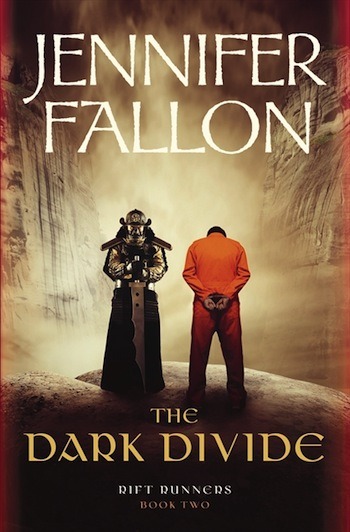
The Dark Divide by Jennifer Fallon

The Dark Divide by Jennifer Fallon is the second book of the Rift Runners (trilogy, I think). The first book was The Undivided.

This is very much the sort of series where you can’t read book two without having read book one before it. The Dark Divide picks up more or less right where The Undivided left off. I don’t think I can say anything too specific about the plot without spoilers for the first book.

The story mainly follows Ren and Darragh, the Undivided twins, Trasa the half-banshee and Pete the cop who is on the case of the shenanigans the other characters committed in the first book.

I liked The Dark Divide more than The Undivided. When I read the first book, I enjoyed it but I was a little disappointed that it wasn’t as full of twisty intrigue as I have come to expect from Fallon’s books (not that disappointed since I still have it 4.5 stars when I read it). The second book more than makes up for it. Where the first book had to introduce a lot of world-building concepts (faeries, rifts between realities, the magic of the twins’ existence), the second book was much more free to dig deeper into everyone’s motivations. There were a lot of ah-ha! moments and a lot of dawning comprehension as pieces of the puzzle came together.

One of the things I particularly liked was the juxtaposition between fantasy-world values and our world values. As in, often times killing someone for the cause in a fantasy book (in general) is seen as necessary. However, move the act (and the fantasy book character) into our world and a host of problems arise.

Another aspect which I thought was well done was the inclusion of a certain real-world recent-historical event. It was something that could easily have felt tacky but worked because the ordinary consequences were given as much (if not slightly more) weight as the plot-related consequences. Also, history wasn’t rewritten to accommodate the plot; from the characters’ point of view, it was a coincidence that affected them but that they had nothing directly to do with.

This is a very good series and I encourage all lovers of fantasy to give it a go. Since I didn’t talk about anything very specific above, I am also going to include the blurb for The Undivided, to give an idea of where the series is coming from.
The Undivided are divided. The psychic twins, Ronan and Darragh, have been separated by the traitor Druid, Amergin, who has kidnapped Ronan and thrown him through a rift into another reality. Now time is running out for Darragh. If Ronan isn’t found soon, they will both die. But his twin brother is lost in a reality where Druids are legend, and there is no magic. Somehow, before the Autumn Equinox, they must find one young man in a world of six billion people…

Meanwhile, Ren Kavanagh has no notion of where he comes from. He is plagued by strange injuries that appear from nowhere and everyone is convinced he is deliberately harming himself for attention. Then he meets the enticing and mysterious Trasa, and before he can figure out how it happened, he is in serious trouble - arrested for arson and possibly murder.

Rescue will come from a completely unexpected direction. Ren is about to discover more about his origins than he bargained for, meet the twin brother he never knew he had, and discover nobody is what they seem, especially his new friend, the half-faerie, half-human Trasa… Amergin’s daughter.

I also like how the covers match thematically. I look forward to putting them on the same shelf.

And if that wasn’t enough, The Dark Divide also has ninja leprechauns. Seriously. How can anyone resist reading about ninja freaking leprechauns with shuriken?

5 / 5 stars

Sunday, 22 April 2012

Burnt Ice by Steve Wheeler

Burnt Ice, the first in the A Fury of Aces series, is Steve Wheeler’s debut novel. I was really excited to read a new ANZ science fiction novel since there are so few of them being published, especially by large publishers (this one is from Harper Voyager, if you’re wondering). And it has such a lovely cover, too (so much SF coming out of the US has unappealing covers with artwork ruined, in my opinion, by unpleasant typography).


When I picked up Burnt Ice, I was expecting something like a Sean Williams and/or Shane Dix novel, but that wasn’t what I got.


Burnt Ice follows the adventures and misadventures of a military engineering crew in a distant future where wars are called “conflicts” and are sanctioned by the ever-watching Games Board. Of course, only part of the story revolves around the Games Board. The novel is actually structured as four almost self-contained stories with different but related missions at their centre. The over-arching plot holds everything together, even if at times it’s not obvious how the current conflict connects.


The plot was solid and fast-paced without a dull moment. New dangers kept arising and the crew’s missions took them to interesting places. The world building was also fairly strong, especially the planet at the start, which I enjoyed reading about. I also liked that there were aliens they didn’t know much about that popped up to cause trouble every now and then.


The writing was heavy on the technobabble, which I didn’t mind, although at times every new procedure was described in a bit too much technical detail. It didn’t bother me at first, but it got a bit much towards the end. On the other hand, the science and pseudoscience didn’t make me angry with it’s lack of credibility (as in, it was mostly correct and at least semi-viable), so that’s always a plus.


There were some things that did bother me, however. The characters were not very well developed and, especially in the first half or so when the focus was on the core crew, it wasn’t that easy to distinguish between them. The characters that stood out were basically Marko, the mainest character, Fritz, The Oddball Genius, and Jan, The (Mysterious) Girl. The other two crew members didn’t read terribly differently to Marko. Very little time was spent developing the personalities and relationships between them to the point where, for example, we’re told when there’s a romantic connection but no reason is really given for it and I was left wondering why those two would even want to hook up. The characters that came along later on were more distinct and interesting, but they weren’t further developed either. It would have been a stronger novel if some of the technobabble were exchanged for some character development.


Easily my favourite character was the sentient ACE (Artificially Created Entity) soft-of-pet Marko built for himself in the latter half of the book. Basically an animal cyborg, it’s quirky lack of understanding of human idioms gave me a couple of laughs. It wouldn’t really have meshed with the plot earlier on, but I do wish it had come along sooner.


The other thing that bothered me was the unnecessary (and I assume unconscious) use of gendered slurs. For example “arrogant woman/bitch” was used two too many times. In an ostensibly gender-equal world, it felt like everyone who screwed up and more than half the dodgy people (as in bad guys, but there were shades of grey and mystery to some of them) were female or AIs. I was particularly offended when someone called the suddenly rogue AI a f*cking bitch (the swearing I don’t object to because the AI was trying to kill them). Even though the AIs were loosely gendered, you can’t get much more asexual than a computer so you’d think notions of gender would have been redefined by that distant future point. As I said, I very much doubt it was intentional sexism, but that doesn’t mean it didn’t bother me.


The ending was very much an ending to part one in a series. There were a lot of unanswered questions, including some mysterious new characters who showed up towards the end and promised (the reader, not so much the other characters, which isn’t a bad thing) some answers as well as more interesting questions. If the characterisation hadn’t bothered me so much I would be interested in reading what happens next. As is, I’m not sure that I will be picking up the next in the (possibly ten book long) series.


3 / 5 stars

Sunday, 25 March 2012

Power Unbound by Nicole Murphy

Power Unbound, by Nicole Murphy, is the second book in the Dream of Asarlai trilogy. You can read my review for the first book, Secret Ones, here.


Where Secret Ones followed Maggie and Lucas, Power Unbound shifts to following Ione, Maggie’s best friend, and Stephen, a gadda who is about to sit for the highest test of power. Although there are a few scenes in Austin, Texas, most of this novel is set in Ireland. Despite the shift in character focus, the overarching plot continues on from the first book, featuring more prominently, and all the characters we like from the first book pop up again.


Ione is unique among gadda for having particularly weak power, despite coming from an old and powerful family. She came to terms with it long before the story started and spends her time working as a computer programmer. She’s also a widow and has a young (10 or 11 year old) son to look after. It would be easy to say that Ione offers more depth of character than Maggie did, but I think what really makes this story better is Murphy’s development as a writer. (And the fact that Lucas’s past in the first book wasn’t exactly straight forward.)


The whole novel hangs together better and I found it more enjoyable. The romantic plot line is less linear and, while we know that the two characters will end up together (it is paranormal romance, after all), the obstacles in their way felt less artificial. It was more about them being silly than external circumstances, which I liked.


The fantasy plot line was more action-packed than in Secret Ones. The danger was greater and the stakes were higher. Also, more progress was made working out who’s been behind all the evil shenanigans. Unlike the first book, it felt less like the relevant characters were flailing around not getting anywhere. (To be fair, in the first book the trouble was quite different in nature and didn’t initially seem to be connected to the overarching plot.)


The end of Power Unbound set up the final book in the trilogy quite well. Unfortunately, I have to wait a few months before I can read it (I want a matching paper set, not the ebook), but I definitely want to know what happens next and how everything is resolved. Oh, I should also mention that while the overarching plot follows on from Secret Ones, I think it’s possible to read Power Unbound by itself. It contains some spoilers for the first book, but doesn’t actually rehash all the details, so you could still read the first book afterwards. Of course, it’s better to read them in order but if, for example, you’re particularly interested in the Ditmar eligible works which include Power Unbound and the third book, Rogue Gadda, you could probably get away with skipping Secret Ones.


Overall, Power Unbound was an enjoyable read. I definitely recommend it to fans of paranormal romance.


4 / 5 stars

Saturday, 24 March 2012

Secret Ones by Nicole Murphy

Secret Ones is Nichole Murphy’s debut novel, published by Harper Voyager (Aus) in 2010. It’s a paranormal romance novel set in Ireland and rural New South Wales. Being a paranormal romance, rather than straight urban fantasy, the romantic plot line was significantly more prominent than what I usually read, which was an interesting change of pace.
The main character, Maggie, is one of the gadda, a race of magic-wielding people who look human, but aren’t (and can’t interbreed). Generally, the gadda start their magic training at the age of thirteen, then progress through levels of examinations as they gain more control of their powers. Maggie, however, didn’t want to start when she was thirteen. She stubbornly chose to finish her ordinary human schooling before entering the gadda world at eighteen. Even after joining the ranks of magic users, she continued to pursue human studies, slowing down her magical studies. The result is that, refreshingly, she isn’t a teenager (it’s possible I’ve been reading too many YA urban fantasy novels with be-all and end-all romantic plotlines) and nothing that happens is particularly unrealistic in terms of her reactions and how she deals with it etc. (And of course, there are more sex scenes than in YA.)


The male lead is a physicist (entirely biased yay!) who crosses the heroine’s path when he takes a research position in Australia at her grandfather’s university. Smart, smoking hot and with a dark past, he makes an excellent foil for Maggie and, to an extent, offers an outsider’s perspective on the gadda.


I found the structure of Secret Ones different to other urban fantasy books I’ve read (admittedly, I can only think of one other paranormal romance book I’ve read recently, so it could just be me). The romantic plot line seemed to be more or less tied up before the climax of the fantasy storyline happens a bit suddenly and then there are more ramifications than I expected. Which isn’t to say the novel was badly paced; quite the contrary, in fact. I didn’t feel bored at any point and there weren’t any paragraphs I wanted to skip. It was just different to what I’m used to.


Secret Ones is book one in a trilogy, but the other two books, Power Unbound and Rogue Gadda focus on other characters. That means that, while the overarching plot isn’t resolved, there was no cliff hanger at the end. Sometimes it’s nice not to feel like the world will end if you don’t pick up the next book straight away. …That said, I think I will pick up Power Unbound next.


I found Secret Ones to be an enjoyable, light read. I recommend it to anyone who feels like a bit of paranormal romance or urban fantasy.


3.5 / 5 stars

Sunday, 26 February 2012

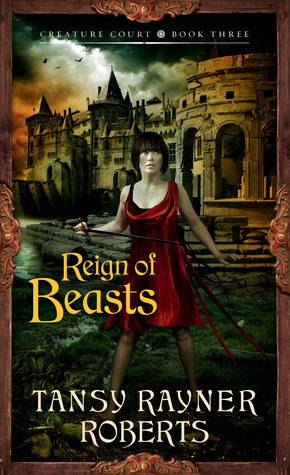
Reign of Beasts by Tansy Rayner Roberts

Reign of Beasts, by Tansy Rayner Roberts, is the final instalment of the Creature Court trilogy. The series is excellent and a testament to how fantastic a writer Roberts is.

It’s not the kind of series where you can pick up the third (or second) book without having read the first two. Luckily for me, I read book one — Power and Majesty — and book two — The Shattered City — when they came out (roughly six months apart, I think). It’s a bit hard to review a third book without saying something about the other books and the series as a whole.

Power and Majesty introduced us to the day world and three friends who, between them, make dresses and garlands for the city’s many celebrations. Then we meet the Creature Court and their dysfunctional night world. It also had a particularly memorable opening of a naked youth falling out of the sky. (How’s that for a hook?)

The following is copied from my LibraryThing review of The Shattered City, which I wrote immediately after I finished reading.

Velody is struggling to keep the two aspects of her life separate: by day she makes dresses and by night she leads the Creature Court in the battle against the sky. It’s bad enough that most of the Creature Court would sooner tear each other apart than help each other. Now the sky is stepping up it’s assault on the city, making it harder for Velody to keep her two worlds separate. It isn’t long before the two worlds start bleeding together.

A secret war is being fought every nox between the Creature Court and the sky. The day folk have no idea it’s happening, but if the Creature Court isn’t careful, then normal people die. If the Creature Court loses the battle, then the whole city will be destroyed.
Dresses, violence, flowers, blood and sex. What more do you want?

This book doesn’t beat around the bush with the action and the reader is quickly launched into the midst of the story. Unlike the first book, there wasn’t a need for setting up the world or back story quite so much, so I felt it had good consistent pacing, whereas book 1, Power and Majesty, was a little slow at the start.

Two things really stood out for me with this book. The first was the juxtaposition of the day world with the events of the night (or nox as it is referred to). During the day we see Velody and her two friends making dresses and garlands and the Duchessa presiding over the never-ending festivals of the day world. During the nox, Velody and her Creature Court fight the sky which is trying to swallow up the city. The days are ordinary (or at least, as ordinary as days get in fantasy books) and the nox are full of violence, sex and blood, often simultaneously. The writing switches between the two flawlessly, even when the two worlds start to collide.

The other stand-out excellent aspect of the book was how unflinchingly the author doled out cruelty to her characters. Building on the troubled pasts established in book one, The Shattered City takes it to the next level by pushing all the characters harder and further and mercilessly inflicting emotional pain on them. It was very well done.

Overall, this was an excellent read and I highly recommending to anyone who didn’t hate the first book. And if you haven’t read the first book, what are you waiting for?

And that brings me to Reign of Beasts. I really felt this series improved with each book. Where the first two books were spent building the world and setting up all manner of conflicts, in the final instalment Roberts meticulously dismantles her world. It’s quite masterfully done and I will be surprised if Reign of Beasts doesn’t win any awards.

Throughout the series, Roberts sets up a variety of conflicts of all magnitudes. In the first book the challenge for Velody seems to be overcoming prejudice, expectations and the established group dynamics to become the first female Power and Majesty. While this bleeds into the second and third books, priorities shift and by the end of Reign of Beasts we learn who the true enemy really is. (No spoilers, but it takes a lot of twists and turns to get there.)

Roberts has populated her world with a variety of strong, wilful, petty, manipulative, animalistic, brutal, loyal characters who all elicit our sympathy at some point and our distaste at others. They are all far from perfect, yet none are quite pure evil. (Incidentally, of the three original girls, Rhian was my least favourite in Reign of Beasts and Delphine, unexpectedly, my favourite.)

A review of Reign of Beasts would be incomplete without some comment on the structure of the novel. There are two simultaneous time lines running through the book, the main one in the “present” immediately following on from The Shattered City, and the other recounting events from the Creature Court’s (pre start of main events) past. All the threads were expertly woven together to enhance the present story and convey interesting (as well as relevant) backstory.

The Creature Court trilogy is definitely worth a read for all fans of fantasy. It’s dark and brutal and pretty dresses are relevant to the plot.

5 / 5 stars

Saturday, 28 January 2012

Hoodwink by Rhonda Roberts

Cross-posed from here.


The first thing I want to note is that despite Hoodwink being the second book in Rhonda Roberts’s Timestalker series, it absolutely stands alone. You don’t have to have read the first book, Gladiatrix, although it’s definitely worth reading for its own sake. If you enjoy Hoodwink, there’s no reason not to go back and read Gladiatrix afterwards. The only spoilers in book 2 for book 1 are of the “main characters are alive” variety.


That said, on to the body of the review!


Hoodwink is about Kannon Dupree, arse-kicking, time-travelling PI in training. Kannon is Australian but living in America because of events in book 1. She takes a case investigating the murder of one of the directors of Gone With the Wind, after his body is discovered in the present, 70ish years after his death.


Sent back to 1939 to pose as his personal assistant, the first thing Kannon discovers in the past is that just about everyone who’s ever met him has plausible motives for wanting the director dead. And so begins her tangled investigation, four days before his murder.


Hampered by internal politics at the NTA (the time-travelling equivalent of NASA), Kannon is only given two days to prepare. And, despite her client having suspicions as to who the murderer was, Kannon quickly realises that she has no where near enough information from the future to be of much use. What should make it easier are the repeated attempts on the director’s life and the fact that he’s already afraid someone is after him. But who is it?


Somewhere, among the mayhem of the Gone With the Wind Set (complete with Clarke Gable, Vivien Leigh and Leslie Howard), Kannon has to work out who has the means and opportunity to murder the director, since everyone has motive.


This is a book not short on conspiracy and arse-kicking. As in Gadiatrix, I like the fact that Kannon can look after herself (thanks to her Aikido training), and that many of the people who try to cross her (violently, at least) are rapidly dealt with. It was amusing to read the reactions of some of the men who assumed she was “just a feeble woman”, although in some cases the amusing part was their expressions when she hit them.


All the loose ends in the past are tied up nicely at the end, but not all the questions raised in the future are fully answered. I hope the next book (due out in September) picks them up again. Since there is a shorter gap between books 2 and 3 than there was between books 1 and 2, I’m also hoping there’s more plot-based connection between them. Aside from Kannon’s change in circumstances, very little of book 1 reappeared in book 2. Not that I think Hoodwink suffered for it. In fact, after I found out where one of the key characters from Gladiatrix had got to, I promptly forgot about some of the other issues raised in the first book. Which is probably a good thing, as I suspect in the longish interim between them, Roberts may have chosen to shift the background focus slightly.


The only thing I would’ve liked to see more of, is Kannon’s relationship with people in the present/future. In particular her friend that helps her out at the start and end. We don’t get to see much of why they’re friends or the connection between them. This is another thing I’m hoping is developed in future books.


Rating: 4.5 / 5 stars.


[For the record, I read the Harper Voyager Australia ebook of Hoodwink, which I purchased off the (Australian) iTunes/iBooks store.]