Showing posts with label terry pratchett. Show all posts

Sunday, 29 November 2015

The Shepherd's Crown by Terry Pratchett

The Shepherd's Crown by Terry Pratchett is the last Discworld book. It's also the concluding volume of Tiffany Aching's story and serves as an epilogue to just about all of the witches that have made an appearance throughout the entire Discworld series.

A shivering of worlds

Deep in the Chalk, something is stirring. The owls and the foxes can sense it, and Tiffany Aching feels it in her boots. An old enemy is gathering strength.

This is a time of endings and beginnings, old friends and new, a blurring of edges and a shifting of power. Now Tiffany stands between the light and the dark, the good and the bad.

As the fairy horde prepares for invasion, Tiffany must summon all the witches to stand with her. To protect the land. Her land.

There will be a reckoning...

This book was sort of sad. Sad because it was the last Discworld book, and indeed the last book Pratchett wrote before he couldn't write any more. (According to the afterword, he had several more books in the works, or at least ideas floating around that will now never be. Which is also quite sad. I need to find an entrance into L-space so I can read those books that never were in our reality.) The Shepherd's Crown is also sad because of some of the events in it, which I don't want to go into too much detail on.

In this book, Tiffany Aching, who has already proved herself as a good witch in the earlier books, has to prove her leadership abilities more than her witching skills. The elves are threatening the Discworld again and it's up to Tiffany to step up and organise the resistance, while becoming more sure of her place in the world.

Although this is a Tiffany book, she is definitely not the only interesting character in it. Nanny Ogg and the more minor witch characters from recent books play a part. Magrat, who we haven't seen much of for several books, plays a key role and it was great to see her at a later stage in her life being awesome and kicking arse.

There was also a new character introduced in this book: Geoffrey, a boy who wants to be a witch. Also, his super-intelligent goat. The symmetry of that story in the last Discworld book and the story of Esk, a girl who wants to be a wizard, in the third Discworld book was not lost on me. I suspect the conclusion of this subplot may have been more developed, given the opportunity, but it wasn't a bad ending.

Tiffany's story had a nice ending though, a nice segue into the next stage of her life. In some ways, nothing much changes for her, but in others everything is different. Really Tiffany has been changing all through the books, it's just more obvious at some points than others. And there will always be Feegles looking out for her.

If you're a fan of Discworld, this isn't a book to miss. I suggest having some tissues ready, though, as endings of all sorts can be sad. If you're unfamiliar with Discworld, then this book does stand alone but I would still recommend at least starting with the first Tiffany Aching book, The Wee Free Men. I am sad that there aren't going to be any more Discworld books, but at least they'll always be available for re-reading. :-(

4.5 / 5 stars

First published: August 2015, Doubleday
Series: Discworld, book the last (41 out of 41) and book 5 of 5 in the Tiffany Aching sequence
Format read: Hardcover
Source: Non-Amazon online book shop

Friday, 26 September 2014

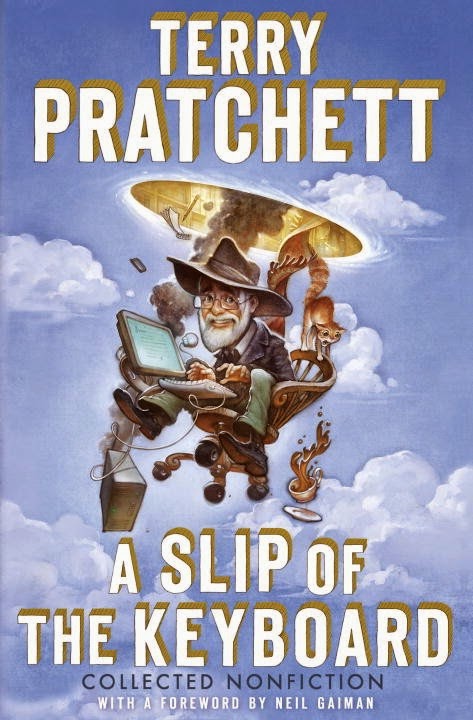
A Slip of the Keyboard by Terry Pratchett

A Slip of the Keyboard by Terry Pratchett is a collection of miscellaneous essays written by the author. Those who, like I, didn't have the chance to read Once More With Footnotes will be pleased to learn that all the non-fiction essays in that volume are contained in this one and all the short fiction appears in A Blink of the Screen, which I have not read. I have, however, read all of the Discworld books and a few non-Discworld books written by Pratchett.
Terry Pratchett has earned a place in the hearts of readers the world over with his bestselling Discworld series — but in recent years he has become equally well-known and respected as an outspoken campaigner for causes including Alzheimer's research and animal rights. A Slip of the Keyboard brings together for the first time the finest examples of Pratchett's non fiction writing, both serious and surreal: from musings on mushrooms to what it means to be a writer (and why banana daiquiris are so important); from memories of Granny Pratchett to speculation about Gandalf's love life, and passionate defences of the causes dear to him.
     With all the humour and humanity that have made his novels so enduringly popular, this collection brings Pratchett out from behind the scenes of the Discworld to speak for himself — man and boy, bibliophile and computer geek, champion of hats, orangutans and Dignity in Dying.
The essays (and transcribed speeches) are arranged into three categories, divided up as sections. The order in which they appear seems to be roughly chronological — in subject matter rather than in original publication dates. Part one, titled "A Scribbling Intruder", mostly deals with things writing- and author-related. Here you will find amusing anecdotes about signing tours (and advice about signing tours), thoughts on fantasy — his own and others' — pieces in convention booklets, introductions to things and so forth. A most memorable essay was "No Worries", an amalgamation of the Australian signing tours Pratchett had done up until then. There was much hilarity.

The second section, "A Twit and a Dreamer", is a more eclectic set of essays etc, as far as topic goes, anyway. There's one essay waxing lyrical about mushrooms and mushroom picking — "That Sounds Funghi, It Must Be the Dawn Chorus" — and another about his grandmother. There is also what I think is the oldest article, "Letter to Vector", written while Pratchett was still in school. And more introductions to things which, quite frankly, make me want to read the books they're introducing.

The final section is entitled "Days of Rage", which makes more sense if you've read the introduction to the collection, written by Neil Gaiman. (I don't often enjoy introductions, but this one was well worth it.) This last section deals with orangutans, the NHS, Alzheimer's and assisted dying. If you've been following Pratchett's progress at all, you'll be aware of his early-onset Alzheimer's (a rare variant that leaves him able to think perfectly well, but unable to type or do up his seatbelt). The last few essays are very much about Alzheimer's and his quest to legalise assisted-dying. It was interesting to read in more detail than I previously had about these issues (and reassuring in terms of wanting more Pratchett books, just saying).

So as not to end on a dark note, the collection does contain one more amusing essay: Terry Pratchett's footnotes to life.

I would not hesitate to recommend this book to Pratchett fans and also anyone interested in reading something autobiographical about him. Of course this is not a proper autobiography and skips many topics that a biography would usually cover, but it does reveal Pratchett's thoughts on many subjects and does sketch out aspects of his early life — mostly through anecdotes as part of speeches. It was a good book to dip into in not-too-large doses. I'm not sure I'd recommend reading it straight through as I found similar topics/ideas/anecdotes come up in a few essays which usually end up grouped together (since they are indeed on a similar topic). They were always presented in a different way, but could still come across as being slightly repetitive; one of the dangers of collecting previously published essays, I think.

4.5 / 5 stars

First published: September 2014, Doubleday
Series: No
Format read: eARC, US edition (the UK/Commonwealth cover is more sedate)
Source: Publisher via Edelweiss

Wednesday, 9 April 2014

Raising Steam by Terry Pratchett

Raising Steam is the latest instalment of Terry Pratchett's Discworld. While, like all the Discworld books, it is a self-contained story, I think long-time Discworld fans will get more out of it than newcomers to the series. It builds most on the goblin plot line in Snuff and — as will be obvious from the blurb — the earlier Moist von Lipwig stories, Going Postal and Making Money. None of them are required reading, especially if you're already familiar with Discworld, but I think it would help. Also, this review contains some spoilers of varying degrees for the aforementioned books and minor spoilers for some of the Watch books.
To the consternation of the patrician, Lord Vetinari, a new invention has arrived in Ankh-Morpork - a great clanging monster of a machine that harnesses the power of all the elements: earth, air, fire and water. This being Ankh-Morpork, it's soon drawing astonished crowds, some of whom caught the zeitgeist early and arrive armed with notepads and very sensible rainwear.

Moist von Lipwig is not a man who enjoys hard work - as master of the Post Office, the Mint and the Royal Bank his input is, of course, vital... but largely dependent on words, which are fortunately not very heavy and don't always need greasing. However, he does enjoy being alive, which makes a new job offer from Vetinari hard to refuse...

Steam is rising over Discworld, driven by Mister Simnel, the man wi' t'flat cap and sliding rule who has an interesting arrangement with the sine and cosine. Moist will have to grapple with gallons of grease, goblins, a fat controller with a history of throwing employees down the stairs and some very angry dwarfs if he's going to stop it all going off the rails...
To me, what the most recent Discworld books have really been about, especially the Moist books, is progress sweeping through Ankh-Morpork. Starting from Going Postal, which was about reviving the postal service, the clacks (semaphore communication) system made a serious appearance and brought fast communication to the Disc. Although the previous Moist books have been ostensibly about Vetinari forcing Moist to reform and run various useful services (post, bank, mint and his wife runs the clacks), Raising Steam has Vetinari throwing Moist in on the ground floor of the budding rail system.

It seems obvious on the surface that the fast progress made in these books is mirroring, to an extent, the rapidity of progress in the real world. I don't know if we'll get it, but the next logical step might be a full-blown industrial revolution with Vetinari steering the ship. Progress, as they say, marches on. The evolution of Ankh-Morpork (and the Disc) is even more obvious if you look at the Watch books alongside the Moist books. The general arc of the Watch books is Vetinari getting Vimes to clean up first himself and then the Watch, turning it into a well-run machine. We see some of the after-effects of Vimes' leadership in Raising Steam when watchmen in faraway places are noted as being trained in Ankh-Morpork. Especially if we look at the past depicted in Night Watch, it is evident that Ankh-Morpork is becoming more modern and safer (for a given definition of "safe"). I hope we do get to see a few more books in this vein. Progress in the Disc is not remotely identical to Roundworld's history, despite various bits in one being analogous to bits in the other. I want to see where Pratchett takes it.

Speaking of comparisons with other Discworld novels, Raising Steam also put me in mind of Moving Pictures. Both are about new technologies being developed — and are about the technology as much as the people — and both are arguably before their times. However, where everything goes horribly wrong in Moving Pictures, it works out well in Raising Steam. I am left wondering whether it was Vetinari's oversight that made the railway a success or whether it was the fact that the railway is built on physics and careful measurements whereas Holy Wood had a much greater reliance on more esoteric elements. (And I feel like a rift in the spacetime continuum was involved, but it's been years since I read it, so I'm not sure.)

Key characters in Raising Steam other than those I've already mentioned are Simnel, the engineer who invented the steam engine train, Harry King and his wife Effie who have been previously featured in their role of running the nightsoil empire (well, mostly Harry has appeared in earlier books), and Of The Twilight The Darkness, a goblin who might have appeared in Snuff but I can't remember. Surprisingly, Drumknott, Vetinari's secretary, played a larger role than he has previously. Also, many old favourites made appearances, especially Vimes, Angua, Detritus and Cheery Littlebottom.

The Low King of the Dwarfs, who we most recently saw in Thud! (I think) is an important minor character as part of the plotline concerning grags fighting against modernity and Ankh-Morporkisation. On the one hand, the grags and their recruits struck me as having strong parallels with religious terrorists, on the other hand, the more interesting dwarf subplot was the continuing discussion of dwarfish gender. For part of the time while I was reading I found myself wishing there was a more in-depth discussion of dwarfish gender, but then I don't think that would have been very Pratchetty. (There was also a period of confusion when, in tiredness, I misread a pronoun and thought someone was gay for a while when they really weren't, but that wasn't the book's fault.)

The dwarfish expression of femininity seems to be (still) mostly confined to chain mail skirts and makeup which I don't really get (since I am female and wear neither skirts nor makeup very often). On the other hand, there was more discussion about why a dwarf's gender is secret until they want to reveal it. While my first thought was that surely genderless dwarfs meant that there was a reasonable amount of equality for them, what I didn't consider until it was pointed out in this book is that by marking all dwarfs as male by default, they were culturally erasing women, not equalising them. It was a case forcing women to pretend not to be, whether they wanted to or not. It's a far cry from Angua introducing Cheery to lipstick and heels and it might not look like feminist progress on the surface, but in this context, turns out it is. Aside from one minor twist which I picked up on before it was revealed (albeit only because I was flicking back through the book in my pronoun confusion), I didn't quite see the nuances of the dwarf-gender discussion coming. It made for a more satisfying ending than I had been expecting on that front.

Obviously, if you are a fan of Pratchett, you should definitely read Raising Steam, especially if you are otherwise up to date. If you haven't read Pratchett before: goodness, why not? But this probably isn't the book to start with. There are a lot of places to start, though, and most of them don't include the very first book. I recommend googling around. The Discworld series has evolved in style since Pratchett started writing it in the 80s (as you'd want to hope it had) so the very early books and the middle period books aren't very similar to the latter period books. A good and particularly standalone example of a latter period book would probably be Monstrous Regiment and a good place to start if you want a lead-in to Raising Steam would be Going Postal.

4.5 / 5 stars

First published: 2013, Doubleday
Series: Discworld, apparently book 40 (It seems like only a couple of years ago book 30 came out, but I'm pretty sure that was when they weren't counting the YA Discworld books as "proper" Discworld books. Progress marches on.)
Format read: Hardcover, oh my!
Source: A RL shop! I think it was a Dymocks.

Thursday, 25 October 2012

Dodger by Terry Pratchett

Dodger is Terry Pratchett's latest book and not, despite the cover, a Discworld novel. It's set in Roundworld London in the first part for the 19th century, which of course bears no resemblance to Ankh-Morpork, not at all.

The back cover blurb:
Dodger is a tosher — a secret scavenger living in the squalor of Dickensian London.

Everyone who is nobody knows him. Anyone who is anybody doesn't.

He used to know his future; it involved a lot of brick-lined tunnels and plenty of filth. But when he rescues a young girl from a beating, things start to get
really messy.

Now everyone who is anyone wants to get their hands on Dodger.
When I first started reading, I found it very difficult to get Ankh-Morpork out of my head. He doesn't mean the Thames, I thought, that's clearly the Ankh! And indeed, Ankh-Morpork has always looked a bit like old London seen in the right light and from the right angle. It didn't actually take me all that long to get into the swing of London as a setting. The different slang and the inclusion of real historical figures such as Queen Victoria and Charles Dickens definitely helped. And if you needed any more evidence that it's set in Roundworld, there was a footnote referring the reader to Google.

I liked the eponymous character. He rises quickly from sewer-searching tosher to someone a bit more respectable, through no intentions of his own, never takes his eye off the ball and never forgets what's important. He has a very strict moral code and, thanks to his room-mate/landlord Solomon Cohen, he knows how to wash to avoid catching anything horrible from the sewers. As a side note, hubby and I were arguing about how old Dodger is. I think he's maybe twenty, give or take a year, but hubby insists that he's a teenager, making Dodger a YA book. My thinking is, he must be old enough to shave regularly and being the stringy type that probably happened a bit later in life. Not that it's important.

My favourite character was definitely Solomon Cohen, Jew living in England after doing a lot of escaping persecution across Europe and the Middle East. He helps keep Dodger on the straight and narrow by forbidding theft, making him wash and helping him spruce up when when the time comes. He's also the character with the best lines, making him enjoyable to read.

Charles Dickens was also an interesting character and, overall, I suspect I might have got more out of Dodger if I'd read more any Dickens. Which isn't to say it wasn't a highly enjoyable read without much prior knowledge of Dickens' history.

I recommend Dodger to any Pratchett fans and to anyone wanting to get into Pratchett that perhaps isn't a fan of fantasy. Written in the style of Discworld but without any magic, I think Dodger would make a good gateway drug to Pratchett's other works.

4.5 / 5 stars

Saturday, 11 August 2012

The Unadulterated Cat by Terry Pratchett

I debated reviewing The Unadulterated Cat by Terry Pratchett and with illustrations/cartoons by Gray Jolliffe. It’s neither fiction nor narrative. It is hilarious however (as though we would expect less from early Pratchett).


The book reads as an information guide about Real Cats as opposed to, well, unreal cats. From the flap-jacket:


Real cats never wear flea collars… or appear on Christmas cards… or chase anything with a bell on it.


Cats with ears that look like they have been trimmed with pinking shears are Real cats.


Real cats do eat quiche. And giblets. And butter. And anything else left on the side if they think they can get away with it. They can hear a fridge door opening two rooms away.


Real cats don’t need names. But they often get called them. ‘Yaargeroffoutofityarbastard’ does nicely.


It’s divided into section such as “How to get a cat”, “Feeding cats” and “Schrodinger cats”. Each presents an entertaining and non-typical view of the subject. Interspersed anecdotes are what really make it.


It’s a very quick read and had me laughing out loud on more than one occasion.

Wednesday, 18 July 2012

The Long Earth by Terry Pratchett and Stephen Baxter

The Long Earth is a collaboration between Terry Pratchett and Stephen Baxter. I didn’t expect to enjoy it as much as I did. My favourite Pratchett books are hands down some of the Discworld novels. My experience with an armful of Baxter books is that he tends to over write this science and tends to reuse similar characters. So I wasn’t sure what to expect. Mainly I was hoping for Pratchetty characters and an interesting story.


That’s pretty much what I got, but better. The whole novel flowed well so there was never any obvious breaks between writers (as one would hope) and front cover notwithstanding, the overall feel seemed more Pratchetty to me. I read in an interview somewhere that the idea of the Long Earth — a series of parallel worlds which followed different biological and cosmic evolutionary tracks to the world we know — was Pratchett’s idea from way back, but he didn’t feel he could do justice to it by himself. Perhaps this is why it feels like a Pratchetty world, although some of the ideas (of odd things encountered) seemed Baxtery.


The story follows a few characters with varying degrees of depth. There is Joshua, a natural stepper (between worlds) who was there, so to speak, on the day when the children of the world downloaded instructions to build their own stepping devices and suddenly disappeared. He is the most central character and, later on, we follow him and a Tibetan reincarnated as a computer across millions of Earths.


We also see many cameos of other characters, some only once, some reappearing several times. All of them play crucial parts in the unfolding of the Long Earth. I mention this because one of the characters on the blurb isn’t a very prominent character, so I thought it odd that he was included. I suspect it would have been a difficult book to write a blurb for.


Overall, The Long Earth is more philosophical than plot-driven, although there are some save-the-day type moments. That said, there was never a dull moment and a lot of the ideas explored were fascinating and, in my opinion, dwelt upon for just the right amount of time. The end, when it came was a little bit sudden but upon reflection I’ve decided I like it. They leave it open so that there could be more books (I don’t expect any, but the back cover of my copy says it’s the first book in an exciting new collaboration… so I don’t know. I’d read it, but I’m more keen for as many Discworld books as possible) but nothing is left hanging, except for, y’know, the fate of all the worlds exactly what happens next.


I would recommend The Long Earth to anyone who enjoys science fiction or fantasy that is thoughtful, character-driven (especially if you count the Long Earth as a character) and immensely interesting.


4.5 / 5 stars