Showing posts with label magical realism. Show all posts

Sunday, 28 March 2021

On Fragile Waves by E Lily Yu

On Fragile Waves by E Lily Yu is a novel about Afghani refugees making their way to Australia, with overtones of magical realism. It follows a family as they journey in a dangerous boat and spend time on Nauru, in one of Australia’s off-shore detention centres.

Firuzeh and her brother Nour are children of fire, born in an Afghanistan fractured by war. When their parents, their Atay and Abay, decide to leave, they spin fairy tales of their destination, the mythical land and opportunities of Australia.

As the family journeys from Pakistan to Indonesia to Nauru, heading toward a hope of home, they must rely on fragile and temporary shelters, strangers both mercenary and kind, and friends who vanish as quickly as they’re found.

When they arrive in Australia, what seemed like a stable shore gives way to treacherous currents. Neighbors, classmates, and the government seek their own ends, indifferent to the family’s fate. For Firuzeh, her fantasy worlds provide some relief, but as her family and home splinter, she must surface from these imaginings and find a new way.

My one hesitation when deciding to read this book was that the author was American. But On Fragile Waves reads as impeccably researched. It follows a family, from the point of the daughter aged around 10, as a lot of terrible things happen to them during their journey and after. 

If you know anything about Australia’s offshore detention system, you’ll expect this to be a pretty bleak book, and it is. Moments of darkness are interspersed with Firuzeh telling stories to herself and to her younger brother. Those stories and Firuzeh’s memories of a friend she made on the way provide the fantastical element that put this book on my radar (that and the author). But mostly the book is set in the real world, and the harsh reality of being a refugee doesn’t end just because they reach Australia. 

This was a moving read and I recommend it to anyone that isn’t explicitly looking for a light and fluffy read. It’s a book that deals with racism and trauma and even though it’s not long, I didn’t find it to be a quick read.

4 / 5 stars

First published: February 2021, Erewhon Books
Series: No
Format read: eARC
Source: Publisher via NetGalley

Tuesday, 17 June 2014

The Girl in the Road by Monica Byrne

The Girl in the Road by Monica Byrne is a remarkable book. It's near-future science fiction set in India, Ethiopia and involving two journeys: one across (northern) Africa, the other across the Arabian Sea. The settings alone should tell you that it is not a run of the mill science fiction novel.
Meena, a young woman living in a futuristic Mumbai, wakes up with five snake bites on her chest. She doesn't know how or why, but she must flee India and return to Ethiopia, the place of her birth. Having long heard about The Trail -- an energy-harvesting bridge that spans the Arabian Sea -- she embarks on foot on this forbidden bridge, with its own subculture and rules. What awaits her in Ethiopia is unclear; she's hoping the journey will illuminate it for her.

Mariama, a girl from a different time, is on a quest of her own. After witnessing her mother's rape, she joins up with a caravan of strangers heading across Saharan Africa. She meets Yemaya, a beautiful and enigmatic woman who becomes her protector and confidante. Yemaya tells Mariama of Ethiopia, where revolution is brewing and life will be better. Mariama hopes against hope that it offers much more than Yemaya ever promised.

As one heads east and the other west, Meena and Mariama's fates will entwine in ways that are profoundly moving and shocking to the core. Vividly imagined and artfully told, written with stunning clarity and deep emotion, The Girl in the Road is a true tour de force.
I need to say up front that I don't know very much about Africa and a little bit more about India, so I am not someone who would notice any small factual/cultural errors. There didn't seem to be anything huge and glaring and the small details felt authentic, but if others disagree, please let me know in the comments. I wasn't actually sure until I got to the end that the author is American (obviously, I could've googled, but didn't), so the level of detail and the amount of research she obviously put in is impressive. But as always, there are potential issues with an outsider writing about any culture. I will note that none of the characters were white, and also that both bisexual and trans identities were also featured. However, the rest of this review won't be dealing with these issues.

The Girl in the Road follows two protagonists, both incredibly unreliable, for different reasons. Meena is a mentally ill Indian woman in her late twenties, living in the late 2060s. After a crisis drives her from her home, she makes her way to Mumbai. In Mumbai she becomes infatuated with the Trail, a string of floating pontoons which collect wave energy from the Arabian sea and stretch from just off the coast of Mumbai to Djibouti, Ethiopia. Still wanting to get away from the forces chasing her, she sets out across the Trail. Since her story is told in first person and partly due to her illness (my guess was that she was bipolar but that wasn't completely clear), Meena's story unravels slowly and not strictly chronologically. One quickly realises that we can't trust everything she tells us and begins to question her decisions as well. It's a fascinating mode of story telling.

Mariama is a young girl (8 or 10 at the start, I think) who suddenly finds she has to fend for herself. She attaches herself to two men transporting oil to Ethiopia, who look after her. Her story is told in first and second person, with Mariama talking to Yemaya, a woman who joins the oil convoy not long after Mariama herself does. Partly because of her age, and partly because of her isolated and unpleasant upbringing (she was a slave), Mariama is also an unreliable narrator, but in a different way. Her point of view was, I think, more decipherable and at times more understandable as well. (There was one scene that I think some people will struggle with. It's a spoiler, but if you're interested, the author blogs about it here.) With Mariama, the reader's interpretation of her situation is, sometiems, more important than her own.

It took me a while to work out how the two storylines were connected. I won't spoil it here, because the slow unravelling of the story is an important part of the journey, but it wasn't obvious at first how they were placed temporally with respect to each other. But eventually it becomes apparent and certain events play out with a terrible inevitability that we, the reader, cannot help to stop. It was a beautifully woven tale.

Not only were the stories beautifully woven together, but similar themes — like the unusual snake in both story lines — intertwined both stories, binding them together as much as actual events do. Byrne has a wonderful turn of phrase, always choosing the best words to convey layers of meaning and always push the narrative forwards. It was a pleasure to read. It was complicated, but not too much so. (Although the Epilogue confused me. I suspect it might make more sense upon re-reading...)

I very strongly recommend this book to everyone. Fans of science fiction should enjoy this very different view of a not-too-distant future. There is also an element of magical realism — and a sort of dream-like quality — for fantasy fans who may not like straight science fiction. But above all, it's an exquisitely written book that I will be recommending to everyone.

5 / 5 stars

First published: May 2014, Crown
Series: No.
Format read: eARC
Source: Publisher via NetGalley

Friday, 25 October 2013

Mistification by Kaaron Warren

Mistification by Kaaron Warren is a strange book. I'm not sure what I was expecting — perhaps to be scarred for life as with Slights — but it's not really like any of Warren's other books/stories (that I've read so far). I'm including the blurb, but with the caveat that it's a bit misleading.
Marvo is a stage magician. His magic is real.

Marvo grows up without knowing his parents, without knowing his heritage, without knowing much about life.
The magicians have always been with us, since the beginning of civilisation. They fill our heads with the mist, keeping us from witnessing the stark reality of existence. But are things so bad that Marvo will bring it down on all of us, forever?

Marvo begins to understand those around him, and his place in the world; he discovers that his remarkable powers can be put to good, or to evil.

He only has to choose...
The misleading thing is that yes, Mistification is Marvo's story. It is, more or less, his life story. But it's also a book about stories. Marvo is driven to understanding the world and people and magic, and he searches for understanding by searching for stories. The book is interspersed with stories that the people he meets throughout his life tell him. Don't get me wrong though, this is not a thinly veiled short story collection. The stories Marvo gathers are short and in a way more like parables (although not in any biblical sense!). For me this made Mistification a difficult book to consume quickly, much like I find anthologies difficult to read straight through. I ended up reading it over the course of several weeks, with breaks to read other books in between. I don't feel that lessened the experience for me, as it might have with another book.

The setting was a bit odd (not in a bad way). Mostly it felt sort of generically non-specific and a bit Australian. If it weren't for a few references to the UK and America being not Marvo's home, I would've guessed it was vaguely British (although he does travel a lot). In fact, the opening put me in mind of somewhere perhaps South American, when a revolution or military coup (or something) had Marvo and his grandmother confined to a large family house. In the end, I could only conclude that Mistification is set nowhere or anywhere.

From a subgenre perspective, Mistification defies classification. It's not horrific in the same way as other Warren books and stories I've read have been, but it's still a bit eerie. Nothing terribly horrible happened (well, not to the main characters anyway), but it was far from a cheery tale. And there was magic, it could've been magical realism if not for the way the existence of magic was stressed. It's also quite literary — character, not plot, driven — and that might not be for everyone. I think it's a book that will be enjoyed much more by people who can appreciate the writing rather than demanding an action-based plot. I liked it, but it's not the kind of book I want to read every day.

One last thing I want to mention is the depth of research on folklore and folk-healing and so forth that evidently went into Mistification. There are five appendices (not required reading to enjoy the novel!) which add background information and small details to the story. And there are footnotes which also add little titbits. (Well, they were endnotes in the ebook edition, formatted quite well from a navigational point of view, but perhaps they're footnotes in the print version? Let me know in the comments if you have a print copy, I'm curious!) Both of these I think made the book easier to dip in and out of. And I'm dying to know how many of the folk-healing and little history snippets were "real". This is another aspect which I enjoyed because it fit well with the style of the book.

Mistification was an interesting read. Rather different to most of the books I read (and review on this blog). I think it has to be approached with a certain mindset to be appreciated (a conclusion drawn from skimming through some unfortunate goodreads reviews) and it's not going to be a book for everyone. People after a fast-paced plot-driven adventure need not apply. But if a more ponderous read is what you're in the mood for, and if my comments above have piqued your interest or if you really love to read stories about the nature of stories, then this is the book for you.

4 / 5 stars

First published: 2011, Angry Robot
Series: No.
Format read: ePub
Source: Purchased from Angry Robot store
Challenges: Australian Women Writers Challenge, Australian Horror Reading Challenge

Wednesday, 10 April 2013

Perfections by Kirstyn McDermott

Perfections by Kirstyn McDermott is the author's second novel and has been shortlisted for a pile of awards this year, despite having only been released last December. It's picked up shortlistings for Aurealis Horror Novel, Ditmar Best Novel and Australian Shadows Award Novel. Reading it, the award nominations are hardly a mystery. The blurb is short and sweet:

Two sisters. One wish. Unimaginable consequences.

Not all fairytales are for children.

Perfections is about two sisters, Antoinette and Jacqueline, who live in Melbourne. The story opens with Jacqueline going off to Brisbane for work shortly after Antoinette's boyfriend dumped her. They don't have much in common other than a shared childhood and a mother. The story follows their separate issues as their lives become increasingly entwined.

Perfections isn't what I think of as psychologically-scarred for life horror (a la Slights) but there is a distinct creepiness to it and there were definitely a few disturbing bits. (Not enough to keep me up at night, but your mileage may vary.) For a large chunk of the book I thought it could be classed as the horror version of magical realism but it got a bit too... much towards the end for such a tentative label.

McDermott made me think about the relationship between the mundane and the horrifying. One doesn't have to peel back many layers to find unpleasantness in the sisters' lives, but McDermott keeps peeling until all they're left with is reality (or some facsimile thereof) and each other.

As I write this, I realise that going into Perfections I had little idea of what the book was actually about, beyond that there were two sisters. None of the reviews I read prior to picking it up (via AWW, one, two, three) reveal the instigating event near the start that kicks off the plot. Which strikes me as odd because it's not what I'd usually consider a spoiler. But I suppose I'll jump on the bandwagon; leave a comment if you want to know.

Perfections was an enjoyable read. McDermott is a skilled writer and uses a few different stylistic tools in some chapters to great effect. I definitely want to pick up her other novel, Madigan Mine, and will be keeping an eye on what she writes in the future. I recommend Perfections to fans of horror and speculative fiction generally. I suspect there's much in there to appeal to a fan of dark contemporary fiction as well (it's not that similar to After the Darkness, but if you enjoyed that book and you don't usually read genre fiction, I'd suggest giving Perfections a shot).

4.5 / 5 stars

First published: December 2012, Xoum
Series: No.
Format read: eBook on iThings
Source: Purchased from iBooks (publisher page)
Challenges: Australian Women Writers Challenge, Australian Horror Reading Challenge

Wednesday, 26 December 2012

Salvage by Jason Nahrung

Salvage is a novella by Jason Nahrung, put out by Twelfth Planet Press, and the first longer work of his I've read (I think I've read a short story before, just don't ask me which one).

Salvage is set on an island near Brisbane, where a couple take their first holiday after a miscarriage. Melanie is the main character and the story primarily follows her continuing journey in coming to terms with the miscarriage, the coldness that has crept into their marriage since, and her husband, Richard's, distraction with work.

While on the island, she meets Helena, a somewhat mysterious waif, with a medical condition that prevents her from fully enjoying their surroundings. She is also holidaying there with her husband. The two women strike up a friendship, but it turns out to be not entirely what Melanie expected.

I liked Melanie as a character but I'm not sure I'd want to be friends with any of the other characters in real life. Richard, while not positioned as an antagonistic character per se, was central to some of Melanie's issues. I'm not sure that I would have put up with him as much as Melanie did.

I found Salvage to be quite dark. I'm inclined to classify it as the horror version of magical realism. The fantastical elements didn't come to the fore until near the end and would have surprised me if I hadn't been expecting them (since Twelfth Planet Press do primarily publish speculative fiction). The publisher is categorising it as "Australian Gothic" which I think is fairly apt. As far as the horror element goes, there was a bit of ickiness and a bit of violence, but nothing which is likely to give me (most people?) nightmares.

I recommend Salvage to people after a quick, dark read. (It's definitely not a cheery story.) I think people who are into contemporary/mainstream/whatever-you-want-to-call-it books would also enjoy Salvage as, like I said, the fantastical elements are relatively minor. I'll certainly be on the look out for more books/stories from Jason Nahrung.

4 / 5 stars

Published: June 2012, Twelfth Planet Press
Format read: Paperback
Source: Publisher giveaway due to minor printing error (which it took me a while to locate)

Wednesday, 21 November 2012

Moscow But Dreaming by Ekaterina Sedia

Moscow But Dreaming is a collection of Ekaterina Sedia's short stories. Most of the stories were previously published in various magazines and anthologies and two, marked with an asterisk in the list at the end, are original to the collection. I hadn't read any of the stories before, though I have read Sedia's novel The Secret History of Moscow, which I quite liked. Several of the stories in the collection are in a similar vein.

Moscow But Dreaming contains twenty-one short stories, with an average length of about thirteen pages — on the shorter side, with nothing approaching novella length. I made some comments after finishing each story which originally posted in the progress report thing on goodreads to help me keep track and that I've reproduced below. (Don't expect anything overly deep from a half-sentence about each book, though.)

I would class the stories included in Moscow But Dreaming into three rough categories: stories set in Russia or the Soviet Union, non-Western fairy tales, and stories with more present-day Western settings. Of course there is some overlap, particularly if you feel foreignly about Russian fairy tales (which I don't). In general, my favourite were the Russian-flavoured stories; they resonated most with me and, as someone who grew up as much with Russian folklore as with Disneyfied Grimm and Andersen, felt both familiar and rare. Many of Sedia's stories are about mundane tragedies, everyday difficulties of lives that have rarely been easy. The result is generally sad tales of lives made better or worse by small magic. Or big magic, out of the main character's control, as a means of escape.

Some stories that stood out were "Citizen Komarova Finds Love", which started off unsurprisingly, but then took a surprisingly gruesome turn and, like many of Sedia's stories, ended sadly, as it also began. "You Dream" is written in a more unusual style — second person — and is a story where now, long after reading it, the Muscovite setting stands out most strongly. "The Bank of Burkina Faso" was one of my favourite stories and one of the few to have a happy ending (not that most of it wasn't sad). It didn't take me where I expected to go and it even featured the Moscow subway dogs (wiki, although google for more exciting news story renditions). I liked the idea in "By the Litre", of being able to imbibe souls and not have it be something terrible and evil. The main characters aren't monsters, they just stumbled upon a way to remember other people's memories and what's wrong with that, if the alternative is nothing?

"Chapev and the Coconut Girl" was about an AI scientist from Lithuania working at MIT. I enjoyed the description of her being other (foreign) and lacking a shared cultural history with those around her. I think this was one of the longer stories, so there was plenty of space for the character to develop. The way she romanticises both Chapaev — a hero of the Red Army — and a folk tale from her mother's travels to Bali was fascinating. Both figures were well outside her time and experience and yet she made up elaborate back stories (or front stories in the case of Chapaev who she fantasised didn't die as presumed) while refusing to get to know many of the people around her. She was one of my favourite characters to appear in this collection.

"There is a Monster Under Helen's Bed" and "A Play for a Boy and Sock Puppets" are both set in the US and feature troubled children. Helen's story, told in part from her adoptive mother's point of view, was tragic in a no-win way and the ending wasn't what I was expecting. The play, although not strictly a play per se, was told from the sock puppet's point of view and was very touching.

Of the non-Western fairytale type stories, my favourites were "Munashe and the Spirits", an African morality tale with overt magic but beginning and ending in the contemporary real world. And, although it had a moral, I hasten to add that it wasn't preachy. And "The Taste of Wheat" in which the fantastical element was a bit uncomfortable — rats turning into babies — but the narcoleptic main character seeing Buddha in her dreams appealed to me.

I also really enjoyed the last story, "A Handsome Fellow". Although I read it most recently and hence it's difficult to gauge how memorable it will be, I have a feeling the final scene will stay with me. A teenage or young adult girl working to keep her mother and young brothers alive during the Siege of Leningrad (WWII).

My least favourite part of the collection was the introduction by Jeffrey Ford. I didn't read it in full when I started the collection because I got bored and wanted to get to the stories (happens with most introductions for me). Reading it afterwards, it rather annoyed me. I suggest skipping it altogether. But then, I don't entirely get introductions to collections. I'd much rather read about what the author thinks of the stories or how it came into being (blame Asimov for that).

In my recent review of Cracklescape, I compared Margo Lanagan to Sedia. It's only fair that I now point out that if you're a fan of Lanagan, giving Sedia a go would be a good move. I strongly recommend this collection to people looking for fantasy stories that are a bit off the beaten path. I've no doubt that the fairy tales will seem exotic to many readers. Anyone with a passing interest in Russia or the Soviet Union will probably find something to like in Moscow But Dreaming. Fans of sad stories (of which I sometimes think there aren't enough in the fantasy genre) will enjoy this collection. If you enjoyed the setting and vibe of The Secret History of Moscow, I strongly recommend this collection.

5 / 5 stars

A side note: it was hard to choose a rating for this; I didn't love every but I loved enough of them to rate it up (and I wanted to put it on my favourite books side panel, which is what 5 star ratings are all about).

~


My notes on each story as I read it in italic, extra comments while writing this review added in plain text. Stories original to the collection are marked with *
  1. A Short Encyclopedia of Lunar Seas 
    • Loved it. Lyrical, whimsical and involving the moon.
  2. Citizen Komarova Finds Love
    • Haunting
  3. Tin Cans
    •  Creepy, tragic and a bit unpleasant to think too much about
  4. One, Two, Three
    • An odd story, I can't decide if it's more or less sad than those that went before it.
  5. You Dream
    • A strange story about misremembered sadness. Also in second person.
  6. Zombie Lenin
    • Another odd story. Dreamlike and sort of about mental illness. Also, the title is pretty great.
  7. Ebb and Flow
    • Reads like a re-imagined Japanese fairy tale. One of the most overtly fantasy-ish stories so far.
  8. There is a Monster Under Helen’s Bed
    • Heartbreaking. Rather ambiguous ending.
  9. Yakov and the Crows
    • Another sad, odd story. Bird element brought Secret History of Moscow to mind.
  10. Hector Meets the King
    •  Short and a bit confusing. Not one of my favourites. Greek mythology-flavoured.
  11. * Chapaev and the Coconut Girl
    • One of the (slightly) longer stories. I liked it.
  12. * The Bank of Burkina Faso
    • A hopeful story and a cute explanation for emails similar to Nigerian scams.
  13. Kikimora
    • A Russian fairytale to escape the aftermath of perestroika. Which is also a nice lesbian love story.
  14. Munashe and the Spirits
    • An African fairy tale of the moral-having type
  15. By the Liter
    • Souls drawn into beer after death. Cute. Short and sweet. I can't think of any other soul-consuming main characters that aren't evil monsters.
  16. A Play for a Boy and Sock Puppets
    • A tale of a sentient and sad sock puppet. Also an autistic child. I wanted to hug the sock puppet by the end.
  17. The Taste of Wheat
    • Another fairy tale type of story, this time Buddhist. And with narcolepsy.
  18. Cherrystone and Shards of Ice
    • A sort of steampunky fantasy with zombies and magic. One of the longer stories. The most ordinary fantasy story (in the sense of not being a fairy tale nor magical realism). I liked it.
  19. Seas of the World
    • Another story about people turning into animals and vice versa. Although it occurs to me that statement is less meaningful when I haven't pointed out each instance of transmogrification.
  20. End of White
    • The white army had retreated to a village on the edge of their land; the Crimean peninsula. But of course, it isn't an ordinary village.
  21. A Handsome Fellow 
    • The siege of Leningrad and a vampire-like creature living among the starving. Heartbreaking.

A review copy of this book was provided to me by the publisher via NetGalley.

Monday, 19 November 2012

Cracklescape by Margo Lanagan

Cracklescape by Margo Lanagan is one of the more recent releases in the Twelve Planets series from Twelfth Planet Press. I have previously reviewed several collections in the series.

This is only the second Margo Lanagan book I've read and the first containing short stories (the other was Tender Morsels). Although there were only four stories in Cracklescape, I really felt like I got a feeling for the sort of stories Lanagan writes. The general feeling actually reminded me a bit of Ekaterina Sedia's stories, but with an Australian flavour rather than a Russian one (and a bit less depressing).

A few words on the stories in Cracklescape:

The Duchess Dresser is about a dresser (presumably the one on the front cover) with a mysteriously stuck drawer and the man who acquires it and puts it in his bedroom. Suffice to say the drawer isn't stuck here because the key cannot be found.

The Isles of the Sun was a strange story and perhaps my favourite in the collection. It's a somewhat modern world fairytale with a bit of a twist: as well as being told from the main child's point of view, it's also partly told from his mother's point of view. I appreciated the look at the other side of the coin. It's easy to write about the kids that go on an incredible, magical adventure, but what about the parents? Nice to see it addressed in a short story.

Bajazzle was strange. Oddly enough, the references the title evoked for me ended up having more relevance to the story that I expected. Other than that, it's an open-to-interpretation piece and I don't think I can say more about it without saying too much. That and I suspect my reaction to it says as much about me as about the story itself. Heh.

Significant Dust was two stories really. The foreground events in the main character's life — themselves told in two time lines — and the story with the dust and the possible aliens. I think I will need to reread this one when I'm less busy and stressed. I have a feeling there's a bit more to the background story than I picked up on the first time through.

All in all, this is a strong collection which fans of Lanagan will enjoy. For those who haven't encountered her work before, I recommend it to fans of magical realism, fairy tales sneaking into the real world and magic in everyday places. I'm not the biggest fan of short stories, particularly not in large doses (a definite upside of the slim Twelve Planets series), but Cracklescape has made me mentally bump White Time, another Lanagan collection waiting on one of my shelves, up my TBR.

4 / 5 stars

Saturday, 29 September 2012

Ms Cellophane by Gillian Polack

First published as Life Through Cellophane by Eneit Press, Ms Cellophane by Gillian Polack was recently republished by Momentum Books as an ebook. While I agree that Ms Cellophane is the catchier title, I can't help but feel that the original title described the book better.

This is by far the most literary book I've read all year. To clarify, I mean literary in the sense of the genre in which the main character's journey is internal, as opposed to the external journeys typical of genre fiction (SFF, crime, romance, etc). That said, Ms Cellophane is also decidedly magical realism.

The protagonist is Elizabeth, who is made redundant from her public service job at the start of the novel and struggles a bit to work out what she's going to do with her life, beyond the immediacy of spending her redundancy package on redecorating her house. As part of the redecorations, she buys an antique mirror which, as you might guess from the cover, features heavily. Throughout the novel, Elizabeth grows closer to a couple of her ex-workmates and, eventually, starts to venture out of her shell. Most telling is that the beginning of the novel is written mostly in diary entries and the end mostly in third person, as she grows less dependent on diarising.

The book sets a very specific mood. I was never bored, but I found I read the first half quite slowly and had to be in the right mood to take it in. The second half was a bit more fast paced and harder to put down, however.

Aside from a few key events, most of the action takes place in Elizabeth's head. It's very much the story of her self-actualisation and discovery. No longer does her job consume her entire life, despite what her somewhat psychotic former boss might want. She always thought of herself as a lonely spinster, but when first friends and then tentative love move into her life, these labels can no longer apply. Not that Elizabeth in any way hesitates to give herself endless labels.

What I enjoyed most about Ms Cellophane was the extent to which I found myself empathising with Elizabeth. I'm neither forty nor a retired public servant, but for most of the book I really understood exactly how she felt. Particularly in the nothing moments where she was rambling to herself. (Also, Polack is a deft hand at having her character say the same things in different and interesting ways that from another writer would probably have come across as repetitive.) I found it a very relatable book, despite my own personal lack of creepy mirror and psychotic ex-boss.

I recently read this interview/conversation between Alan Baxter and Gillian where Alan quotes his original review of Ms Cellophane to say:
I must admit that I felt a bit weird reading it. It was like I was hiding out during a secret women’s business meeting, hearing about things I shouldn’t know.
and they go on to discuss that reaction a bit further. Now having read the book, I'm even more fascinated by this response. Yes, it's a very personal look into Elizabeth's head but is the inside of Elizabeth's head really that foreign to men? If any men reading this have read the book, I'd love to hear from you. Of course, this type of narrative from the inside of Elizabeth's head is quite rare in speculative fiction which is usually concerned with some sort of exterior journey not solely an interior one.

All in all, I enjoyed Ms Cellophane a lot and I strongly encourage anyone looking for something a little bit different in spec fic to give it a go. And anyone who usually reads literary fiction (though why you're reading this blog, I'm not sure) and is looking for a soft introduction to magical realism.

4.5 / 5 stars

Tuesday, 18 September 2012

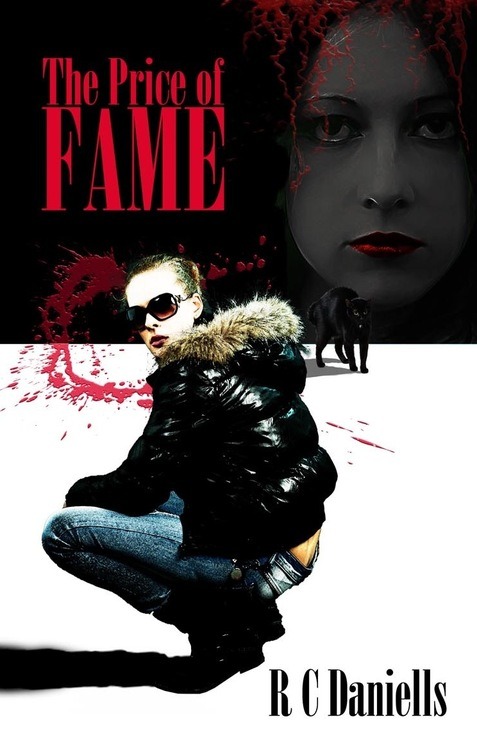
The Price of Fame by RC Daniells

The Price of Fame by RC Daniells is epic fantasy writer Rowena Cory Daniells' first foray into paranormal crime. Just as her fantasy books are intense and difficult to put down, so was The Price of Fame.

The Price of Fame is the story of Antonia, a film school graduate who moves from Queensland to Melbourne to make a documentary about the Tough Romantics, an 80s punk band whose singer was murdered just before they made it big. Accompanied by former classmate and hunk, Monty, as her camera and effects man, she begins to dig into the band's past. Her initial plan is to focus on their early creative dynamic and steer clear of the sensationalist murder angle. She even rents the house in St Kilda where the band lived before they were famous. Of course, the more she digs into the past, the more it becomes apparent there's more to the singer's murder than generally known.

As Antonia and Monty learn more, their present-day story is interspersed with a story of events in the 80s centred about, O'Toole, the taxi driver who was accused of the murder. Through his eyes we see the visceral reality of life on the Street (Fitzroy St) for the fringes of society in St Kilda. As you might expect (especially if you know anything about Melbourne and St Kilda's history), that world is full of drugs and casual violence.

Daniells has O'Toole not originate in that world but move there after his divorce. In some ways, he's not so different to the people around him, but he's different enough that he's still a bit of a tourist. This is a clever move on the author's part as it gives the reader a more easily relateable character who can report on Street conditions without being entirely a part of the scene (and neatly sidesteps any issues of authenticity compared with writing from the point of view of a Street personality).

I have a soft spot for stories set in Melbourne, my home city. I might not have spent all that much time in St Kilda, but I've walked down Acland Street and bought pastires, and been to Luna Park and ridden the same roller coaster the band rides in the book (a few safety-induced renovations later). The language Daniells uses is distinctly Australian, particularly in the slang all the characters use, which I also enjoyed.

Overall, I enjoyed The Price of Fame and read it in two sittings, finding it difficult to put down, especially once the 80s story started to unfold. It has minor paranormal elements, but they don't really become pivotal until the end and could almost be dismissed as magical realism (if paranormal elements aren't your sort of thing). This easily one of the most realistic novels (as opposed to speculative fiction) I've read this year. (Shift by Em Bailey is the only other one that competes.)

I strongly recommend The Price of Fame to anyone who enjoys mystery/crime novels, paranormal fiction and/or historical Melbourne.

5 / 5 stars

A copy of the book was provided by the author for review.

Monday, 16 April 2012

Shift by Em Bailey

I came across Shift by Em Bailey while browsing some ebook store (I don’t actually remember which one, probably Kobo since that’s where I bought it). It was the blurb that first intrigued me, so allow me to post it here:


Olive is not crazy – although there was that incident last year and that spell in the psych ward, but now she’s taking her meds and staying away from the toxic ‘in’ crowd. But when new girl Miranda turns up, Olive knows that there is something very dangerous about her, even if everyone else doesn’t. But who will believe her, when everyone probably thinks she’s crazy anyway? That is, everyone except her best friend, Ami, whom her mother disapproves of for some strange reason. But all is not what it seems in this page-turning thriller and there are twists and turns that you just cannot predict.


This isn’t an SFF book. At most I’d tentatively call it magical realism. It’s full of psychological drama and there is blurring of reality so you’re not always sure what’s real and what isn’t. It’s also a book about mental illness about being weird and about dealing (or not) with those things.


I really loved it.


Honestly, there was only one aspect I disliked about it and it’s not the sort of thing that would bother everyone. The author is Australian (this is her first YA book, but she has written books for younger readers as Meredith Badger) and the book is indisputably set in an Australian coastal town near either Melbourne or Sydney (my theory is Melbourne, but I may be biased). It’s definitely Australia because they have high schools like we do (years 7 to 12) and wear school uniforms in state schools (I only recently learnt this is a bit of an Australian quirk) and, well it all sounded Australian. But. It also felt like the most direct mentions of Australianness had been removed or carefully not mentioned. At one point the main character goes for a run through the forest, not the bush. There’s a scene near a fig tree, which in itself isn’t that strange, but no gum trees were ever mentioned even thought they must have been ever-present. It just bothered me a bit. A setting made slightly generic but not completely. I would have enjoyed seeing more Australia in it.


Mind you, that was a very small component. The rest of the book — the characters, the plot — was top notch. Olive was great. She was a flawed narrator but that was part of the charm. We were so deeply inside her head that we could only guess things she didn’t know herself a little while before they happened. The way some events were foreshadowed, you had to be paying more attention than Olive was to notice.


The other characters were also very believable. Creepy Miranda was particularly well drawn and mysterious to just the right extent. The secondary characters of best friend, ex-best friend and love interest were also well crafted. I’m not sure that I can properly say what I liked about them without spoilers, however.


And the ending was great. A perfect mix of suspense, action and, well, spoilers.


Even though it’s not really fantasy or science fiction, I think this is still the kind of book lovers of SFF YA would enjoy. And lovers of mainstream YA too, particularly of the darker variety. I loved it. One of my top books read this year. (Oh, and isn’t the cover great? It’s particularly apt, too.)


5 / 5 stars