Friday, 20 June 2014

Short stories on the Hugo 2014 ballot

This time I've read and reviewed all the Hugo short stories. There's only four of them this year and, of course, they are the shortest fiction category. I quite liked most of them, and I think they will be hard to rank. Right now the Swirsky and the Chu are vying for first place in my mind (with the others not far behind).

On a side note, it's really pleasing to see how wonderfully diverse this category is. There are two queer stories and two stories featuring non-western cultures (Chinese and Thai). Whatever else you might want to say about the Hugo ballot, what I've read so far (these and some novelettes) has been pleasingly diverse and varied.


“If You Were a Dinosaur, My Love” by Rachel Swirsky 

(Apex Magazine, Mar-2013)

Well that escalated. What starts as a fantastical story describing the world in the title and beyond, end on a pretty depressing note. I liked the story more for that, but do not mistake this for happy light reading. Also, quite short for the bracket.


“Selkie Stories Are for Losers” by Sofia Samatar 

(Strange Horizons, Jan-2013)

There are two possible meanings to this title, if you think about it, and the story leans towards the less obvious (to me, anyway) alternative. Not a conventional story and a pretty good read. (And yes, there are selkies in it.)


illustration by christopher silas neal
Illustration by Christopher Silas Neal

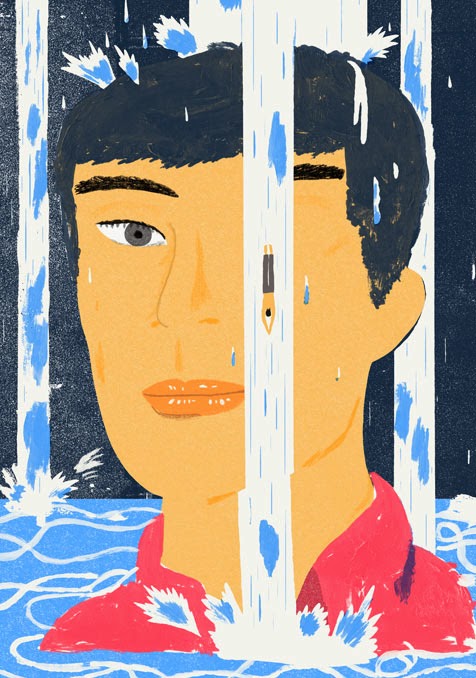
“The Water That Falls on You from Nowhere” by John Chu 

(Tor.com, 02-2013)

An interesting high-concept that takes a back seat to a very human story (and I don’t think that’s a bad thing). In a world where, for no known reason, water falls on you when you tell a lie, a young(ish) man navigates his relationships and, in particular, the decision to finally come out to his parents.


illustration by victo ngai
Illustration by Victo Ngai

“The Ink Readers of Doi Saket” by Thomas Olde Heuvelt 

(Tor.com, 04-2013)

Probably my least favourite of the bunch. I liked the Thai culture aspect, but the story itself wasn’t as serious as the other three and so didn’t really do it for me. It was vaguely amusing but not, to me, funny enough to make up for the lack of seriousness.

Tuesday, 17 June 2014

The Girl in the Road by Monica Byrne

The Girl in the Road by Monica Byrne is a remarkable book. It's near-future science fiction set in India, Ethiopia and involving two journeys: one across (northern) Africa, the other across the Arabian Sea. The settings alone should tell you that it is not a run of the mill science fiction novel.
Meena, a young woman living in a futuristic Mumbai, wakes up with five snake bites on her chest. She doesn't know how or why, but she must flee India and return to Ethiopia, the place of her birth. Having long heard about The Trail -- an energy-harvesting bridge that spans the Arabian Sea -- she embarks on foot on this forbidden bridge, with its own subculture and rules. What awaits her in Ethiopia is unclear; she's hoping the journey will illuminate it for her.

Mariama, a girl from a different time, is on a quest of her own. After witnessing her mother's rape, she joins up with a caravan of strangers heading across Saharan Africa. She meets Yemaya, a beautiful and enigmatic woman who becomes her protector and confidante. Yemaya tells Mariama of Ethiopia, where revolution is brewing and life will be better. Mariama hopes against hope that it offers much more than Yemaya ever promised.

As one heads east and the other west, Meena and Mariama's fates will entwine in ways that are profoundly moving and shocking to the core. Vividly imagined and artfully told, written with stunning clarity and deep emotion, The Girl in the Road is a true tour de force.
I need to say up front that I don't know very much about Africa and a little bit more about India, so I am not someone who would notice any small factual/cultural errors. There didn't seem to be anything huge and glaring and the small details felt authentic, but if others disagree, please let me know in the comments. I wasn't actually sure until I got to the end that the author is American (obviously, I could've googled, but didn't), so the level of detail and the amount of research she obviously put in is impressive. But as always, there are potential issues with an outsider writing about any culture. I will note that none of the characters were white, and also that both bisexual and trans identities were also featured. However, the rest of this review won't be dealing with these issues.

The Girl in the Road follows two protagonists, both incredibly unreliable, for different reasons. Meena is a mentally ill Indian woman in her late twenties, living in the late 2060s. After a crisis drives her from her home, she makes her way to Mumbai. In Mumbai she becomes infatuated with the Trail, a string of floating pontoons which collect wave energy from the Arabian sea and stretch from just off the coast of Mumbai to Djibouti, Ethiopia. Still wanting to get away from the forces chasing her, she sets out across the Trail. Since her story is told in first person and partly due to her illness (my guess was that she was bipolar but that wasn't completely clear), Meena's story unravels slowly and not strictly chronologically. One quickly realises that we can't trust everything she tells us and begins to question her decisions as well. It's a fascinating mode of story telling.

Mariama is a young girl (8 or 10 at the start, I think) who suddenly finds she has to fend for herself. She attaches herself to two men transporting oil to Ethiopia, who look after her. Her story is told in first and second person, with Mariama talking to Yemaya, a woman who joins the oil convoy not long after Mariama herself does. Partly because of her age, and partly because of her isolated and unpleasant upbringing (she was a slave), Mariama is also an unreliable narrator, but in a different way. Her point of view was, I think, more decipherable and at times more understandable as well. (There was one scene that I think some people will struggle with. It's a spoiler, but if you're interested, the author blogs about it here.) With Mariama, the reader's interpretation of her situation is, sometiems, more important than her own.

It took me a while to work out how the two storylines were connected. I won't spoil it here, because the slow unravelling of the story is an important part of the journey, but it wasn't obvious at first how they were placed temporally with respect to each other. But eventually it becomes apparent and certain events play out with a terrible inevitability that we, the reader, cannot help to stop. It was a beautifully woven tale.

Not only were the stories beautifully woven together, but similar themes — like the unusual snake in both story lines — intertwined both stories, binding them together as much as actual events do. Byrne has a wonderful turn of phrase, always choosing the best words to convey layers of meaning and always push the narrative forwards. It was a pleasure to read. It was complicated, but not too much so. (Although the Epilogue confused me. I suspect it might make more sense upon re-reading...)

I very strongly recommend this book to everyone. Fans of science fiction should enjoy this very different view of a not-too-distant future. There is also an element of magical realism — and a sort of dream-like quality — for fantasy fans who may not like straight science fiction. But above all, it's an exquisitely written book that I will be recommending to everyone.

5 / 5 stars

First published: May 2014, Crown
Series: No.
Format read: eARC
Source: Publisher via NetGalley

Sunday, 15 June 2014

Tsana's June Status

It's been a strange month. I found out with less than two weeks to go that I could in fact vote for the Ditmars — I had completely forgotten that I was a supporting member of last year's NatCon — so I madly tried to read all the stories and books for that. I didn't quite finish everything, but I read all the short fiction and enough of the other categories to make a decision. This also resulted in buying all the books that I didn't already have. Turns out, that's a lot of books acquired in the past month... and a lot of short stories read (by my standards, at least).

And of course, the Ditmar awards were actually awarded. And, since awards season is well and truly upon us, the Australian Shadows Awards were also announced.

In unrelated and much more mundane news, I also wrote my usual monthly round-up for the Australian Women Writers Challenge blog, which you can read here.


What have I read?


What am I currently reading?


I was reading Trucksong by Andrew Macrae but, for the first time this year, I've consciously stopped  reading reading a book when I was a substantial part of the way in. It's not an objectively bad book — there's nothing wrong with the writing — but it just wasn't for me. It was actually really hard to decide to stop reading. Once I was a substantial chunk of the way in it felt like a waste to just give up, even if I wasn't enjoying it. It was when I was three-quarters of the way in that I realised that even if I did finish, I wouldn't get a good review out of it. With bad books it's easy; you can just list and discuss the problems. But this was just a book that didn't click with me, rather than one that had specific faults. Also, one of my new year's resolutions was to let myself not finish books, so go me.

When I realised that I was in fact able to vote in the Ditmars I started a lot of books that I didn't necessarily finish but still plan to. I've so far only read the two Ditmar-shortlisted stories in Prickle Moon by Juliette Marillier, but I hope to get back to it sooner rather than later (if only because being part-way through several books at once is a bit stressful). I also started reading Fragments of a Broken Land: Valarl Undead by Robert Hood, which is a fantasy/horror (dark fantasy?) novel. Not very far in yet (but far enough to rank it on my ballot).

Moving away from Australian books, I haven't had a chance to pick up Stolen Songbird by Danielle L. Jensen again, because of the Ditmar books, but I'm still planning to finish it. I've also just started reading Use Only As Directed, an anthology edited by Simon Petrie and Edwina Harvey and I'm about to start Girl in the Road by Monica Byrne this evening.


New Booksies:


A lot of my favourite authors seem to have recently released books too, which definitely added to the virtual pile I'm about to list... Furthermore, the 2014 Hugo Packet was released adding to by TBR pile and my acquired books. But the way that works for me is I only add a free book to my "books owned" list (on LibraryThing) if I actually read it, or read a significant portion before giving up. For example, I am not going to make any attempt to read the Wheel of Time series at this point in my life because a) I'm pretty sure I won't like it that much and b) it's way too long to fit in (both in generally and also around other reviewing/reading commitments and desires).
  • Thief's Magic by Trudi Canavan — purchased because a favourite author
  • Prickle Moon by Juliet Marillier — purchased because Ditmars
  • The Bride Price by Cat Sparks — purchased because Ditmars
  • The Year of Ancient Ghosts by Kim Wilkins — purchased because Ditmars
  • The Lowest Heaven edited by Anne C. Perry and Jared Shurin — purchased because Ditmars
  • Fragments of a Broken Land by Robert Hood — purchased because Ditmars
  • Afterworlds by Scott Westerfeld — eARC. I've already read it, but it's not out until September, so no review until then. But oh my goodness this book was AWESOME. I can't wait until more people have read it so I can discuss it with them. !!! 5 stars. (Mind you, I suspect people who aren't interested in/involved with the publishing industry may not like it as enthusiastically, but shh.)
  • Delete by Kim Curran — eARC from Strange Chemistry/Angry Robot. The conclusion of the trilogy including Shift and Control
  • The Guild of Assassins by Anna Kashina — eARC from Angry Robot, sequel to Blades of the Old Empire
  • The Mirror Empire by Kameron Hurley — eARC, also from Angry Robot. Haven't read anything of hers before, but I've heard a lot of good things, so looking forward to it.
  • City of Heavenly Fire by Cassandra Clare — purchased because I've enjoyed all her books.
  • Guardian by Jo Anderton — preorder came in. Purchased because favourite author.
  • Ancillary Justice by Ann Leckie — Purchased because Hugos and heard a lot of things. Didn't want to get to the end of the extract and have to break.
  • I, Morgana by Felicity Pullman — eARC from Momentum, because it sounded good and also AWW
  • Chasing the Valley 3: Skyfire by Skye Melki-Wegner — eARC from Random House, because I loved the first book
  • Chasing the Valley 2: Borderlands by Skye Melki-Wegner — purchased because I got the eARC of book 3 and also because I loved the first book and was intending to get around this this either way
  •  Last Year, When We Were Young by Andrew Mckirnan — eARC because the author is a friend (and because I want to read it)


Saturday, 14 June 2014

The Wizard's Promise by Cassandra Rose Clarke

The Wizard's Promise by Cassandra Rose Clarke is a new story arc set in the same world as The Assassin's Curse and The Pirate's Wish. The main character is the daughter of a friend of Annana from those books and is even named after her.
All Hanna Euli wants is to become a proper witch – but unfortunately, she’s stuck as an apprentice to a grumpy fisherman. When their boat gets caught up in a mysterious storm and blown wildly off course, Hanna finds herself further away from home than she’s ever been before.

As she tries to get back, she learns there may be more to her apprentice master than she realized, especially when a mysterious, beautiful, and very non-human boy begins following her through the ocean, claiming that he needs Hanna’s help.
I enjoyed The Wizard's Promise. I don't think it was as ground-breaking as the earlier two books, but it was a pleasant read. It can be summarised as "girl who wants to be a witch is stuck being a fisherwoman and a three-day fishing trip goes exceedingly awry."

One of the things I like about this world is how equal women are. It's not unusual that Hanna is a) a fisherwoman and b) has magic. When, later in the book, she finds herself alone in a strange place, she finds work on a (different, larger) fishing boat to make enough money to get by. No one ever questions her ability to do things because of her gender (a little bit because of her age, but even then, not very much).

One of the things that bugged me in the earlier books was Annana's accent/dialect, emphasised by the first-person narrative. That was absent in The Wizard's Promise, which made it an easier read, I think. But on the other hand, there wasn't the element of amusing banter between the two leads. Hanna spends a lot of time more or less alone. She makes friends and is never completely isolated, but most of the time she is alone in her mission. On the other hand, it was refreshing to read a book with such a self-sufficient heroine. She doesn't break down when things go wrong and she is stranded alone, but rather takes the most practical steps she can to work towards getting back home.

Also, there isn't a romantic storyline (although there might be in the sequel), despite what the blurb implies. Isolfr, the boy mentioned in the blurb, is more of an enigma than a love interest. Mind you, his magical abilities do lead to some amusing interactions, which I won't spoil. Overall, this possibly could have been a bit more fast-paced, but I was never bored, there were just a few slower bits. Thinking about it more, it's probably more a case of the plot not building up to a save-the-world-type event, but rather a more sustained level of excitement with a few peaks before the climax.

As I said, The Wizard's Promise was a fun read. I would recommend it to fans of adventure stories, YA or otherwise. It's not the most exciting read ever, but not everything has to be. I will definitely be picking up any sequels and will probably keep on reading everything the author writes.

4 / 5 stars

First published: May 2014, Strange Chemistry
Series: yes? Book 1 of 2 and also part of an on-going universe
Format read: eARC
Source: Publisher via NetGalley
Thursday, 12 June 2014

Australian Shadows Awards announced!

Last night the Australian Shadows Awards were announced. I may not have this completely right, so please correct me if I'm wrong, but I believe they were announced on Facebook. You can still go read the proceedings, as it were, on the organisation's Facebook page (until something else exciting happens, I suppose), which you can access without being logged in. I have basically copied the results from there. I expect they will soon appear on the Australian Shadows/AHWA website, but they have not yet as of this writing.

The Australian Shadows Awards are awarded by the Australian Horror Writers Association, which describes them thusly:
The Australian Shadows are the annual literary awards presented by the AHWA and judged on the overall effect — the skill, delivery, and lasting resonance — of horror fiction written or edited by an Australian.

Each category below lists the finalists with the winner bolded. Congratulations to all the winners and finalists!

(I see that I have read very few of the works listed below, which probably means I'm not keeping up with horror as much as I would like to be :-/ )


Edited Publication


MIDNIGHT ECHO 9, BY GEOFF BROWN
A KILLER AMONG DEMONS, BY CRAIG BEZANT
BABY TEETH – BITE SIZED TALES OF TERROR, BY DAN RABARTS AND LEE MURRAY
STAR QUAKE 1, BY SOPHIE YORKSTON


Collected Works


THE BONE CHIME SONG AND OTHER STORIES, BY JOANNE ANDERTON


Short Story


NIP, TUCK, ZIP, PLUCK, BY JOHN PAUL FITCH
FENCE LINES, BY JOANNE ANDERTON
THE NEST, BY C.S. MCMULLEN
CATERPILLARS, BY DEBBIE COWENS
THE DEAD WAY, BY JC HART


Novel


UNDEAD KELLY, BY TIMOTHY BOWDEN
TOPSIDERS, BY SCOTT TYSON
809 JACOB STREET, BY MARTY YOUNG


(Inaugural) PAUL HAINES SHADOWS AWARD for LONG FICTION.


SOUL KILLER, BY ROBERT HOOD
THE HOME FOR BROKEN DOLLS, BY KIRSTYN MCDERMOTT
THE UNWANTED WOMEN OF SURREY, BY KAARON WARREN


Tuesday, 10 June 2014

Novelettes: three from the 2014 Hugo ballot

Having received the Hugo voter packet, I started reading some of the shorlisted fiction. I'm not sure if I'll end up reviewing everything, but for now I've decided to share my thoughts on three of the shortlisted novelettes. All are really excellent stories that do not make ranking them easy.


“The Lady Astronaut of Mars” by Mary Robinette Kowal 

(maryrobinettekowal.com / Tor.com, 09-2013)

A lovely story. Set in a alternate version of the 80s, on Mars, it was not quite what I expected. The bulk of the story takes place 30 years after the titular character was on the first mission to Mars. She is mostly retired but still dreams of the stars. Her husband is terminally ill and a large part of the story deals with their life choices from her point of view. Most notably, their decision not to have children because of her career. It's nice to see a story dealing with these issues; women "sacrificing" family life for their careers is not often a focus and rarely a positive one, especially when compared with male characters making the same choices. A really great story.


“The Waiting Stars” by Aliette de Bodard 

(The Other Half of the Sky, Candlemark & Gleam)

Another excellent story. It follows two threads of story: salvagers trying to revive a family ship that was relegated to a ship graveyard during a war, and a group of girls who were “rescued” during the way and brought up the Galactic way. At first it was not obvious how the two threads were related — apart from both parties being Dai Viet. Once it was revealed what the connection was, I experienced a “wow” moment as everything slotted together and the thrust of the story changed. What I had been reading as a sort of war-induced Stolen Generation type of story turned into something both completely different and chillingly not.

(Picture used only for this free, non-commercial edition, under a Creative Commons Attribution Non-Commercial License)
Cover credits: violscraper on Flickr

“The Truth of Fact, the Truth of Feeling” by Ted Chiang 

(Subterranean, Fall 2013)

I enjoyed this story even though it was a story in a very different sense of the word. It’s told as a piece of futuristic narrative journalism, putting me in mind of #longreads type of journalistic pieces, juxtaposed with a story of the Tiv tribe in Western Africa. Jijingi of the Tiv spends time with a European missionary learning how to write. On the one hand, we have the future journalist writing about the social and personal effects of a new technology can can search ubiquitously recorded personal video logs, and on the other we have Jijingi coming to terms with the concept of writing and learning about its uses and faults as a memory aid. What starts off as an exploration of types of memory (internalised and externalised, organic and technologically assisted), turns into a discussion of the nature of truth, as the title suggests. Honestly the only slight disappointment (and I do mean slight) with this story was that the story of Jijingi was inserted by the journalist, rather than placed next to the journalist’s story by the writer (if that makes sense). I think it’s because it made the journalist seem a little too self-aware in the end. But it was still a good, thoughtful story.

Sunday, 8 June 2014

Ditmar Award Winners 2014

The Ditmar Awards and the Norma K Hemming Award (and the Victorian Chronos Awards) were announced at Continuum X this evening. Thanks to the tweeting prowess of @AlanBaxter and the Continuum Convention twitter account, I and others were able to follow along the proceedings at home. It is thanks to their quick thumbs/fingers that I am able to post a list of winners so quickly. The magic of the internet!

Congratulations to all the winners! A lot of well-deserved awards were handed out. 

Below I've bolded each winner within the shortlist and, where applicable, included a cover art. Links go to my reviews where those exist.


Best Novel

  • Ink Black Magic, Tansy Rayner Roberts (FableCroft Publishing)
  • Fragments of a Broken Land: Valarl Undead, Robert Hood (Wildside Press)
  • The Beckoning, Paul Collins (Damnation Books)
  • Trucksong, Andrew Macrae (Twelfth Planet Press)
  • The Only Game in the Galaxy (The Maximus Black Files 3), Paul Collins (Ford Street Publishing) 


Best Novella or Novelette

  • "Prickle Moon", Juliet Marillier, in Prickle Moon (Ticonderoga Publications)
  • "The Year of Ancient Ghosts", Kim Wilkins, in The Year of Ancient Ghosts (Ticonderoga Publications)
  • "By Bone-Light", Juliet Marillier, in Prickle Moon (Ticonderoga Publications)
  • "The Home for Broken Dolls", Kirstyn McDermott, in Caution: Contains Small Parts (Twelfth Planet Press)
  • "What Amanda Wants", Kirstyn McDermott, in Caution: Contains Small Parts (Twelfth Planet Press) 


Best Short Story

  • "Mah Song", Joanne Anderton, in The Bone Chime Song and Other Stories (FableCroft Publishing)
  • "Air, Water and the Grove", Kaaron Warren, in The Lowest Heaven (Jurassic London)
  • "Seven Days in Paris", Thoraiya Dyer, in Asymmetry (Twelfth Planet Press)
  • "Scarp", Cat Sparks, in The Bride Price (Ticonderoga Publications)
  • "Not the Worst of Sins", Alan Baxter, in Beneath Ceaseless Skies 133 (Firkin Press)
  • "Cold White Daughter", Tansy Rayner Roberts, in One Small Step (FableCroft Publishing) 


Best Collected Work


Best Artwork

  • Cover art, Eleanor Clarke, for The Back of the Back of Beyond by Edwina Harvey (Peggy Bright Books)
  • Illustrations, Kathleen Jennings, for Eclipse Online (Nightshade Books)
  • Cover art, Shauna O'Meara, for Next edited by Simon Petrie and Rob Porteous (CSFG Publishing)
  • Cover art, Cat Sparks, for The Bride Price by Cat Sparks (Ticonderoga Publications)
  • Rules of Summer, Shaun Tan (Hachette Australia)
  • Cover art, Pia Ravenari, for Prickle Moon by Juliet Marillier (Ticonderoga Publications) 


Best Fan Writer

  • Tsana Dolichva, for body of work, including reviews and interviews in Tsana's Reads and Reviews
  • Sean Wright, for body of work, including reviews in Adventures of a Bookonaut
  • Grant Watson, for body of work, including reviews in The Angriest
  • Foz Meadows, for body of work, including reviews in Shattersnipe: Malcontent & Rainbows
  • Alexandra Pierce, for body of work, including reviews in Randomly Yours, Alex
  • Tansy Rayner Roberts, for body of work, including essays and reviews at www.tansyrr.com


Best Fan Artist


Best Fan Publication in Any Medium

  • Dark Matter Zine, Nalini Haynes
  • SF Commentary, Bruce Gillespie
  • The Writer and the Critic, Kirstyn McDermott and Ian Mond
  • Galactic Chat Podcast, Sean Wright, Alex Pierce, Helen Stubbs, David McDonald, and Mark Webb
  • The Coode Street Podcast, Gary K. Wolfe and Jonathan Strahan
  • Galactic Suburbia, Alisa Krasnostein, Alex Pierce, and Tansy Rayner Roberts 


Best New Talent

  • Michelle Goldsmith
  • Zena Shapter
  • Faith Mudge
  • Jo Spurrier
  • Stacey Larner 


William Atheling Jr Award for Criticism or Review

  • Reviews in Randomly Yours, Alex, Alexandra Pierce
  • "Things Invisible: Human and Ab-Human in Two of Hodgson's Carnacki stories", Leigh Blackmore, in Sargasso: The Journal of William Hope Hodgson Studies #1 edited by Sam Gafford (Ulthar Press)
  • Galactic Suburbia Episode 87: Saga Spoilerific Book Club, Alisa Krasnostein, Alex Pierce, and Tansy Rayner Roberts
  • The Reviewing New Who series, David McDonald, Tansy Rayner Roberts, and Tehani Wessely
  • "A Puppet's Parody of Joy: Dolls, Puppets and Mannikins as Diabolical Other", Leigh Blackmore, in Ramsey Campbell: Critical Essays on the Master of Modern Horror edited by Gary William Crawford (Scarecrow Press)
  • "That was then, this is now: how my perceptions have changed", George Ivanoff, in Doctor Who and Race edited by Lindy Orthia (Intellect Books) 

Did that mean Tansy got two trophies for the same award? Genuinely curious... Does the Atheling have a trophy? Possibly not.


Peter McNamara Award

goes to...

Garth Nix


Norma K Hemming Award


  • A Very Unusual Pursuit – City of Orphans by Catherine Jinks (Allen & Unwin)
  • Caution: Contains Small Parts by Kirstyn McDermott (Twelfth Planet Press)
  • Dark Serpent by Kylie Chan (HarperVoyager)
  • Fairytales for Wilde Girls by Allyse Near (Random House)
  • Rupetta by N. A. Sulway (Tartarus Press (UK))
  • Trucksong by Andrew Macrae (Twelfth Planet Press)


Saturday, 7 June 2014

Uprising by Sarah Cawkwell

Uprising by Sarah Cawkwell is the first book in the Heirs of the Demon King series. It's set in an alternate historical timeline where magic and demons cause changes to English history as we know it. The blurb from goodreads:
Epic fantasy meets alternate history in a sweeping saga that crosses the medieval world. Matthias Eynon must escape the clutches the Witchhunters and locate the masters of the four magic arts to overthrow the tyrannical Demon King, descendant of the twisted Richard III.

Mathias Eynon's dreams were small. A dabbler in magic, and son of a magician, he expected to live in obscurity in his home in the Welsh hills, quietly conducting his experiments and hoping not to draw too much attention to himself.

But fate has other plans for him. It is the Year of Our Lord Fifteen-Ninety, and a revolution is quietly brewing, here and further abroad. Richard V has overstayed his rule, some say; others whisper that the whole line of Demon Kings must be burned out. Mathias son of a man executed for the practice of magic, forbidden by the paranoid king is set to become a symbol, and a leader.

And to do that, he needs champions. A wise woman sends him to the corners of the known world to the frozen lands of the Danes, to the pirate-haunted ports of Spain, to the mountains of the German Empire, to the burning sands of the Holy Land to bring back masters of the four magic arts. With the best and brightest of Richard's Witch Hunters on his heels, he sets out to gather his allies.
It's a long blurb, but I wanted to include it because Uprising has two main characters Mathias, who is mentioned above at length and Tagan, who maybe doesn't get as many as many point-of-view scenes, but is just as important to the plot. She's not even mentioned in the blurb as a love interest (which she also is)! I didn't like Tagan as a character, but now I'm outraged on her behalf. Poor Tagan. Moving on.

Uprising diverges from real-world historical events thusly: Richard the Lionhearted brings magic back from the Crusades (then dies). Magic spreads throughout England (and Wales) and is eventually outlawed more or less because the peasants were getting too uppity. When the War of the Roses comes along and Richard III is about to be defeated, he makes a pact with a demon to win. So Henry Tudor is defeated and Richard III's offspring get lumped with the demon curse/pact. The actual action is set in the time of Richard V. Mathias and Tagan go on a quest to save the world. Most of the story is their journey and their being surprised at how different everything is from Wales. Also, we are repeatedly reminded that they're Welsh (actually, that was mostly amusing).

This was not the worst book I've ever read. But it was far from the best. I chose to read it because I thought I should branch out from my usual fare of Aussie-authored fantasy; a decision I now regret. It was a hard slog to read. This was not helped by the fact that it essentially had two prologues: an excerpt from a history book followed by Richard III making his pact with a demon, the latter taking place about 100 years before the main action. It was not a short prologue and I was already finding the book tedious by the time I got to chapter one. I had hoped that things would pick up then, but they did not. I have to admit, I ended up making my iPad read the book to me while I did something else with my hands. If I hadn't had that option, I probably wouldn't've finished it.

The main problems are that the prose just isn't interestingly written. There's more telling than there should be (rather than showing). Then, even when interesting things were happening, I found myself getting annoyed at mainly Tagan and Mathias for being naïve and shocked easily. Tagan, especially, was often patronised and — unrelatedly — set her jaw determinedly an awful lot. I also didn't like their courtship at the start (they were betrothed for most of the book, I think from the very start) which was a bit stilted, awkward and patronising, none of those in an endearing way.

So, to summarise, I did not like Uprising and I will definitely not be suffering through the sequel. I am a bit torn as to how many stars to give it, though, since it was technically not so bad (Cawkwell can string sentences together competently, that was never an issue); it's main flaw was not being engagingly written. I suppose since I'm tossing up between 2 and 3 stars I'll split the difference. Suffice to say, I don't recommend this book. If anything, it has confirmed my fears about branching out geographically to new BFF authors.

2.5 / 5 stars

First published: June 2014, Abaddon Books
Series: Heirs of the Demon King book 1 of (I'm assuimg) 3
Format read: eARC
Source: Review copy from the publisher

Thursday, 5 June 2014

The Year of Ancient Ghosts by Kim Wilkins

The Year of Ancient Ghosts by Kim Wilkins is a collection of five novellas. It is also the first thing of hers that I've read (despite having bought one of her novels many years ago...). I initially bought it and started reading it because the first, titular, story was shortlisted for a Ditmar, but boy am I glad I did! Not for nothing was the collection also shortlisted for an Aurealis Award and did the same story win the Best Horror Short Story Aurealis and make the Fantasy shortlist as well.

The stories contained within this collection are a mix of modern and Medieval (ish) and take us on five very different journeys. Not being much of a historian, I didn't make the connection until the afterword, but all the stories are connected by common history. All of them, including the two modern ones, are set in or take cues from the Middle Ages.

I think my favourite was "The Year of Ancient Ghosts" and I can see why it was the story to garner award nominations when one or two others (the second is a bit murky and probably doesn't count) were also first published here. Not only is it a gut-wrenching tale, it's also probably more accessible than the others.

Of the three non-modern tales, I found myself wanting more from "The Crown of Rowan". Not because it was lacking, but because there was more to the world than we really got to see in detail in the story. I was pleased to learn, when I got to the end of the collection and read the afterword, that Wilkins is working on a novel set in the same world. I will definitely be reading it when it eventuates. (Actually, I just looked Wilkins up on iBooks and it looks like the novel, Daughters of the Storm, will be out in November, so yay.)

Individual stories aside (and you can, of course, read more of my thoughts on them below), Wilkins' writing is masterful. She has the knack of using the right words to tell the story without being unnecessarily flowery in language nor too dull. I'm not sure there was a bad sentence in the entire collection. The details, historical and otherwise, are also meticulously researched so that every detail rings true. I first noted it in the main character's reaction to having to go to a foreign supermarket in "The Year of Ancient Ghosts", but it persisted throughout.

I highly recommend this collection to pretty much everyone. It's an excellent read and the expertly-crafted stories will not disappoint. I will definitely be keeping an eye out for other books by Kim Wilkins (the one presently in my TBR is unfortunately on another continent) and I look forward to reading more of her work.

~

THE YEAR OF ANCIENT GHOSTS — Set in the present, a woman whose husband is in a coma (or similar) decides to go to Scotland (from Australia) with their two-year-old to visit his foster parents as they had originally planned. It’s a cold story (sometimes literally) with a feeling of creeping dread permeating through it. I feared for some of the characters, not sure how far into the realms of darkest horror Wilkins would take it. In the end, all I can say is: it was a wonderful and emotional tale.

THE CROWN OF ROWAN — This was a good story, but I was expecting it to be more dire than it was. It's set in a fairly low-technology fantasy world with small kingdoms, skirmishes and minor magic (hedge magic, maybe, although it wasn't defined in the story) and gives us a pretty good snapshot of what life is life for some of the characters, most notably the protagonist. The wife of a king is pregnant and the story follows her through the course of the pregnancy until just after the baby is born. There are also a few subplots, but she's the main focus. I said I was expecting it to be more dire, that's mainly because of the element of magical portents and messages but also because it finished too soon. Wilkins left us wanting more with some of the main character's choices hanging in the balance. I wanted to know what happened next!

DINDRANA’S LOVER — An Arthurian tale featuring Sir Percival's sister, Dindrana. There were a few elements to this: a magic castle that only the lost can find, with a mistress whose nature is hinted at in the epigraph, and a young maiden who, on the one hand can think on her feet and on the other resents being forced to remain a virgin until her eventual marriage to (she presumes) some horrible old man. I was amused by this tale, for all that it didn't end too cheerily. Oh, and I wanted to slap Galahad.

WILD DREAMS OF BLOOD — A present-day tale of a woman with super strength who has learnt to hide it her whole life. Her life starts to change when she finds out who her father is. A fairly straight-forward story, but very well-crafted.

THE LARK AND THE RIVER — Set in Conversion England, as Christianity is encroaching on heathen beliefs. Although not the saddest story in the collection (that honour goes to “The Year of Ancient Ghosts”), it had the saddest ending. Other people might disagree. The main character is the daughter of a violent man and, despite her father's anger at the church, she becomes fascinated by the new priest.

5 / 5 stars

First published: 2013, Ticonderoga Publications
Series: no
Format read: ePub
Source: Purchased from SmashWords
Challenges: Australian Women Writers Challenge, Aussie Horror Reading Challenge

Monday, 2 June 2014

Some Fine Day by Kat Ross

Some Fine Day by Kat Ross is the author's début novel. I began reading it with some trepidation since the YA SF I've read recently has been rather hit and miss, but I needn't have worried. Some Fine Day delivered on its potential.
Sixteen-year-old Jansin Nordqvist is on the verge of graduating from the black ops factory known as the Academy. She's smart and deadly, and knows three things with absolute certainty:

1. When the world flooded and civilization retreated deep underground, there was no one left on the surface.

2. The only species to thrive there are the toads, a primate/amphibian hybrid with a serious mean streak.

3. There's no place on Earth where you can hide from the hypercanes, continent-sized storms that have raged for decades.

Jansin has been lied to. On all counts.
Some Find Day was a good read with only some little niggles impinging on my reading experience. I particularly enjoyed that the plot was a bit more complex than some YA books. It wasn't quite the standard book one formula of A: world sucks, B: main character notices, C: she starts to change it. There were a few extra letters in there, and I was glad that the big conspiracy wasn't the simple Everything Is A Lie (despite what the blurb implies).

The world building, especially from a societal point of view, is pretty good. The society Jansin lives in is martial but realistic. There isn't, for example, some outer wasteland where useless people are sent to die. Instead, there's an ordinary seedy shanty town populated by druggies and criminals. The government employs propaganda but isn't as restrictive as it could be (until you cross them, but that's another matter) and isn't as absolutely secretive as in many dystopian YA books. I would, in fact, not call this a dystopia. It's post-apocalyptic, yes, and there are problems with the government, but not significantly more so than in the present. And, in general, there are diplomatic relations in place with other countries/regions that the people are aware of.

Most of my niggles were minor things. For example, Nu London is indeed more or less what's left of the UK and yet it strikes me as a fundamentally USian name. "Nu" and "new" are not pronounced the same way in all British accents. To me, "nu" looks like it should be pronounced "noo", which is how yanks say "new", not how the rest of us (well, in the UK/ANZ) do. There was also the confusing matter of Jansin's train to her training academy making a five hour trip within the same prefecture, whereas the train to Nu London took only six hours. Also the author referring to GPS for position information when GPS actually refers to the specific set of satellites (the general term is GNSS to include other sets of satellites) and, of course, wouldn't work underground. It's not that they can't have an underground system of position awareness, it's that it should be called something else. I am also curious about the ever-slighted Southern Hemisphere. If the hypercanes can't cross the equator, does that mean the five hypercanes they've named are all in the Northern Hemisphere, or are only three in the north with two in the south? In the latter case, it sounds like the Southern Hemisphere is the safer place to be, since we know for certain that the fastest and most destructive hypercane lives in the north. On the other hand, I was initially a bit suspicious of the temperature not being an issue underground (especially since they use geothermal power) but it ended up being addressed in passing later in the book.

Overall, I enjoyed Jansin's character development. On the one hand there was the expected shift from being raised in the military system to seeing the outside world and changing her views. I particularly liked that Jansin started seeing things differently just from her holiday near the start, before more spoilery plot events forced her to re-examine her views. I don't think that happens all too often in these sorts of stories. Closer to the end, the method Jensin uses to get away from the bad guys is also unusual in YA and it was gratifying to see her considering some of the implications. And that was a very vague sentence because I'm trying to avoid spoilers.

Another thing I enjoyed about Some Fine Day was that, as well as the Rest of the World actually existing (so rare!), there was a pretty racially diverse cast of characters. We mostly just have names go off, but there are a lot of different ethnicities represented, which is always nice to see.

I found the underground setting a bit hard to picture at first, but when Jansin came back to it after a holiday/interlude on the surface (near the start), I found it much clearer; it was easier to see how it worked when we had a comparison, I think. (Although I still think it's weird that they live in houses inside caves, instead of using caves as houses, but I can see how it relates to making things seem "normal" to help people adapt. But still... other civilisations have lived in caves...)

All in all, I enjoyed Some Fine Day and what small niggles I had were overshadowed by the good parts. I highly recommend it to fans of YA and especially post-apocalyptic YA with a different approach. As I've said, I wouldn't really call it dystopian, but you can't deny that hypercanes caused by catastrophic global warming are apocalyptic. I would also recommend it to anyone looking for YA with a slightly more complex plot than standard. It's not a very short book and it uses the extra pages well. Small niggles aside, this is the kind of YA I'd like to see more of (even more so if it weren't for the niggles, I suppose).

4.5 / 5 stars

First published: July 2014, Strange Chemistry
Series: Seems to be...
Format read: eARC
Source: Publisher via NetGalley