Tuesday, 15 July 2014

Chasing the Valley: Skyfire by Skye Melki-Wegner

Chasing the Valley: Skyfire by Skye Melki-Wegner is the concluding volume of the Chasing the Valley trilogy. I have previously reviewed the first book, Chasing the Valley, and the second book, Borderlands. It has been a journey I have enjoyed a lot; I don't think I've read anything quite like it before. This review will contain spoilers for the earlier books.
What if you achieve everything you’ve dreamed of – and it turns into a nightmare?

Danika and her crew of refugees finally reach the Magnetic Valley. Will it be the safe refuge and land of freedom they had imagined? When a runaway girl is shot down before their eyes, Danika and her friends realise that this new land is no paradise. They must try to fit in at all costs – even if revealing their secrets will mean a death sentence.

The conclusion to the Chasing the Valley trilogy will reveal explosive surprises and terrifying new dangers.
Skyfire picks up only moments after Borderlands left off. I don't think it's a spoiler to say that it opens with the sky (in the distance) literally on fire. The crew has reached the promised land of the magnetic valley but it is not the verdant utopia they were lead to believe. (I suppose there wouldn't've been much story if it were.)

The country they find themselves in is an improvement on what they left behind but not as much as they had hoped. There are strange laws about what people with certain proclivities (magic) can and can't do in society and the ruler is a three hundred year old man with a singular proclivity. The crew quickly learn that no one likes to question the ruler or speak against him at all (always suspicious). Have they stumbled out of the frying pan and into the fire? If you mean a literal fire (in the sky), then yes. But enough about the plot.

I'm a bit conflicted with how this series finished off. On the one hand, all three books have very different settings and new problems to go with them. The new setting isn't actually the part I feel conflicted about. It's the way in which the story escalated book to book. The personal stakes were already pretty high (death if they didn't flee in book one), but by the third book new revelations up the ante to the point of them needing to save the world.

But the thing is, it was all actually foreshadowed from the start. So although some elements seemed to me to come from left field, they didn't, not really. I have no doubt that the author had planned out the entire series before book one was done.

It also ended in a place where I wanted to know what happened next. Sure, the world was safe (that's so not a spoiler) and everything was probably going to be  OK... but that doesn't mean that the next step was obvious. I would like there to be more books about Dannika and the others, but I suspect there might not be.

Oh, and the thing I complained about in my review of Borderlands — someone not picking up an important object — was actually resolved. Not quite the way I would' have liked it to be, but in a way that made sufficient sense given the plot. So yay.

Anyway, Chasing the Valley is an excellent series. All three books have been very close to being five stars for me, but just not quite. Skyfire is the same. Obviously, that still makes it a really good series. I highly recommend it to everyone.

4.5 / 5 stars


First published: July 2014, Random House AU
Series: Chasing the Valley, book 3 of 3
Format read: eARC
Source: Publisher via NetGalley
Challenges: Australian Women Writers Challenge

Sunday, 13 July 2014

Razorhurst by Justine Larbalestier

Razorhurst by Justine Larbalestier is a YA historical fantasy set in Sydney in the 1930s. I have to admit, I didn't know very much about Sydney in the 1930s until I read this book but it certainly seems like it was an interesting period.
The setting: Razorhurst, 1932. The fragile peace between two competing mob bosses—Gloriana Nelson and Mr Davidson—is crumbling. Loyalties are shifting. Betrayals threaten.

Kelpie knows the dangers of the Sydney streets. Ghosts have kept her alive, steering her to food and safety, but they are also her torment.

Dymphna is Gloriana Nelson’s ‘best girl’, experienced in surviving the criminal world, but she doesn’t know what this day has in store for her.

When Dymphna meets Kelpie over the corpse of Jimmy Palmer, Dymphna’s latest boyfriend, she pronounces herself Kelpie’s new protector. But Dymphna’s life is in danger too, and she needs an ally. And while Jimmy’s ghost wants to help, the dead cannot protect the living . . .
Razorhurst follows two main characters, both of whom can see ghosts: Kelpie, a street urchin and Dymphna, the most expensive prostitute in the city. Kelpie has survived on the streets in large part thanks to some ghost who have taken her under their wings, helped her find food and taught her general survival skills. Dymphna has survived mostly by being good at what she does and having the right appearance and upbringing to impress higher society types.

One of the things I found really interesting was the way the story was told. Alternating chapters were from Kelpie and Dymphna's points of view and in between chapters there were short, semi-omniscient mini-chapters (I'd call them sections but they did have headings, if not numbers) telling the story of someone's past, usually. If not a flashback to one of the main characters' pasts, then the back story of one of the secondary or incidental characters. As a story-telling method it worked really well. The reader gained information that neither Kelpie nor Dymphna knew, which fleshed out the plot and, in some cases, cast other events in a new light. Or gave us back story for the main characters which it didn't make sense to insert into the main narrative. In this way, Razorhurst is as much about the region of Surrey Hills more generally as it is about Kelpie and Dymphna specifically. I found it a really effective way to set the historical scene.

I enjoyed Razorhurst a lot. Larbalestier has a way of revealing information gradually that worked really well for me. There were some things we didn't learn about Kelpie until much later, which other authors may have foregrounded much sooner. I'd be more specific, but I don't want to ruin the reading experience for others. In part, though, I think this is also a reflection of how Kelpie hasn't had much opportunity — until the start of the story — to put her own life into context with those around her who aren't also living in the streets. For example, she doesn't even know how old she is at the start of the story and doesn't understand why people keep asking her that anyway. Dymphna, on the other hand, has always been very aware of her place in life and society and how to play the roles she needs to to survive. More acutely horrible things have happened to Dymphna, but she's also had more opportunities and knows how to make use of them. Kelpie, on the other hand, has mostly only had to worry about finding (barely) enough food and somewhere warm to sleep.

The ghosts are an important element in the story but not actually the driver of the plot in anyway. They're just another form of character and, at times, a challenge for Dymphna and Kelpie to overcome. The main plot is of the "who will try to kill us next and where can we be safe" variety, and the whole novel spans approximately twenty-four hours.

I highly recommend Razorhurst to pretty much everyone. Well, not younger-than-YA readers, since there's several short bursts of acute violence — the story does revolve around razor gangs, after all — but anyone interested in historical fiction as well as the more speculative element. I think the story will work for both types of readers, and for readers who don't usually read YA.

5 / 5 stars

First published: June 2014, Allen & Unwin
Series: No.
Format read: ePub
Source: Purchased from iBookstore
Challenges: Australian Women Writers Challenge

Friday, 11 July 2014

Saga Volume Three by Brian K Vaughan and illustrated by Fiona Staples

Saga Volume Three, written by Brian K Vaughan and illustrated by Fiona Staples, is (obviously) the third volume of collected comic issues, comprising of issues 13 to 18.
Saga is the sweeping tale of one young family fighting to find their place in the universe. Searching for their literary hero, new parents Marko and Alana travel to a cosmic lighthouse on the planet Quietus, while the couple's multiple pursuers finally close in on their targets.
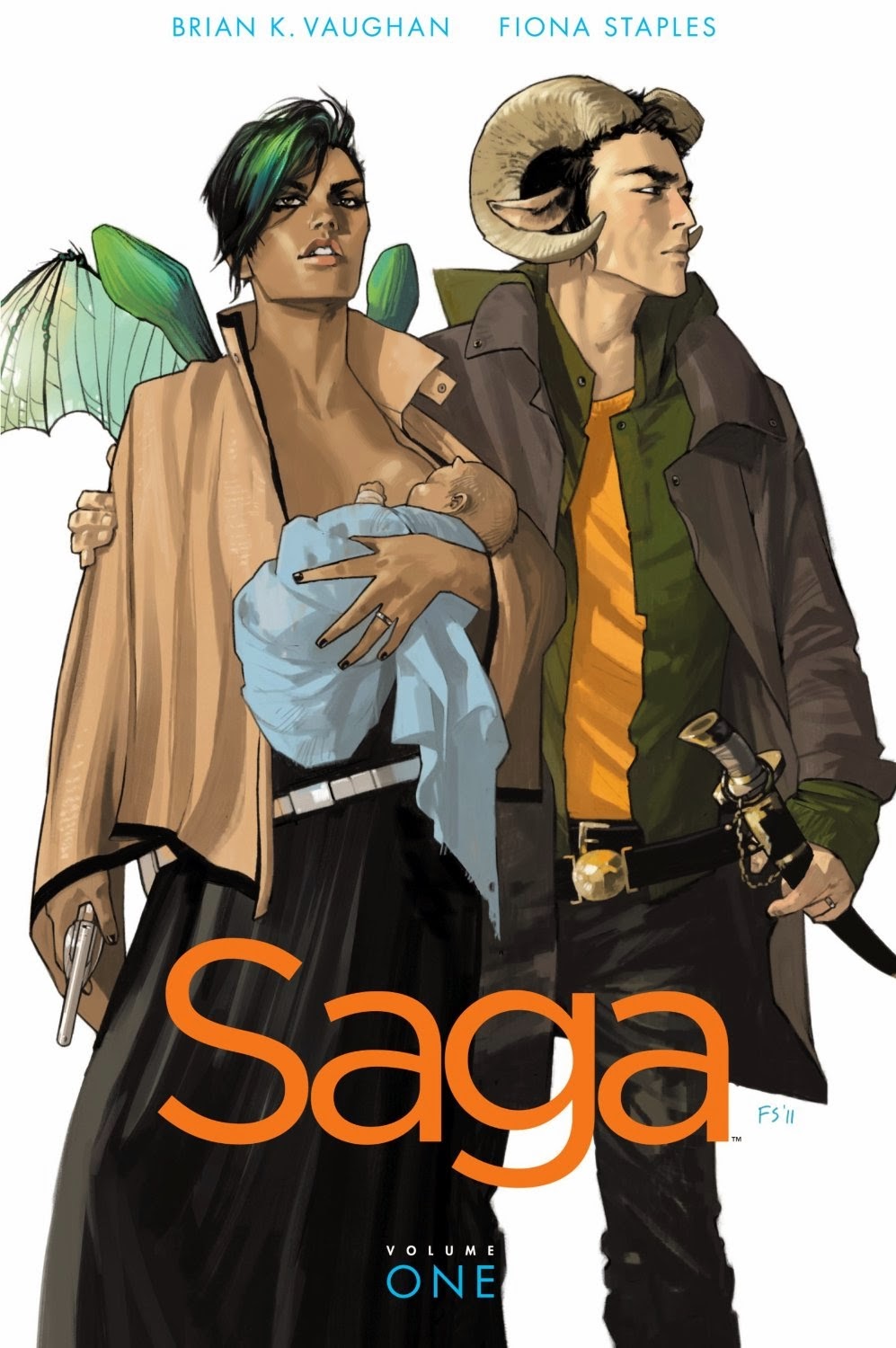
When I read the first two volumes (my reviews of Volume One and Volume Two), I was a little weary of the number of female characters. But as the story has progressed, it seems to have accreted more of them, which I appreciated. The cover art of this volume is a good example; neither of those two characters were proper characters when the story started.

Gwendolyn, the woman on the cover, while not wearing what I would call sensible clothes (but they could be worse), proves herself to be an interesting character. We first learn of her only through Marko, who was engaged to her before he went to war. She initially sounds relatively insignificant but when she shows up in person, we find out that, just as Marko changed when he went to war, so to did Gwendolyn when she stayed back.

One of my favourite characters, who's been around since Volume One but who I haven't mentioned, is Izabel. She's the ghost of a teenage girl who died stepping on a landmine. More accurately, the ghost of half a teenage girl. She's pretty great and not the kind of character I would have expected to see. (Even if we can see her intestines.) Also, she provides a counterpoint to everyone being wrapped up in the war. Although her parents were freedom fighters and despite the way she died, she's not invested at all.

We also get to know two new characters with their own story line: two reporters who have caught the trail of the story of Alana, Marko and their child. They run around trying to chase down leads and, in the process, we learn about their home world. Really, I think it's fair to say that the more we learn about each character, the more interesting they become.

I've been enjoying Saga and I'm sad that I now have to wait for an indeterminate time for the next volume. I also recommend starting from the start if this is the first review that you're reading.

4 / 5 stars

First published: March 2014, Image Comics
Series: Saga, Volume 3 of ongoing
Format read: Paper! Glossiness!
Source: Purchased from the Science Fiction Bookshop

Wednesday, 9 July 2014

Saga Volume Two by Brian K Vaughan and illustrated by Fiona Staples

Saga Volume Two, written by Brian K Vaughan and illustrated by Fiona Staples is the second volume of collected comic issues. It contains issues 7 to 12. It continues the story right where Volume One left off, telling us more about the background and history of Mako, the narrator's father.
SAGA is sweeping tale of one young family fighting to find their place in the universe. Thanks to her star-crossed parents Marko and Alana, newborn baby Hazel has already survived lethal assassins, rampaging armies, and horrific monsters, but in the cold vastness of outer space, the little girl encounters her strangest adventure yet... grandparents.

I didn't think about it that much when I was reading Volume One, but I quite like the style of the narration in Saga. The way it's included puts me in mind of voice overs in movies which take place over action-y scenes and that was exactly how I pictured it. It also means that, despite the narrator still being a baby in the comic (not much time has passed since it started), we can start to get to know her as an adult.

Volume Two introduces a few new characters — one in particular that I wasn't expecting to see so soon — and progresses the plot incrementally. That is one of the frustrating things about reviewing comic books; the nature of the medium makes them very brief and difficult to go into much depth over. (I say this before having listened to the Galactic Suburbia Spoileriffic episode; I'm sure they found plenty to talk about for almost two hours.) So I present a few random thoughts.

I was amused that the language written in blue letters is called Blue. I also checked what it was with Google Translate. I had suspected it was Esperanto, and turns out it is. It was an interesting choice to have a couple of pages of dialogue written entirely in Blue. That was the point at which I decided to check what the language was, but I ended up not translating all of it because it wasn't mysterious from the context (and also because lazy). Still, it was an interesting contrast to other scenes where only one person is speaking in Blue and the other doesn't necessarily understand them.

I was also really taken by the style of the historical vision art. (I would call it a flashback but it flashed to before the character's lifetime.) The way it sort of blurred was really cool. It was only used in one bit, but it was memorable.

Saga Volume Two is a recommended read for people who have read and enjoyed Volume One. I don't recommend starting at Volume Two because of plot continuity. I am definitely going to read the third volume.

4 / 5 stars

First published: 2013, Image Comics
Series: Saga, Volume Two of ongoing (? Three so far)
Format read: Paper!
Source: Purchased from the Science Fiction Bookshop

Monday, 7 July 2014

Saga Volume One by Brian K Vaughan and illustrated by Fiona Staples

Saga Volume One, written by Brian K Vaughan and illustrated by Fiona Staples, is the first volume in a science fantasy/space opera comic book series. First volume in the sense that it's the first trade collection of the first six individual issues. I picked it up because I've been hearing some good things about it (and some less good things that still made me curious) and because Volume 2, which I shall get to shortly, is on this year's Hugo shortlist for Best Graphic Story. Also Volume 1 won the same Hugo last year.
When two soldiers from opposite sides of a never-ending galactic war fall in love, they risk everything to bring a fragile new life into a dangerous old universe.

From New York Times bestselling writer Brian K. Vaughan (Y: The Last Man, Ex Machina) and critically acclaimed artist Fiona Staples (Mystery Society, North 40), Saga is the sweeping tale of one young family fighting to find their place in the worlds. Fantasy and science fiction are wed like never before in this sexy, subversive drama for adults.
The story opens with the baby on the cover being born and is lightly narrated by her future self. This opening volume sets up several story lines: there's the parents trying to keep their baby safe and not get themselves killed in the middle of a warzone, and there are two unrelated character groups trying to track them down and kill them (and capture the baby).

The story deals with forbidden love — the parents come from different races (who, obviously can interbreed) — particularly in the reactions of other characters when they are confronted with the couple. It's also pretty gritty, in that there's a lot of violence and hardly anyone is a nice person (although possibly not as literally bloody as grimdark fantasy, but I'm not so sure). Also there are a lot of boobs, some of them needless. Like the spider lady bounty hunter really didn't need to be topless (and as a bounty hunter, I have to wonder why it seemed like a good idea). By contrast, the only penises that appear are in the background on a (weird) prostitute planet, which still contains more boobs. If you didn't pick it up from the last few sentences, this is not really a PG read; it's definitely intended for adults.

So far, I'm enjoying the story, which is just as well because I already have volumes two and three ready to go. It's definitely aimed at SFF readers and I wouldn't call it anything other than science fantasy, genre-wise. (OK, I lied, I might also call it space opera, but I remain faintly confused about what space opera actually is.) There are some interesting species represented, like the robots that book completely human (to the point of reproducing the same way) except for having screens for faces. By contrast, the welcoming committee on the prostitute planet was a bit weird and alarming.

Saga seems not to be for the faint of heart, but it's not as dark as quite a lot of fantasy books I've read.

4 / 5 stars

First published: 2012, Image Comics
Series: Saga, Volume 1 of (ongoing?)
Format read: Paper! Gasp!
Source: Purchased from Bokus.com (Swedish retailer)

Friday, 4 July 2014

Chasing the Valley: Borderlands by Skye Melki-Wegner

Chasing the Valley: Borderlands by Skye Melki-Wegner is the second book in the Chasing the Valley trilogy. I have previously reviewed the first book, Chasing the Valley. If you haven't read the first book, it's probably best to skip this review if you're spoiler averse. I'm pretty sure just the blurb contains a bit of spoiler.
Danika and her crew of escaped refugees are seeking the safety of the Magnetic Valley – and trying to evade Sharr Morrigan, the king's most lethal hunter. But the borderlands they must cross to reach the Valley are smugglers' territory: lawless, wild and steeped in ancient magic. When one of the crew is badly wounded, Danika turns to the smugglers for help – and accepts a bargain that might prove deadly.

It is Lukas, however, who hides the most dangerous secret. What has he seen through the eagle's eyes? The answer can be found in an alchemy charm and a smuggler's tale, and will lead Danika and her friends to an electrifying, unputdownable showdown.
"Unputdownable" is a silly word, but it is a good descriptor in this case. As soon as I started reading Borderlands, I was wondering why I hadn't picked it up sooner (it's been out for 6 months). Oh well, at least I don't have to wait to read the third book, which has just come out.

Borderlands has everything I loved about Chasing the Valley, including things I had forgotten I loved. Five(ish) teenagers continue their difficult and high-stakes journey from their home city to the mythical Valley where they hope to seek asylum. They're still being chased by the King's ruthless hunters (and one in particular who has it out for them) and, even without that, the going is tough.

Danika and the crew meet new people, loose people, gain other people... actually one of the things that has really amused me across both the first two books is that, after learning before they left that a crew of five is the optimal number to survive the journey to the valley, they crew has almost continuously contained five people. Not always the same five people, but five people. So I guess the advice at the start was right (and it probably shouldn't amuse me as much as it has).

There was only one small thing that bothered me in this book and it really was small. Without venturing into spoilers, there was one point where some valuable (and useful) stuff was available to be easily grabbed, and we're not told whether anyone did grab it. Only, through omission, that Danika did not. I'm hoping it comes up again in the third book and we learn that Teddy the thief grabbed it when Danika wasn't looking. Sorry about the vagueness, there.

Honestly, I don't have much else to say about Borderlands. I really enjoyed it, for all the same reasons I enjoyed the first book. The worldbuilding, including the magic system, is pretty original, particularly in execution. The behaviour of the royal family continues to be baffling — possibly too baffling, in terms of plausible sustainability — but works with the story. Looking back at my review of book 1, I see that I objected to the fact that everyone seemed to obey the taboo of not exposing their necks before they turned eighteen and could safely reveal their proclivity (type of magic). That was actually addressed in book 2, when they meet people who live outside the law in a different way to the main characters. So yay.

Basically, Chasing the Valley continues to be an excellent series. I highly recommend it to any fans of fantasy, especially anyone interested in fairly original, alchemical fantasy. It is a series to be enjoyed by all readers, young and old. Although I won't argue that it is indeed YA (the main characters are around seventeen), it doesn't necessarily "feel" like YA secondary world fantasy. Possibly because my experience with other YA secondary world fantasies has been less good, but if you're in the same boat, don't pass up Chasing the Valley.

4.5 / 5 stars


First published: January 2014, Random House (AU)
Series: Chasing the Valley book 2 of 3
Format read: ePub (iBooks)
Source: Purchased from iBooks
Challenges: Australian Women Writers Challenge

Tuesday, 1 July 2014

Innocence Lost by Patty Jansen

Innocence Lost by Patty Jansen is the first book in the For Queen and Country fantasy series, which is not related to any of her other series. It's set in a fantastical Dutch-inspired land and is actually pretty short for a fantasy novel.
Johanna has a special gift. If she touches wood, she sees the wood's "memories". The problem is, her gift is strictly forbidden by the Church of the Triune.

The wood shows her that a fierce army is headed for the city of Saardam. Unaware of the danger, the kingdom is instead happily anticipating their annual ball and gossiping about the arrival of the mysterious crown prince whom no one has seen in years.

Johanna has to tell someone, but who and why would anyone believe her?

This was an enjoyable read. It's brevity and style made it an easy read, which was exactly what I felt like at the time. It did end on a bit of a cliffhanger, however, so fair warning for those that don't like 'em. The second book, Willow Witch, is already out, if that helps, however I suggest not reading the blurb since it does rather spoil the end of Innocence Lost.

Johanna is the daughter of a rich merchant. She doesn't like dresses and isn't keen on marrying but, as her father points out, if she doesn't marry someone, she can't inherit the business. Even better, if she marries the prince, she will be allowed to inherit in her own right, and not only through her husband. But, when she finally meets the prince, she discovers why he's been in seclusion for most of his life.

<spoiler for prince's condition, revealed about halfish way>
The prince has some sort of intellectual disability. The entire extent of his issues aren't clear, but the term bandied about the most by characters in the book was "halfwit". There are problems, of course, with his inheriting the throne and, for that matter, finding someone to marry (the fact that his father pissed off a lot of nobles doesn't help on that front either). I thought the matter was dealt with well enough and almost every cringe moment had a counterpoint.
</ end spoiler>

The other characters are Johanna's market friend, who also has magic and who spends the whole book bewitched (or something) into not being able to talk. We only really learn about her from Johanna's perspective. Well, I should say, the whole book is in close third person from Johanna's point of view. But the other central characters, Johanna's maid and her father, show more of themselves on the page by interacting more directly (and we still get Johanna's commentary on them).

The prose is easy to read and not overly flowery. There were some very memorable lines/scenes throughout. I want to share one of my two favourites (the second is a spoiler, so I won't).  It can pretty much be summarised with this quote:
Kylian said softly, “You know you’re not like any woman I’ve ever met?”

Johanna turned her head sharply to him. “Then you haven’t met any real women, only dishrags.”
I quite enjoyed Innocence Lost and I definitely want to read the sequel at some point. *eyes scary TBR pile* I recommend it for anyone after a light, non-strenuous read. I should also note that it's not YA — the main character is 24 — but it's not that far off. Also, being quite short, it's obviously much less complex, plot-wise, than BFF books.

4 / 5 stars

First published: March 2014, Self-published
Series: For Queen and Country book 1 (of 4, I think)
Format read: eARC
Source: author via NetGalley
Disclaimer: Although Patty is a friend, I have endeavoured to give an unbiased review
Challenges: Australian Women Writers Challenge

Sunday, 29 June 2014

Red Sonja Volume 1: Queen of Plagues by Gail Simone

Red Sonja Volume 1: Queen of Plagues written by Gail Simone and illustrated by Walter Geovani is, somewhat obviously, the first volume of a new Red Sonja reboot. It contains the first six issues of the ongoing series. Long-time readers of mine will know that I've only gradually started getting into comic books this year, so I do not have a lot of background to go off. I got this comic (and a bunch of others) from the most recent and still-running (for 11 more days, as of writing) Humble Bundle, an excellent deal.
Gail Simone (Batgirl, Birds of Prey) gives the iconic fantasy heroine a fresh new attitude! Red Sonja, the She-Devil with a Sword, intends to pay back a blood debt owed to the one man who has gained her respect... even if it means leading a doomed army to their certain deaths! Who is Dark Annisia, and how has this fearsome warrior accomplished what no god nor demon has been able to do: force Sonja to her knees in surrender? An epic tale of blood, lust, and vengeance, Queen of the Plagues takes Red Sonja from the depths of her own grave to the heights of battlefield glory. 
This is forms an introduction and origin story for Red Sonja. Not having read about her before — in fact, the main reason I'd even heard about her was thanks to my mother talking about her in the context of Conan the Barbarian books. But I wanted to give it a go because of the female lead character and because I've heard lots of good things about Gail Simone.

The story is split between the "present" and events that happened three years earlier. Sonja's city is threatened by both plague and a supernatural (or, well, non-human) army, and it is her job to defend it. With the help of two teenage body guards. The story is filled out by flashbacks to Sonja's time as a gladiator-type slave three years earlier and to her childhood.

It was an interesting story and I enjoyed learning about Sonja as I turned the pages. I also liked the progression of her clothing. Although the start of each issue had a full-page illustration of the traditional chainmail bikini, and she was wearing aforementioned bikini at the start, she gradually acquires more clothes as the story progresses. By the end she was even in full-body armour, which was exciting. I don't know if it will stick in subsequent issues, but it made me happy. That chainmail bikini is SO incredibly stupid.

Anyway, I highly recommend Red Sonja Volume 1: Queen of Plagues to anyone with a passing interest in the character or barbarian-type stories in general. I'll definitely be getting the second volume when it comes out (later in the year, according to Goodreads).

4 / 5 stars

First published: February 2014, Dynamite Entertainment
Series: Red Sonja Volume 1 of ongoing
Format read: ePub comic (on iPad iBooks — not a bad experience, almost as good as ComiXology, which I shall be avoiding in the future)
Source: Humble Bundle

Friday, 27 June 2014

Bound by Alan Baxter

Bound by Alan Baxter is the first novel I've read by the author, although I have read short stories in the (recent) past. I have to admit I wasn't entirely sure what to expect from this book (aside from accurate fight scenes) and I don't think I could've predicted what I did get.
Alex Caine is a martial artist fighting in illegal cage matches. His powerful secret weapon is an unnatural vision that allows him to see his opponents’ moves before they know their intentions themselves.

An enigmatic Englishman, Patrick Welby, approaches Alex after a fight and reveals, ‘I know your secret.’ Welby shows Alex how to unleash a breathtaking realm of magic and power, drawing him into a mind-bending adventure beyond his control. And control is something Alex values above all else…

A cursed grimoire binds Alex to Uthentia, a chaotic Fey godling, who leads him towards chaos and murder, an urge Alex finds harder and harder to resist. Befriended by Silhouette, a monstrous Kin beauty, Alex sets out to recover the only things that will free him - the shards of the Darak. But that powerful stone also has the potential to unleash a catastrophe which could mean the end of the world as we know it.
Probably the simplest way to describe Bound is as an origin story for Alex. At least, that's how it felt when I got to the end. I'm probably getting ahead of myself saying that, though. Let me go back to the beginning.

Alex has a small talent for magic and is discovered by a more experienced magic user after using his magical intuition to win a cage match. After that, he picks up magic pretty quickly. Too quickly I thought, until the main thrust of the novel revealed itself. There were two really interesting aspects to the story, I thought. First, there's the effect the cursed grimoire has on him. Being cursed, it is inherently evil and its magic insinuates its way into Alex's mind. It doesn't exactly control him, but it has a negative influence. I found Alex's struggle with what's inside of him fascinating. He wonders, during the book, whether he is becoming evil himself and I found myself asking the same questions. I really wasn't sure how it was going to go, which made it a more exciting read.

I can't not mention the main antagonists (aside from the cursed grimoire, that is). We are exposed to the magic relic dealer, Hood, through the eyes of his PA, Sparks. Hood has no scruples and spends the book trying to get his hands on whatever it is that Alex and Silhouette have (he doesn't actually know). Sparks is a more difficult and interesting character. At first, I thought she was another of Hood's victims under some sort of spell. That may have been just misinterpretation on my part because later on it becomes clear that she does actually care about him and stays with him by choice. On the one hand, this did make the character feel a bit inconsistent, but on the other hand I quite liked reading about her (I won't go so far as to say I liked her as a person...). It's unclear whether she will appear in the next book (my guess is not, but who knows), but I certainly wouldn't object if she did make an appearance.

Until the end, I was expecting Hood and Sparks to be the antagonists in subsequent books, but it looks like their storyline has been resolved. That's part of what makes me say that I see Bound as an origin story for Alex. The other things is... I feel silly for not noticing until the very end that Hood and Sparks were named for certain friends of the author's. I wasn't sure whether to laugh or headdesk (or headiPad, as the case may have been), when I realised.

Bound was an action-packed and fast-paced read with elements of moral ambiguity and horror. You could also call it a dark urban fantasy, if you were so inclined. If you are looking for a darkish and violent read, then Bound is the book for you. It's also self-contained if sequels aren't your thing. Mind you, I think I remember reading that books 2 and 3 will be out soon (like months, rather than years, apart), so there won't be a long wait until we get more of Alex and Silhouette's story, if long waits aren't your thing. I have no idea where the story might go next, but I want to find out.

3.5 / 5 stars

First published: July 2014, Voyager AU
Series: Alex Cain book 1 of 3
Format read: eARC
Source: Publisher via NetGalley
Challenges: Australian Horror Reading Challenge

Tuesday, 24 June 2014

Use Only As Directed edited by Simon Petrie and Edwina Harvey

Use Only As Directed, edited by Simon Petrie and Edwina Harvey, is the latest anthology to come out of Peggy Bright Books. I have previously reviewed Light Touch Paper, Stand Clear by the same editors and I think Use Only As Directed improves upon the earlier anthology. I particularly liked that there was a clear theme to the anthology — basically, what it says on the bottle cannister.

Although not all of the stories were necessarily cheery, I found the anthology relatively up-beat on the whole. (Having said that and looked over the stories, perhaps that's as much a commentary on other things I've been consuming lately...) There is a wide variety of stories contained within; every story sticks to the theme, but there are a lot of very different interpretations. I appreciate the lack of homogeneity and the novelty of getting something completely different each time I picked up the anthology.

My favourite stories were "The Blue Djinn’s Wish" by Leife Shallcross, "Future Perfect" by Janeen Webb and "Home Sick" by M Darusha Wehm. There is basically nothing these three stories have in common. The first is a genie story, the second is sort of almost hard SF and the third is, I suppose, more ecological near-future SF with a huge pile of refined rubbish. I also quite enjoyed "Yard" by Claire McKenna, which was a bit darker but ultimately satisfying.

Basically, I think there's something in this anthology for everyone. You may not like every story but, assuming you like any spec fic (and I'm not sure why you're reading this blog if you don't), there will probably be a story you enjoy in Use Only As Directed. As usual, I have some brief thoughts on each story below. If you haven't yet sampled a Petrie and Harvey anthology, this one would be a good place to start.

~

Dellinger (Charlotte Nash) — A tale of cyborgs and sentient space ships. I liked the ideas explored. What happens when you create an artificial sentience based on a human mind then set it to controlling a ship?

The Blue Djinn’s Wish (Leife Shallcross) — Easily the best genie story I've ever read. The princess who finds the magic bottle is happy and already has everything she could wish for, but will that last?

The Kind Neighbours of Hell (Alex Isle) — A grimoire and a demon summoning... But as the grimoire used correctly?

Mister Lucky (Ian Nichols) — the protagonist has the ability to control luck (more or less). An amusing, fast-paced read.

Home Sick (M Darusha Wehm) — set on the floating island of rubbish in the Pacific. Climate refugees from a submerged Pacific nation are sent there by the New Zealand government and the main character chooses to go with them. An interesting story that I enjoyed.

Always Falling Up (Grant Stone) — Interesting take on clone soldiers and the man who provided the template for their minds. Fits the theme very obviously, but it's a bit more of a philosophical take, I thought.

Yard (Claire McKenna) — Although it didn't start promisingly (violence that I wasn't in the mood for), I really liked where this one went. And the main character, and her yard.

Never More (Dave Freer) — An amusing tale of a wizard's apprentice who used to be a cat. And his quest to become acceptable to a girl-cat. Also a raven.

Fetch Me Down My Gun (Lyn McConchie) — Interesting but a bit heavy handed. I didn't love the first half, but the second half improved it with added meaning.

Uncle Darwin’s Bazooka (Douglas A Van Belle) — A bit slow to start, but then it gets to the bit combining genetics and fairies, so what’s not to like? The ending was a bit predictable though.

The Climbing Tree (Michelle Goldsmith) — A story about disappearing children. Not bad, but not as creepy as intended, I think.

Large Friendly Letters (Stephen Dedman) — A post-apocalyptic setting, some feral teenagers and a munitions trader. What could possibly go wrong?

Future Perfect (Janeen Webb) — One of my favourites in this anthology. The story was up-beat (albeit not exactly cheery) and made me think. Admittedly, it mostly made me think about incorrect interpretations of the many worlds hypothesis, but it’s never bad to think extra thoughts about quantum mechanics.

The Eighth Day (Dirk Flinthart) — I couldn’t not read this in church singy-monotone, which was a little off-putting and induced confusing flashbacks. Also, the pay-off wasn’t as good as I was hoping, given the aforementioned monotone in my head.

4 / 5 stars

First published: June 2014, Peggy Bright Books
Series: no
Format read: eARC
Source: Review copy provided by the editors