Saturday, 6 April 2019

Perihelion Summer by Greg Egan

Perihelion Summer by Greg Egan is a standalone science fiction novella from Tor.com. The combination of author I like and imprint of consistently good novellas meant that I was definitely going to read this at some point. Happily I got an early copy, so I can share this review just before release.

Greg Egan's Perihelion Summer is a story of people struggling to adapt to a suddenly alien environment, and the friendships and alliances they forge as they try to find their way in a world where the old maps have lost their meaning.

Taraxippus is coming: a black hole one tenth the mass of the sun is about to enter the solar system.

Matt and his friends are taking no chances. They board a mobile aquaculture rig, the Mandjet, self-sustaining in food, power and fresh water, and decide to sit out the encounter off-shore. As Taraxippus draws nearer, new observations throw the original predictions for its trajectory into doubt, and by the time it leaves the solar system, the conditions of life across the globe will be changed forever.

The premise of this book is a fairly technical apocalypse, involving black holes. There are some maths and physics details near the start, but it’s not opaquely technical, in my opinion. Most of the story focuses on the characters dealing with the disaster and its aftermath and observing and interacting with others doing the same. There were a lot of thoughtful little bits included, which made the read more delightful. For example the headlines from various newspapers (which will be most appreciated by Australian and British readers, I think) and comments about Australian spying in Timor-Leste.

I found Matt’s relationship with his mother both interesting, in the difficulties it added to the book, and a bit incomprehensible, with regards to her attitude. I ended up thinking about her attitude a lot and I think it comes down to this: I can understand apocalypse-denial, but not once the apocalypse is actually happening. As a child of refugees, the idea of not leaving a doomed home to save yourself when you have the ability to just baffles me. I know the mother character’s feelings are reflecting real people’s attitudes but somehow it’s even worse when shown in such an extreme situation. Anyway, that part — Matt’s interactions with his family — gave me a lot of feelings, in the way that good books often do.

This was an excellent read and I couldn’t put it down, even though I had to sleep. I highly recommend it to fans of realistic (ish) apocalypse fiction and Greg Egan’s other books. It’s a brilliant combination of character dynamics and accessible science. I really must get around to reading more Greg Egan.

5 / 5 stars

First published: April 2019, Tor.com
Series: No.
Format read: Paper ARC *gasp*
Source: Won in a Twitter competition

Thursday, 4 April 2019

#ReadShortStories (46 to 50)

The milestone of reaching 50 short stories read for the year comes just as I begin my Hugo reading, with story number fifty coming from the short story shortlist. If you would like to join me in reading the Hugo nominated fiction (or non-fiction etc) then I draw your attention to this post on File 770, which goes through the short list and directs you to where you can read/watch/listen to everything for free or, at least, read an excerpt or watch a trailer.


Internal Investigations by Naomi Alderman — This story was interesting in so far as it looked at hacking the mind/body, but not exceptionally original in doing so. It was well written enough to be enjoyable and creepy, which counts for a lot. Source: https://www.bbc.co.uk/programmes/p00pbgrk

The Frequency of Compassion by A. Merc Rustad — There were too many very wrong throwaway statements about space/physics for me to enjoy this story. For me they overshadowed what was otherwise a nice story about an agender and neuroatypical protagonist making first contact at the edge of the solar system. Source: https://uncannymagazine.com/article/the-frequency-of-compassion/

The Stars Above by Katharine Duckett — An excellent story, my favourite in the issue so far. A small Kazakhstani village returns to nomadism and living off the grid after aliens invade. The protagonist being a foreigner worked well for the outsider view and the links to family back in the US. Source: https://uncannymagazine.com/article/the-stars-above/

The Things I Miss the Most by Nisi Shawl — An unexpected story essentially about a hallucination generated by a futuristic treatment for seizures. I found it touching and difficult to have a single opinion on, in a good way. Source: https://uncannymagazine.com/article/the-things-i-miss-the-most/

The Rose MacGregor Drinking and Admiration Society by T. Kingfisher — An amusing story about the tables turning on a group of fairies who usually get their way and enjoy leaving humans to pine after them. Short and sweet. Source: https://uncannymagazine.com/article/the-rose-macgregor-drinking-and-admiration-society/


Tuesday, 2 April 2019

#ReadShortStories (41 to 45)


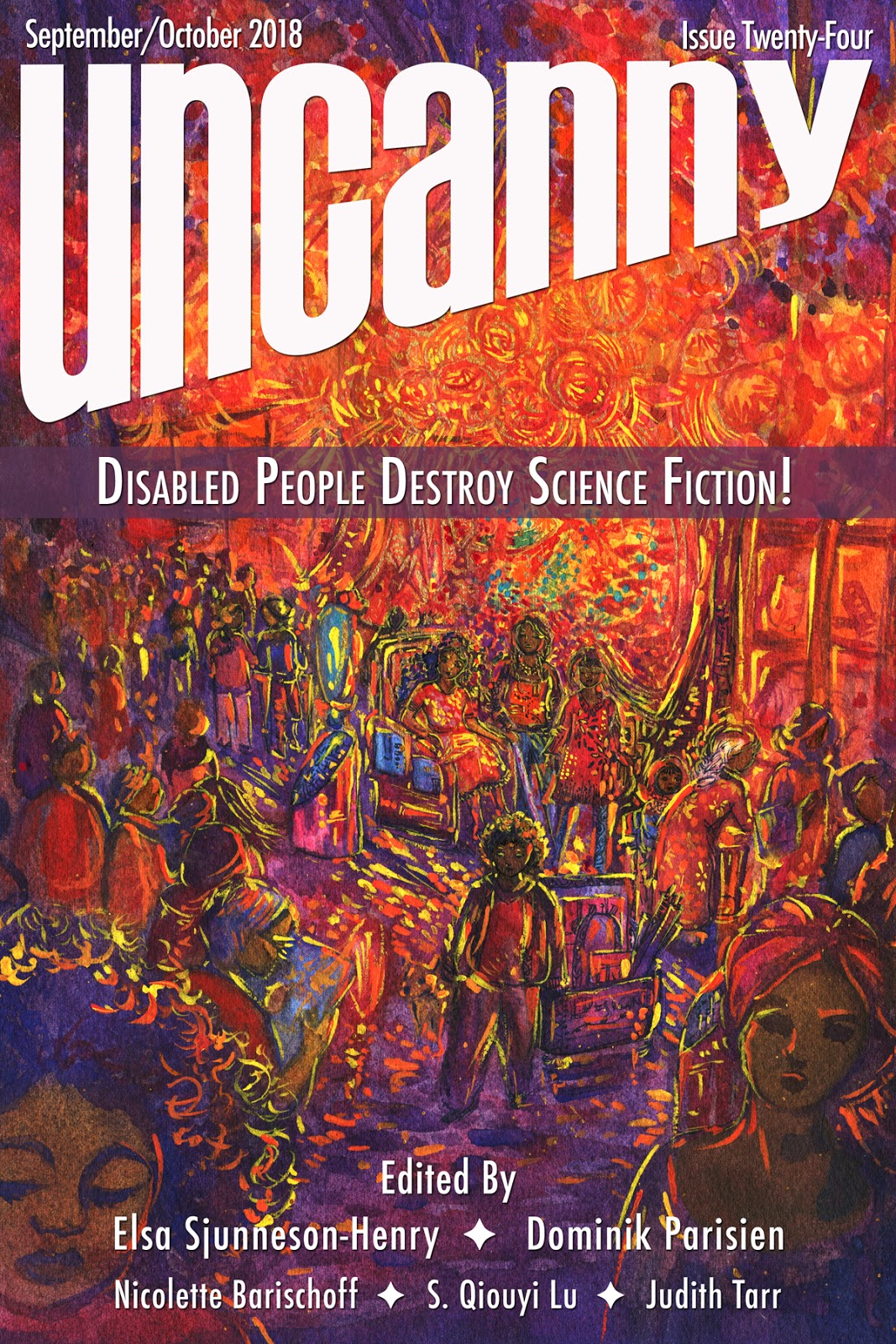
More disabled people destroying science fiction in this batch. And a couple of flash pieces from Nature Futures.

I have been too busy using up all of my brain spoons on various things (mostly work) so these preambles might continue to be short for the foreseeable future. Feel free to leave me a comment if you actually miss them.


Birthday Girl by Rachel Swirsky — A look at how approaches to mental illness/neurodiversity in children have changed over a generation. Highlighted by comparisons between the protagonist and her young niece. Source: https://uncannymagazine.com/article/birthday-girl/

An Open Letter to the Family by Jennifer Brozek — An epistolary story set in the far future. A woman tells her family of upcoming medical plans. It was a more interesting take than I expected from the opening paragraphs. Source: https://uncannymagazine.com/article/an-open-letter-to-the-family/

Heavy Lifting by A. T. Greenblatt — A coder/hacker girl working with her slightly douchey friend to tack down factory robots gone rogue in a (vague) post-apocalyptic world. A fun read.  Source: https://uncannymagazine.com/article/heavy-lifting/

A Picture is Worth by Beth Cato — An amusing flash piece about Martians who have severe ideological differences to the human race. Source: https://www.nature.com/articles/d41586-019-00884-6

The Librarian by Robert Dawson — A flash piece about a neglected library staffed only by a robotic librarian. I got an unnecessarily bitter vibe from it, though it wasn’t exactly a bad story. Source: https://www.nature.com/articles/d41586-019-00905-4

Saturday, 30 March 2019

#ReadShortStories (36 to 40)


A mixed bag here, from flash to long novella to getting back into New Suns to starting a new (to me) issue of Uncanny. I really enjoyed "Geometries of Belonging" by Rose Lemberg and I am definitely going to read more stories set in that universe. On the other hand, I was stuck part way through "Blood and Bells" for a long time which is one reason why my progress on New Suns has been so slow of late. The book is already out so I will try to get through the last few stories quickly and get my full review written up and posted soon.


Please [redacted] My Last E-mail by Kurt Pankau — A flash in the form of an email about an earlier email that was definitely not full of factual information about a robot army. Source: https://www.nature.com/articles/d41586-019-00797-4

Geometries of Belonging by Rose Lemberg 
Although I was warned, I was still surprised at how long this story was. It’s a novelette but it must be close to the upper limit. It took me a few days of reading in short- to medium-sized bursts to get through it. But I really enjoyed it. 

The world building is quite substantial so it did take me a little bit to get fully immersed in the world, but once I did I was hooked. The attitudes of the main character are deftly used to highlight the way the world works and even allow us to learn about other countries in this world. There were significant elements of both trans and autistic (I think) experiences, though not named as such, because fantasy world. I found these were presented in a very compelling way that left much scope to empathise with the protagonist. 

I gather there are other stories set in the same world and I am now very keen to read them and plan to track down what I can. 

Blood and Bells by Karin Lowachee — This story was a slog to get into and I ended up setting it aside for quite a while. When I came back to it and read further it was more interesting (to see the actual plot develop). Gang warfare and a father trying to protect his kid in the middle of a murder investigation. Source: New Suns edited by Nisi Shawl

Give Me Your Black Wings Oh Sister by Silvia Moreno-Garcia — An enticing story about a witch living in a city and attempting to lead a normal life. I enjoyed the time and writing style especially. Source: New Suns edited by Nisi Shawl

The House on the Moon by William Alexander — A mostly fun story but an unsubtle one. A kid with a cane on the moon, a field trip to a castle, some depressing recent (future) history. Quite readable, though the ending was a little confusing, with an element out of left field. Source: https://uncannymagazine.com/article/the-house-on-the-moon/

Wednesday, 27 March 2019

The True Queen by Zen Cho

The True Queen by Zen Cho is set after the events of Sorcerer to the Crown, but is not a direct sequel since it follows a different group of characters. I enjoyed Sorcerer to the Crown and generally recommend starting there to get a delightful introduction to the world, but if you can't get your hands on it, I don't see a problem with starting with The True Queen (especially if you don't mind being spoiled for the end state of Sorcerer to the Crown).

Fairyland’s future lies in doubt

The enchanted island of Janda Baik, in the Malay Archipelago, has long been home to witches. And Muna and her sister Sakti wake on its shores under a curse, which has quite stolen away their memories. Their only hope of salvation lies in distant Britain, where the Sorceress Royal runs a controversial academy for female magicians. But the pair travel via the formidable Fairy Queen’s realm, where Sakti simply disappears.

To save her sister, Muna must learn to navigate Regency London’s high society and trick the English into believing she’s a magical prodigy. But when the Sorceress Royal’s friends become accidentally embroiled in a plot – involving the Fairy Queen’s contentious succession – Muna is drawn right in. She must also find Sakti, break their curse and somehow stay out of trouble. But if fairyland’s true queen does finally return, trouble may find her first . . .

This was an excellent read. I had put off starting it for a little while because I wanted to finish other books I was part way through first. But (eventually) putting them aside and starting The True Queen was an excellent decision. I remember enjoying Sorcerer to the Crown very much when I read it, but that was a few years ago and in audiobook form, so my memory of it was hazier than I would have liked. I need not have worried, though since The True Queen follows a new character and gives us a good grounding in the world — and the Malaysian side of the world, at that — before introducing us to most of the recurring characters.

Muna starts off the book with no memory of who she is or why she washed up on a beach. She and her sister are taken in by a powerful local witch and, when little progress is made in curing them of the mysterious curse, they are sent to England to find out more. That's where things go wrong and also where the main connection to the earlier book lies.

I really enjoyed The True Queen. It made me laugh with its incidental humour and told an intriguing story which was captivating even though we, the reader, were given more than enough information to make connections that the protagonist overlooked for perfectly understandable reasons. And through the second most prominent character, Henrietta, we got a closer look at English society, the ways in which Prunella — the first Sorceress Royal — had changed society and the ways in which she hadn't.

I highly recommend The True Queen to anyone who enjoys fantasy with a dollop of humour or regcency-ish settings or Malaysian settings, for that matter. I continue to adore Zen Cho's writing (have you read her short stories?) and I will avidly read anything else of hers that I come across.

5 / 5 stars

First published: March 2019, Macmillan
Series: Sorcerer Royal, book 2 of 2 (so far)
Format read: eARC
Source: Publisher via NetGalley

Sunday, 24 March 2019

More Awards News - Aurealis Series and Tiptree


I am a little slow posting this news, but I didn't want it to pass without mention. Not long ago, I posted about the Aurealis Awards short list. The shortlist for the Sara Douglass series award came out a bit later and, though I missed it at the time, I wanted to share it with you all. This is only the second time the Best Series Aurealis will be awarded, so it's very interesting to look at the composition of the shortlist. (You can see the first shortlist at the bottom of this page.) I've included this year's shortlist below, and you can also see it here.

The other award which was recently announced is the Tiptree Award. This one is a bit unusual in that they announce the winner, an honour list and a long list all in one go. The winner this year is Gabriela Damián Miravete for her short story “They Will Dream In the Garden”. You can read the Honour and Long List at the Tiptree website.

2018 Sara Douglass Book Series Award shortlist


Blackthorn & Grim [Dreamer’s Pool (2014), Tower of Thorns (2015), Den of Wolves (2016)], Juliet Marillier (Pan Macmillan Australia)

Captive Prince [Captive Prince (2014), Prince’s Gambit (2014), Kings Rising (2016)], C S Pacat (Penguin Random House)

Electric Empire [The Diabolical Miss Hyde (2015), The Devious Dr Jekyll (2015), The Dastardly Miss Lizzie (2017)], Viola Carr (HarperCollins Publishers)

The Fire Sermon [The Fire Sermon (2015), The Map of Bones (2016), The Forever Ship (2017)], Francesca Haig (HarperCollins Publishers)

Zeroes [Zeroes (2015), Swarm (2016), Nexus (2017)], Deborah Biancotti, Margo Lanagan & Scott Westerfeld (Allen & Unwin)


Friday, 15 March 2019

#ReadShortStories (31 to 35)


More progress on the New Suns anthology in this batch of short stories, plus a detour to a couple of other stories. I now have a Nature subscription, so I expect to be reading each week's Nature Futures story in paper when the magazine/journal arrives. I imagine that will increase the proportion of flash fiction featured here.


Burn the Ships by Alberto Yáñez — A story of conquerors from the east colonising an empire in southern America. There is oppression and slaughter and vengeful magic. I think the setting is an alternate world rather than a precisely real historic setting. It was a longer story and featured culture that I have not come across too frequently in stories. Source: New Suns edited by Nisi Shawl

The Freedom of the Shifting Sea by Jaymee Goh — One of my favourite stories in the collection. A multigenerational epic featuring a mermaid/mermillipede (any description from me isn’t going to do her justice, I suggest just reading the story). I liked the twist on the traditional mermaid idea and the way the story spanned many years, in bursts. Source: New Suns edited by Nisi Shawl

Three Variations on a Theme of Imperial Attire by E. Lily Yu — As the title says, variations on the story of the Emperor’s new clothes. It adds to the obvious take and was written in a very readable voice. Source: New Suns edited by Nisi Shawl

The Last Child by L R Conti — A flash about artificial life that grows and learns but is programmed to end when its task is finished. This one rubbed me the wrong way a bit. I wasn’t a fan. Source: https://www.nature.com/articles/d41586-019-00749-y

Emergency Landing by Seanan McGuire — I was promised this would ruin flying for me, but it wasn’t at all what I expected on that front. Horror, yes, but not centred around the actual plane part. Source: Seanan McGuire’s Patreon

Wednesday, 13 March 2019

A Memory Called Empire by Arkady Martine

A Memory Called Empire by Arkady Martine is a story of galactic empire and the author’s debut. I was drawn to it by two blurbs: the summary from the publisher and the recommendation from Ann Leckie. Combined they gave the impression that the book would appeal to fans of the latter, and I don’t think that impression was wrong.

Ambassador Mahit Dzmare arrives in the center of the multi-system Teixcalaanli Empire only to discover that her predecessor, the previous ambassador from their small but fiercely independent mining Station, has died. But no one will admit that his death wasn't an accident--or that Mahit might be next to die, during a time of political instability in the highest echelons of the imperial court.

Now, Mahit must discover who is behind the murder, rescue herself, and save her Station from Teixcalaan's unceasing expansion--all while navigating an alien culture that is all too seductive, engaging in intrigues of her own, and hiding a deadly technological secret--one that might spell the end of her Station and her way of life--or rescue it from annihilation.

The story in A Memory Called Empire follows the Ambassador from a small space station colony and she begins her placement in the grand galactic empire. Her people, the Lsel, use brain recorders to preserve knowledge and before Mahit leaves she receives the memories of the previous ambassador. Except they’re fifteen years out of date and no one knows what actually happened to the previous ambassador. Finding out is her main motivation.

On the one hand, this is the story of someone alone in a foreign planet. On the other hand, she’s not entirely alone, since she has Yskander, the previous ambassador, in her head, and it’s not entirely a foreign world since she’s been studying their language and in love with their culture for a long time. Of course, things are not so clear cut, which is also the source of much of the tension in the book. That and a series of events entirely out of Mahit’s purview.

I found this to be an interesting and entertaining read. At times it would drag for a minute, but then there’d be a funny quip or a dramatic event and the story would pick up again. That aspect did emphasise how long this book was, which I hadn’t entirely expected, but since it was enjoyable, I also didn’t mind.

A Memory Called Empire explores empire and dominant culture. How to resist it and the extent to which that isn’t entirely possible. The more we learn about Mahit’s predecessor’s approach to his job, and the more more we see of the citizenry’s reactions to Mahit, the more dominant the empire seems. The political intrigue aspect of the plot was well done also (and I always like political intrigue in my stories), and included some unexpected turns.

I highly recommend this book to all fans of space opera, interstellar empires and politics seen from a person and outsider perspective. While the general style of the book has some similarities to Ann Leckie’s works, I feel most comfortable comparing it with Provenance rather than Ancillary Justice for the tone evoked. A Memory Called Empire is the first of a series but it tells a self-contained story. I want to know more of this world and how certain events develop, but we, the readers are not left in the lurch to wait for a sequel.

4.5 / 5 stars

First published: March 2019, Tor
Series: Teixcalaan book 1 of 2 announced
Format read: eARC
Source: Publisher via NetGalley

Tuesday, 5 March 2019

#ReadShortStories from varied sources (26 to 30)


Another random batch here. It's been a period of slow reading for me, of late. Too much other stuff going on, particularly with important and potentially life-changing deadlines hanging over me. Such is academia. In any case, I have scraped together some stories from various sources (five sources for five stories), all of them interesting reads.


unkind of mercy by Alex Jennings — A slightly creepy story. It reminded me of the episode of Doctor Who with the ghost angels that was part of the Tenth Doctor’s last season finale. With a very different ending, of course. Source: New Suns edited by Nisi Shawl

The Day Girl by Rivqa Rafael — A sort of steampunk story about a woman working in a factory that makes a healing potion. A well written and interesting read that I would not have minded having more of. Source: http://escapepod.org/2019/01/24/escape-pod-664-the-day-girl/

Valentine's Day by Xia Jia — A short and horrifying science fiction story about a Valentine’s Day date gone viral, in a future with minimal privacy in public. Horrific thought, good story. Source: https://motherboard.vice.com/en_us/article/wnj7p4/valentines-day

Ten Things Sunil and I Forgot to Prepare for, When Preparing for the Apocalypse by Shane Halbach — The title is an accurate description of the story. As well as the list of forgotten things, there is normal prose detailing the situation. Note that it’s a YA story and also that the plan wasn’t very good. Source: http://www.castofwonders.org/2019/01/cast-of-wonders-343-staff-picks-2018-ten-things-sunil-and-i-forgot-to-prepare-for-when-preparing-for-the-apocalypse/

The Tentacle and You by John Wiswell — A flash story about what to expect upon implantation of your new tentacle. It escalated in a compelling way. Source: https://www.nature.com/articles/d41586-019-00684-y

Saturday, 23 February 2019

#ReadShortStores while travelling (20 to 25)


A mixed bag of stories this batch. I did a lot more reading of stories that interested me in the moment than I usually do. It can be fun to read without much obligation.

Articulated Restraint by Mary Robinette Kowal — A short piece about a training session intensified by a life-or-death situation in orbit and a sprained ankle. It was nice to get back to the Lady Astronaut world, even for a brief read. I can’t tell how well this story stands without the background reading, though. Source: https://www.tor.com/2019/02/06/articulated-restraint-mary-robinette-kowal/

Come Home to Atropos by Steven Barnes — Told in the form of a horrifyingly unsubtle infomercial, this story is about assisted dying and euthanasia tourism. The overtones of historic and modern slavery seemed a bit gauche for an infomercial but certainly added to the plausibility of the story overall. (Also, the story was more a a take on racism than an interrogation of the concept of assisted dying.) Source: New Suns edited by Nisi Shawl

The Fine Print by Chinelo Onwualu — The premise of the story was a bit unpleasant (from a feminist point of view) and I didn’t feel the story itself really made up for that, despite acknowledging it. The writing was fine but I didn’t really enjoy the plot. Source: New Suns edited by Nisi Shawl

Threnody for Little Girl, with Tuna, at the End of the World by Seanan McGuire — A story about the last tuna in the world and the woman that got to name him. I hadn’t been sure what to expect from the title, but I got an interesting read, set in a not so distant future. Source: Seanan McGuire’s Patreon

A House by the Sea by P H Lee — A weird story. Not sure what it’s meant to be about, other than open to some interpretation. And probably something sinister like abuse. Source: https://uncannymagazine.com/article/a-house-by-the-sea/