Showing posts with label Kaaron Warren. Show all posts

Sunday, 26 August 2018

#ReadShortStories to milestone quantities (146 to 150)

Wow, I've hit 150 stories in my attempt to read more short fiction and I think it's safe to say that I'll probably reach 200 by the end of the year. I've even not been neglecting novels etc as much as I did closer to the start of the year. Huzzah!

This batch is exclusively Mother of Invention stories, because I was on a bit of a roll and because it was easy to just keep reading the next story on my phone while I was commuting or waiting for things over the past week. I'm almost done with that anthology though, so there will probably be fewer AI stories once it's done.


Living Proof by Nisi Shawl — A story about an AI reproducing. The setting was quite different — a prison — and to some degree aspects of the story put me in mind of Bitch Planet. Not the overall thrust of the narrative, however, which is more about purpose from the AI perspective. Not my favourite story, but I didn’t hate it. Source: Mother of Invention edited by Rivqa Rafael and Tansy Rayner Roberts

S’elfie by Justina Robson — A very interesting story about a world in which everyone has an AI personal assistant and what happens when they move far beyond what we currently have with Siri etc. Told from the point of view of one of these AIs, while her human is working on something in secret, I really enjoyed the incomplete knowledge of the narration.  Source: Mother of Invention edited by Rivqa Rafael and Tansy Rayner Roberts

Knitting Day by Jen White — A lovely story about knitted robots, poor working conditions and the subversion of capitalism. I enjoyed it, despite its grim setting and whimsical approach to assembly. Source: Mother of Invention edited by Rivqa Rafael and Tansy Rayner Roberts

The Revivalist by Kaaron Warren — A creepy story (of course, look at the author) about a process that imbues discarded robots with the last words of the dead. Mostly murder victims. I liked it. And note it wasn’t heavy on the horror, more creepy/eerie. Source: Mother of Invention edited by Rivqa Rafael and Tansy Rayner Roberts

Arguing with People on the Internet by E H Mann — An interesting story about an AI set loose arguing with people on the internet to unexpected consequences. Also features an asexual protagonist and engages with the concept of motherhood from a different angle. I quite liked it. Source: Mother of Invention edited by Rivqa Rafael and Tansy Rayner Roberts

Sunday, 28 September 2014

Interview with Kaaron Warren

Today I have an interview with Kaaron Warren, author of fiction in all sorts of lengths and all shades of horrific.

Your novels Slights and Mistification are very different in tone but they both contain stories within the larger story of the novel. This is particularly obvious in Mistification but it also appears in Slights (and I believe is central to Walking the Tree which I haven’t read). Can you tell us what drives you to add this extra layer to your novels?

You’ve hit the nail on the head when you talk about ‘layers’. This is exactly what it is. It’s about seeking further meaning in these stories, and about bringing the story and the characters to life. An early inspiration in my writing is Queen Scheherazade. I loved A Thousand and One Nights from a young age.  Another is Life; a User’s Manual by George Perec, a wonderful novel full of details and stories within stories within stories. I love to know the story behind the story. The story beneath the story. The details, the nitty gritty. I love to follow a story trail till it comes to an end.


Are you working on any more novels? If so, can you tell us anything about it/them?


The Solace of Saint Theresa, about a woman who knows how you’re going to die by the ghosts who haunt you. She doesn’t trust the ghosts, though, because she doesn’t always understand them. When she discovers a place called the Grief Hole, where teenagers go to die, she finally understands she needs to work with the ghosts in order to be the Saint she so clearly wants to be.

The Keeper of Truth, a re-imagining of my short story “The Lighthouse Keeper’s Club”, where the worst criminals are given the choice of a death sentence, or eternal life. The question is, “Who would you send to the Tower?”


The Underhistory, the novel I’ve just embarked on through a Fellowship with Old Parliament House. At heart, it’s inspired by art, Australian Prime Ministers, and the victims of John Glover, the Granny Killer.

You write a lot of short stories as well. What to your mind are the pros and cons of the novel versus the short story or novella forms?

Short stories and novels and novellas are all so different.

A short story can have a single focus. You can play with a single idea (a photographer who can momentarily reanimate the dead, for example) and make that shine. You need layered characters, plot and meaning, but you can have that idea as the central point; the core of the story.

A novel needs more beyond that central idea, and must explore many angles. With a novel, you can look into the story behind the story and follow many paths. A short story needs to stay more focussed.

A novella is a glorious combination of the best of both worlds!


Why horror? What compels you to write creepy/scary/disturbing stories?

Quite honestly, these are the stories that present themselves. The ideas that pop into my head. This is the way I interpret the news, the way I incorporate nightmares and the way I try to make sense of a world that can be terrifying.

The truth I imagine is not always pleasant.

Thank-you Kaaron for taking the time to answer my questions!

Friday, 25 October 2013

Mistification by Kaaron Warren

Mistification by Kaaron Warren is a strange book. I'm not sure what I was expecting — perhaps to be scarred for life as with Slights — but it's not really like any of Warren's other books/stories (that I've read so far). I'm including the blurb, but with the caveat that it's a bit misleading.
Marvo is a stage magician. His magic is real.

Marvo grows up without knowing his parents, without knowing his heritage, without knowing much about life.
The magicians have always been with us, since the beginning of civilisation. They fill our heads with the mist, keeping us from witnessing the stark reality of existence. But are things so bad that Marvo will bring it down on all of us, forever?

Marvo begins to understand those around him, and his place in the world; he discovers that his remarkable powers can be put to good, or to evil.

He only has to choose...
The misleading thing is that yes, Mistification is Marvo's story. It is, more or less, his life story. But it's also a book about stories. Marvo is driven to understanding the world and people and magic, and he searches for understanding by searching for stories. The book is interspersed with stories that the people he meets throughout his life tell him. Don't get me wrong though, this is not a thinly veiled short story collection. The stories Marvo gathers are short and in a way more like parables (although not in any biblical sense!). For me this made Mistification a difficult book to consume quickly, much like I find anthologies difficult to read straight through. I ended up reading it over the course of several weeks, with breaks to read other books in between. I don't feel that lessened the experience for me, as it might have with another book.

The setting was a bit odd (not in a bad way). Mostly it felt sort of generically non-specific and a bit Australian. If it weren't for a few references to the UK and America being not Marvo's home, I would've guessed it was vaguely British (although he does travel a lot). In fact, the opening put me in mind of somewhere perhaps South American, when a revolution or military coup (or something) had Marvo and his grandmother confined to a large family house. In the end, I could only conclude that Mistification is set nowhere or anywhere.

From a subgenre perspective, Mistification defies classification. It's not horrific in the same way as other Warren books and stories I've read have been, but it's still a bit eerie. Nothing terribly horrible happened (well, not to the main characters anyway), but it was far from a cheery tale. And there was magic, it could've been magical realism if not for the way the existence of magic was stressed. It's also quite literary — character, not plot, driven — and that might not be for everyone. I think it's a book that will be enjoyed much more by people who can appreciate the writing rather than demanding an action-based plot. I liked it, but it's not the kind of book I want to read every day.

One last thing I want to mention is the depth of research on folklore and folk-healing and so forth that evidently went into Mistification. There are five appendices (not required reading to enjoy the novel!) which add background information and small details to the story. And there are footnotes which also add little titbits. (Well, they were endnotes in the ebook edition, formatted quite well from a navigational point of view, but perhaps they're footnotes in the print version? Let me know in the comments if you have a print copy, I'm curious!) Both of these I think made the book easier to dip in and out of. And I'm dying to know how many of the folk-healing and little history snippets were "real". This is another aspect which I enjoyed because it fit well with the style of the book.

Mistification was an interesting read. Rather different to most of the books I read (and review on this blog). I think it has to be approached with a certain mindset to be appreciated (a conclusion drawn from skimming through some unfortunate goodreads reviews) and it's not going to be a book for everyone. People after a fast-paced plot-driven adventure need not apply. But if a more ponderous read is what you're in the mood for, and if my comments above have piqued your interest or if you really love to read stories about the nature of stories, then this is the book for you.

4 / 5 stars

First published: 2011, Angry Robot
Series: No.
Format read: ePub
Source: Purchased from Angry Robot store
Challenges: Australian Women Writers Challenge, Australian Horror Reading Challenge

Saturday, 16 March 2013

Ishtar edited by Amanda Pillar and KV Taylor

Ishtar, edited by Amanda Pillar and KV Taylor, is a collection of three novellas about the Assyrian and Babylonian goddess of love and war, Ishtar. The three novellas cover the past, the present and the future and together tell an overarching story of Ishtar's trail through thousands of years of humanity. Overall, I was impressed at how well the three novellas hung together and told a cohesive overarching story.


"The Five Loves of Ishtar" by Kaaron Warren is a story spanning thousands of years in the Mesopotamian region. Told from the perspectives of a series of Ishtar's washerwomen — each the daughter of Ishtar's previous washerwoman — it focuses partly on the men in Ishtar's life and partly on life generally at that time. From a god to Gilgamesh to kings, Ishtar's loves are broad and at times it seems her life revolves around them. At times war is her central concern and her army.

I liked the younger Ishtar, before she grew quite so jaded and belligerent, when she was still unsure of herself and cared at least a little about others (which is an ironic statement if you read the story). It was interesting to watch her and her concerns change through the eyes of a succession of servants.

What I also found interesting was how this story served to showcase the broadness of Warren's writing abilities. "The Five Loves of Ishtar" is very different to her other work that I've read; not only vastly different in setting to Through Splintered Walls and Slights, but also different in tone, theme and types of characters. It makes me excited to see what sort of writing I will encounter from her next.

"And the Dead Shall Outnumber the Living" by Deborah Biancotti is similar in tone and setting (modern Sydney) to the stories in Bad Power but with Ishtar, rather than superheroes, of course. It follows Adreienne, a detective given an unusual set of homicides to investigate. Of course we know the supernatural origins of the bodies — since Ishtar has to show up at some point — but it was still a compelling story. I enjoyed watching Adreienne slowly uncover the truth. The extra characterisation Biancotti throws in, particularly around Adreienne's sister, was a nice touch that added depth to the story.

Interestingly enough, it was this story that convinced me to classify the collection as horror. Going in I was definitely expecting fantasy and dark fantasy elements, but when Warren's story wasn't as horrifying as some of her other work I assumed the collection overall might not quite count as horror. It does.

"The Sleeping and the Dead" by Cat Sparks is a post-apocalyptic tale set in a world with not much left in it other than sand. Doctor Anna is the protagonist and works at a fertility clinic in a desert with only strange death and sex worshipping nuns for company. There don't seem to be many men left in the world and when a few stumble upon the clinic, Anna and the nuns set out to find their leader.

My favourite aspect of this story was all the allusions to earlier events, particularly to Ishtar's roots. It relies on knowledge of the previous stories more than one would expect from an ordinary collection, but in this context it works beautifully. I enjoyed having more of an idea of what was going on than Anna did most of the time, and watching her come towards her own realisations.

~

Overall, this is a strong collection. I like what Morrigan (the publisher) have been doing with themed collections (see also Grants Pass and The Phantom Queen) and I think Ishtar is an excellent example of how communal story-telling can work to great effect. I recommend Ishtar to fans of dark fantasy and horror.

4 / 5 stars

First published: 2011, Gilgamesh Press (an imprint of Morrigan Books)
Format read: ebook on my Kobo and iPad (yay for not DRM)
Source: Purchased from Smashwords
Challenges: Australian Women Writers Challenge, Australian Horror Reading Challenge

Thursday, 10 January 2013

Through Splintered Walls by Kaaron Warren

Through Splintered Walls by Kaaron Warren is the sixth of the Twelve Planets series of collections out from Twelfth Planet Press. You can read my reviews of the other collections at this link.

Through Splintered Walls contains three short stories followed by one novella. They're titled "Mountain", "Creek", "Road" and "Sky", which I think is a great set of names for within a collection. To me, the collection can easily be split into two parts, the short stories on the one hand, and the novella on the other.

The Short Stories


"Mountain" is about a ghost-haunted mountain and a woman who often drives over it on the way to the coast. The mountain and its ghosts hold many secrets, which they don't always share with passers by. But the main character has seen some of them and the reader learns a few more.

"Creek" is about quaking women who drowned in creeks. They claw their way through Australia's shallow creekbeds and call out, demanding to know what happened to their loved-ones. Olivia, our protagonist, first encountered them when she was young and has been haunted by them ever since. I loved the ending of this one, but I shan't elaborate because spoilers.

"Road" is a tale about an older couple who live at a black spot on the road (as in, a place where there are many accidents). They're quite used to injured people running up to their house and asking to use their phone (it's a mobile phone black spot too), and they always lay out a wreath for the accident victims. But is that all there is to it? You'll have to read the story to find out.

The Novella

"Sky", unlike the short stories, is a somewhat less literal title. The story is named after the weird small country town, somewhere north of Sydney, in which much of the action takes place. The protagonist, Zed, is not very likeable at all (he is, in fact, a rapist — you've been warned). From when we first meet him as a child, seen through his school-teacher's eyes, to the main action when he finds himself in Sky, I didn't relate to Zed at all, but kept reading because I wanted to know what happened next. (Whereas with the short stories, I cared about the characters.)

Sky is a horror town in a classically dystopic way; everyone is employed because to get a job or to advance, they have to challenge the person currently holding that job and fight to the death. But Zed keeps being drawn there, for various reasons. I suspect his being a terrible person heightens the feelings of disgust the reader has towards Sky, since even he finds the place disgusting. The story is told in seemingly random parts which eventually come together in a coherent string of cause and effect.

I didn't enjoy "Sky" as much as the short stories. Not because it was bad, but because it made me uncomfortable in a less enjoyable way. If anything, it reminded me most strongly of Warren's Slights, but less horribly disturbing. Whereas the short stories are almost the kind of creepy tales you might tell around a camp fire at night.

I enjoyed Through Splintered Walls very much, despite reading the three short stories in the middle of the night during a bout of insomnia (I'm not sure why this seemed like a good idea at the time, but I suppose it could have been worse). I recommend the collection to fans of horror and creepy stories. There are a few dismembered body parts floating around in "Sky" but nothing overly gory on the page. Er, except for the bit with the cat food factory grinder. The collection is definitely in my top three of the Twelve Planets (along with Love and Romanpunk by Tansy Rayner Roberts and Bad Power by Deborah Biancotti).

4.5 / 5 stars

First published: 2012, Twelfth Planet Press
Series: Twelve Planets number 6 (but there's no reason to read them in any particular order)
Format read: ebook
Source: Twelve Planets ebook subscription
Challenges: Australian Women Writers Challenge 2013, Aussie Horror Reading Challenge

Tuesday, 8 May 2012

Slights by Kaaron Warren

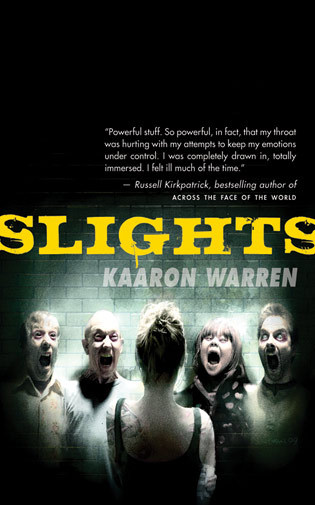
Slights by Kaaron Warren is a disturbing book. This should not come as a surprise to people familiar with the author’s other work (or anyone who read the quote from Russell Kirkpatrick on the cover).


Stevie (short for Stephanie because her parents were expecting a boy) is a psychopath in the literal sense of the word: she lacks empathy, consideration, is obsessive and fairly self-centred. She is not a sympathetic character, but she is fascinating.


After a car accident which kills her mother and puts her in hospital, she has a near-death experience. Instead of seeing a white light or a tunnel or something like that, she finds herself in a room filled with all the people who she’s slighted at some point in the past. Hence the title and hence the cover. (Speaking of the cover, how creepy do the rightmost dude’s eyes look?) And her slighted people do unpleasant things do her.


Beyond that, it’s a difficult book to explain. It doesn’t exactly have a plot, it’s more an examination of Steve’s life, told in first person, including her learning new things about her past as she gets older. Her life isn’t particularly pleasant. I found the first third or so of the book quite confronting and it squicked me out a bit. I had to take breaks from reading it, although that became less necessary as it progressed (or I became desensitised). I wouldn’t suggest this book to anyone with any sort of conventional triggers (particularly sexual ones). Fair warning.


As the book progressed, I felt it became less about horrible things happening to people (sometimes Steve, sometimes others around her) and more about the things happening in Steve’s head. And towards the very end, aspects of her family history that she wasn’t necessarily aware of when they were happening in her youth.


I knew why the people were in the room and who they were; each and every one had been slighted by me, and each slight, by me or anybody else, snapped up a bit of their soul and sent it to the dark room of some unknowing person. Or to my dark room.


The progression of her understanding of the room she goes to when she has near-death experiences (yes, they’re plural, the story would have much less impact if they weren’t) is interesting. I felt it was the kind of book that might be studied in a high school English class, if it was a bit more age-appropriate. I certainly found it more meaningful than some of the novels by Tim Winton I was forced to read.


In case you didn’t pick it up, Slights is definitely a horror novel. Don’t read it if you don’t like icky things or being inside the minds of disturbing people. On the other hand, if you like being disturbed and enjoy a dark psychological read, then this is a good book to pick up.


4 / 5 stars