Showing posts with label guest post. Show all posts

Tuesday, 12 December 2017

Preview chapter: The Last Guard by KJ Taylor

Following up on my review of The Last Guard by KJ Taylor, the first book in a new series set in the author's griffin universe (The Fallen Moon Trilogy and The Risen Sun trilogy are set in the same world), I have a sample chapter to share with you all. First, in case you don't feel like clicking through to my review, the blurb and then the sample is under the cut. And just so you're not surprised, note that it isn't from the first chapter...


Southerner Sergeant Kearney "Red" Redguard is the last of a disgraced family, and a loyal guardsman. And with a murderer stalking the streets, the city guard is his city's best defense.
But in the North, King Caedmon Taranisäii is gathering his army, and the cruel Night God prepares for the downfall of the South. A new dark griffin roams the land, warning of the war to come.
Betrayed and sent on the run, Red must fight to save his homeland.
But it may already be too late...


Sunday, 5 April 2015

Guest Post: Kim Curran on the top ten things that inspire her to write

Today I have a guest post from Kim Curran, author of the Shifter trilogy. You can read my reviews of the books: Shift, Control and Delete. It's a YA sci-fi action series and the final book has just come out. I also interviewed Kim a couple of years ago, around when Control was released. By the way, be sure to read to the very end of the post where there's a giveaway.

Top ten things that help inspire me to write


1) Burning ideas I can’t get out of my head and that wake me up at night
This is the best bit of being a writer: when an idea blindsides you and you just have to, HAVE TO, write it. You feel like your head is a balloon about to take flight. Nothing beats that feeling. Not book deals or publication days. It’s the best.

2) My office
I’m lucky enough to have a room at home that’s dedicated to writing. Which mostly means it’s packed full of books, free-range post-it notes (that won’t stay stuck to my walls) and a handful of toys. It’s a mess, but it’s a space that’s all mine.

3)  Busy trains / buses
There’s no better way to block out annoying commuters than to lose yourself in a world of your own creation. I wrote most of Shift and Control long hand while on my commute to and from work on the 243 bus from Waterloo to Shoreditch.

4) A new notebook
When I have one of those shiny exciting ideas I have to start scribbling it down before it floats away. And so a beautiful, clean and unspoiled notebook becomes a must. My brand of choice is Leuchtturm1917. Although don’t ask me to pronounce it.


5) Other authors
When I read a truly great book, one that makes me sigh over its brilliance, it pushes me to want to be a better writer.

6) My friends and family
More often than not, I have very little faith in myself as a writer. Which is when having people around me who believe in me, and will me to go on, is so important.

7) My tattoos
I got them after going through a phase where I seriously considered giving up writing. Now they’re a reminder that I can’t give up no matter what.

8) Boredom
Nothing inspires me to sit down and make up new world more than having nothing to do. It’s my mother’s fault. If ever I whinged, “I’m bored!” she would counter with, “Well you can do the washing up, that will keep you amused.” And suddenly I’d come up with something to entertain myself. 

9) My dinosaur onesie
When I’m having a low day, I pull on my dinosaur onesie, wag my tail and feel suddenly better about everything.

10) My readers
Knowing there are people out there who enjoy reading what I’ve written and who might like to read what I write next, well, it’s the most humbling form of inspiration there is.

Dublin-born Kim Curran is the award-nominated author of books for young adults, including Shift, Control and Delete.

She studied Philosophy & Literature at university with the plan of being paid big bucks to think deep thoughts. While that never quite worked out, she did land a job as a junior copywriter with an ad agency a week after graduating. She’s worked in advertising ever since and is obsessed with the power of the media on young minds.
She is a mentor at the Ministry of Stories and for the WoMentoring Project. And lives in London with her husband and too many books.

To find out more visit www.kimcurran.co.uk, or follow Kim on Twitter or Goodreads.

Giveaway!

To win all three books in the Shifter trilogy enter in the Rafflecopter widget below!


a Rafflecopter giveaway

Sunday, 22 March 2015

Guest Post: Rowena Cory Daniells on Choices

Today I have a guest post from Rowena Cory Daniells, author of many excellent fantasy books such as the King Rolen's Kin series and The Outcast Chronicles. Most recently, her first trilogy has been re-released as an omnibus edition: The Fall of Fair Isle. I haven't had a chance to review it yet (soon, soon) but you can browse my reviews of Rowena's other books here.

It’s the protagonist’s choices that make it interesting

At least it is for me. I like character driven plots. There’s nothing wrong with a natural disaster or a war to test a character, but I like it when the protagonist has a moral quandary and they are bound by their honour system.

Years ago I came across one of the Poldark books. It was back before the internet, when it was hard to find books and I read number five or six so I didn’t know the set up for the story but I liked the way the characters were limited by the expectations of their position in life and their gender. Now there’s a new Poldark series staring Aiden Turner as Ross Poldark. Here he is with Eleanor Tomlinson as Demelza.


And I discovered how the author Winston Graham set up the story. Ross comes back from the American war of Independence only to learn that the woman he loves, believing him dead, has agreed to marry his cousin and his father has died leaving him a rundown mine and a barren farm. With nothing to offer Elizabeth, he must stand aside while she marries his cousin. As for Elizabeth, she must honour her word.

The characters’ moral quandaries and the consequence of their actions keeps you watching.


In The Fall of Fair Isle the characters agonise over moral dilemmas while being bound by their gender, race and culture. This series starts after the great battle and explores the lengths the characters go to, to ensure the peace, or in one case to disrupt the peace. Whatever the other characters may think of them, they believe that they are doing the right thing.

Imoshen, named after her famous ancestor, has surrendered to General Tulkhan the invader. Her goal is to ease the transition of power but Reothe, her once-betrothed has survived the war and needs her help to win back Fair Isle.


While The Fall of Fair Isle does continue the story of the mystical T’En race, it is set six hundred years after The Outcast Chronicles and can be read as a stand-alone trilogy.


Unlike The Outcast Chronicles, The Fall of Fair Isle has a smaller cast of characters and is a more intimate story, delving into the motivations of the main characters. It is a reprint of my original trilogy which was published between 1999 and 2003.

I hope the Fall of Fair Isle sweeps the reader away and keeps them wondering what the characters will do next.

Saturday, 17 January 2015

Guest Post: Duncan Lay on Writing Battle Scenes

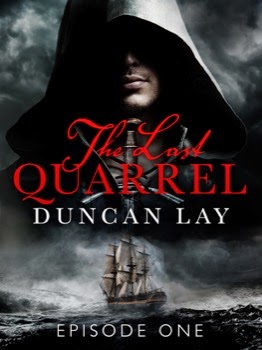
Today I have a guest post from Duncan Lay, whose new book, The Last Quarrel, is coming out from Momentum over the next few months. Starting with Episode One on the 22nd of January, there will be a new episode out every fortnight. The full book in the omnibus edition will be out on the 23rd of April. In the meantime, read on to learn about writing plausible battle scenes, something Duncan does so well.

Once upon a time, fantasy books could take the Bilbo Baggins approach to battles. In other words, the hero gets hit over the head and misses the entire thing, waking up after all the intestines have been swept up into a nice pile and the screaming has stopped. CS Lewis was also notorious for skipping battle scenes, usually by having forests come alive and chase all the baddies away. Which seems silly on the part of the trees, seeing as all that blood and bone makes excellent fertiliser. But, thanks to Peter Jackson and the Narnia adaptations, as well as the likes of 300, today's audiences aren't going to be satisfied with merely the hint of a battle. They want to see dramatic battles, ferocious swordplay and an impressive body count.

However, before you decide to go all Legolas and have heroes slaughtering baddies in enormously inventive ways, you had better think about how battles were fought in human history. In fact, when it comes to your battles and army training, you almost need to be writing more historical fiction than fantasy. Today's reader has a very strong dodginess detector and you run the risk of losing them unless you have done some research.

Fantasy asks the reader to suspend their disbelief from the moment they open the cover. But there is a fine line there. Force the reader to accept too much and, at best, you lose all the dramatic tension you just spent 200 pages building up. Worse, you could lose them completely.

You can't be lazy and just "wing" the battle scenes. You have to take it seriously, or don't include it at all. It's better to find another way to resolve the drama than give the reader something they find unsatisfying.

You must remember that:
  • Peasants can't just pick up weapons and take on hardened warriors. It takes even fit men months to develop any sort of proficiency with weapons. If you don't have that time available, then you need to think of something else. Sure they won't be swordsmen in anything less than six months but they could learn to hold a spear or pike in a week or two.
  • Archery is a skill that takes 10 years to master. But they could be reasonable with a crossbow in a week or two.
  • Armour does provide protection from swords and knives, but not spears. Edged weapons quickly get blunt and can't cut but instead bludgeon. Fighting in armour, with swords, is exhausting and after no more than half an hour, even the best warrior will be so tired they cannot lift their sword.
  • Armies need to eat. Unless they have wagons full of food, they can't march long distances and fight.
These are all simple ideas but can have a dramatic effect on your battle plans. You have to take the time and trouble to work these things out. After all, you wouldn't create a world that makes no sense, with jungles next to snowfields. So why have a battle scene like that? You can't be lazy, or the reader will punish you for it.

So do some research, plot out your battle with as much detail as a pivotal emotional scene and then all you need to do is garnish with blood, brains, bones and intestines. Your talking, walking, fighting trees will thank you for it - and so will your readers.