Showing posts with label catherine asaro. Show all posts

Friday, 12 September 2014

Aurora in Four Voices by Catherine Asaro

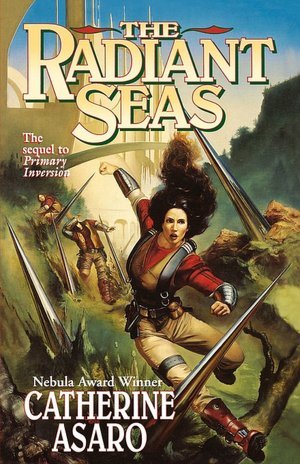
Aurora in Four Voices by Catherine Asaro is a collection of short stories that I listened to in audiobook form after the author ran a Kickstarter campaign to record it. I have previously reviewed Asaro's novel, The Radiant Seas, which is set in the same universe as the stories in Aurora in Four Voices.

I didn't love all of the stories in this collection, although I didn't hate any of them either. My least favourite was definitely "Ave de Paso", in which the main characters didn't particularly grab me and which also had a bit of a squick factor towards the end. I liked many things about "Aurora in Four Voices" and I'd say it was probably my second favourite story. I had mixed feelings about the relationship between the two main characters since Soz is the main character of the other Asaro books I've read and her OTP the main character was not. I also enjoyed "Light and Shadows" although it was not, I think, supposed to be an overly cheery story. My favourite story was easily "City of Cries" and I was interested to learn in the outro that there is a novel sequel coming late this year. I will have to keep an eye out for that.

One thing all the stories have in common — with the exception of "Light and Shadows" which only really has the one male character in it — is strong female characters. This is something common to all of Asaro's work, I believe. People seeking hard science fiction populated by women who actually do things, would do well to check out Asaro's work. And in case you were in any doubt that her SFnal universe is indeed hard, this collection contains a short maths essay at the end. I have to admit, I found it difficult to listen to — my brain went into lecture mode and turned off — but luckily there was a simplified URL mentioned to the written and illustrated essay online. You can read it here. (And if you need further proof, some of the mathematical concepts used in her stories have been published in mathematical journals.)

As always, I've written some notes about the stories as I read them. I recommend this collection to people wanting to get an idea of Asaro's work. The stories are pretty broad in setting and, I think, a good showcase of the sort of stories she can write. I particularly recommend it to SF fans looking for more women in their fiction.

~

Aurora in Four Voices — Not bad, about Soz (main character in Primary Inversion and Radiant Seas and others I haven't read) and, more prominently, a man who has been trapped on a planet populated by mathematical and artistic geniuses who like to live in eternal night. He has been mistreated by, well, a mean chap and when Soz shows up she helps him escape his situation.

Ave de Paso — Meh. A pair of orphaned cousins deal with recent bereavement, the desert and magical possession by a malevolent spirit. Not terrible, but not my favourite.

The Spacetime Pool — Your classic present-day maths graduate falls into gate in the spacetime continuum and finds herself in an alternate universe where she's at the centre of an empire-changing prophesy. I wasn't fond of the whole "you must marry me and not my brother because he's a bastard" opening but since it's a novella there was plenty of room to turn it around and I enjoyed the heroine rescuing herself with the application of mathematics.

Light and Shadows — A heart broken test pilot deals with his pain by trying to go harder, faster further. When he pushes his plane beyond the specified limits he gets a bit more than he expected. An amusing story (well, not the parts where he was sad about his dead lover) about a character I'm pretty sure reappears in Skolian Empire books I've read.

City of Cries — This was my favourite story of the bunch. It's a gender-flipped hard-boiled PI story in an SF setting. And when I say gender-flipped, I don't just mean that the ex-military PI is female (though she is) but all the trope-mandatory characters are gender flipped. I found this delightful even while unpleasant things were happening to people.

A Poetry of Angles and Dreams — not a story but an essay, which you can read here. For someone with a maths degree, it was a fairly straight-forward description of concepts. Particularly the imaginary number half of the essay starts at the most basic level and builds up to the more complex (lol, pun) concept of Riemann sheets. I suspect the second part of the essay, about Fourier transforms/analysis would be less enlightening to the lay person.

4 / 5 stars

First published: 2012 Isfic Press (audiobook 2014)
Series: Stories set in the Skolian Empire universe (apparently including the ones that don't seem like they are)
Format read: Audiobook
Source: Kickstarter reward

Sunday, 15 July 2012

The Radiant Seas by Catherine Asaro


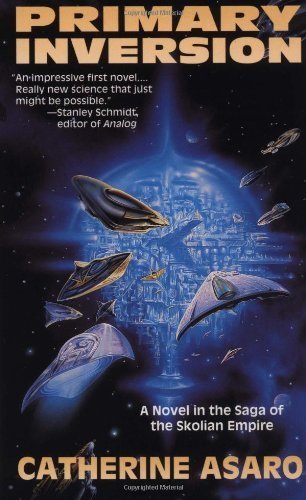
The Radiant Seas by Catherine Asaro is the second book I’ve read in the Skolian Empire saga (which actually has three empires in it with the two main ones having different names so it gets confusing but that’s the term I’m going to stick with). The other book that I’ve read was Primary Inversion which, chronologically, immediately precedes The Radiant Seas. For this review to make sense, I’m going to have to include a spoiler for the end of Primary Inversion, but I’ll put in a warning when I get to that.


Asaro’s universe contains three interstellar empires:


  • The Skolians whose ruling family are powerful telepaths and who can communicate instantaneously through a telepathic web that three of the imperial family hold in place with their minds (and to do so they have to be the most powerful type of telepaths, a condition that involves recessive genes and can’t be genetically engineered.

  • The Eubians who are ruled by the irredeemably evil (and genetically specific) class of Aristos. Evil because they literally gain transcendent pleasure from being in proximity to the suffering of telepaths. Their mission in life is generally to acquire as many telepathic slaves as they can, the more powerful the better (and, incidentally, they don’t see anyone else as fully human, especially the telepaths but including ordinary humans).

  • And then there’s the Earth and Allied Worlds who try to stay out of the never ending conflicts between the other two empires and don’t entirely believe how horrible the Eubians are with their slavery and torture.

The main characters are mostly Skolian and the antagonists are all Eubian although they’re not all as automatically evil as it might seem (but most are) and do have proper motivations for what they do, always an important trait in bad guys. The story in The Radiant Seas picks up exactly where Primary Inversion left off and spans many (17ish) years.


Before I get to the spoilers, a few words on the science because I can’t review an SF book without commenting on that. Asaro’s science, real and made up, is pretty good and (most importantly ;-p ) didn’t annoy me. It was a good mix between made up stuff (the telepathy) told from a scientific point of view and fairly hard semi-plausible science like the propulsion systems. Asaro actually has a PhD in physical chemistry theoretical atomic and molecular physics so much of the quantum and relativity stuff is plausible. She even published a paper about the theory behind her faster than light travel system. In short, nothing to complain about here.


And to be able to talk about the plot, I have to mention a spoiler for the end of Primary Inversion…


~


SPOILER WARNING FOR PRIMARY INVERSION


***


WARNING OF SPOILERS


***


YOU HAVE BEEN SPOILER-WARNED FOR PRIMARY INVERSION (NOT RADIANT SEAS)


~


At the end of Primary Inversion, Soz, next in line to be the Imperator (Skolian), and Jabriol II, heir to the Imperial throne (Eubian), fall in love when Soz discovers Jabriol isn’t in fact an Aristo but part of a secret genetic experiment to breed telepathy into the imperial line. Rather than feeding on telepaths, he is the most powerful type of telepath himself (as is Soz). Since peace between their empires is inherently impossible while there are still Aristos running around, they ran off to a deserted planet together. The Radiant Seas picks up when they’re busy making copious babies while their families mourn them, then get on with waging war against each other.


Because the story spans so many years, it really felt like the first half was setting up the events of the second half. There were some action scenes in the first half and the story definitely progressed, but there were moments when it felt like it was dragging. In the second half, Soz and Jabriol (and their kids) rejoin civilisation and their respective empires, the story really picks up. Soz trying to rescue Jabriol was much more exciting than them making babies while their families fought.


Aside from the few boring bits (which weren’t enough to ruin anything, in my opinion), I quite enjoyed this novel. I mostly liked Soz because she kicks arse but I did find the whole running away from imperial duties thing a bit selfish. However, it was also nice to see an alternative narrative where duty isn’t held up as the most important thing and the character chooses family. (I still think they should’ve hung around to fix things up more first…)


Overall, I would recommend this book to people who enjoy science fiction with epic world-spanning empires, lots of political intrigue and long range plots. I definitely suggest reading Primary Inversion before The Radiant Seas, however, since a lot of world building and, more importantly, plot set up, takes place in the earlier book.


4 / 5 stars