Showing posts with label Time travel. Show all posts

Tuesday, 12 May 2020

T.I.M.E Stories by Christophe Lambert

A bit of a change of pace for this review. Some time ago, I reviewed a story-based board game called T.I.M.E Stories, or, more accurately, the first scenario in the T.I.M.E Stories series. Since then, my husband and I have played through all the T.I.M.E Stories scenarios as they were released. We liked some more than others and are moderately invested in the overarching story — we would be even more invested if it were better written and plotted. That's theoretically where today's book review comes in. To go with a reboot/upgrade of the game story (the gaming system changed), there is a new novelisation of the story. I was a bit sceptical of it when I first heard about it, since the writing in the games itself has been patchily translated (from French, as has this book). But my husband was very enthused and wanted to read it, so I have let him write the review, which is what you'll find in the rest of this post.

It is the year 2468. Spotted by a recruiter, Tess Haiden passed the many tests required to join a highly secretive organisation with flying colours. But she is in for a shock: T.I.M.E Agency has been sending agents through time for several years. Thanks to considerable resources, they prevent anomalies and paradoxes by dispatching their agents to different eras and places around the world. But over the course of her many missions, Tess learns that they are not the only ones using these time corridors, and she begins to wonder about the true nature of the T.I.M.E agency… 

This book is based on the Time stories series of board games. Some background is necessary here, the games are classic adventure games in a box, where the players travel back in time to a scenario where they have to solve problems with the timeline. A number of adventures have been released and the developers recently changed the system, separating the old games into what they call the white cycle and starting the new white cycle.

The main draw of this book is that it helps bridge the gap between the white cycle and the blue cycle of the board game time stories. It mostly serves to introduce the main characters in the new cycle, while explaining some of the unexplained mysteries. If you want to know who all the new characters are in the new games, read this book. If you haven’t played time stories or don’t care enough about the storyline, probably give this book a pass.

The prose is a little strange, with excessive detail used when setting the scene. This is useful in a game where these details are clues, but just slow down the book. There were often asides that didn’t add anything to either the story or the characters.

When the characters were time travelling, a lot of the pressure came from the arbitrary time limit enforced on time travel missions. This is an important part of the game, but doesn’t work so well in a book. A lot of the first mission in particular had the characters constantly updating each other on how much time was left rather than what they were doing.

I’m happy I read this book to get a better understanding of the time stories setting, but that’s the only reason I have to recommend this book.

2.5 / 5 stars

First published: May 2020, Angry Robot
Series: Not yet
Format read: eARC
Source: Publisher via NetGalley

Thursday, 23 April 2020

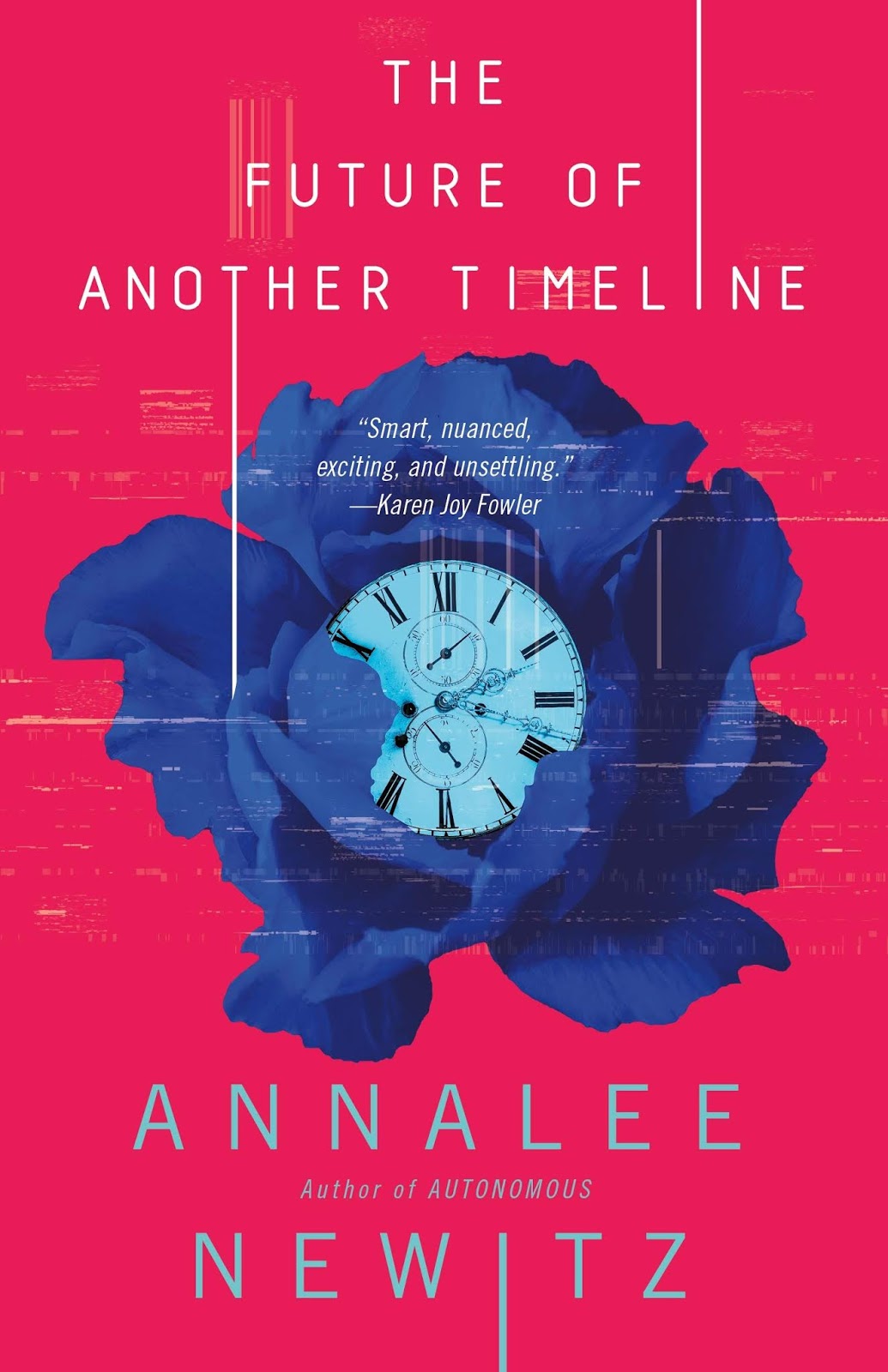
The Future of Another Timeline by Annalee Newitz

The Future of Another Timeline by Annalee Newitz is a time-travelling science fiction novel. I picked it up based on the promise that there would be both time travel and lesbians, though it turned out to be more diverse than just that description implies.

1992: After a confrontation at a riot grrl concert, seventeen-year-old Beth finds herself in a car with her friend's abusive boyfriend dead in the backseat, agreeing to help her friends hide the body. This murder sets Beth and her friends on a path of escalating violence and vengeance as they realize many other young women in the world need protecting too.

2022: Determined to use time travel to create a safer future, Tess has dedicated her life to visiting key moments in history and fighting for change. But rewriting the timeline isn’t as simple as editing one person or event. And just when Tess believes she's found a way to make an edit that actually sticks, she encounters a group of dangerous travelers bent on stopping her at any cost.

Tess and Beth’s lives intertwine as war breaks out across the timeline--a war that threatens to destroy time travel and leave only a small group of elites with the power to shape the past, present, and future. Against the vast and intricate forces of history and humanity, is it possible for a single person’s actions to echo throughout the timeline?

I am still internally screaming about something in this book I can't even talk about here because it is a massive spoiler.
😱 😱 😱
OK, I found some people to talk it over with, so that's out of my system now. Moving on to the actual review.

As you might expect from a book about time travel, there are a couple of story threads in this book, though they get a little more tangled up than non-time travelling flashback sequences tend to. We have Tess, who is from the near future and working with a secret feminist cabal to stop misogynists from editing women's rights out of the timeline (loosely speaking). She travels to various times, with a particular focus on 1892-3 with regards to her research and secret mission. And then in the 1990s we have some punk rock teenage girls living their slightly crappy lives and going to gigs, as seen through the eyes of Beth, one of the teens.

The 1990s storyline serves to highlight the differences between the starting timeline and the parallel world that we, the readers, live in. It also sets up a background for Tess and people like her, especially when Tess starts trying to change her past by illegally travelling to the 1990s. This is tangentially related to my internal screaming above.

But the overarching story is about fighting for rights and the methods by which history is made/changed. An ongoing debate in the book concerns the efficacy of collective action vs the Great Man theory; whether history can be changed incrementally and/or whether killing Hitler actually does anyone any good. But this is more a book about the characters, mostly women, looking out for each other, no matter the time period. If that's your jam, then this may well be the book for you.

Overall I really enjoyed this book. Some parts of it took my by surprise and there was more violence than I expecting going in, but it was violence born out of the anger of the oppressed as much as anything else, and the book was very much in conversation with the justification, or not, of some forms of violence. While there might be a bit of a squick factor associated with some of the violence, I thought it was explored thoughtfully in the book as a whole.

I highly recommend The Future of Another Timeline to fans of time travel and/or feminism. This is the first thing I've read by Annalee Newitz and I am interested in picking up more of their work in the future.

4.5 / 5 stars

First published: 2019, Tor Books
Series: No
Format read: ePub
Source: Purchased from Kobo

Thursday, 10 October 2019

Before the Coffee Gets Cold by Toshikazu Kawaguchi

Before the Coffee Gets Cold by Toshikazu Kawaguchi is a short-ish novel of time travel, told in four parts. Originally published in Japanese, it was recently translated into English. I picked it up because the time travel aspect interested me.

In a small back alley in Tokyo, there is a café which has been serving carefully brewed coffee for more than one hundred years. But this coffee shop offers its customers a unique experience: the chance to travel back in time.

In Before the Coffee Gets Cold, we meet four visitors, each of whom is hoping to make use of the café’s time-travelling offer, in order to: confront the man who left them, receive a letter from their husband whose memory has been taken by early onset Alzheimer's, to see their sister one last time, and to meet the daughter they never got the chance to know.

But the journey into the past does not come without risks: customers must sit in a particular seat, they cannot leave the café, and finally, they must return to the present before the coffee gets cold . . .

This is one novel but it's divided into four parts, each focussing on a different character, albeit with a lot of overlap. The story is set almost entirely in a cafe with timeless decor that has an urban legend attached to it: time travel is possible inside the cafe. Whenever customers ask about travelling back in time, however, they are quickly put off by the very restrictive rules presented to them. Before the Coffee Gets Cold is about four people who did not let the restrictive rules stop them.

This was a very gentle and character-driven read. In each section, we get to know a particular character and their motivations for wanting to time travel. And, arguably most interestingly, their reasons for accepting the limitation of the cafe's time travel capabilities. The book was written in a nuanced but not overly-dramatic tone. Although I usually prefer plot-driven and/or drama-filled stories, I found myself keen to pick this one up again each evening.

I enjoyed Before the Coffee Gets Cold and I recommend it to anyone looking for a different sort of time travel story. I've heard it has been made into a (Japanese) movie called Cafe Funiculi Funicula and I'm interested in watching it as well, though I'm not sure how easy it will be to get my eyes on.

4 / 5 stars

First published: September 2019, Picador (Japanese version first published in 2015)
Series: No
Format read: eARC
Source: Publisher via NetGalley

Tuesday, 9 July 2019

This Is How You Lose the Time War by Amal El-Mohtar and Max Gladstone

This Is How You Lose the Time War by Amal El-Mohtar and Max Gladstone is a short novel about two time-travelling agents who start corresponding with each other. It's written in a poetic style and is half-epistolary, half-prose.

Among the ashes of a dying world, an agent of the Commandant finds a letter. It reads: Burn before reading.

And thus begins an unlikely correspondence between two rival agents hellbent on securing the best possible future for their warring factions. Now, what began as a taunt, a battlefield boast, grows into something more.

Except discovery of their bond would be death for each of them. There’s still a war going on, after all. And someone has to win that war. That’s how war works. Right?

This is a remarkable book, told in a very poetic style, with chapters alternating between snippets of our characters’ lives and the letters they send each other. Although it is written as prose, one feels as though one is reading poetry. The use of imagery and metaphor is strong and frequent and the relationship between the characters shifts as they become more obsessed with each other as they learn more about the other.

At first I had difficulty keeping the characters straight in my mind — Red and Blue, from futures Garden and Agency, wait, which was which again? — but then it became clearer as they obtained more identifying characteristics. There was [the one that had happened to] and [the one that did this thing], to keep it spoiler-free. I started reading this book while travelling and I don’t recommend reading it in a noisy environment. It was easier to enjoy at home, calmly. Or at least with noise-cancelling headphones on. It is the kind of book that demands your full attention to properly take in its words and worlds.

I don't generally like spending too much time comparing books to other things, but it feels particularly topical in this case. This Is How You Lose the Time War is a book that pushes many if the same buttons as Good Omens by Terry Pratchett and Neil Gaiman or Killing Eve but with a more poetic writing style than Good Omens and more emphasis on the relationship between enemy agents than Killing Eve. (I speak of the TV show Killing Eve, here — the books it’s based on look dreadful.) Also, in the struggle for a better future, no one side is clearly better than the other, which is not how most oppositional relationships are portrayed. In Killing Eve, Villanelle is the assassin so MI6 agent Eve clearly has the moral high ground. And things are both more and less ambiguous in Good Omens, where the two sides are literally heaven and hell. But if you liked either of those stories for their protagonist relationships, this is the book for you. Especially if you wished there was more time travel in them.

Actually, before I wrap up, I will say a few words on the time travel aspect. It's both integral to the story and sort of minimally done. No mechanics are explained, which makes sense for the style of the book, and all the time travel feats are basically magic, as far as we mere time-bound mortals are concerned. Sometimes that sort of thing bothers me, but in this case it fits in perfectly with the style of the book. The time travel is absolutely not the point, the letters between Blue and Red are, and doing it any other way would have been bizarre. For all that I've said the prose is very poetic, it's also very sparse (in the way of poetry, now that I think about it). For this reason, it took me a little while at the start of the book to feel grounded in the story (or as grounded as one can be in such a story) but, again, it makes perfect sense for what it is.

I really liked this book. I highly recommend it to fans of doomed and/or oppositional romance (is that the right term?), poetic letters and magical time travel. It's a quick read but a powerful one. If you're not sure whether the style is right for you, I think it's something you could quickly determine by reading the sample chapters on your favourite ebook store. In any case, I highly recommend This Is How You Lose the Time War.

5 / 5 stars

First published: July 2019, Jo Fletcher Books
Series: No, I don't think so
Format read: eARC
Source: Publisher via NetGalley

Wednesday, 29 May 2019

Gods, Monsters, and the Lucky Peach by Kelly Robson

Gods, Monsters, and the Lucky Peach by Kelly Robson is a novella set in a post climate-collapse world, with a few other apocalypses thrown in. I did not realise, before I started reading, that it was science fiction. Possibly that’s because I didn’t read the blurb properly (or at all — I don’t remember), but I think it’s mainly that the cover didn’t strike me as obviously science fiction rather than fantasy. As a result, since I’ve been more in the mood for SF than F of late, I didn’t pick it up when I first saw it and have come to it now because it was shortlisted for a Hugo Award.

Discover a shifting history of adventure as humanity clashes over whether to repair their ruined planet or luxuriate in a less tainted past.

In 2267, Earth has just begun to recover from worldwide ecological disasters. Minh is part of the generation that first moved back up to the surface of the Earth from the underground hells, to reclaim humanity's ancestral habitat. She's spent her entire life restoring river ecosystems, but lately the kind of long-term restoration projects Minh works on have been stalled due to the invention of time travel. When she gets the opportunity take a team to 2000 BC to survey the Tigris and Euphrates rivers, she jumps at the chance to uncover the secrets of the shadowy think tank that controls time travel technology.

I enjoyed this novella. It touches on a lot of different ideas and concepts that interest me. The characters are working to rebuild the surface of the Earth after severe ecological collapse and various other disasters have plagued humanity in the meantime, including a plague which lead to the main protagonist having prosthetic (tentacle) legs. It also touches on bodily autonomy and the morality of interacting negatively with people in the past if the timeline is erased when you leave (or is it?). While all these issues are interesting, Gods, Monsters, and the Lucky Peach is still only a novella in length, so the issues aren't delved into in as much depth as they could be.

Before I finished reading, when I mentioned that I was part-way through this book, some people mentioned that they'd liked the book but not the ending, which made me a bit apprehensive. I bring it up because what I expected from their completely spoiler-free reactions was not at all what I got. In short, the ending was a little abrupt, which was slightly disappointing because I wanted to see more of what happened with the characters, but I thought it made sense in the context of the book. Actually, my main criticism is the way in which the rules of time travel remain a bit vague. One character tells the others what they are, but the other characters remain sceptical about some of them, so we, the reader, aren't sure whether to believe him either. Other aspects of the worldbuilding were more detailed, which I liked, but the uncertainty surrounding the time travel bothered me. Not enough to dislike the book, just enough to feel unsure about some of the resolution.

Overall, however, this was an entertaining read and I recommend it to fans of mid-future SF, climate apocalypse fiction, and also time travel stories. It's Hugo shortlisted is well-earned and I will be having trouble ranking it among the other novellas.

4.5 / 5 stars

First published: 2018, Tor.com
Series: No
Format read: ePub
Source: Hugo Voter Packet

Sunday, 20 January 2019

Paper Girls Vol 5 by Brian K Vaughan and Cliff Chiang

Paper Girls Vol 5 written by Brian K Vaughan and illustrated by Cliff Chiang is the fifth volume in the ongoing series. As I discovered after finishing it (and suspected while I was reading) this is actually the penultimate volume of the series. And it shows. In a good way.

Can anyone escape fate? That’s what Mac and her fellow newspaper delivery girls must discover as they escape the year 2000 and travel to the distant future. Plus, the truth behind the mysterious “old-timers” is finally revealed.

After finding the previous Paper Girls volume a little bland, I was pleasantly surprised by how much this one upped the ante. It starts off much like the previous volumes have, with the girls in a new time and finding Cleveland less familiar than they’d like, but quickly raises the stakes. As I was reading, especially towards the end of the volume, I got the sense that the story would be wrapped up soon, which just made it more exciting. The overarching plot, which has always been in the background and has mainly been too confusing for the girls to piece together, is brought to the fore in this volume. Suddenly, a lot of things (almost) make sense and we are made aware of just how badly everything can go wrong. It was an exciting read.

I enjoyed this volume a lot and I definitely recommend it to any fans of the Paper Girls series. If you found the previous volume to be a bit bland, then I urge you to persist. This volume is more interesting and the end of the series is nigh. I am very much looking forward to the concluding volume and am a bit disappointed that I have to wait months for it to be completed.

4.5 / 5 stars

First published: December 2018, Image Comics
Series: Paper Girls volume 5 of 6 planned. Contains issues #21–25
Format read: Trade paperback
Source: Purchased at All Star Comics in Melbourne

Friday, 18 January 2019

Paper Girls Vol 4 by Brian K Vaughan and Cliff Chiang

Paper Girls Vol 4 written by Brian K Vaughan and illustrated by Cliff Chiang is the fourth collected instalment of Paper Girls comics. This is the kind of comic that tells one continuous story over several volumes, so I don't recommend jumping in at volume 4 if you haven't read the previous three.

The mind-bending, time-warping adventure from BRIAN K. VAUGHAN and CLIFF CHIANG continues, as intrepid newspaper deliverer Tiffany is launched from the prehistoric past into the year 2000! In this harrowing version of our past, Y2K was even more of a cataclysm than experts feared, and the only person who can save the future is a 12-year-old girl from 1988.

This volume continues the story, as expected. This time, the girls find themselves in 1999 on New Year’s Eve when things are a little bit strange. And that’s without the giant robots and other time travellers. To me this volume felt like it was mostly running around and avoiding violence (or not, at times). It did progress the overall story but not quite as much as I would have liked. We did get to meet another future self of one of the girls, which was interesting.

While I wouldn’t say this was my favourite volume, I still enjoyed it and I still intend to read the next volume soon. This is a very sequential series and I don’t recommend staring part way through. New readers are best severed starting with volume 1. For continuing readers still invested in the story, I see no especially compelling reason to skip this issue, so read it if you haven’t already.

4 / 5 stars

First published: 2018, Image Comics
Series: Paper Girls vol 4 of ongoing series, collecting issues 16 to 20
Format read: Trade paperback
Source: Purchased from All Star Comics in Melbourne

Tuesday, 4 September 2018

The Psychology of Time Travel by Kate Mascarenhas

The Psychology of Time Travel by Kate Mascarenhas is the author's debut novel. I grabbed it because the blurb and cover grabbed me but I went in with a bit of trepidation, not knowing what to expect. As it turned out, I needed have worried. This was an excellent read and I highly recommend it to just about everyone.

1967: Four young female scientists invent a time travel machine in their remote lab in Cumbria. They become known as the pioneers: the women who led the world to a future where no knowledge is unattainable.

2016: Ruby Rebello knows that her beloved grandmother was one of the pioneers, but she refuses to talk about her past. Ruby's curiosity soon turns to fear however, when a newspaper clipping from four months in the future arrives in the post. The clipping reports the brutal murder of an unnamed elderly lady.

Could the woman be her Granny Bee?

This book is set in a world where time travel was invented in 1967 and is now, in the early twenty-first century, a normal part of life. It's a more common and established part of society than, say, space travel is, with a large British organisation overseeing the system and policing time travellers across the timeline. The story follows the inventors of time travel and some of the younger generation that come into contact with it one way or another.

A central plot element is a locked-room murder, which is discovered by one of the characters and for which both victim and perpetrator and initially mysterious. Mental illness and psychology are also central to the plot. The book examines the psychological effects of time travel and what underlying conditions they may exacerbate, as well as sensitively dealing with a traumatised character. There's also the psychology of time traveller culture, which is very interesting and disturbing and also central to the plot.

As might be expected from a book about time travel, The Psychology of Time Travel is told out of chronological order, with relatively short chapters that are only a scene or two long. While the purpose of each chapter wasn't necessarily obvious while reading it, they quickly slotted together to form a larger picture. The book is also well-written enough so as to be interesting even when I wasn't sure how a particular scene was linked to the whole. This intricate mosaic of story is what impressed me most about this book and made for an unexpectedly excellent read.

One last thing I want to mention is what the author has done with the gender distribution of characters. Basically, she's written a gender swapped reality so that all the key characters — all four time travel pioneers and all the other point of view characters — are female. I can only think of one male character that wasn't there as someone's father or husband, including most of the background characters (though there were a couple of male secretaries). I didn't realise this immediately, but it was a fun change of pace to play "spot the male character" rather than the reverse.

Overall, I really enjoyed The Psychology of Time Travel and found it to be an excellent read. I recommend it to anyone who doesn't hate time travel or women and enjoys some psychological exploration in their reads. It's particularly impressive for a debut novel and I am very interested to see what Mascarenhas brings us in the future.

5 / 5 stars

First published: August 2018, Head of Zeus
Series: No
Format read: eARC
Source: Publisher via NetGalley

Saturday, 26 May 2018

Paper Girls Volume 3 by Brian K Vaughan and Cliff Chiang

Paper Girls Volume 3 written by Brian K Vaughan and illustrated by Cliff Chiang is, obviously, the third volume in the Paper Girls comic series. I have previously read and reviewed Volume 1 and Volume 2. This is the kind of series that tells a single ongoing story, so I don't recommend starting anywhere other than Volume 1 if you haven't already read the previous volumes/issues. This review contains spoilers for the previous volumes.

The multiple Eisner and Harvey Award-winning series from BRIAN K. VAUGHAN and CLIFF CHIANG continues, as newspaper deliverers Erin, Mac and Tiffany finally reunite with their long-lost friend KJ in an unexpected new era, where the girls must uncover the secret origins of time travel... or risk never returning home to 1988. 

In this volume we see the four paper girls in prehistoric times continuing their disturbing adventure. They meet some more strange people as well as some... slightly less strange people. Some strange aspects introduced earlier start to make more sense in this volume, while other new mysteries are encountered.

I found this volume to be an enjoyable continuation of the ongoing story. I feel like this is getting to be one of those series where it's hard to review a volume on its own (I have similar problems reviewing Saga) because it really is just a chapter in a story that isn't finished. I am enjoying the format which introduces the setting of the next volume at the end of the previous one. It gives me something to look forward to when I get my hands on Volume 4.

I have been really enjoying Paper Girls and I recommend it to fans of SF, time travel, and weird stuff. For the optimal reading experience you should definitely start with Volume 1 rather than coming into the story in the middle. This is a series I plan to keep reading to completion.

4.5 / 5 stars

First published: 2017, Image Comics
Series: Volume 3 of 4 so far, containing issues #11–15
Format read: Trade paperback
Source: Local comic book shop

Thursday, 24 May 2018

Paper Girls Volume 2 by Brian K Vaughan and Cliff Chiang

Paper Girls Volume 2 written by Brian K Vaughan and illustrated by Cliff Chiang continues the story begun in Volume 1, which I read after it was shortlisted for a Hugo Award last year. I really enjoyed the first volume, so I took the opportunity to pick up volumes 2 and 3 when visiting a comic book shop recently. This review contains spoilers for volume 1.

After surviving the strangest night of their lives in the Cleveland suburb of Stony Stream, intrepid young newspaper deliverers Erin, Mac, and Tiffany find themselves launched from 1988 to a distant and terrifying future... the year 2016.

What would you do if you were suddenly confronted by your 12-year-old self? 40-year-old newspaper reporter Erin Tieng is about to find out in this action-packed story about identity, mortality, and growing older in the 21st century.

This picked up the story right where it left off and, even though it's been a while since I read the first volume, I didn't have trouble getting back into the story, even if I didn't remember all the details. This is an ongoing story so this volume just covers the next arc of story rather than coming to any final conclusions. I think it did a good job containing a linked story with obvious entry and exit points.

The story is set mainly in 2016 and follows the twelve-year-old paper girls from 1988 as they try to work out what's happening and navigate the unfamiliar world of their future. Meanwhile, for reasons related to their time travelling, a lot of bad stuff is also going on, which forms the backdrop to their story. (Why does all the pop culture love giant tardigrades, btw?) This instalment doesn't raise as many questions as the first one did, but that's partly because we have some grounding in the world now and also because some of the same questions come up again.

I am continuing to really enjoy Paper Girls and I am definitely invested in the story. I've already got Volume 3 in hand and I plan to keep on reading as long as the comics keep on coming. If you enjoyed Stranger Things but would have liked more science fiction rather than horror, this may be the comic for you. That said, I didn't actually like Stranger Things at all, and I love this series, so the similarities may end at the part where the 80s are involved. I can't think what else it's comparable to though.

4.5 / 5 stars

First published: 2016, Image Comics
Series: Paper Girls volume 2 (of 4 so far), containing issues #6–10
Format read: Trade paperback
Source: Real life comic book shop

Monday, 8 January 2018

Just One Damned Thing After Another by Jodi Taylor

Just One Damned Thing After Another by Jodi Taylor is the first in a rather long series (nine books according to a quick glance at goodreads) about time travelling historians. I picked it up because my mum has been recommending the series to me incessantly, so I bought the first book to make her stop.

Behind the seemingly innocuous façade of St Mary's, a different kind of historical research is taking place. They don't do 'time-travel' - they 'investigate major historical events in contemporary time'. Maintaining the appearance of harmless eccentrics is not always within their power - especially given their propensity for causing loud explosions when things get too quiet.

Meet the disaster-magnets of St Mary's Institute of Historical Research as they ricochet around History. Their aim is to observe and document - to try and find the answers to many of History's unanswered questions...and not to die in the process. But one wrong move and History will fight back - to the death. And, as they soon discover - it's not just History they're fighting.

Follow the catastrophe curve from 11th-century London to World War I, and from the Cretaceous Period to the destruction of the Great Library at Alexandria. For wherever Historians go, chaos is sure to follow in their wake....

The title is a pretty accurate description the plot of the book, alas. It's a series of events, very loosely linked by a bit of an overarching plot that I can only hope becomes more significant in the later volumes. Also a lot of plot holes, but I'll get to that later. The book starts with the main character being recruited to the organisation of time-travelling historians, takes us through her training and then suddenly jumps forward four years with minimal cues in the text. A conversation in the middle of a chapter about people having known each other for four years really shouldn't be the main indication that so much time has passed. That's just one example, but it's symptomatic of an overall lack of polish that could have been fixed by a good structural edit. (More copy-editing wouldn't have hurt either, but that wasn't the main problem.) As far as I can ascertain, these books were originally self-published but have since been picked up by various small publishers. It doesn't seem like they were edited for re-release either, unless the newish print editions are completely different to the ebooks. (I can appreciate the difficulty in making significant changes in a book 1 when later books have to remain coherently linked to it, but still.)

The biggest problem with this book was, like I said, the structure. It's one thing to ignore the standard western story-telling structures of climax and denouement etc. Fine. But a bit of foreshadowing and firmer worldbuilding would not have gone astray. Establishing the crappiness of the near-future world would have fit brilliantly at the start, but instead there was more worldbuilding loaded up near the end, which was very frustrating.

The only thing that kept me turning pages instead of giving up in frustration was the author's ability to string a series of events together into something approaching a compelling yarn. It was an addictive read, despite the part of my mind that was despairing at what I mentioned above. (Of course, that means that it could have been brilliant with better editing. Alas.) The main characters were well-written and I was invested in their outcomes. On the other hand, I did keep losing track of some of the minor characters and was much less invested in them, including at times I was clearly supposed to be invested. As far as the minor romance plot goes, let's just say I found our protagonist much more forgiving than I would have been and I did not end the book very invested in that relationship.

As for the plot, Jodi Taylor's historians start off on the Connie Willis side of things and, rather bafflingly given what they and the reader know about the bad guys by that point, shift over to the Kage Baker side of time travelling historians (without the cyborgs). I can't say I found their motivations exceptionally consistent, especially in the moments when it really mattered and when the people who knew the full picture were involved. That got particularly annoying towards the end.

For all my annoyance as evidenced in the above paragraphs, I mostly enjoyed reading Just One Damned Thing After Another. I wouldn't recommend it above Connie Willis or Kage Baker, although it was funnier than many of those authors' books (except To Say Nothing of the Dog by Connie Willis, which is hilarious). Right now I'm pretty torn about whether I will read the next book in the series. I expect I would be entertained but, even if the writing improves with successive books, I don't trust that I won't continue to be frustrated.

3.5 / 5 stars

First published: Self-published in 2013, my edition Accent Press 2015
Series: The Chronicles of St Maries book 1 of about 9 (and ongoing I think)
Format read: ePub
Source: purchased from iBooks

Thursday, 29 June 2017

Paper Girls by Brian K Vaughan and Cliff Chiang

Paper Girls Volume 1 by written by Brian K Vaughan and illustrated by Cliff Chiang is the first book in what I believe is an ongoing series. I picked it up because it was shortlisted for a Hugo Award and conveniently presented to me in the Hugo voter packet, but I had previously heard good things about it and it was already on my radar to eventually buy. So yay Hugo packet. What I didn't realise until I was reading it was the genre. From the cover art of Volume 1 and the freaking blurb I was expecting something geeky and female-driven. And I mean, it is... but there are also very distinct speculative elements to it.

In the early hours after Halloween of 1988, four 12-year-old newspaper delivery girls uncover the most important story of all time. Suburban drama and otherworldly mysteries collide in this smash-hit series about nostalgia, first jobs, and the last days of childhood.

Which part of that blurb suggests anything about, like, aliens or time travel? NONE OF IT! And saying that here might be a bit of a spoiler, but I think not knowing would put potentially interested readers off more than I have spoiled just by saying that. So. Young girls, aged around twelve, in 1988, who deliver newspapers and encounter aliens and time travel. What's not to like?

The only downside of Paper Girls is that it's a volume 1 in an ongoing series, meaning that the story is in no way complete, many (most) questions are left unanswered and it ends in a cliffhanger. Happily, the second volume is already out and the third is coming relatively soon, so I am looking forward to continuing the story in the near future, just as soon as I get around to making a trip to the comic book shop.

I recommend Paper Girls to fans of nostalgia, girls and spec fic. I'm not entirely sure where the story is going, but I am very happy to continue along for the ride.

5 / 5 stars

First published: 2016, Image Comics
Series: Paper Girls, ongoing series, contains issues #1–5
Format read: watermarked PDF
Source: Hugo Voter Packet

Sunday, 4 September 2016

T.I.M.E Stories: Asylum

T.I.M.E Stories is not a book or a comic or even a short story. It's a board game. More specifically, it's a choose your own adventure story with pretty pictures, a couple of puzzles to solve and a selection of characters for two to four players to control. Or, if you prefer a computer game metaphor, it's a point and click adventure translated to cards and a board. In any case, I'm reviewing it here because it's primarily a story and something I expect many SFFH people will enjoy.

The T.I.M.E Agency protects humanity by preventing temporal faults and paradoxes from threatening the fabric of our universe. As temporal agents, you and your team will be sent into the bodies of beings from different worlds or realities to successfully complete the missions given to you. Failure is impossible, as you will be able to go back in time as many times as required.

T.I.M.E Stories is a narrative board game. Players will live adventures in various worlds, through the eyes and characteristics of their character. They will have to fight, search, discuss, and be clever and convincing to the characters they meet… and sometimes even the other agents.

Each player will be able to include the dose of “roleplay” they want into the character they’ll have chosen. But they will also need to optimize their actions.

Each scenario contains a new world, new characters, new rules, and new surprises.

The basic box contains the T.I.M.E Stories system and the Asylum scenario.

T.I.M.E Stories is the series and, I suppose, architecture for the game. The basic premise is that you are a team of new recruits that the T.I.M.E Agency is sending on missions to prevent temporal faults. When you are sent back in time, you basically possess a contemporaneous character (a bit creepy) and use them to explore the past and fulfil your mission. The game presents you with scenic images and narrative text that guides you through the world and presents you with choices and occasionally puzzles to solve.

Asylum is the story/scenario that comes with the base game of T.I.M.E Stories (and you need the base game to play other scenarios). It's set in 1921 Paris, in an asylum, as the name suggests. The characters you play as are all patients with different abilities and strengths depending on their personality and condition. The other characters you interact with are staff (doctors, nurses, orderlies) and other patients. You finish/win the game by going to enough places, finding clues and hence preventing the creation of a temporal fault. Because there's time travel on the one hand, and a limited amount of time in the past to get things done, you can (or, basically, need to) go back in time more than once to complete the mission. This allows you to try mutually exclusive options on subsequent run-throughs, which I enjoyed.

The theme of Asylum is, of course, inherently ableist, and I was a little apprehensive going into what I knew was a horror scenario set in a psychiatric facility in a time period when mental health care wasn't exactly great. But really it could've been worse. The horror elements weren't based in being afraid of the patients, but rather various non-human creatures and the non-patients behind the evil plot.

It took me and my husband three runs to finish the game, which took about two and a half hours. But that was with us solving the puzzles pretty quickly and your mileage may vary (there are only two puzzles though). We then went back and played through from scratch (not keeping the items you're allowed to keep between runs) to test some of the actions we didn't take the first time, but that only took about half an hour because we didn't to reread or think too much about the places we'd already visited.

Overall, I enjoyed the experience of T.I.M.E Stories: Asylum and I look forward to playing other scenarios. From some of the minor details in Asylum, I gather there will be some more of the overarching story revealed in future scenarios, which I am particularly looking forward to. The only really disappointing thing, for me, was how quickly it was over. We are hoping that the future scenarios are longer or more complex, but the internet is unclear on this point (without clicking on the spoilers, anyway).

4 / 5 stars

First published: 2015, Space Cowboys / Asmodee
Series: T.I.M.E Stories, the first scenario in an ongoing series (3 more currently out, one more about to be released)
Format read: Er, board game
Source: An online tabletop game shop

Tuesday, 7 June 2016

Split Infinity by Thalia Kalkipsakis

Split Infinity by Thalia Kalkipsakis is the second book in the Lifespan of Starlight trilogy, following on from book 1, Lifespan of Starlight, which I read and reviewed recently. I really enjoyed this sequel, and it made me realise that the only reason I didn't give Lifespan of Starlight 5 stars (I gave it 4.5) is because reading bad goodreads reviews before reading the book had me anticipating it taking a turn for the crappy, which it didn't. Split Infinity continued on in the same trope-avoiding way as the first book. Oh, also, the blurb and this review contain MAJOR SPOILERS for the first book.

A split-second decision, a single time-skip. The world that you know, gone in a blink.

Now a sharp and adept time-skipper, Scout jumps years ahead to find the world transformed. Technology has accelerated and the people she knows have grown up, or disappeared. Most pressing, the government that she was trying to escape has used the time to prepare for the return of the time skippers. Caught between finding the mother she left behind and time-skipping ahead with Mason, a series of events lead Scout deeper into the tunnel than ever before.

The only way out is by the strength of her love and the power of her mind. The illusion of time has one more surprise, one with the power to change everything.

As you probably gathered from my preamble, I enjoyed this book a lot. One of my favourite things about it is that Scout, the main character, is pretty smart and doesn't make stupid decisions for no better reason than to further the plot (a YA pet peeve of mine). In fact, whenever I thought "she should do blah" to solve whatever problem she was facing, she generally did or did something even more clever. That's not to say that the book was predictable, just that obvious smart courses of action weren't conveniently ignored by the protagonist.

I mentioned in my review of the first book that I didn't think the government quite counted as dystopian because almost everyone (who wasn't in Scout's position) was basically doing OK. In this book, which is mostly set a bit further in the future than we see in the first book, the repressiveness of the government took a turn for the worse and definitely feels more dystopian. Whether or not Scout (and friends) will be directly addressing that beyond just trying to keep themselves safe is unclear. Although it's more dystopian than the first book, it's not following the obvious beats of a YA dystopia (yet — I suppose the third book could change that).

On the topic of not following obvious beats, there were a few time travel beats that I thought this second book might end on and to be honest, until the very end I kind of wanted it to end that way. But once the end game was playing out, it became clear that the book wasn't going to end quite the way I expected. There is another cliff hanger, though (that bit I did expect).

In my review of the first book I didn't talk much about time travel because I didn't want to give that aspect of the story away. This second volume is very much more of a time travel narrative, so I think it should be mentioned. One of the things that I think makes this series so successfully compelling is that it took two unrelated, solid ideas — everyone being chipped and time travel — and combined them to make a story greater than the sum of its parts. It helps that the portrayal of being chipped is done in a relatively fresh way (like when Scout has trouble crossing the road without a chip), and that the method of time travel is novel and both constrained (jumping forward, not moving from where you were and arriving naked) and liberal (anyone can learn to do it).

Finally, Scout has a very close relationship with her mother, which doesn't change when the whole time travel thing starts. Scout's mother isn't conveniently out of the way or kidnapped, does worry about her, and is a motivator for Scout to do various things. Her mother's strong presence is balanced by the fact that Scout has a lot of freedom, especially for a 14 or 15 year old, but I appreciate her not being orphaned or neglected from the outset.

To reiterate, I enjoyed Split Infinity a lot and would whole-heartedly recommend it and the first book to fans of character-driven YA and science fiction. Although there is a romantic element in the books, it was actually stronger in the first book than the second, and isn't very prominent overall (and wow did I appreciate the fact that Scout didn't do anything to stupid for cute boys). I am eagerly awaiting the last book in the series, alas I think I'll be waiting about a year to read it.

5 / 5 stars

First published: May 2016, Hardie Grant Egmont
Series: Lifespan of Starlight book 2 of 3
Format read: Paper!
Source: Purchased (from Big W...)
Challenges: Australian Women Writers ChallengeAussie Science Fiction Reading Challenge

Monday, 30 May 2016

Lifespan of Starlight by Thalia Kalkipsakis

Lifespan of Starlight by Thalia Kalkipsakis is a YA science fiction novel I picked up from the library after it caught my eye in a bookshop. I went into it with some trepidation, having also read some less favourable reviews on Goodreads, but I ended up quite enjoying it.

In 2084, three teenagers discover the secret to time travel. At first their jumps cover only a few seconds, but soon they master the technique and combat their fear of jumping into the unknown.

It's dangerous. It's illegal. And it's utterly worth it for the full-body bliss of each return.

As their ability to time jump grows into days and weeks, the group begins to push beyond their limits, with terrifying consequences. Could they travel as far as ten years, to escape the authorities? They are desperate enough to find out.

But before they jump they must be sure, because it only works in one direction.

Once you trip forwards, there's no coming back.

Lifespan of Starlight is set in a near-future dystopian Melbourne, where everyone is chipped and these chips give them access to everything from food and water rations to safe road crossings. Scout (or Coutlyn) is an illegal. She wasn't chipped as a baby because her mother was supposed to have aborted her. Instead she bribed a doctor to keep quiet and has been sharing her own, not overly-plentiful, rations with Scout. Existing as a non-person has also taught Scout how to code and hack to get around the system. This is especially useful for things like triggering traffic lights to let her cross.

Scout's being illegal is a key element of the story, but one not mentioned in the blurb, for some reason. The blurbed part of the story — the time travel aspect — begins when Scout is moping in her cave and a dying woman suddenly appears in front of her. As in turns out, that woman was a time traveller and, when Scout steals her chip and hacks it to make it her own, she inadvertently falls in with some teens trying to learn to time travel.

The time travelling is a side-aspect of Scout's story, although it is the pivotal element. Most of Scout's time is taken up with trying to legitimise herself in the eyes of society. With her new chip she even gets to apply to go to a good school. Much of the story explores the difficulties Scout faces in being illegal, in pretending not to be illegal and what happens when her friends find out the truth. There was a poignant moment when her friends point out which "real citizen" her actions most affected, as though being a real citizen is more relevant than being a real person.

This is a fairly character-driven story. There is no world to save, no government to overthrow (well, I mean, there is because life is a bit dystopian, but none of the kids are  trying to fix that through rebellion or anything). Their problems are less grand and more personal, but still culminate in an exciting semi-cliff hanger ending.

I recommend this book to fans of science fiction more than YA. I felt that it had more SF tropes and ideas in it than YA-spec fic tropes. It's not an action-packed story, but I still found that I wanted to come back to it every time I put it down. I am looking forward to reading the next book and finding out what happens in the next chapter of Scout's life.

4.5 / 5 stars

First published: 2015, Hardie Grant Egmont
Series: Yes. Book 1 of 2 so far of a planned trilogy
Format read: Paperback!
Source: Borrowed from the library
Challenges: Australian Women Writers Challenge, Aussie Science Fiction Reading Challenge

Sunday, 4 October 2015

The Infinite Loop by Pierrick Colinet and Elsa Charretier

The Infinite Loop by Pierrick Colinet and Elsa Charretier is a self-contained comic book mini-series. The blurb caught my eye on NetGalley because of the time travelling lesbians element, which it absolutely delivered on. (I couldn't find a nice cover image for the collected volume, so the image to the right is from issue #1, but I gather the same art is being used for the collection.)

A science-fiction series that asks the age-old question, "What would you risk for a chance at true love?" Meet Teddy, a young woman who lives in a faraway future where time traveling is a common practice and her job is to maintain the status quo by correcting time paradoxes. But when she meets Ano, "a time paradox" and the girl of her dreams, Teddy must decide between fixing the time stream or the love of her life, both of which have unique consequences. A dynamically graphic, science-fictiony, poetical, paradoxical wunderkind of a sexy, time-traveling, adventure-packed comic.

The story is about Teddy who is part of what we could loosely call the time police. Her job is to travel through time and space dealing with anomalies — things that shouldn't be there like dinosaurs in the 20th century. Dealing with anomalies involves erasing them from the continuum so they don't continue to cause trouble. But then Teddy meets a human anomaly, with whom she falls in love.

The somewhat odd thing, that isn't addressed as much as I would have expected, is that the society of future time travellers does not believe in love. They view it as a quaint historical phenomenon and so are shocked when Teddy falls in love. (And also shocked by the fact that the anomaly, Ano, isn't a proper person because she is an anomaly.)

What follows is Teddy running away from the world, discovering a huge conspiracy and fighting to fix everything despite said conspiracy. There are a few confusing time loops — but it's not a proper time travel story if there aren't confusing time loops — and Teddy's path crosses with alternate reality versions of herself.
<minor spoiler>
And because I was a bit concerned when I was reading, there is indeed a happy ending.
</spoiler>

Overall this was a fun, if slightly confusing, read. I was glad to read a self-contained comic that wasn't part of a longer series. Recommended if you enjoy time travel stories and/or lesbians.

4 / 5 stars

First published: December 2015, IDW Publishing
Series: Yes, but this volume collects the entire series
Format read: eARC
Source: NetGalley

Thursday, 2 October 2014

Langue[dot]doc 1305 by Gillian Polack

Langue[dot]doc 1305 by Gillian Polack is a time-travel novel set mostly in 1305. It basically documents the expedition's stay in 1305 and the contemporaneous goings-on in the town of Languedoc. It is the second novel I've read by the author, the other was Ms Cellophane, which is unconnected.
There are people involved. That's the first mistake.
Scientists were never meant to be part of history. Anything in the past is better studied from the present. It's safer.
When a team of Australian scientists — and a lone historian — travel back to St-Guilhem-le-Désert in 1305 they discover being impartial, distant and objective just doesn't work when you're surrounded by the smells, dust and heat of a foreign land. They're only human after all.
But by the time Artemisia is able to convince other that it's time to worry, it's already too late.
Langue[dot]doc 1305 is an unusual book. It's told in a series of short scenes, switching between characters from the present (or, I suppose, near future, since they can time travel) and townsfolk in 1305. Commonly such short scenes would be an indication of a fast-paced, action-heavy plot, but that is not the case here. It is not a long book, coming in at just under 300 pages, but it is a slow, languorous read. The short scenes (and I should note, not all of them a super-short, but many are) give snapshots of minor events both in the lives of the expedition and the locals. Although seemingly unconnected at first, these do tend to lay down context for later happenings.

The characters are not at all what I expected. Artemisia, the only historian on the mission, is positioned very much as the main character, even as she is isolated from the rest of the expedition due to a clash of personalities and (research) culture. The scientists, quite frankly, often acted very pettily and put me in mind of the public servants in Ms Cellophane (in particular, I found similarities between the two antagonist characters). I felt like I should be on the side of the scientists (because I am one) but they were mostly such annoying people that I was very much on Artemisia's side throughout.

Gillian Polack is a historian, specialising in Medieval France, so I have no doubt that all the history included was as accurate as possible. I am also quite sure that there were jokes that I didn't pick up on because I am not a historian, but that did not make it an unenjoyable read. Instead, I suspect others with a stronger medieval background will get more out of it than I did.

I recommend Langue[dot]doc 1305 to anyone with a passing interest in history (especially Medieval France), speculative fiction reader or not. On the other hand, those looking for action and adventure would be better off looking elsewhere.

4 / 5 stars

First published: November 2014, Satalyte Publishing
Series: No.
Format read: Paper! Uncorrected Proof
Source: LonCon purchase
Disclaimer: Gillian is a friend but — as always — I have endeavoured to give an unbiased review
Challenges: Australian Women Writers Challenge, Australian Science Fiction Reading Challenge

Sunday, 8 December 2013

In the Company of Thieves by Kage Baker (and Kathleen Bartholomew)

In the Company of Thieves is a collection of short stories and novellas by Kage Baker, set in the Company universe (link to Goodreads series page). I've previous read all the Company novels (with the exception of The Empress of Mars, which doesn't fit chronologically with the others) and as many short stories as I could easily get a hold of, which was far from all of them. As such, I was coming to this collection already knowing a lot of the Company's back story. That definitely affected my reading.

As usual, notes on each story are included at the end of the review.

The stories seem to be arranged chronologically according to history. The first four stories are probably the most accessible to readers unfamiliar with the Company. My previous knowledge informed my reading significantly, but I think the stories will still work well for new readers. I had forgotten how hilarious Kage Baker's short stories can be; the novels, which stuck more strongly in my mind, are less funny, I think. The last three stories had me laughing out loud several times.

There are two pairs of stories that go together thematically. The first pair is "The Unfortunate Gytt" and "The Women of Nell Gwynne's" both of which feature the pre-Company secret society and have a steampunk setting. The last two stories, "Rude Mechanicals" and "Hollywood Ikons", feature the same two recurring characters, Joseph and Lewis, the former of whom has several novels written about him. Both also happen to be set in Hollywood.

Reading this collection made me want to try harder to get a hold of what Kage Baker stories of the Company I haven't yet managed to. I strongly recommend this collection to fans of the Company novels or stories. To readers new to Kage Baker's work, there are worse ways be be introduced to it. Since the stories cover several characters and time periods, In the Company of Thieves will in some ways give readers a better idea of the series as a whole than a single novel covering just one setting.

~

“THE CARPET BEDS OF SUTRO PARK” — Autistic cyborg used as a camera recorder to capture San Francisco through to roughly the present from the 1800s. His love for the city and one of its inhabitants all that matters to him. Nice story.

"THE UNFORTUNATE GYTT" — A steampunk adventure to retrieve a special object. Featuring Edward and told from the point of view of a new recruit to the pre-Company secret society in Victorian England.

"THE WOMEN OF NELL GWYNNE'S" — Read before and remembered fairly well so I didn't re-read. A novella about women who serve the secret society of the previous story as spies.

"MOTHER AEGYPT" — Ultimately hilarious novella. It grew in me as I read, starting unremarkably and culminating in a pretty hilarious climax. I think there are certain extra nuances to be gained in this one for readers familiar with the Company world, but only in terms of backstory. The main story itself should be accessible (and amusing) to new readers as well as old. Although I can't say the main character was particularly likeable; a conman who, at the start, has fallen on hard times. But his plight and thought-processes are entertaining, so I didn't mind.

“RUDE MECHANICALS” — A hilarious comedy of errors following recurring cyborg characters Joseph and Lewis. Although I'd read this one before, in audiobook form, I had little memory of it (the occasional trouble with audiobooks). Lewis is working for a director in 1930s Hollywood and Joseph is trying to preserve a certain piece of treasure for their future overlords. The universe is against Joseph, however, and everything that can go wrong does, and he drags Lewis into his mess.

"HOLLYWOOD IKONS" — This story, if I interpret the foreword correctly, was researched and planned by Kage Baker but finished by her sister, Kathleen Bartholomew, after her death. The very start of this one didn't grab me because the voice did not sound like the Joseph I remembered. Also, it included more of a introduction to Dr Zeus than any of the other stories and that felt odd in the last story of the collection. But once the plot got started I was sucked in, particularly once the humour kicked in. In a way, it's another comedy of errors, but less so than the previous story. In this one, the errors mostly occurred in the past and Joseph, with a bit of help from Lewis, has to put everything right. Although I was sceptical at the start as to whether I would enjoy reading any other incomplete-at-death Kage Baker stories, this one ultimately convinced me to at least give another one a shot, should it come up. It also had me shaking my fist at cancer for taking her away too soon.

4.5 / 5 stars

First published: November 2013, Tachyon Publications
Series: The Company. Accompanying short stories.
Format read: eARC
Source: The publisher via NetGalley

Thursday, 10 October 2013

Viral Nation by Shaunta Grimes

Viral Nation by Shaunta Grimes is a post-apocalyptic YA novel about an autistic girl and her brother (and her service dog). I have mentioned in the past that I tend not to read blurbs between deciding to read a book (in this case because it was mentioned on the Diversity in YA blog) and actually reading it. In this case, that meant what I was expecting was a post-apocalyptic story with an autistic girl. What I got was also dystopian and had time travel, which threw me a little at first (because obviously I didn't look closely enough at the cover when I started reading either).
After a virus claimed nearly the entire global population, the world changed. The United States splintered into fifty walled cities where the surviving citizens clustered to start over. The Company, which ended the plague by bringing a life-saving vaccine back from the future, controls everything. They ration the scant food and supplies through a lottery system, mandate daily doses of virus suppressant, and even monitor future timelines to stop crimes before they can be committed.

Brilliant but autistic, sixteen-year-old Clover Donovan has always dreamed of studying at the Waverly-Stead Academy. Her brother and caretaker, West, has done everything in his power to make her dream a reality. But Clover’s refusal to part with her beloved service dog denies her entry into the school. Instead, she is drafted into the Time Mariners, a team of Company operatives who travel through time to gather news about the future.

When one of Clover’s missions reveals that West’s life is in danger, the Donovans are shattered. To change West’s fate, they’ll have to take on the mysterious Company. But as its secrets are revealed, they realize that the Company’s rule may not be as benevolent as it seems. In saving her brother, Clover will face a more powerful force than she ever imagined… and will team up with a band of fellow misfits and outsiders to incite a revolution that will change their destinies forever.
Despite the shift between my expectations and what I got, I loved this book. At first I thought the time travel aspect was rather strange — and honestly I still do, but not in a bad way — but it contributed to a complex and full world. One of my pet peeves with a lot of dystopian YA is poorly thought-through (or lazy) world-building, but Viral Nation certainly doesn't contain that flaw. Although the world is revealed slowly as the characters learn more about it, so I admit I was a little sceptical at first. (Side note: I think the blurb is slightly wrong because I remember the text mentioning 48 cities, not 50, which makes more sense since who knows what happened to distant Alaska and Hawaii after civilisation collapsed?) But as the conspiracy is revealed, it becomes increasingly interesting, especially since by the end we still don't know everything, partly thanks to the time travel aspect, but mostly because the author hasn't revealed it yet.

That aside, Viral Nation hooked me in from the very beginning. From the prologue, in which we glimpse the pandemic that wreaked havoc across the US (little word from the rest of the world, but less obnoxiously than most), to the teenage protagonists in chapter one, I was sucked in. Clover is completely a sympathetic character and I found myself cheering her on almost immediately, and cringing when social situations went badly for her. I also grew rather fond of her dog, despite being more of a cat person. ;-)

West, Clover's older brother, is also a point of view character. Again, I was a little sceptical at first when his point of view popped up before Clover's, but I'm pleased to report he was not there to steal Clover's limelight. He was an important character in his own right, but not at the expense of Clover's character, which made me happy. I picked up Viral Nation because I was keen to read about a non-typical protagonist — an autistic one in this case — coping in a post-apocalyptic world. I'm glad I did and I was pleased that there wasn't anything poorly done (as far as I could determine, but I am by no means an expert on autism). It added an extra dimension to the book (although for a YA book of this nature it already had rather a lot of dimensions to be getting on with) and although Clover's autism ended up being integral to the plot, I didn't find that was done objectionably. Also, it was nice to see an autistic girl for a change.

The only disappointment with Viral Nation is that it's the first in the series. It's not that I don't want to keep reading about Clover and friends — I do — it's that I can't keep reading now and I want to know what happens. The second book doesn't come out until next Northern summer. Sigh. On the one hand, if it was a standalone, I'd already know how everything turned out but there's no way Grimes could have fit as much worldbuilding depth into a single volume (y'know, unless it was a very loooong single volume).

I highly recommend Viral Nation to fans of YA post-apocalyptic dystopias. Adult fans will also enjoy it, as I did, although like me they may find themselves sceptical of it at first. Fans of intelligent characters who do not make incredibly stupid decisions to further a weak plot, should also find something to like here. Readers looking for a minority main character, especially an autistic one, will hopefully be very pleased with Viral Nation. Possibly also dog lovers.

5 / 5 stars

First published: July 2013, The Berkley Publishing Group / Penguin US
Series: Viral Nation book 1 of ? (my guess is trilogy)
Format read: eARC
Source: Publisher via NetGalley

Friday, 5 October 2012

Coyote by Rhonda Roberts

Coyote by Rhonda Roberts is the third book in her Timestalker series. However, as with the earlier books it stands alone as a complete story and contains minimal spoilers for the earlier books (pretty much just back-story and love interests, I think). If you're interested, you can read my review of Hoodwink, the previous book, here.

Kannon Dupree is a private investigator with access to a time portal. She specialises in very cold cases. In Coyote she goes back to the wild west to investigate a massacre on behalf of the survivor/hero's descendent. More specifically, she's charged with finding the hero's diary as proof of what really happened. Of course, nothing is as simple as it seems or there wouldn't be much of a story.

I enjoyed this novel a lot and had fun reading it. Although the historical events and the places at the centre of the story in the Wild West are made up (other than the obviously real cities of San Francisco and Santa Fe), Roberts has obviously done her research. She includes a lot of interesting historical facts and details many of which were new to me, someone who hasn't read or seen many westerns.

I really like Kannon as a character. She kicks arse, although there is less of that in Coyote than in the earlier books, and her character development progresses nicely in Coyote. I wasn't a big fan of her love interest though, carried over from Hoodwink. He kept trying to protect and rescue Kannon, two things she is rarely in need of. It was frustrating for her and I completely empathised with her. Honestly, I was rooting for them to break up. Although, I should point out, not because he's a poorly written or boring character, more because his actions were annoying to both me and Kannon (except she also has feelings for him).

I am very much looking forward to reading the next book in this series. Each book has stood more or less alone and each has introduced a new weird thing (of the fantasy-ish variety) happening in relation to the past. So far they seem unrelated to each other but I'm wondering if at some point it'll come together. Or perhaps it will just be a series of strange events that follow Kannon around and which make the Timestalker series difficult to categorise as fantasy (techy time travel) or science fiction (weird stuff).

I highly recommend this series if you enjoy strong (in both connotations of the phrase) heroines and varied story lines. Coyote doesn't disappoint.

4.5 / 5 stars