Showing posts with label poetry. Show all posts

Sunday, 2 June 2019

Algorithmic Shapeshifting by Bogi Takács

Algorithmic Shapeshifting by Bogi Takács is a collection of mostly speculative poems. I'm not a big reader of poetry, but I have mostly enjoyed, for example, the poems that appear in Uncanny Magazine. Since I also enjoy Takács's writing, this seemed like a good place to start reading more poetry.

Algorithmic Shapeshifting is the first poetry collection of Bogi Takács, winner of the Lambda award for editing Transcendent 2: The Year's Best Transgender Speculative Fiction, and finalist for the Hugo and Locus awards. Algorithmic Shapeshifting includes poems from the past decade and previously unpublished work. The scope of the pieces extends from the present and past of Jewish life in Hungary and the United States to the far-future, outer-space reaches of the speculative—always with a sense of curiosity and wonder.

There is a variety of poems contained in this collection, from very short to longer works and written in different styles. Some are more narrative and some more abstract. A lot of them tell a story, although a few (fewer than I expected, to be honest) went over my head. Some were very sweet love poems, some were chilling dystopian tales. Most tended towards the science fictional or the fantastical, which definitely appealed to me. Several poems engaged with Jewish themes in various ways. A few were less conventional (I think that's the right description) such as "The Tiny English-Hungarian Phrasebook for Visiting Extraterrestrials" which told a story in a clever way, and "The Oracle of DARPA", which was an amusing poem in the form of an interview between DARPA trying to build a weapon and an oracle giving oblique answers and unexpected side effects.

With short story collections and anthologies I usually include comments on each story unless it's flash fiction. I didn't think that would work for me with poems, so instead I'm just going to discuss/react to some of the poems that stood out for me. I was expecting "A User Guide to the Application of Gem-Flowers" to be horrific rather than wholesome. I was wrong. "Trans Love Is" was very sweet, as were a few other love poems I didn't explicitly mark out. "Periodicity" and "Flee to Far Shores" were both about leaving bad political situations and migration; I found them quite meaningful. I found the sort-of-reveal at the end of "The Third Extension" quite satisfying. "A Hail of Pebbles and Dust" was particularly science fictional, about a tidally locked planet. I liked the way "The Size of a Barleycorn, Encased in Lead" engaged with the idea of time-proof sign-posting (for nuclear waste). "Six Hundred and Thirteen Commandments" told a nice story in several verses spread across time, about completing commandments in different lives.

Finally, I want to mention that I had a review copy of the ebook and there were a few typographical notes in there about how the ebook differs in presentation from the original, intended form. One poem ought to have had two verses printed on opposite sides of a double page spread. Another was originally published in an animated form online and, although there description prefacing it was quite accurate, I didn't fully understand the point until I clicked through to see the original version. It's interesting, given these two examples, that neither the ebook or the paper book can be truely said to be the definitive version of the entire collection. I kind of like the idea of there no being one true version...

If you are a fan of poetry or Takács's writing more generally, then I heartily recommend this collection. I am far from being an expert in speculative poetry, but I enjoyed it a lot and I wouldn't hesitate to recommend it to others who are also interested in reading more speculative poetry (perhaps in between their speculative fiction).

4.5 / 5 stars

First published: May 2019, Aqueduct Press
Series: Not in the usual sense
Format read: eARC
Source: Review copy courtesy of the author

Tuesday, 1 January 2019

#ReadShortStories, that are intersectional, as the year draws to a close (211-215)

For all that this post is going up in the new year, this are the last short stories I read in 2018. That brings my short story total up to 215 stories, which I'll go into more detail (and stats) in a dedicated roundup post. In the meantime, these stories all come from Meet Me at the Intersection, an anthology edited by Rebecca Lim and Ambelin Kwaymullina. So far, it's been a lot more contemporary/realist and less spec fic than I usually read.

Dear Mate by Kyle Lynch — A distressing story, in some ways, about a young person who wants a job but has little idea how to get one. Although I didn’t realise how young he was until near the end, which did make it a bit less distressing. Source: Meet Me at the Intersection edited by Rebecca Lim and Ambelin Kwaymullina

Embers by Ezekiel Kwaymullina — A sad, short poem about dyslexia. Source: Meet Me at the Intersection edited by Rebecca Lim and Ambelin Kwaymullina

Harry Potter and the Disappearing Pages by Olivia Muscat — An essay/memoir about the author going blind at the start of high school and the frustrations of being disabled in modern society. Source: Meet Me at the Intersection edited by Rebecca Lim and Ambelin Kwaymullina

Fragments by Mimi Lee — The story of a young Chinese Australian dealing with her grandfather’s death and a difficult family situation. This was an interesting read but in some ways (the mental illness ways more than the grief ways) felt like it ily scratched the surface. I wouldn’t have minded it being longer but I can see why it made sense to leave it where it was. Source: Meet Me at the Intersection edited by Rebecca Lim and Ambelin Kwaymullina

Stars in our Eyes by Jessica Walton — A wonderful story about geeky teens and adults that made me laugh. Certainly the most fun story so far. Source: Meet Me at the Intersection edited by Rebecca Lim and Ambelin Kwaymullina

Monday, 24 December 2018

#ReadShortStories that are mostly poems (206 to 210)

A transitional batch here. And a poetry heavy one. I finished off Uncanny Issue 22 (at last) and started reading Meet Me at the Intersection, an Australian anthology edited by Rebecca Lim and Ambelin Kwaymullina and featuring stories about a variety of minority identities.


Lorelei by Ali Trotta — A lovely poem about love and other things. Source: https://uncannymagazine.com/article/lorelei/

What Grew by Sarah Gailey — I really liked this poem. It’s part body horror surrounding regular pregnancy and part fantastical. Source: https://uncannymagazine.com/article/what-grew/

Okuri Inu, or the sending-off dog demon by Betsy Aoki — I am not sure exactly what this poem is about. My first thought was depression, but perhaps not. Source: https://uncannymagazine.com/article/okuri-inu-or-the-sending-off-dog-demon/

Night Feet by Ellen van Neerven — A story about a teenaged girl playing soccer. And a bit how poverty and family circumstances are hurdles to that end. I expect the story would be more exciting for people who are into soccer, which I am not. Source: Meet Me at the Intersection edited by Rebecca Lim and Ambelin Kwaymullina

Dream by Graham Akhurst — A poem with formatting that didn’t work on my phone screen and was much more powerful when I was able to read it on the iPad. It’s also the kind of poem that becomes clearer with subsequent readings. Source: Meet Me at the Intersection edited by Rebecca Lim and Ambelin Kwaymullina

Saturday, 22 December 2018

#ReadShortStories (up to 205)


A bit of a different configuration in this batch, since I read through most of Resist Fascism before getting a chance to post incremental updates about the stories. To be less repetitive, I'm skipping those stories and jumping straight to the next ones I read, rounding them off to a multiple of five to keep things neat.

As you will soon see, I fell into a bit of a hole reading some stories published in Wired, after being linked to a Murderbot prequel. Wired's paywall only lets you read 4 stories a month, which is exactly why I stopped reading after four of their stories by authors that caught my eye. 🤷‍♀️

Then I went back to reading the issue of Uncanny I had put down a while ago. I originally put that one down because I was partway through a story that just wasn't doing it for me. Once I realised that no one was forcing me to read anything, I skipped the rest of that story and carried on with the issue. Huzzah.

~

Compulsory by Martha Wells — A short story about our beloved Murderbot, set before the main series. Contains no spoilers, so it’s also a good place for prospective readers to get a taste of the series. Source: https://www.wired.com/story/future-of-work-compulsory-martha-wells/

Trustless by Ken Liu — An interesting take on legal contracts: in the future they are coded (like computer code that needs to be compiled) and fully binding with regards to payment. As expected, a good read. Source: https://www.wired.com/story/future-of-work-trustless-ken-liu/

Farm by Charlie Jane Anders — A super depressing take on the future state of journalism that I hope never comes to pass. Source: https://www.wired.com/story/future-of-work-farm-charlie-jane-anders/

Real Girls by Laurie Penny — A nice little story about fake AI girlfriends and feelings. I quite liked it. It got the tone exactly right for what it was. Source: https://www.wired.com/story/future-of-work-real-girls-laurie-penny/

The Cook by C.L. Clark — A flash story about the romance between a soldier and a cook, both female. Source: https://uncannymagazine.com/article/the-cook/

In Blue Lily’s Wake by Aliette de Bodard — A story set in the Mindship/Dai Viet universe. It’s about a plague that killed a lot of humans and one Mindship. The nature of the disease, involving strange hallucinations, made this a slightly surreal read and a little difficult to follow in my jetlagged state. But I mostly enjoyed it. Source: https://uncannymagazine.com/article/in-blue-lilys-wake/

Persephone in Hades by Theodora Goss — A fairly narrative poem on the subject matter, examine motives. Source: https://uncannymagazine.com/article/persephone-in-hades/


Monday, 9 July 2018

#ReadShortStories and poems that are more varied (121-125)


This batch represents the end of Uncanny Issue Twenty-One, a short detour and the start of a new anthology: Mother of Invention edited by Rivqa Rafael and Tansy Rayner Roberts. I was a Kickstarter backer of Mother of Invention and I see it's full of authors that I like (starting with Seanan McGuire as you'll see below) so that should be a good read. Stay tuned for more.


Old Habits by Nalo Hopkinson — Ghosts living in a mall and replaying their deaths daily. Not a cheerful read, but I enjoyed it overall. Source: https://uncannymagazine.com/article/old-habits/

Swallow by Hal Y. Zhang — Kind of a weird poem. Clearly I struggle with reviewing the more abstract ones. About fish and reincarnation maybe? Source: https://uncannymagazine.com/article/swallow/

A View from Inside the Refrigerator by Andrea Tang — I had to read this one twice to take it in properly, the second time after having reminded myself of the title, which explains it well. The poem of a fridged woman, the hero’s motive. A concept I can always get behind the dissection of. Source: https://uncannymagazine.com/article/view-inside-refrigerator/

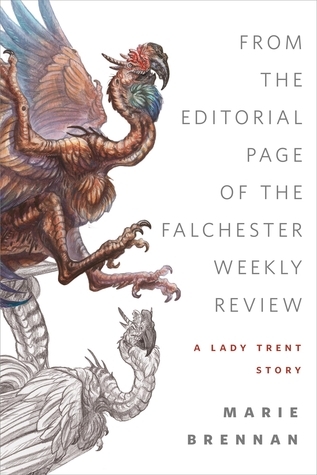
From the Editorial Page of the Falchester Weekly Review (A Lady Trent Story) by Marie Brennan — An epistolary story told through letters to the editor. More specifically, we see a dispute play out between Isabella, the protagonist of the Memoirs of Lady Trent series, and another naturalist. I found it very amusing, but I’m not sure that it stands well outside of the context of the series, but it slots in quite nicely after the third book, Voyage if the Basilisk (with only the most minor spoilers for that book). Source: https://www.tor.com/2016/04/05/from-the-editorial-page-of-the-falchester-weekly-review-a-lady-trent-story/

Mother, Mother, Will You Play With Me? by Seanan McGuire — A story about an AI child learning through games and growing up. I enjoyed it, although it wasn’t what I expected (from the title and author I expected something creepier). I liked how many different ideas it explored, and also the ending. Source: Mother of Invention edited by Rivqa Rafael and Tansy Rayner Roberts

Saturday, 7 July 2018

#ReadShortStories or poems from Uncanny (116 to 120)


Another exclusively Uncanny batch today. Not much left to go in Issue Twenty-One. The next batch will contain the last of it, I expect, along with something new. I have quite enjoyed the poems in this issue of Uncanny, more so than in the previous issue. Possibly because they're more narratively driven? Or more narratively driven in the style that appeals to me? Something like that.

Found Discarded: A Love Poem, Questionably Addressed. by Cassandra Khaw — Pretty much what it says on the label. I liked the allusions and conclusion of this one. Source: https://uncannymagazine.com/article/found-discarded-love-poem-questionably-addressed/

drop some amens by Brandon O’Brien — An amusing poem about prayer-bombs falling on various people. Source: https://uncannymagazine.com/article/drop-some-amens/

The Fairies in the Crawlspace by Beth Cato — Horrifying and wonderful. A poem about fairies and a little girl that grows up. I really liked this one. Source: https://uncannymagazine.com/article/the-fairies-in-the-crawlspace/

די ירושה by Sonya Taaffe — According to Google Translate, the title means “Quite an inheritance”. A short poem, with an interesting resonance. Source: https://uncannymagazine.com/article/די-ירושה/

The Howling Detective by Brandon O’Brien — A mysterious murder of an evil person and a lagahoo (loosely speaking something like a Trinidadian werewolf) combine in this powerful story. I quite enjoyed it and the way it engaged with a difficult subject. I got momentarily lost in the chronology, but that’s probably because I was tired when I read it. Source: https://uncannymagazine.com/article/the-howling-detective/

Thursday, 17 May 2018

#ReadShortStories that are flashy (87 to 90)


A bit of a jump in numbering this batch because I didn't want to repeat the stories that appeared for the first time in my Hugo posts and my final review of The Underwater Ballroom Society. If you missed reading my Hugo posts, you can see my thoughts and reviews of the short story ballot here and the novelette ballot here. (For completion, my novella discussion is here.) If you want to check out my reviews of the last few stories in The Underwater Ballroom Society — and my review of the whole anthology, you can find the final and complete review here.

This batch, which brings the total number of stories I've read this year to 90, contains some flash, a poem and the first story in the next anthology I've started reading: Not So Stories edited by David Thomas Moore. This anthology attempts to decolonise stories in the vein of Rudyard Kipling's Just So Stories and make them relevant to the modern age. With stories written by culturally diverse writers, of course. So far, it seems to be off to a good start.


How the Andan Court by Yoon Ha Lee — A flash piece that is more of a love letter explaining the absence of roses. Source: http://www.yoonhalee.com/?p=235

Ships in the Night by S B Divya — A flash story about a girl who can see futures and the changes everyone and everything will go through, who meets a girl who is unchanging. Source: http://dailysciencefiction.com/hither-and-yon/slipstream/s-b-divya/ships-in-the-night

Persephone in Hades by Theodora Goss — A narrative poem (is that the right term?) about Persephone missing winter while held prisoner by Hades. Source: https://uncannymagazine.com/article/persephone-in-hades/

How the Spider Got Her Legs by Cassandra Khaw — Probably my favourite Khaw story so far. Told in the style of Kipling/traditional children's cosmology stories as suggested by the title. It was also a bit longer and more complicated than I might have expected with a few acts to the story rather than just one simple origin explanation of how the spider got her legs. Anyway, I rather liked it. Source: Not So Stories edited by David Thomas Moore

Tuesday, 27 March 2018

#ReadShortStories ...That Are Mostly Poems (61 to 65)

An unusual batch this time around because I read all the Uncanny Issue 20 poems in a row, which I'm not sure is the best way to do it. Especially since my poetry reviewing skills a woefully underdeveloped compared with prose fiction. Maybe next time I'll read the poems between stories or something.

To cap it off and balance the relatively short poems, I went for a longer story from Tansy Rayner Roberts. A queer romcom about spy gadget scientists, it would have stood out even without the poems for contrast.

The Knight of the Beak by Sofia Samatar and Del Samatar — I have no idea how to review some poems, it turns out. Sorry. About a knight, sort of. Source: https://uncannymagazine.com/article/the-knight-of-the-beak/

The Cat’s Daughters by Nitoo Das — A lovely fantastical poem about the daughters of a cat. Told before they were born and after and involving magical deals. Source: https://uncannymagazine.com/article/the-cats-daughters/

Shadow-Song by Sonya Taaffe — Another poem that I’m not sure how to review. This one passed me by with my having only vague ideas as to what it’s about. Source: https://uncannymagazine.com/article/shadow-song/

1532 by Ana Hurtado — A bit too stream of consciousness for my taste. The lack of line breaks in this poem made it harder for me to follow (but again, probably best not to trust my opinion on poems). Source: https://uncannymagazine.com/article/1532/

Super Spy Science Secret Santa by Tansy Rayner Roberts — A super fun novelette set in an undisclosed Australian location. The protagonist is the head of a research group whose job it is to develop high-tech spy gadgets for the agents out in the field. An amusing and entertaining story about a Secret Santa design competition, hating fun, avoiding explosions and romance. Source: Tansy Rayner Roberts’ Patreon

Friday, 23 March 2018

#ReadShortStories (56 to 60)

In this batch, I finished reading the fiction in Uncanny Issue 20. But then, after thinking I only had articles left, I realised there was still poetry hiding towards the end so I'm not actually quite finished. But almost. (And as a reminder I'm lumping poems in with short stories in these mini-reviews, which is why there's one here and will be next batch as well.)

Your Slaughterhouse, Your Killing Floor by Sunny Moraine — A violent, angry story about being alone, about love, about destroying the world. About a girl walking into a bar and meeting another girl like her. About the end of the world. I’m not sure that I exactly *enjoyed* this story, but I certainly *felt* it. A powerful read. Source: https://uncannymagazine.com/article/slaughterhouse-killing-floor/

The Utmost Bound by Vivian Shaw — This story is about a couple of astronauts piloting a rover on Venus and finding something strange. I think it was intended to be SF horror, but I personally didn’t find it as horrific as the main character did, which lessened the impact somewhat. It wasn’t a bad story, but seeing as there was supposed to be (or so it seemed to me) more emotional impact than I felt, it fell a little flat. Source: https://uncannymagazine.com/article/the-utmost-bound/

The Date by RK Kalaw — Short and about non-humans on a date. It had some similarities with “Your Slaughterhouse, Your Killing Floor” but didn’t pack as powerful a punch and hence suffered for the comparison. (And it was not only shorter but also less angry.) Source: https://uncannymagazine.com/article/the-date/

Conservation Laws by Vandana Singh — An interesting longer story about anomalies on Mars, set in a future with people living there and on the moon. I liked the way in which the protagonist was introduced before telling his story, and also the fact that the framing narrator was someone else and saw him from a different perspective. Source: https://uncannymagazine.com/article/conservation-laws/

The Early Ones by Sofia Samatar and Del Samatar — To be honest, the way the formatting came out in the ebook on my phone, I didn’t immediately realise this was a poem rather than flash. But either way, I enjoyed it. About beings that were there before “civilisation” came along. Source: https://uncannymagazine.com/article/the-early-ones/

Friday, 26 January 2018

Short stories 16 to 20

This batch of stories was the point at which I realised that I should include poems in this whole keeping track of stories thing. Not because I read that many poems, but because otherwise any isolated poems aren't noted anywhere and that seemed like a wasted opportunity. I don't know that my reviews of poems are going to be any good (see first example below), but hey. Very short things are generally quite hard to review.

The stories (and poem):

Apathetic Goblin Nightmare Woman by Cassandra Khaw — An angry poem about meeting expectations, or not. Source: https://uncannymagazine.com/article/apathetic-goblin-nightmare-woman/

A Salvaging of Ghosts by Aliette de Bodard — A story about murky depths that warp reality and a mother mourning her dead daughter. Kind of a depressing story, set in the Xuya universe with additional interesting local world building. Source: http://www.beneath-ceaseless-skies.com/stories/a-salvaging-of-ghosts/

Rabbit Heart by Alyssa Wong — A brief story about short-lived replacements for rich people’s dearly departed. Source: https://firesidefiction.com/issue37/chapter/rabbit-heart/

The Spy Who Loved Wanton Mee by Vina Jie-Min Prasad — A short spy story that reminded me of the old spoof TV show “Get Smart” set in Singapore and more queer. Amusing and unserious. Source: http://queersoutheastasia.com/spy-loved-wanton-mee-vina-prasad-issue-1

How to Select a Durian at Footscray Market by Stephanie Campisi — This was a bit too over-written to properly grab me. There was an interesting story in there somewhere, but I found it drowned, a bit, in similes. Source: Sprawl edited by Alisa Krasnostein

Tuesday, 7 March 2017

Spelling the Hours edited by Rose Lemberg

Spelling the Hours edited by Rose Lemberg, subtitle Poetry Celebrating the Forgotten Others of Science and Technology, is not the kind of book I would usually go out of my way to pick up, mainly because I don't read very much poetry. I'd glad I did, though.

"When I first envisioned Spelling the Hours, I imagined a crowd of poets first researching and then writing about forgotten figures of science and technology around the world. What happened instead was much more intimate: many, if not all the poets wrote about people with whom they were already deeply familiar." - From the Introduction

The idea behind Spelling the Hours was to highlight some of the overlooked figures in science and technology. In practice, this means that it was a collection of poems about people other than straight cis men in science and tech. A lot of the poems were about women who did not get contemporaneous credit or recognition for their work. There was a lot of breadth in the topics covered from physics and astronomy to medicine and computing. Some of the names were familiar to me, like Jocelyn Bell and Lise Meitner, but most were not. I imagine that most readers will find at least some new names in this volume.

I'm not going to comment on every poem individually. One that particularly stood out to me was "Girl Hours" by Sofia Samatar, the last poem in the chapbook. It focusses on Henrietta Swan Leavitt and the "girl hours" used to perform calculations. I liked how it mimicked the structure of a scientific paper but in reverse and it was a poignant note to end the chapbook on.

They were all good poems though and I highly recommend this chapbook to fans of science and poetry and to anyone interested in hearing about some overlooked scientific names. I should add that, one of the reasons some of the names were familiar to me is because I am a scientist myself and some of these stories get around a bit more in the scientific community (I've seen an award named after Lise Meitner being presented and I heard about Jocelyn Bell pretty much when I learnt what a pulsar was). I imagine a different spread of names might be familiar (or more unfamiliar) to different people.

4.5 / 5 stars

First published: 2016, Stone Bird Press
Series: no
Format read: paperback
Source: gift from publisher

Thursday, 26 May 2016

The Beatriceid by Kate Elliott

The Beatriceid by Kate Elliott is an epic poem written in the style of The Aeneid but about girls at school and a prank. It is set in the world of Elliott's Spiritwalker books, which start with Cold Magic and which I haven't read.

Before Andevai, the waking of dreaming dragons, the war for Europa, and the cruel treachery of the Wild Hunt, cousins Catherine and Beatrice Hassi Barahal were novice students at the Academy. Here, Cat and Bee learned of mathematics and politics, history and storytelling. But not all stories are told or remembered in the same way--particularly where the tale of Dido and Aeneas, and the fate of Carthage and Rome are concerned.

To the victors go the spoils--only this time, it is the gilded-tongued Bee and the quick-footed Cat who will collect the winnings.

Set before the start of Cold Magic, The Beatriceid is a brand new, standalone short story written in Iambic Pentameter that reimagines The Aeneid in a feminist, Phonecian light.

This poem was shorter than I expected it to be, with the poem itself only taking up about half the ebook pages. The rest of the book was filled with an afterword explaining the reasoning behind the poem, an essay about self-rejection, and an interview with Kate Elliot conducted by the Book Smugglers. I generally wouldn't go out of my way to buy this sort of extra content in ebook form, but I didn't mind reading it after the main event.

The poem was quite amusing, featuring school girls' retellings of the story of Dido and Aeneas — modified to fit into the alternate history of the fantasy universe — framed by a school girl prank. I quite enjoyed reading the epic poetic style employed to speak of school shenanigans. And the actual prank itself. I suspect there were also several references to the source material that went over my head, but that didn't spoil my enjoyment of the poem.

I am, at this point, wondering why I haven't already read Cold Magic. From the description in the afterword, it sounds like a fantasy book I would enjoy. It was a little strange, perhaps, to read the Beatriceid without having read any other books set in the same world, but after Tansy raved about it on Galactic Suburbia, I couldn't resist. I don't think there are any issues reading it without the wider context, but I suspect people already familiar with the characters will get more out of it.

4 / 5 stars

First published: 2015, Book Smugglers Publishing
Series: Set in the Spiritwalker universe. Goodreads has it listed as book "3.5"
Format read: ePub
Source: purchased from Kobo store

Saturday, 2 March 2013

The Sunlit Zone by Lisa Jacobson

The Sunlit Zone by Lisa Jacobson is different to the books I normally read. It's written in verse. It's also much more literary than my usual fare, even when compared with the more literary books I've read recently, like the The Mad Scientist's Daughter. I admit I probably wouldn't have given it much of a second glance if not for the fact that after I tweeted in mock shock about a spec fic book* making the Stella longlist, Kerryn Goldsworthy (chair of the Stellar judging committee) tweeted at me that there were actually two spec fic books on the longlist and directed me to The Sunlit Zone.

*Sea Hearts by Margo Lanagan, which I'll get around to reading and reviewing some time hopefully soon

The Sunlit Zone is told by North in two parallel time-lines: her present in 2050 and her childhood from birth in 2020ish through to high school and university. North is a marine biologist, working in the fictional Victorian coastal town Anglers Bay, where she grew up. The future chapters serve mainly to establish North's character, friends and the setting. The real story, in my opinion, was the journey through her childhood.

The form of the writing means that mostly what we see isn't quite a long narrative as prose would more likely be, but a series of moments, some directly connected to the ones either side, others a bit less so. The glimpses we see of North's childhood show her growing up with her uniquely different twin sister on one hand (with allusions of selkie) and the neighbour's perfect genetically engineered daughter on the other. The friction comes from both sides; her sister's childish joy standing in the way of North's chosen activities, and the neighbour's sophisticated perfection, egging North on.

The science fictional elements in The Sunlit Zone are relatively minor, mostly confined to the genetic engineering and futuristic mundane technology. As a science fiction reader, I found the technology a bit iffy. The brevity of the form restricted the descriptions spent on future tech leaving fewer words with which to stuff it up. Nevertheless, there were a few odd things like referring to future ereaders generally as ibooks and similar. The sciencey strength, to me, was the marine biology and genetic engineering, although a biologist might disagree with me. Overall, the worldbuilding was the weakest part and the delivery (the writing) the strongest.

I was surprised how readable The Sunlit Zone was, given that it's poetry of which I don't usually read much. If you're wondering, it's not rhyming verse, although there are a few occasional scattered rhymes. I may be wrong, but I got the feeling that the more upset North was the more there was a rhyme and beat, although most of the time it was absent. I think others who don't usually read poetry would equally find it readable and should give it a try. If you're unsure (as I admit I was), you can read a sample in the Kobo store to get an idea of what it's like.

I really enjoyed reading The Sunlit Zone, but ultimately I was disappointed by the ending. It was a bit too subtle for my tastes. The story is a personal journey for North in which she comes to terms with her past, which is fine. The disappointment comes from the fact that I feel if it was a more science fictional (or fantastical) story, the ending would have been a bit more hopeful and less mundane. I suppose it's that I had an image in my head of an ending that almost but not quite came to pass. The real ending made me rethink the whole book and find it more depressing than I had upon first reading. Having given this point more consideration I've realised that my expectations were based on a spec fic trope that the author, being a poetry person, rather than a spec fic person (as far as I can tell from her website), probably wasn't aware of/didn't give consideration to while writing. And so the trope's absence in the ending of The Sunlit Zone does not necessarily signify the depressing view I first thought. Interesting how our expectations can define how we perceive stories and how we think stories should work.

Anyway, The Sunlit Zone was overall a good if unusual read. I would recommend it to anyone looking for something different to the usual spec fic fare. I think it's worth a read purely for the way it's written (which I suppose is why it made the Stella longlist) and I imagine readers who usually shy away from speculative fiction would enjoy it as literature. It's not a long read, either, and not the kind of poetry that one has to reread a few times to digest, so I do encourage you to give it a go.

4 / 5 stars

First published: 2012, Five Islands Press
Series: No.
Format read: Kobo ebook
Source: Kobo store
Challenges: The Australian Women Writers Challenge, Australian Science Fiction Reading Challenge