Showing posts with label historic fantasy. Show all posts

Monday, 19 July 2021

She Who Became the Sun by Shelley Parker-Chan

She Who Became the Sun by Shelley Parker-Chan is the first book in the Radiant Emperor series. Since I try not to remember blurbs, I did not realise until partway through that it was based on a historical person. This does mean that Wiki can tell you where the story is going, but this isn't much of a spoiler since the journey is very open to interpretation, as Parker-Chan shows us.

She’ll change the world to survive her fate . . .

In Mongol-occupied imperial China, a peasant girl refuses her fate of an early death. Stealing her dead brother’s identity to survive, she rises from monk to soldier, then to rebel commander. Zhu’s pursuing the destiny her brother somehow failed to attain: greatness. But all the while, she feels Heaven is watching.

Can anyone fool Heaven indefinitely, escaping what’s written in the stars? Or can Zhu claim her own future, burn all the rules and rise as high as she can dream?

I enjoyed this book a lot. Set shortly before the fall of the Yuan Dynasty, it follows a peasant girl, Zhu, who grew up in a famine and extreme poverty. Her sheer determination to survive and not  have an insignificant "nothing" destiny, sees her take on her brother's identity and join a monastery. Unlike many stories with the girl-dresses-as-boy trope, it does not involve a romance with her best monk friend but rather takes a more complicated and queer direction. I really enjoyed reading about Zhu and I appreciated the lengths she was willing to go to for her goal/dream/destiny.

The other protagonist is a eunuch general on the Yuan side (as opposed to the people who are sick of being ruled over by the Yuan, which is the side Zhu is on). He is bitter and vengeful against the Yuan but in an interesting position, since he genuinely likes the Prince he serves. He and Zhu have a few run-ins, which were quite dramatic, despite the fact that they both want similar things. I didn't enjoy his point of view sections as much, especially in the first part of the book, but they got more interesting as we learnt more about him and as events progressed. In any case, he was a good foil for Zhu.

I highly recommend this book to people who enjoy historic fantasy, especially people looking for books set in Asia. She Who Became the Sun did not end on a cliffhanger, but did leave the story unfinished, so I am very much looking forward to reading the next book, when it comes out.

5 / 5 stars

First published: July 2021, Tor Books
Series: The Radiant Emperor book 1 of ?
Format read: eARC
Source: Publisher via Netgalley

Sunday, 15 March 2020

Songwoman by Ilka Tampke

Songwoman by Ilka Tampke is set during the time of the Roman invasion of Britain, around the 40s AD. It is technically a sequel to Skin, but actually both books stand alone fairly well. They follow the same protagonist, but the two stories are separate, if sequential. I read Skin during a blog hiatus, so there is only a mini review of it, alas.

Haunted by the Roman attack that destroyed her home, Ailia flees to the remote Welsh mountains in search of the charismatic war king, Caradog, who is leading a guerrilla campaign against the encroaching army.

Ailia proves herself an indispensable advisor to the war king, but as the bond between them deepens, she realises the terrible role she must play to save the soul of her country.

Set in Iron-Age Britain, Songwoman is a powerful exploration of the ties between people and their land and what happens when they are broken.

I started reading Songwoman after a day trip to northern Wales, during which a friend and I visited a few castles (built more than a millennium after this book was set), and drove through Snowdonia with some breathtaking views, even in winter. So I was excited to start reading a book set in roughly the same area. The setting of Songwoman did not disappoint. The plot, however, was a little slow.

The bulk of the story involves Ailia being part of the inner circle of Caradog's resistance army. Her personal journey is split between learning the mystical arts, her relationship with Caradog, conflict with some of Caradog's other advisors, and the actual war. The war is mostly a series of small skirmishes and recruitment negotiations, and hence felt like it moved slowly, but in a realistic way. I actually found the relationship with Caradog the most drawn out. I don't want to spoil too much, but I will say that it was interesting that he was portrayed in a way that could be read as bipolar, but that was the most interesting thing about him. I did not quite understand Ailia's emotional attachment to him, especially since I spent a chunk of the start of the book hoping a key character from Skin would make an appearance (he did not).

So on the one hand, Songwoman was a little slow — though not unpleasant to read, aside from a few brief atrocities — but on the other hand, I was actually surprised at how little time was covered in the book. Near the end, there's a scene in which Ailia returns somewhere and notes that it's been a year since she was last there, at the start of the book. I was honestly shocked that only a year was supposed to have passed. This is maybe because, as the author mentions in the afterword, a few years of historical events were compressed  into one year for expediency. However, given my other reaction, I'm wondering whether that was the best choice. That said, I actually liked certain events around the ending a lot. (Being vague to avoid spoilers.) It added an extra dimension to the story, confusing timing aside.

Anyway, I mostly enjoyed Songwoman, even though it took me a while to get through. I recommend it to fans of historical fantasy and, particularly, Welsh settings. While it makes sense to read after Skin, it's not entirely necessary. While I don't expect a sequel, I am broadly interested in the author's future works.

4 / 5 stars

First published: 2018 Text Publishing, with US edition March 2020
Series: sequel to Skin
Format read: eARC
Source: Publisher via Edelweiss

Saturday, 14 September 2019

The Resurrectionist of Caligo by Wendy Trimboli and Alicia Zaloga

The Resurrectionist of Caligo by Wendy Trimboli and Alicia Zaloga is, I believe, the debut novel of both coauthors. It's a fantasy-Victorian-era/gas-lamp fantasy novel about a princess and a "resurrectionist" who (illegally) digs up bodies to sell to doctors and medical students. Also, it has a gorgeous cover, which I urge you to zoom in on if you haven't already.

With a murderer on the loose, it's up to an enlightened bodysnatcher and a rebellious princess to save the city, in this wonderfully inventive Victorian-tinged fantasy noir.

"Man of Science" Roger Weathersby scrapes out a risky living digging up corpses for medical schools. When he's framed for the murder of one of his cadavers, he's forced to trust in the superstitions he's always rejected: his former friend, princess Sibylla, offers to commute Roger's execution in a blood magic ritual which will bind him to her forever. With little choice, he finds himself indentured to Sibylla and propelled into an investigation. There's a murderer loose in the city of Caligo, and the duo must navigate science and sorcery, palace intrigue and dank boneyards to catch the butcher before the killings tear their whole country apart.

This book is set in a world where the nobility (and especially royalty) has magic, technology is roughly early-Victorian, and class and poverty divides are stark. Our low-class protagonist, Roger, wants to be a surgeon, but can't afford the tuition fees. He also becomes interested in a string of murders after stumbling over an unusual dead body and wants to solve them, getting himself framed in the process. The princess Sibylla, meanwhile, was a childhood friend-then-lover of his, but is mostly consumed by her own typical problems, like a forced betrothal to her annoying cousin. Their stories don't directly intersect until quite late in the book, which I found a little disappointing. I kept waiting for a dramatic reconnection, but it was pushed back surprisingly far.

I found the start of the book a little slow. This was exacerbated by the fact that the blurb summarises a large swath of the story and I was more than half-way through the book by the time I felt like I'd caught up with the expectations the blurb had set. Also, while Roger was trying to solve the murder mystery, it wasn't so much his cleverness that helped him with the day as luck, always a disappointing plot twist.

Overall, this book was OK. It took me a while to get into it and the resolution was interesting but not executed the way I expected. There's also a spoilery thing near the end which made me raise an eyebrow for the lack of exploration given to it and was an unpleasant note to leave on. That said, the story is self-contained but the end set up a potential sequel which could be an interesting read. I would certainly consider picking it up if it comes to exist. I recommend this book to fans of gas-lamp fantasy and Victorian-ish settings. Also, corpses.

3.5 / 5 stars

First published: September 2019, Angry Robot
Series: Not yet but maybe?
Format read: eARC
Source: Publisher via NetGalley

Saturday, 28 April 2018

#ReadShortStories... about underwater ballrooms and bloody revolutions (76 to 80)


This batch mostly, but not solely, contains stories from The Underwater Ballroom Society, an anthology edited by Stephanie Burgis and Tiffany Trent that I’ve been reading (as you may have noticed if you regularly follow my blog posts). I kind of expected that I’d break them up a bit more, but things worked out this way when the stories were hard to put down.

Penhallow Amid Passing Things by Iona Datt Sharma — This story took a little bit to get into its stride, but I enjoyed it once it did. Smuggling, a brief lesbian romance, and fading magic are the elements that make up this story. The world was well constructed, for all that we only saw a small part of it. I find myself wondering whether there are other stories set there. Source: The Underwater Ballroom Society edited by Stephanie Burgis and Tiffany Trent

Mermaids, Singing by Tiffany Trent — I really enjoyed this novella. It’s set in Victorian London and follows a weredog from another world and a half-Chinese British girl from this one. The depth of world building is excellent and the story balances the weird fantasy elements with the more mundane well. Source: The Underwater Ballroom Society edited by Stephanie Burgis and Tiffany Trent

After a Revolution by Dimas Ilaw — An angry story about resistance in the real world and the horror of various revolutions in the Phillipines. The second I’ve read from this author in a similar vein and I continue to be unsure how I should feel about the story as a story (aside from outraged at the content). Source: https://uncannymagazine.com/article/after-a-revolution/

A Brand New Thing by Jenny Moss — A story set in the late 1920s about a neuroatypical girl, her disapproving family, books and something magical. I really enjoyed it and was delighted by the book references and metaphors. I was also pleased with the happy ending. Source: The Underwater Ballroom Society edited by Stephanie Burgis and Tiffany Trent

Four Revelations from the Rusalka Ball by Cassandra Khaw — Not a novella; actually a fairly short story. Much shorter than I expected. But on the other hand, about the level of surreal that I’ve come to expect from Cassandra Khaw. The title pretty much says it all. Source: The Underwater Ballroom Society edited by Stephanie Burgis and Tiffany Trent

Thursday, 21 September 2017

Please Look After This Angel: and other winged stories by Tansy Rayner Roberts

Please Look After This Angel: and other winged stories by Tansy Rayner Roberts is a short collection of four short stories that was originally given away to her newsletter subscribers (which is how I got it), then Patreon supporters, and soon will be available for general sale.

Even the most ordinary lives have extraordinary moments.
A breath of frozen time.
A shabby angel spotted in a bookshop, or at a party.
An ex-girfriend turned famous poet, who wants to trap you as her muse.
A lonely prisoner, weaving a tangled web to pass the time when her lover wil actually notice her.
A soldier, exhausted from the War Effort against the aliens, making an emotional connection with her enemy.

These stories have wings.

I picked this up partly because of my challenge to myself to read 100 short stories by the end of the year, and this little collection happened to be near the top of my iBooks pile of short fiction. It also lured me in by being fairly short, and hence feeling like a less daunting time investment when I'm also in the middle of a novel I don't want to put down for long (stay tuned). As usual, I have written some comments on each story as I've gone along. Because I've been partly using the comments to tweet about the stories as I read them, they may be briefer than usual (but generally longer than the tweeted versions.

~

Please Look After This Angel — A story about an ordinary life which happens to intersect with an angel a few times.

The Raven & Her Victory — A creepy, magical, Poe-inspired story about lesbians. I enjoyed it, but wow was the ending creepy and kind of surreal.

The Curse Is Come Upon Me, Cried — A weird story. A blend of fairytale, the modern world, Arthurian themes and horror. Probably my least favourite, although I liked the imps and the idea of maintaining a sense of self when you're invisible.

Of War & Wings — Steampunk angel women fighting off alien invaders in a Blitz-like London (but set earlier than WWII). My absolute favourite story of the collection. Gorgeous and terribly sad. I suspect it's an excellent fit for fans of Roberts' Creature Court trilogy.

~

I really enjoyed this collection and I recommend it to all fans of the author's work and to fans of spec fic (more on the fantasy side) stories generally. I especially loved "Of War & Wings" which had a lot of depth in worldbuilding, to make it all the more heartbreaking. I highly recommend picking up a copy of the collection when it shortly becomes available.

4.5 / 5 stars

First published: September 2017, self-published
Series: No
Format read: ePub
Source: freebie from newsletter subscription and also Patreon
Disclaimer: Although Tansy is a friend, I have endeavoured to give an unbiased review
Challenges: Australian Women Writers Challenge

Friday, 18 August 2017

Snowspelled by Stephanie Burgis

Snowspelled by Stephanie Burgis is a fantasy novella set in an alternate magical England (Angland) and featuring a female magician. Her femininity is notable because in Angland men do the magicking while women do the politicking.

In nineteenth-century Angland, magic is reserved for gentlemen while ladies attend to the more practical business of politics. But Cassandra Harwood has never followed the rules...

Four months ago, Cassandra Harwood was the first woman magician in Angland, and she was betrothed to the brilliant, intense love of her life.

Now Cassandra is trapped in a snowbound house party deep in the elven dales, surrounded by bickering gentleman magicians, manipulative lady politicians, her own interfering family members, and, worst of all, her infuriatingly stubborn ex-fiancé, who refuses to understand that she’s given him up for his own good.

But the greatest danger of all lies outside the manor in the falling snow, where a powerful and malevolent elf-lord lurks...and Cassandra lost all of her own magic four months ago.

To save herself, Cassandra will have to discover exactly what inner powers she still possesses – and risk everything to win a new kind of happiness.

A witty and sparkling romantic fantasy novella that opens a brand-new series for adults from the author of Kat, Incorrigible, Masks and Shadows and Congress of Secrets.

This is a romance-light romance novella. There is a romantic storyline but it was secondary to the main story of our heroine, Cassandra, which involved a dangerous run in with an elven lord and an unnatural snowstorm. The elves in this story, by the way, are more Pratchett than Tolkien, aside from having a treaty with the humans.

This was a fun story in a somewhat gender-swapped world, giving a slightly different take on a woman trying to enter a male-dominated field. I didn't really understand why, in a world ruled by women, they were still wearing skirts, however. Nevertheless the core idea of a society ruled by alternative gender roles was interesting and the tale had a distinct feminist bent to it, even within the context of the fantasy world.

Snowspelled was a delightful read and I am definitely looking forward to reading more about Cassandra, her adventures, and her friends. I recommend it to fans of historical and/or regency(-esque) fantasy and fantastical romance. The next instalment in this series is coming in 2018 and I, for one, can't wait.

4.5 / 5 stars

First published: September 2017
Series: yes. Volume one of The Harwood Spellbook, the first of a planned series
Format read: ePub
Source: ARC from author in Twitter giveaway

Saturday, 28 May 2016

Sorcerer to the Crown by Zen Cho

Sorcerer to the Crown by Zen Cho is the author's first full-length novel and the first book in a trilogy. You may recall my recent reviews of Cho's novellas, which I quite enjoyed. I started listening to Sorcerer to the Crown as an audiobook shortly after reading those. The nature of audiobooks meant that it took me a while to clock up enough driving time to get through it all.


At his wit’s end, Zacharias Wythe, freed slave, eminently proficient magician, and Sorcerer Royal of the Unnatural Philosophers—one of the most respected organizations throughout all of Britain—ventures to the border of Fairyland to discover why England’s magical stocks are drying up.

But when his adventure brings him in contact with a most unusual comrade, a woman with immense power and an unfathomable gift, he sets on a path which will alter the nature of sorcery in all of Britain—and the world at large… Less

Sorcerer to the Crown follows two characters in Regency England: the Sorcerer Royal, Zacharias Wythe, and Prunella Gentleman, an orphaned young lady who starts off the story as the ward of the mistress of a magical school for girls. The school does not concern itself with teaching girls magic, however, rather it teaches them how to suppress it so that the proper magic users of the world — i.e. men — can get on with the proper magical work. The two characters' path's cross when Zacharias is strong-armed into visiting the school to give a talk.

There was much hilarity in this book. I found myself laughing out loud several times. A lot of the humour comes from manner-punk interactions, which put me in mind of Gail Carriger's books, as did Cho's novellas. This novel is actually more similar to Carriger's work since there is magic (but not werewolves in society or anything like that), more humour, and a strongly English setting.

I enjoyed reading the interactions between Prunella and Zacharias — and the other characters, but especially those two — very much. They were both excellent characters. Prunella sewed mayhem wherever she went — other than social situations in which that would be inappropriate! — while Zacharias was an interesting character to read for other reasons. He is tightly constrained by his position, by societal expectations and by the fact that he is black and has to live with never ending microaggressions. He is always painfully aware of what is appropriate and what people might think, whereas Prunella is less concerned with that, especially in magical situations. Their conflicting interplay lead to much amusement.

I really enjoyed this book. I suspect I would've enjoyed it even more if I read it with my eyes rather than my ears, but that only really affected how long it took me to get into the story at the start. That said, it mostly worked well as an audiobook. I think I would prefer to read the sequel with my eyes, but mainly so that I could get through it faster. I cannot wait until the next book is released and am a bit disappointed that I have to wait until next year! I strongly recommend this to all fans of fantasy, humorous fantasy and manner punk. I loved it.

4.5 / 5 stars

First published: 2015, Ace
Series: Sorcerer Royal book 1 of 3
Format read: audiobook
Source: Audible

Tuesday, 24 May 2016

Waters of Versailles by Kelly Robson

Waters of Versailles by Kelly Robson is a novella about an ex-soldier (well, officer, I think) currently residing in Versailles and fitting the palace with plumbing. As in new-fangled toilets, and also fountains. He has some supernatural help.

Waters of Versailles by Kelly Robson is a charming novella of court intrigue in 1738 Versailles as a clever former soldier makes his fortune by introducing a modern water system (and toilets) to the ladies of the palace. He does this with magical help that he may not be able to control.

I was kind of expecting this novella to be funnier than it was. The concept struck me as lending itself to a comedic tale, but this wasn't one. That's not to say it wasn't lighthearted and, at times, amusing, but going in, I had been hoping to laugh more.

That said, it was a fun and entertaining read. I certainly wasn't bored at any point. Sylvain, the protagonist, paints himself into a corner with his plumbing venture and a lot of things go wrong for him. The main story was his progress in fixing problems and pushing new limits with the plumbing.

Although it wasn't as laugh-out-loud funny as I had hoped, I enjoyed this novella and will happily read any more of Robson's work that crosses my path. I recommend Waters of Versailles to fans of period fantasy and court shenanigans. Also, you can read it free on Tor.com.

4 / 5 stars

First published: June 2015, Tor.com
Series: No.
Format read: iBooks ePub
Source: Purchased from iBooks

Friday, 6 May 2016

Soundless by Richelle Mead

Soundless by Richelle Mead is a standalone YA novel, set in a mountainous Chinese (fantasy) village. The main labour in the village is mining and the unique premise of the story/world building is that the entire village is deaf and has been for several generations.

For as long as Fei can remember, no one in her village has been able to hear. Rocky terrain and frequent avalanches make it impossible to leave the village, so Fei and her people are at the mercy of a zipline that carries food up the treacherous cliffs from Beiguo, a mysterious faraway kingdom.

When villagers begin to lose their sight, deliveries from the zipline shrink. Many go hungry. Fei and all the people she loves are plunged into crisis, with nothing to look forward to but darkness and starvation.

Until one night, Fei is awoken by a searing noise. Sound becomes her weapon.

She sets out to uncover what’s happened to her and to fight the dangers threatening her village. A handsome miner with a revolutionary spirit accompanies Fei on her quest, bringing with him new risks and the possibility of romance. They embark on a majestic journey from the peak of their jagged mountain village to the valley of Beiguo, where a startling truth will change their lives forever…

Fei lives in an isolated and oppressed village that is forced to mine and send valuable metals down the mountain (via a pulley system) in exchange for barely enough food to survive. Due to her skill as a painter, Fei doesn't have to work in the mines and instead gets to live a life of relative luxury. However, when her sister starts to lose her sight and an accident drives her star-crossed love interest to take action, Fei finds herself taking action too. A perilous climb down the cliff side of their mountain takes the two teens on a journey that shows them the truth about the outside world and their village's circumstances. Redressing the wrongs done to their village isn't straightforward, of course.

An important thing to know about the premise of Soundless is that Fei, the main character, magically gains hearing fairly early on. Although the rest of the village remains deaf and Fei continues to sign all the time (because magic hearing does not come with magic speech recognition), it's not a book about a deaf main character. (However, as my husband pointed out when I was telling him about it, some of Fei's experiences may be similar to those of people hearing for the first time after getting cochlear implants.)

In any case, I found this a more interesting and compelling read than I initially expected. I ended up reading it in about two sittings — it's not a long read — and enjoyed the reasonably straightforward plot. I admit I wasn't sure how much of a spec fic novel it was going to turn out to be since there are minimal fantasy elements other than at the very start and end, but the ones at the end are especially fantastical.

I would recommend this to fans of YA, especially those looking for a quick read and to whom the premise appeals. I wouldn't specifically recommend it for people looking for disability in their fiction. It doesn't do a terrible job in that respect... but on the other hand there is the whole magical cure aspect for the main character. Your mileage may vary.

4 / 5 stars

First published: 2015, Razorbill
Series: Nope!
Format read: ebook
Source: Borrowed from the library (via BorrowBox)

Sunday, 17 April 2016

Monstrous Little Voices: New Tales From Shakespeare's Fantasy World

Monstrous Little Voices is a novella anthology, containing five somewhat interlinked novellas written by Jonathan Barnes, Emma Newman, Kate Heartfield, Foz Meadows and Adrian Tchaikovsky. They are more or less set in the world of some of Shakespeare's plays, but extended beyond what happens in the original play, and tweaked so that all the referenced plays actually happened in the same world of fairies, magic and politics.

Mischief, Magic, Love and War. 

It is the Year of Our Lord 1601. The Tuscan War rages across the world, and every lord from Navarre to Illyria is embroiled in the fray. Cannon roar, pikemen clash, and witches stalk the night; even the fairy courts stand on the verge of chaos. 

Five stories come together at the end of the war: that of bold Miranda and sly Puck; of wise Pomona and her prisoner Vertumnus; of gentle Lucia and the shade of Prospero; of noble Don Pedro and powerful Helena; and of Anne, a glovemaker’s wife. On these lovers and heroes the world itself may depend. 

These are the stories Shakespeare never told. Five of the most exciting names in genre fiction today – Jonathan Barnes, Adrian Tchaikovsky, Emma Newman, Foz Meadows and Kate Heartfield – delve into the world the poet created to weave together a story of courage, transformation and magic. 

This was an interesting read, even when the stories touched upon Shakespearean plays I was not very familiar with. My favourite story was definitely the opening one, "Coral Bones" which extended the story of The Tempest beyond where the play ended and included some neat genderfluid characterisation. My second favourite story was probably the closing one, "On the Twelfth Night", mainly for the way it played with narrative by writing in the second person. That story would not have really made sense without all the stories preceding it, however. I was particularly impressed by how the later stories seemed to be aware of events in the earlier stories. An excellent feat of narrative planning.

I definitely recommend this anthology to fans of Shakespeare and fans of fantasy fiction generally. And theatre. These novellas push Shakespeare's plays into new territory, giving them some modern sensibilities without literally modernising the settings. As always, individual comments on the stories are below.

~

"Coral Bones" by Foz Meadows — What happens after The Tempest. Miranda has left the island, but the real world did not bring her as much joy as she hoped. Luckily, she still has Ariel, the genderfluid fairy who helped raise her and keep her sane. This was a very strong start to the anthology, which had me wanting to come back for more every time I had to set it aside. The main story is neatly intertwined with flashbacks to the island, which serve to build up our understanding of and sympathy for Miranda's relationship with Ariel. In the meantime, we also see quite clearly Miranda learning about herself and the world and, thanks to Ariel's influence (or really, just her presence from an early age), questioning her place and identity in it.

"The Course of True Love" by Kate Heartfield — This novella involves some of the characters from Midsummer Night's Dream but mainly focused on a hedge witch (well, a wyrtwitch) who stumbles upon a prisoner of Titania's and ends up helping him out. This wasn't a bad novella but I just didn't love it as much as the previous one, which set the bar quite high. I suspect if I'd read it in isolation without the comparison, I would have enjoyed it more. As it was, it was well written enough, but didn't push the envelope like "Coral Bones" did.

"The Unkindest Cut" by Emma Newman — A young woman is fated to marry her love in an alliance that will end a war. But even though it has been foretold, nothing is straightforward when Prospero is involved, or the cursed knife from Macbeth. Not a bad story, but I thought it ended a little abruptly. I didn't dislike the ending, but wouldn't've minded seeing more, or more immediately before the end. (Also, it was a depressing ending, which I wouldn't have wished upon the main character. :-/ ) It was a nice touch to have the Miranda from "Coral Bones" appear and I am impressed with the planning that must have gone into this anthology.

"Even in the Cannon’s Mouth" by Adrian Tchaikovsky — I felt a bit lost during the middle of this story. I think it might have been because of the more theatrical/script-like scene changes the author used. It took me a little while to get used to paying attention to them properly. That said, I liked the version of Macbeth that appeared in this one (and had sort of been mentioned in earlier stories, but not nearly as clearly). I especially loved the ending as it involved Macbeth. Not to be too obvious with the spoilers, but a favourite loophole-fail is resolved. I also got the impression that this story was leading into some sort of climax in the last story...

"On the Twelfth Night" by Jonathan Barnes — This last story was fascinating in many ways. It did sort of tie up some of the weirder elements of the plot brought up in the previous story, but that wasn't what really made it stand out. Usually, it was written in second person... and (very minor spoiler) the second person was Shakespeare's wife. Not quite the wife of the Shakespeare that we know, though, but rather a non-playwright from a parallel universe. I found it quite a compelling read (especially compared with the previous novella, which did not hold my interest). Unfortunately, for readers who might have picked these novellas up individually rather than in the collected volume, I'm not sure that this novella would work as well as a standalone. But it does make an excellent conclusion to this anthology.

4.5 / 5 stars

First published: January 2016, Rebellion
Series: No, unless you count Shakespearian as a series
Format read: eARC
Source: Publisher via NetGalley

Sunday, 13 July 2014

Razorhurst by Justine Larbalestier

Razorhurst by Justine Larbalestier is a YA historical fantasy set in Sydney in the 1930s. I have to admit, I didn't know very much about Sydney in the 1930s until I read this book but it certainly seems like it was an interesting period.
The setting: Razorhurst, 1932. The fragile peace between two competing mob bosses—Gloriana Nelson and Mr Davidson—is crumbling. Loyalties are shifting. Betrayals threaten.

Kelpie knows the dangers of the Sydney streets. Ghosts have kept her alive, steering her to food and safety, but they are also her torment.

Dymphna is Gloriana Nelson’s ‘best girl’, experienced in surviving the criminal world, but she doesn’t know what this day has in store for her.

When Dymphna meets Kelpie over the corpse of Jimmy Palmer, Dymphna’s latest boyfriend, she pronounces herself Kelpie’s new protector. But Dymphna’s life is in danger too, and she needs an ally. And while Jimmy’s ghost wants to help, the dead cannot protect the living . . .
Razorhurst follows two main characters, both of whom can see ghosts: Kelpie, a street urchin and Dymphna, the most expensive prostitute in the city. Kelpie has survived on the streets in large part thanks to some ghost who have taken her under their wings, helped her find food and taught her general survival skills. Dymphna has survived mostly by being good at what she does and having the right appearance and upbringing to impress higher society types.

One of the things I found really interesting was the way the story was told. Alternating chapters were from Kelpie and Dymphna's points of view and in between chapters there were short, semi-omniscient mini-chapters (I'd call them sections but they did have headings, if not numbers) telling the story of someone's past, usually. If not a flashback to one of the main characters' pasts, then the back story of one of the secondary or incidental characters. As a story-telling method it worked really well. The reader gained information that neither Kelpie nor Dymphna knew, which fleshed out the plot and, in some cases, cast other events in a new light. Or gave us back story for the main characters which it didn't make sense to insert into the main narrative. In this way, Razorhurst is as much about the region of Surrey Hills more generally as it is about Kelpie and Dymphna specifically. I found it a really effective way to set the historical scene.

I enjoyed Razorhurst a lot. Larbalestier has a way of revealing information gradually that worked really well for me. There were some things we didn't learn about Kelpie until much later, which other authors may have foregrounded much sooner. I'd be more specific, but I don't want to ruin the reading experience for others. In part, though, I think this is also a reflection of how Kelpie hasn't had much opportunity — until the start of the story — to put her own life into context with those around her who aren't also living in the streets. For example, she doesn't even know how old she is at the start of the story and doesn't understand why people keep asking her that anyway. Dymphna, on the other hand, has always been very aware of her place in life and society and how to play the roles she needs to to survive. More acutely horrible things have happened to Dymphna, but she's also had more opportunities and knows how to make use of them. Kelpie, on the other hand, has mostly only had to worry about finding (barely) enough food and somewhere warm to sleep.

The ghosts are an important element in the story but not actually the driver of the plot in anyway. They're just another form of character and, at times, a challenge for Dymphna and Kelpie to overcome. The main plot is of the "who will try to kill us next and where can we be safe" variety, and the whole novel spans approximately twenty-four hours.

I highly recommend Razorhurst to pretty much everyone. Well, not younger-than-YA readers, since there's several short bursts of acute violence — the story does revolve around razor gangs, after all — but anyone interested in historical fiction as well as the more speculative element. I think the story will work for both types of readers, and for readers who don't usually read YA.

5 / 5 stars

First published: June 2014, Allen & Unwin
Series: No.
Format read: ePub
Source: Purchased from iBookstore
Challenges: Australian Women Writers Challenge

Tuesday, 1 July 2014

Innocence Lost by Patty Jansen

Innocence Lost by Patty Jansen is the first book in the For Queen and Country fantasy series, which is not related to any of her other series. It's set in a fantastical Dutch-inspired land and is actually pretty short for a fantasy novel.
Johanna has a special gift. If she touches wood, she sees the wood's "memories". The problem is, her gift is strictly forbidden by the Church of the Triune.

The wood shows her that a fierce army is headed for the city of Saardam. Unaware of the danger, the kingdom is instead happily anticipating their annual ball and gossiping about the arrival of the mysterious crown prince whom no one has seen in years.

Johanna has to tell someone, but who and why would anyone believe her?

This was an enjoyable read. It's brevity and style made it an easy read, which was exactly what I felt like at the time. It did end on a bit of a cliffhanger, however, so fair warning for those that don't like 'em. The second book, Willow Witch, is already out, if that helps, however I suggest not reading the blurb since it does rather spoil the end of Innocence Lost.

Johanna is the daughter of a rich merchant. She doesn't like dresses and isn't keen on marrying but, as her father points out, if she doesn't marry someone, she can't inherit the business. Even better, if she marries the prince, she will be allowed to inherit in her own right, and not only through her husband. But, when she finally meets the prince, she discovers why he's been in seclusion for most of his life.

<spoiler for prince's condition, revealed about halfish way>
The prince has some sort of intellectual disability. The entire extent of his issues aren't clear, but the term bandied about the most by characters in the book was "halfwit". There are problems, of course, with his inheriting the throne and, for that matter, finding someone to marry (the fact that his father pissed off a lot of nobles doesn't help on that front either). I thought the matter was dealt with well enough and almost every cringe moment had a counterpoint.
</ end spoiler>

The other characters are Johanna's market friend, who also has magic and who spends the whole book bewitched (or something) into not being able to talk. We only really learn about her from Johanna's perspective. Well, I should say, the whole book is in close third person from Johanna's point of view. But the other central characters, Johanna's maid and her father, show more of themselves on the page by interacting more directly (and we still get Johanna's commentary on them).

The prose is easy to read and not overly flowery. There were some very memorable lines/scenes throughout. I want to share one of my two favourites (the second is a spoiler, so I won't).  It can pretty much be summarised with this quote:
Kylian said softly, “You know you’re not like any woman I’ve ever met?”

Johanna turned her head sharply to him. “Then you haven’t met any real women, only dishrags.”
I quite enjoyed Innocence Lost and I definitely want to read the sequel at some point. *eyes scary TBR pile* I recommend it for anyone after a light, non-strenuous read. I should also note that it's not YA — the main character is 24 — but it's not that far off. Also, being quite short, it's obviously much less complex, plot-wise, than BFF books.

4 / 5 stars

First published: March 2014, Self-published
Series: For Queen and Country book 1 (of 4, I think)
Format read: eARC
Source: author via NetGalley
Disclaimer: Although Patty is a friend, I have endeavoured to give an unbiased review
Challenges: Australian Women Writers Challenge

Saturday, 7 June 2014

Uprising by Sarah Cawkwell

Uprising by Sarah Cawkwell is the first book in the Heirs of the Demon King series. It's set in an alternate historical timeline where magic and demons cause changes to English history as we know it. The blurb from goodreads:
Epic fantasy meets alternate history in a sweeping saga that crosses the medieval world. Matthias Eynon must escape the clutches the Witchhunters and locate the masters of the four magic arts to overthrow the tyrannical Demon King, descendant of the twisted Richard III.

Mathias Eynon's dreams were small. A dabbler in magic, and son of a magician, he expected to live in obscurity in his home in the Welsh hills, quietly conducting his experiments and hoping not to draw too much attention to himself.

But fate has other plans for him. It is the Year of Our Lord Fifteen-Ninety, and a revolution is quietly brewing, here and further abroad. Richard V has overstayed his rule, some say; others whisper that the whole line of Demon Kings must be burned out. Mathias son of a man executed for the practice of magic, forbidden by the paranoid king is set to become a symbol, and a leader.

And to do that, he needs champions. A wise woman sends him to the corners of the known world to the frozen lands of the Danes, to the pirate-haunted ports of Spain, to the mountains of the German Empire, to the burning sands of the Holy Land to bring back masters of the four magic arts. With the best and brightest of Richard's Witch Hunters on his heels, he sets out to gather his allies.
It's a long blurb, but I wanted to include it because Uprising has two main characters Mathias, who is mentioned above at length and Tagan, who maybe doesn't get as many as many point-of-view scenes, but is just as important to the plot. She's not even mentioned in the blurb as a love interest (which she also is)! I didn't like Tagan as a character, but now I'm outraged on her behalf. Poor Tagan. Moving on.

Uprising diverges from real-world historical events thusly: Richard the Lionhearted brings magic back from the Crusades (then dies). Magic spreads throughout England (and Wales) and is eventually outlawed more or less because the peasants were getting too uppity. When the War of the Roses comes along and Richard III is about to be defeated, he makes a pact with a demon to win. So Henry Tudor is defeated and Richard III's offspring get lumped with the demon curse/pact. The actual action is set in the time of Richard V. Mathias and Tagan go on a quest to save the world. Most of the story is their journey and their being surprised at how different everything is from Wales. Also, we are repeatedly reminded that they're Welsh (actually, that was mostly amusing).

This was not the worst book I've ever read. But it was far from the best. I chose to read it because I thought I should branch out from my usual fare of Aussie-authored fantasy; a decision I now regret. It was a hard slog to read. This was not helped by the fact that it essentially had two prologues: an excerpt from a history book followed by Richard III making his pact with a demon, the latter taking place about 100 years before the main action. It was not a short prologue and I was already finding the book tedious by the time I got to chapter one. I had hoped that things would pick up then, but they did not. I have to admit, I ended up making my iPad read the book to me while I did something else with my hands. If I hadn't had that option, I probably wouldn't've finished it.

The main problems are that the prose just isn't interestingly written. There's more telling than there should be (rather than showing). Then, even when interesting things were happening, I found myself getting annoyed at mainly Tagan and Mathias for being naïve and shocked easily. Tagan, especially, was often patronised and — unrelatedly — set her jaw determinedly an awful lot. I also didn't like their courtship at the start (they were betrothed for most of the book, I think from the very start) which was a bit stilted, awkward and patronising, none of those in an endearing way.

So, to summarise, I did not like Uprising and I will definitely not be suffering through the sequel. I am a bit torn as to how many stars to give it, though, since it was technically not so bad (Cawkwell can string sentences together competently, that was never an issue); it's main flaw was not being engagingly written. I suppose since I'm tossing up between 2 and 3 stars I'll split the difference. Suffice to say, I don't recommend this book. If anything, it has confirmed my fears about branching out geographically to new BFF authors.

2.5 / 5 stars

First published: June 2014, Abaddon Books
Series: Heirs of the Demon King book 1 of (I'm assuimg) 3
Format read: eARC
Source: Review copy from the publisher

Thursday, 5 June 2014

The Year of Ancient Ghosts by Kim Wilkins

The Year of Ancient Ghosts by Kim Wilkins is a collection of five novellas. It is also the first thing of hers that I've read (despite having bought one of her novels many years ago...). I initially bought it and started reading it because the first, titular, story was shortlisted for a Ditmar, but boy am I glad I did! Not for nothing was the collection also shortlisted for an Aurealis Award and did the same story win the Best Horror Short Story Aurealis and make the Fantasy shortlist as well.

The stories contained within this collection are a mix of modern and Medieval (ish) and take us on five very different journeys. Not being much of a historian, I didn't make the connection until the afterword, but all the stories are connected by common history. All of them, including the two modern ones, are set in or take cues from the Middle Ages.

I think my favourite was "The Year of Ancient Ghosts" and I can see why it was the story to garner award nominations when one or two others (the second is a bit murky and probably doesn't count) were also first published here. Not only is it a gut-wrenching tale, it's also probably more accessible than the others.

Of the three non-modern tales, I found myself wanting more from "The Crown of Rowan". Not because it was lacking, but because there was more to the world than we really got to see in detail in the story. I was pleased to learn, when I got to the end of the collection and read the afterword, that Wilkins is working on a novel set in the same world. I will definitely be reading it when it eventuates. (Actually, I just looked Wilkins up on iBooks and it looks like the novel, Daughters of the Storm, will be out in November, so yay.)

Individual stories aside (and you can, of course, read more of my thoughts on them below), Wilkins' writing is masterful. She has the knack of using the right words to tell the story without being unnecessarily flowery in language nor too dull. I'm not sure there was a bad sentence in the entire collection. The details, historical and otherwise, are also meticulously researched so that every detail rings true. I first noted it in the main character's reaction to having to go to a foreign supermarket in "The Year of Ancient Ghosts", but it persisted throughout.

I highly recommend this collection to pretty much everyone. It's an excellent read and the expertly-crafted stories will not disappoint. I will definitely be keeping an eye out for other books by Kim Wilkins (the one presently in my TBR is unfortunately on another continent) and I look forward to reading more of her work.

~

THE YEAR OF ANCIENT GHOSTS — Set in the present, a woman whose husband is in a coma (or similar) decides to go to Scotland (from Australia) with their two-year-old to visit his foster parents as they had originally planned. It’s a cold story (sometimes literally) with a feeling of creeping dread permeating through it. I feared for some of the characters, not sure how far into the realms of darkest horror Wilkins would take it. In the end, all I can say is: it was a wonderful and emotional tale.

THE CROWN OF ROWAN — This was a good story, but I was expecting it to be more dire than it was. It's set in a fairly low-technology fantasy world with small kingdoms, skirmishes and minor magic (hedge magic, maybe, although it wasn't defined in the story) and gives us a pretty good snapshot of what life is life for some of the characters, most notably the protagonist. The wife of a king is pregnant and the story follows her through the course of the pregnancy until just after the baby is born. There are also a few subplots, but she's the main focus. I said I was expecting it to be more dire, that's mainly because of the element of magical portents and messages but also because it finished too soon. Wilkins left us wanting more with some of the main character's choices hanging in the balance. I wanted to know what happened next!

DINDRANA’S LOVER — An Arthurian tale featuring Sir Percival's sister, Dindrana. There were a few elements to this: a magic castle that only the lost can find, with a mistress whose nature is hinted at in the epigraph, and a young maiden who, on the one hand can think on her feet and on the other resents being forced to remain a virgin until her eventual marriage to (she presumes) some horrible old man. I was amused by this tale, for all that it didn't end too cheerily. Oh, and I wanted to slap Galahad.

WILD DREAMS OF BLOOD — A present-day tale of a woman with super strength who has learnt to hide it her whole life. Her life starts to change when she finds out who her father is. A fairly straight-forward story, but very well-crafted.

THE LARK AND THE RIVER — Set in Conversion England, as Christianity is encroaching on heathen beliefs. Although not the saddest story in the collection (that honour goes to “The Year of Ancient Ghosts”), it had the saddest ending. Other people might disagree. The main character is the daughter of a violent man and, despite her father's anger at the church, she becomes fascinated by the new priest.

5 / 5 stars

First published: 2013, Ticonderoga Publications
Series: no
Format read: ePub
Source: Purchased from SmashWords
Challenges: Australian Women Writers Challenge, Aussie Horror Reading Challenge

Saturday, 12 April 2014

The 57 Lives of Alex Wayfare by M G Buehrlen

The 57 Lives of Alex Wayfare by M G Buehrlen is the first book of hers I've read and I'm pretty sure it's her début.
For as long as 17-year-old Alex Wayfare can remember, she has had visions of the past. Visions that make her feel like she’s really on a ship bound for America, living in Jamestown during the Starving Time, or riding the original Ferris wheel at the World’s Fair.

But these brushes with history pull her from her daily life without warning, sometimes leaving her with strange lasting effects and wounds she can’t explain. Trying to excuse away the aftereffects has booked her more time in the principal’s office than in any of her classes and a permanent place at the bottom of the social hierarchy. Alex is desperate to find out what her visions mean and get rid of them.

It isn’t until she meets Porter, a stranger who knows more than should be possible about her, that she learns the truth: Her visions aren’t really visions. Alex is a Descender – capable of traveling back in time by accessing Limbo, the space between Life and Afterlife. Alex is one soul with fifty-six past lives, fifty-six histories.

Fifty-six lifetimes to explore: the prospect is irresistible to Alex, especially when the same mysterious boy with soulful blue eyes keeps showing up in each of them. But the more she descends, the more it becomes apparent that someone doesn’t want Alex to travel again. Ever.

And will stop at nothing to make this life her last.
I have mixed feelings about this one. The very start immediately got me interested with Alex playing a prank on one of her teachers. But she does whinge a lot, especially at the start, about how she has these weird flashbacks (which, to the reader, are obviously the point of the story) and thus it's better if she has no friends. I mean, I liked Alex overall, but there were times when she thought she was doing something special (by making herself an outcast) when really she was just being a teenager.

Then she meets Porter, who plays the role of adult mentor. Of course, he drags out his explanation of WTF has been going on as long as possible and manipulates her into working for him without fully understanding what she's actually doing. It's not all bad, but he is definitely on the morally ambiguous side of things. The revelations we get towards the end are partly not that surprising, once the climax begins, and partly satisfying. A mixed bag. Oh, I will add that I found some of the earlier "here is what's going on" explanations from Porter a little too info-dumpy for my liking.

Really, I found the first half of the book a little slow. I didn't quite share Alex's connection with 1920s Chicago, and it took a while before we learnt what and why was happening. And then once it was explained, the worldbuilding — or more specifically, the way Alex's (and others') abilities worked. Nothing major, but a few little "hang on, what about..." moments which I won't go into detail on because spoilers. They were ultimately minor enough to be overlooked, though.

I quite liked Jensen, Alex's only, albeit not straightforward, friend in the present. Her family were also all great characters. The only disappointment was that other than her family (which included her parents, two grandparents and two sisters), there were no female characters that she was on good terms with. All the non-familial "nice" characters were male. And at one point, she even says (out loud, to Jensen) that all other girls are vapid. Which is so not cool.

I'm not sure whether I'll read the sequel, The Untimely Deaths of Alex Wayfare. For much of the book I was thinking probably not, but then the climax piqued my interest and there were sufficient threads left hanging to keep me interested. And there are reveals left to come that I want to know if I've guessed correctly about. So I'll probably decide when it comes out. For now, I'm pencilling it in as a maybe.

I recommend The 57 Lives of Alex Wayfare to YA fans looking for something a bit different. It's not perfect, and it has slow bits, but it wasn't bad. I think other people will enjoy some aspects, like the worldbuilding, more than I did.

3.5 / 5 stars

First published: March 2014, Strange Chemistry
Series: Yes. Book 1 of (I think) 2, Alex Wayfare series
Format read: eARC
Source: Publisher via NetGalley

Sunday, 25 August 2013

Blood of Tyrants by Naomi Novik

Blood of Tyrants by Naomi Novik is the penultimate book in the Temeraire series. I recently reviewed the previous book, Crucible of Gold. This review contains minor spoilers for the earlier books and, in my opinion, the premise of this one is a bit of a spoiler by itself, even though it's the first thing we learn on page one. If you've read the earlier books and want to be surprised, maybe skip this review (enough  to say I enjoyed it), and skip all the blurbs too. The only spoilers for Blood of Tyrants in this review involve historical events that actually happened and thus aren't really spoilers. But you've been warned. The slightly misleading blurb follows:
Shipwrecked and cast ashore in Japan with no memory of Temeraire or his own experiences as an English aviator, Laurence finds himself tangled in deadly political intrigues that threaten not only his own life but England’s already precarious position in the Far East. Age-old enmities and suspicions have turned the entire region into a powder keg ready to erupt at the slightest spark—a spark that Laurence and Temeraire may unwittingly provide, leaving Britain faced with new enemies just when they most desperately need allies instead.

For to the west, another, wider conflagration looms. Napoleon has turned on his former ally, the emperor Alexander of Russia, and is even now leading the largest army the world has ever seen to add that country to his list of conquests. It is there, outside the gates of Moscow, that a reunited Laurence and Temeraire—along with some unexpected allies and old friends—will face their ultimate challenge...and learn whether or not there are stronger ties than memory.

Blood of Tyrants was much more enjoyable than the previous book in the series. It took a different direction and I found that I did not grow tired of it nearly as easily. The beginning is very fresh and different, especially coming to it, as I did, soon after Crucible of Gold. The three parts of the novel are fairly distinct, with part one being set in Japan, part two in China and part three in Russia.

I was quite taken with the Japanese dragons Novik introduced and the way the narrative jumped between Laurence and Temeraire was particularly effective since their stories are quite disparate. It was interesting to see the way yet another culture interacts with dragons. In this case similarly to the Chinese but not identically, partly because the dragons themselves are physically different. There was also a bit of dragon-based historical animosity mentioned between Japan and China, which I would have liked to hear more about. When it came to Laurence sword-fighting with a Japanese character, I thought the way Novik described Laurence's reaction to the difference in English versus Japanese sword techniques believable. Too often I've seen authors get a little too specific about the Japanese techniques in a way that their characters are unlikely to fully process in the heat of battle.

Part two takes us back to China for what I would think of as the main plot of this novel, despite it not directly involving Napoleon at all. Their goal from the end of the previous book was to secure China's allegiance against the French empire and they are faced with some unexpected trials on the journey to achieving this. I felt that the book could easily have ended at the end of part two (perhaps with a little fleshing out, but not much would have been needed), especially given the strong resolutions of the Chinese story lines.

Because then there was the third part. In Russia. With terribly portrayed Russians. Which would not have been so bad if it weren't for the fact that every other piece of American media does the same thing, usually worse. Especially Hollywood. The evil/horrible/pick-a-negative-descriptor Russians is a trope that I am VERY MUCH OVER and would not be sad to never see again. Really. The Cold War is over. It's been over for more than two decades. Not to mention that in the context of the Napoleonic Wars, it hasn't even started. Can you tell I'm angry? Sure, I'm also biased, but that doesn't make my anger less justified. And no, this is not the worst portrayal of Russians in a piece of Western literature, but this camel's back was long ago broken beyond veterinary help. It's also not the only culture Novik hasn't done justice to (the Indigenous Australians in Tongues of Serpents spring immediately to mind) but it's the one that pissed me off personally. The negative portrayal, by the way, involves the brutal (and illogical given the events of earlier books!) treatment of Russian dragons. To the Russian army's detriment, of course. What would be the point if Laurence couldn't be set up to save them in multiple ways?

Also, the one Russian phrase used was both transliterated wrongly (in the sense that it did not follow the standard conventions) and grammatically incorrect. Whoo. (Google Translate, while still grammatically off, does a better job in terms of word choice too, which is worrying.) It's not really an important point, but still.

Ahem. So the last part aside, I quite enjoyed Blood of Tyrants. As the penultimate book, there was some expectation of it setting up the final resolution of the Napoleonic Wars for the last book. Which it did when it ended on a bit of a cliff-hanger. Without knowing exactly what will happen in the last book (I can only assume Napoleon's forces will be significantly diminished by the coming Russian winter, since real life, thus leading to a glorious victory for Laurence and the British and presumably their allies though it's hard to be sure on the last point), I still think Blood of Tyrants would have worked better ending as they leave China, putting the entire Russian part into a single volume, instead of spread across two. It would also have allowed more exposition of those events and, for example, leant more emotional impact to the burning of Moscow, which I found a little underdone.

Anyway, Blood of Tyrants was a much more enjoyable read than Crucible of Gold. Despite my reservations, I look forward to the concluding volume in the Temeraire saga, which will hopefully come out next year (but I couldn't find any announcements). For fans of the series, Blood of Tyrants is a must read. For those who were a bit hesitant to pick it up after Crucible of Gold, I strongly recommend giving Blood of Tyrants a go.

4 / 5 stars

First published: August 2013, Del Rey (US edition)
Series: Temeraire, book 8 of 9
Format read: eARC
Source: Publisher, via NetGalley

Friday, 9 August 2013

Crucible of Gold by Naomi Novik

Crucible of Gold by Naomi Novik is the seventh book in the Temeraire series. Yes, seventh. The series started with Temeraire (in the UK/ANZ, but published as His Majesty's Dragon in the US) and is set during the time of the Napoleonic wars, in an alternate universe where dragons exist, are intelligent and team up with humans.
Former Aerial Corps captain Will Laurence and his faithful dragon, Temeraire, have been put out to pasture in Australia—and it seems their part in the war has ended just when they are needed most. The French have invaded Spain, forged an alliance with Africa’s powerful Tswana empire, and brought revolution to Brazil. With Britain’s last desperate hope of defeating Napoleon in peril, the government that sidelined Laurence swiftly offers to reinstate him, convinced that he’s the best man to enter the fray and negotiate peace. So the pair embark for Brazil, only to meet with a string of unmitigated disasters that forces them to make an unexpected landing in the hostile territory of the Incan empire. With the success of the mission balanced on a razor’s edge, an old enemy appears and threatens to tip the scales toward ruin. Yet even in the midst of disaster, opportunity may lurk—for one bold enough to grasp it.
It's been around three years since I read the sixth book in the series, Tongues of Serpents (I had been foolishly waiting first for an Australian edition then, when I realised it wasn't coming, the US paperback, since hardcovers are silly and more expensive). As a result, I was a bit foggy on some of the characters. Particularly the one which I think we haven't seen much of since book 2 (Throne of Jade) which I read around when it came out in 2006. Honestly, a little bit more back story, particularly for the aforementioned character, Hammond, would have been nice. That said, I wasn't lost per se, there was just a lot of "who is this guy again, and why do I care?" at the start.

From memory, I think some of the Temeraire books can be read as standalones or out of order (albeit with sustained spoilers for earlier books), but the same cannot be said for Crucible of Gold. Not so much because the plot relies very heavily on previous events, but because there were a lot of slow bits, and it was only my caring about the characters that made me keep picking it up to continue reading. As it was, it almost took me two weeks to get through it (a large part of the reason blogging's been slow, sorry) and I got distracted by two other books in the meantime.

The prose, which I remember enjoying in the earlier books, did not help with the pacing. It's written in a sort of early nineteenth century style with lots of archaic words and phrases and a restraint which reflects Laurence's stiff upper-lip. (Although, actually, Laurence is rather liberal for the time period.) I found some of the action scenes were duller than they could have been (I only really found one of them exciting and that was, arguably, the least consequential).

By contrast, there were several hilarious sections, which were easily my favourites. The humour was mostly situational, often arising from the dragons' misunderstandings of human politicking. I also enjoyed the development whereby Laurence (and Granby) realised what we readers have known for some time now; that they do not own their dragons, their dragons own them. Although I did find it mildly problematic that it was Incan and Tswanan (southern African) people who had more of a sense of belonging to their dragons, compared with the European attitudes of owning dragons and commanding them like ships (and the Chinese attitude of treating them as equal). On the other hand, I did feel that once we learnt more about the former cultures, it turned out to be less troubling than it appeared on the surface. But your mileage may vary.

On an entirely different note, after reading some article about queer representation in books, I was wracking my brain, trying to remember if a gay character had appeared in earlier books (I think not?), and then, not two pages later, someone came out as gay in Crucible of Gold. I shan't reveal whom, but I will say a big fuss was not made, aside from the come-out-ee being surprised and having to come to terms with it. And of course the sheer taboo for the time period was a big factor. I will be quite interested to see if Novik does anything further with the information in the last two books.

Crucible of Gold contains tragedy, adventure, hilarity and dragons. And of course several beloved characters from earlier books. I definitely don't suggest starting from this book if you haven't read any of Novik's work before. However, I definitely recommend the Temeraire series as a whole to all readers of historic fantasy. As well as fighting the Napoleonic Wars, the series takes Temeraire and Laurence across five continents (not Antarctica and not North America), reimagined in the presence of dragons. To readers who have read the earlier books in the series, this isn't the best of the bunch, but I still recommend reading it, if only for a few significant events that take place. (And really, if you've gotten this far, don't you want to push through to the end?)

3.5 / 5 stars

First published: 2012, Del Rey
Series: Temeraire, book 7 of 9
Format read: Paper! Paperback!
Source: US edition ordered off Book Depository since only the first 6 are available in the UK/ANZ :-/

Thursday, 25 October 2012

Dodger by Terry Pratchett

Dodger is Terry Pratchett's latest book and not, despite the cover, a Discworld novel. It's set in Roundworld London in the first part for the 19th century, which of course bears no resemblance to Ankh-Morpork, not at all.

The back cover blurb:
Dodger is a tosher — a secret scavenger living in the squalor of Dickensian London.

Everyone who is nobody knows him. Anyone who is anybody doesn't.

He used to know his future; it involved a lot of brick-lined tunnels and plenty of filth. But when he rescues a young girl from a beating, things start to get
really messy.

Now everyone who is anyone wants to get their hands on Dodger.
When I first started reading, I found it very difficult to get Ankh-Morpork out of my head. He doesn't mean the Thames, I thought, that's clearly the Ankh! And indeed, Ankh-Morpork has always looked a bit like old London seen in the right light and from the right angle. It didn't actually take me all that long to get into the swing of London as a setting. The different slang and the inclusion of real historical figures such as Queen Victoria and Charles Dickens definitely helped. And if you needed any more evidence that it's set in Roundworld, there was a footnote referring the reader to Google.

I liked the eponymous character. He rises quickly from sewer-searching tosher to someone a bit more respectable, through no intentions of his own, never takes his eye off the ball and never forgets what's important. He has a very strict moral code and, thanks to his room-mate/landlord Solomon Cohen, he knows how to wash to avoid catching anything horrible from the sewers. As a side note, hubby and I were arguing about how old Dodger is. I think he's maybe twenty, give or take a year, but hubby insists that he's a teenager, making Dodger a YA book. My thinking is, he must be old enough to shave regularly and being the stringy type that probably happened a bit later in life. Not that it's important.

My favourite character was definitely Solomon Cohen, Jew living in England after doing a lot of escaping persecution across Europe and the Middle East. He helps keep Dodger on the straight and narrow by forbidding theft, making him wash and helping him spruce up when when the time comes. He's also the character with the best lines, making him enjoyable to read.

Charles Dickens was also an interesting character and, overall, I suspect I might have got more out of Dodger if I'd read more any Dickens. Which isn't to say it wasn't a highly enjoyable read without much prior knowledge of Dickens' history.

I recommend Dodger to any Pratchett fans and to anyone wanting to get into Pratchett that perhaps isn't a fan of fantasy. Written in the style of Discworld but without any magic, I think Dodger would make a good gateway drug to Pratchett's other works.

4.5 / 5 stars

Saturday, 26 May 2012

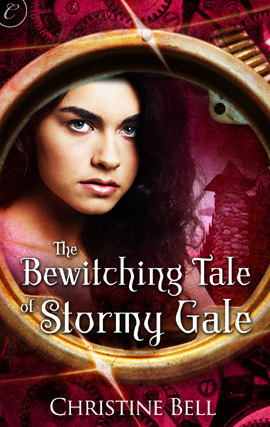
The Bewitching Tale of Stormy Gale by Christine Bell

The Bewitching Tale of Stormy Gale by Christine Bell is the second story set in the same world and with the same protagonists. I read it without reading the first novella, The Twisted Tale of Stormy Gale, also from Carina Press, and I didn’t feel this novel/novella (it’s right on the cusp) suffered for it. I suspect it contained many spoilers for the first story, and I can guess the general plot of the first story, but at no point did I feel lost or confused for not having read it.


That said, it’s possible this review might contain spoilers for The Twisted Tale of Stormy Gale simply because I’m not entirely sure which bits might be spoilery. You’ve been warned.


Stormy, as she is affectionately known, is apparently a time pirate. I say apparently because nothing particularly piratical takes place in BToSG (sorry, it’s too long to keep typing out), but it’s part of her back story. She was born in 19th century London, spent her childhood poor and on the streets until she was taken in by a time-traveller who took her and her adopted brother to the 21st century at age 14ish. Now living in the 19th century and married to the Duke of Leister, I found Stormy a little too blasé about her acquired wealth. I was willing to believe that hanging out in the 21st century modern mannerisms might have rubbed off on her, but I was unwilling to believe that after a childhood of poverty she could so casually mention her toddler daughter intentionally destroying a dress without being angry for her ungratefulness. (Especially since Stormy isn’t a bad person.) It was a really minor, throw-away line but it bothered me for the lack of authenticity.


The story revolves around Stormy identifying a suspicious time traveller, having her husband and brother help her follow him around and then a rescue adventure after her brother accidentally gets himself transported in time with aforementioned shifty time traveller. They end up in Salem a couple of years after the witch trials where her brother appearing out of time gets him arrested for witchcraft. Of course.


It was a fun read. Not the kind of story to be taken too seriously because then you start noticing the people in the past sounding a little bit too much like modern Americans. There was a surprising twist near the end which livened it up after I thought the tying up of loose ends would be predictable. Stormy started out as brash and amusing but later on became a bit less of the strong heroine I was expecting. From what we learnt/were told about her, I expected more saving of the day on her part.


I’ve tagged it as romance, because it’s marketed thus, but the pairing isn’t the main character (since Stormy is already married). This didn’t bother me at all, but I thought maybe I should warn romance readers who might be expecting more.


Overall, I might pick up the first story and/or the sequel (when it becomes available at some unknown point in the future). I recommend it to anyone interested in a light time-travel story, with some light steampunk overtones and a bit of romance thrown in.


I received an advanced review copy of The Bewitching Tale of Stormy Gale courtesy of Carina Press. It will be released on the 28th May and will be purchasable from this link.


3.5 / 5 stars