Showing posts with label Thoraiya Dyer. Show all posts

Tuesday, 27 February 2018

#ReadShortStories (41 to 45)

This batch looks like a Yoon Ha Lee binge, and it is a bit, but I also had a pretty long break between stories here. Life stuff and my escaping the aforementioned through Zelda: Breath of the Wild (a video game) has lead to reduced reading. Whoops.

Anyway, <3 Yoon Ha Lee and his stories. The three included here are all set in the Machineries of Empire series (see also my reviews of Ninefox Gambit and Raven Stratagem), and I really love that world and the characters. I can't wait for book three to come out, and hopefully there are more stories set in that world that I haven't read left for me to get to.

I would also like to highlight the last story, "The House That Creaks" by Elaine Cuyegkeng as a pretty great horror story (and not overly gory, as far as I'm concerned). The author is a relatively new discovery for me (yay reading a bunch of short stories) and I've been enjoying her work. Go have a read if horror is your thing.


Extracurricular Activities by Yoon Ha Lee — Set in the same universe as Ninefox Gambit and Raven Stratagem, this story follows Jedao while he is still young. He goes on an undercover mission to extract a friend from academy. I really enjoyed this story. It was funny with serious moments. A good read for both readers of the novels and new comers to the world. Source: https://www.tor.com/2017/02/15/extracurricular-activities/

The Battle of Candle Arc by Yoon Ha Lee — Shuos Jedao leads a Kel army to victory against heretics. I had some memory of this particular battle being mentioned in the novels (Ninefox Gambit and Raven Stratagem), but misremembered the context. In any case, an interesting read, even more so since it was published years before the novels. Clearly the authors has been living in this world for a long time. Also, the explanations of the factions and calendar were done particularly well, especially given how complicated they can get. This story is a good introduction to the world. Source: http://clarkesworldmagazine.com/lee_10_12/

Yowie by Thoraiya Dyer — A story about being overwhelmed and lost. And yowies. A look at a dreary life amid a fantastical discovery. Not a bad story, but not exactly a pleasant read either. Source: Sprawl edited by Alisa Krasnostein

The Robot’s Math Lessons by Yoon Ha Lee — An adorable flash story about a robot making friends with a little girl (who I think is Cheris from Ninefox Gambit). Source: http://www.yoonhalee.com/?p=793

The House That Creaks by Elaine Cuyegkeng — The story of a haunted house told fro the house’s point of view. A really interesting take, but also pretty creepy since we learn about the (supernatural) rituals that made the house haunted, as well as it’s pre-haunted past in the Philippines. Source: http://thedarkmagazine.com/the-house-that-creaks/


Friday, 2 February 2018

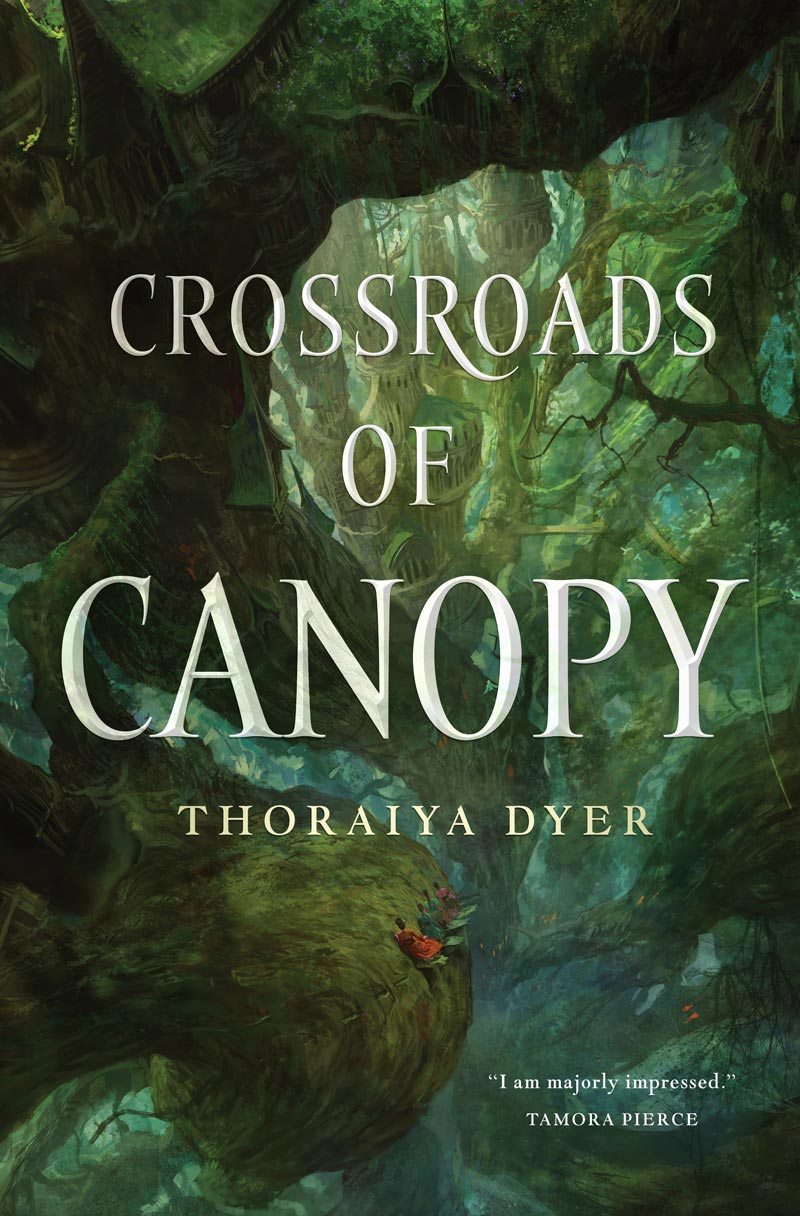
Crossroads of Canopy by Thoraiya Dyer

Crossroads of Canopy by Thoraiya Dyer is an epic fantasy novel set in a world built on trees in a mighty, magical forest. It’s her debut novel and the first of the Titan's Forest series. Until the release of this book last year, Dyer was primarily known as an award-winning short story writer and I have read several of her short stories in the past.

At the highest level of a giant forest, thirteen kingdoms fit seamlessly together to form the great city of Canopy. Thirteen goddesses and gods rule this realm and are continuously reincarnated into human bodies. Canopy’s position in the sun, however, is not without its dark side. The nation’s opulence comes from the labor of slaves, and below its fruitful boughs are two other realms: Understorey and Floor, whose deprived citizens yearn for Canopy’s splendor.

Unar, a determined but destitute young woman, escapes her parents’ plot to sell her into slavery by being selected to serve in the Garden under the goddess Audblayin, ruler of growth and fertility. As a Gardener, she yearns to become Audblayin’s next Bodyguard while also growing sympathetic towards Canopy's slaves.

When Audblayin dies, Unar sees her opportunity for glory – at the risk of descending into the unknown dangers of Understorey to look for a newborn god. In its depths, she discovers new forms of magic, lost family connections, and murmurs of a revolution that could cost Unar her chance…or grant it by destroying the home she loves.

The setting and world building in this book were great, but it was the characterisation of the protagonist, Unar, that really sold it for me. Unar first comes to a goddess’s magical garden to avoid being sold as a slave by her parents. She quickly takes to learning magic and becomes convinced that she is destined for great things. And she is, that’s why she’s the protagonist, they’re just not quite the great things she was hoping for. Her arrogance leads her into a lot of trouble and a lot of things go wrong for her.

There were quite a few cringe-worthy occurrences — horrible things happening to not-horrible people — and occasionally I got annoyed at Unar doing something stupid, but for the most part this was a very enjoyable read. (And if Unar never did anything stupid, what room would there be for her to grow?)

Back to the world building, this isn’t a world living on a single giant tree, as I had first expected before I started reading. This is a whole forest made up of a wide variety of trees. A lot of them are distinctly Australian in flavour, which was a nice touch. The better-off people live in the canopy with the gods, while others eke out a less prosperous existence lower down, where there’s less sun and scary predators. There is also clearly a lot more to the god and magic stuff than has been revealed in this first book. I look forward to learning more about it in the sequel.

This was a very good read and I highly recommend it to all fans of fantasy. Readers looking for a different setting, that is very much not Medieval European, will find much to appreciate here. I am definitely planning to read the sequel very soon and I look forward to learning more about the world as we discover what comes next for the characters.

4.5 / 5 stars

First published: 2017, Tor
Series: Titan's Forest
Format read: ePub
Source: Purchased from iBooks

Friday, 14 June 2013

The Compay Articles of Edward Teach by Thoraiya Dyer / The Angælien Apocalypse by Matthew Chrulew

This book is a novella double from Twelfth Planet Press, printed so that the "front" cover has cover art for one novella and when you flip it over the "back" cover forms the front cover for the other novella.

~

The Company Articles of Edward Teach by Thoraiya Dyer is the first novella I read of the two. I've made no secret of admiring Dyer's work in the past, and this is no exception.

The story is about two disaffected teenagers, both of whom have zero desire to follow the paths their parents have in mind for them. Layla's parents want her to be a doctor, but she just wants to party, have fun, and make boys fall in love with her. Avi's parents want him to become a lawyer, but to avoid that fate he broke several driving laws so that his impending criminal record would prevent that future career.

At first I was a bit confused as to how Layla and Avi's lives matched the cover art and title, but then they both wander into a costume shop with a shifty shopkeeper and bam, magic costumes transport them back in time and into other bodies and also a pirate ship. The titular Edward Teach is Blackbeard the pirate (which some of you may have already known, but I didn't) and the two present day teens find themselves in the bodies of pirates with future and piratey memories warring inside their minds.

The story follows them as they learn how to function in this new world and try to survive. Dyer shows us a traumatic and life-changing experience for the teens in a brutal cut-throat (literally) world. I enjoyed reading about how each of them came to terms with their situation and their lives and how their experiences changed them.

The Company Articles of Edward Teach was an excellent read. I highly recommend it to fans of realistic pirates, fantasy and Dyer's work. It is worth buying this double just for this novella alone.

4.5 / 5 stars

~

The Angælien Apocalypse is the first work I've read by Matthew Chrulew and Goodreads leads me to believe it might be his longest work thus far (short stories in anthologies are also listed).

It's about the end of days in the Christian Rapture sense,  except instead of what one might think of as conventional angels, the beings coming to Earth are aliens. Angelic aliens. Angæliens. And Demœliens. And the main characters get mixed up in the whole apocalypse thing.

And it was severely not my sort of thing. There wasn't anything specifically wrong with it that I can point to and say was done badly (well, except for the nitpicky thing where one of the characters', Joachim's, nickname, Joke, is pronounced like the noun not "yo-keh" as it ought to be). It was the combination of theme and content, I think. Possibly I'm a bit over stories which riff off biblical ideas in this way.

It wasn't badly written and there was a lot of action. I just felt my attention wandering a lot while I was reading and, as a result, it took me much longer to get through than the Dyer novella (a few days, interspersed with other reading compared with one evening). As I have said, I can't quite pinpoint why and I suspect your mileage may vary.

3 / 5 stars

~

First published: 2010, Twelfth Planet Press
Format read: Paper! Made from trees!
Source: Purchased at Continuum Convention
Challenges: Half of it goes towards the Australian Women Writers Challenge

Saturday, 25 May 2013

Light Touch Paper, Stand Clear edited by Edwina Harvey and Simon Petrie

Light Touch Paper, Stand Clear is an unthemed anthology edited by Edwina Harvey and Simon Petrie. The anthology itself was shortlisted for a Ditmar award as was Joanne Anderton's story "The Bone Chime Song". Two stories were also shortlisted for Chronos Awards (the Victorian spec fic awards which will be announced at Continuum in a couple of weeks): “Five Ways to Start a War” by Sue Bursztynski and “The D_d” by Adam Browne.

Light Touch Paper, Stand Clear is quite a mixed bag as far as story content and style goes, not entirely surprising given that it's unthemed. When I was reading, it was impossible to guess what sort of story would come next.

My favourite stories were the quirkier ones. "History: Theory and Practice" by Dave Luckett and "The Travelling Salesman and the Farmer’s Daughter" by Katherine Cummings both involved a serious set up leading to more than initially met the eye. "Murder at the Tip" by Anna Tambour, "Mary Had a Unicorn" by Ripley Patton and "Hard Cases" by Sean McMullen took an offbeat premise and followed it through to the obvious conclusion without flinching. I particularly liked "Mary Had a Unicorn" although I can't say I'd want to live in that world with drugs so prevalent. On the other hand, "Hard Cases" gave me a bit more vicarious glee than is probably healthy.

Two other stories I quite liked (and which don't really fall in the quirky category) were "Faet's Fire" by Thoraiya Dyer, which had beautiful writing, and "Kindling" by Kathleen Jennings, which was a pleasant wander through the lives of bar patrons. I should also mention "Bone Chime Song" by Joanne Anderton, which is excellent, but which I skipped in Light Touch Paper, Stand Clear since I'd already read it.

More thoughts on each story, recorded as soon as I finished reading it, below. Overall, Light Touch Paper, Stand Clear is a diverse anthology which showcases a variety of stories and authors. I recommend it to fans of short fiction, perhaps looking for diverse reads in one single package.

~

"Bone Chime Song" by Joanne Anderton — previously read and reviewed, when I said "Eerie, well imagined. A complete world glimpsed through a short story."

"Five Ways to Start a War" by Sue Bursztynski — a tale of gods meddling in the lives of men and the real cause of the Trojan War. Interesting changes of perspective with each section.

"History: Theory and Practice" by Dave Luckett — Packed with a surprising amount of historical detail, an amusing story set in the Dark Ages. The protagonist is more than meets the eye. Enjoyed the reveal.

"D___d" by Adam Brown — exploration and industrialisation of hell. Sort of. Didn't quite do it for me (purely subjective reaction).

"The Travelling Salesman and the Farmer’s Daughter" by Katherine Cummings — Cute science fiction story with all the right elements. Travelling scout recruiting lost planets to the galactic empire. I expected a twist, but didn't quite pick it.

"Faet's Fire" by Thoraiya Dyer — A farm, a coal seam, a girl, a boy and Faet, a bird monster. Very well written and an enjoyable read, a little dark.

"Murder at the Tip" by Anna Tambour — About the horrors that could ensue were the irritating machines in our lives sentient and granted personhood. (Ironically, this was the story my Kobo chose to misbehave on.)

"The Subjunctive Case" by Robert Porteous — a detective story about a mysterious murder and a detective who can split himself into two parallel universe investigations.

"Mary Had a Unicorn" by Ripley Patton — a story set in a world in which drugs are particularly prevalent and unicorns have been genetically engineered to search and destroy them.

"Between the Lines" by Brenda Cooper — a story about conspiracies and hope in the future. I didn't find it entirely believable and it reminded me a bit of Cold War SF. Not a bad story, though.

"The Godbreaker and Unggubudh the Mountain" by Ian McHugh — a story of power struggles between fantasy creatures and mountain gods. Fight scenes a bit protracted for a short story.

"Hard Cases" by Sean McMullen — a story about a group of people taking a hard stand against the kind of people who refuse to believe in global warming. I enjoyed it, perhaps thanks to a bit of vicarious activism. Ahem.

"Kindling" by Kathleen Jennings — a story about paths crossing and diverging. A barmaid with a knack for bringing people together. I quite liked it.


First published: 2012, Peggy Bright Books
Series: no.
Format read: ePub on all the devices
Source: A review copy provided courtesy of the editors

Wednesday, 20 March 2013

Asymmetry by Thoraiya Dyer

Asymmetry by Thoraiya Dyer is the latest in Twelfth Planet Press's Twelve Planets series of collections. You can read my reviews of the other collections at this link.

Asymmetry does not contain linked stories like some of the other Twelve Planets — in fact they're all very diverse. They fall in different places on the science fiction to fantasy spectrum, but one thing they have in common is sheer innovativeness. These are the first stories I've read of Dyer's and I was very impressed. I'll definitely be keeping an eye out for more of her work in the future.

"After Hours" is a story about a vet, some army dogs and a werewolf. I think it was my favourite in the collection. It's told from two different first person perspectives which have very distinct personalities. Although the formatting kindly lets us know which narrator is speaking, I think it would have been clear even without the typographic distinction. A mark of the strong writing. Also, I appreciated how Dyer's veterinary experience clearly came out in this story.

"Zadie, Scythe of the West" is a gender-flip story set in a fantasy world. To put it simplistically, it's a world where women are warriors and men are housekeepers but the worldbuilding is more complex than that. There are very clear ideological reasons for why the women go to war and also for the rules constraining their abilities to do so. I suspect it's the sort of story others might compare with Ursula Le Guin or Joanna Russ but I don't feel well-versed enough in those authors' works to do so.

"Wish Me Luck" is a science fiction story set in another solar system in a time when interstellar travel exists (but is rare and expensive). The science element is fairly esoteric (in the quantum mechanical sense) and, were it a longer piece, one might call it space opera. In a way, it's a story about a man who just wants to get home. There's more to it, of course.

"Seven Days in Paris" is hard to explain properly without spoilers. It's the sort of story where almost every aspect becomes apparently only gradually. I'll say it's about a disposable clone created somewhat illegally and ostensibly for the greater good. It's told from the clone's perspective, interesting because the clone does not (at first) have any idea what's going on.

~

Overall the stories deal with themes of identity and belonging in different ways, a trend I noticed only now as I was writing the mini-reviews above. I like how the more I think about them, the more I'm finding things to think about in them. There is nothing simple here. An excellent collection.

Asymmetry is a quick read, with all four stories of the short variety rather than longer novelettes or novellas. It's also a highly enjoyable read which I recommend to anyone interested in modern Australian speculative fiction. Reading and thinking about Dyer's stories made me want to be able to write like that. Dyer is definitely a writer I will be keeping an eye on.

5 / 5 stars

First published: March 2013, Twelfth Planet Press
Series: Twelve Planets (a series of collections)
Format read: ebook on my iThings
Source: Subscription to ebook editions of the Twelve Planets
Challenges: Australian Women Writers Challenge