Tuesday, 11 July 2017

Rivers of London by Ben Aaronovitch

Rivers of London by Ben Aaronovitch is the first in an ongoing urban fantasy series set in contemporary London. It's been recommended to me by several people over the years and I just got around to reading it now because the series as a whole was shortlisted for a Hugo Award. I'm glad I finally read it, and I can see why people have been recommending it to me.

Probationary Constable Peter Grant dreams of being a detective in London’s Metropolitan Police. Too bad his superior plans to assign him to the Case Progression Unit, where the biggest threat he’ll face is a paper cut. But Peter’s prospects change in the aftermath of a puzzling murder, when he gains exclusive information from an eyewitness who happens to be a ghost. Peter’s ability to speak with the lingering dead brings him to the attention of Detective Chief Inspector Thomas Nightingale, who investigates crimes involving magic and other manifestations of the uncanny. Now, as a wave of brutal and bizarre murders engulfs the city, Peter is plunged into a world where gods and goddesses mingle with mortals and a long-dead evil is making a comeback on a rising tide of magic.

Rivers of London follows a London policeman from when he finishes his probationary uniformed stint and as he moves on to his next assignment, narrowly avoiding being permanently assigned to paperwork. It all begins when he sees a ghost after a murder and starts to become aware of the supernatural world. As it turns out, the Metropolitan Police have a supernatural division and that's where he ends up, more or less, trying to solve a series of magic-influenced murders with his new boss.

The tone of the book put me in mind of Douglas Adams and Terry Pratchett — in many ways the humour of the former and the London-ness (Ankh-Morpork-ness) of the latter. It was an entertaining read and it was partly the voice of Peter, the first person narrator, that kept me turning pages. The only negative in the writing style was the frequency with which Peter mentions being attracted to various women and also their breasts and/or his penis, but it wasn't too frequent and didn't by any means ruin the book for me.

I also enjoyed the slightly different take on the urban fantasy side of things — although it's possible I feel that way due to not having read enough urban fantasy books. A significant side plot deals with the... rulers of the river Thames and its tributaries (hence the title) and it provided some entertaining additional flavour.

I already have the next few books in the series waiting for me, and I intend to keep reading sometime in the near future (possibly after I've dug myself out of my reviewing backlog a little). I enjoyed Rivers of London and I recommend it to anyone who has even a passing enjoyment for urban fantasy and humour (especially British humour).

4.5 / 5 stars

First published:
Series: The Peter Grant / Rivers of London series book 1 of 6 so far
Format read: ePub
Source: purchased several years ago and also in the Hugo voter packet — I'm not actually sure which version I read

Monday, 10 July 2017

Cetaganda — The Vorkosigan Saga Project

Cetaganda is the latest book we’ve read in our Vorkosigan Saga Project. In it, we see Miles and Ivan sent on a diplomatic mission to attend the Empress of Cetaganda’s funeral. Of course, knowing Miles the trouble-magnet, he could never just attend a funeral.


You can read Katharine’s review of Cetaganda here, and Tsana’s review here.


Katharine: So here we are again. We know Miles is going to find trouble (or it’ll find him), but it must be a record for it to have found him before their ship even manages to dock properly.


Tsana: Yes! But you know, if it didn’t, it would have been a much more boring story. I actually really liked how it opened with something weird happening and then it was a while before anything related popped up again. All while Miles in angsting about “WTF, it must be a trap somehow!” etc. But you know what my absolute favourite part of this book was? Ivan’s childhood reminiscences about Miles’s hijinx.


Katharine: Aha he’s still so outraged about it all - and hell, who isn’t, we’re always bringing things like this at work or school reunions. I’m loving that we get to see more of Ivan and therefore, their past and a slightly more relaxed version of Miles as he’s able to rely on Ivan for everything he’s too embarrassed about with everyone else. And that we see Ivan’s intelligence, and how it differs from Miles.


Tsana: Ivan’s intelligence seems to mostly be centred on trying to stay out of the trouble Miles is generating…


Katharine: And excelling at social occasions where Miles likes to trip over his own curiosity. Like, he’s good with the ladies but he can also handle polite conversation and cues so much better.


Tsana: Ah, I loved the bit where he was drugged but came through it fine in a way Miles probably wouldn’t have been able to (also wouldn’t have been in that situation to begin with). But we’re getting a bit ahead of ourselves.


This is the first book where we get to see the Cetagandan home world and in which the Cetagandans aren’t just enemies to be fought or outwitted or avert a war with. What did you think of the planet?


Katharine: I thought it sounded spectacular, like everything would be pristine gardens (and that’s why the slightly dilapidated house would be of particular note) and buildings like the Taj Mahal everywhere. I keep wondering whether Bujold very slightly bases each planet or race on a different culture on earth - not that she doesn’t have the imagination to come up with something totally different of course - just to be, I don’t know, clever?


Tsana: I thought there were a few vague overtones of Japanese culture in Cetaganda. Not overtly, but based on, for example, the idea of flower-arranging taken to the extreme with genetic engineering. (I’m still a bit traumatised by that kitten tree.) But then the bubbles the haut ladies use put me a little bit in mind of burkas etc but with very different cultural ramifications and origins.


Katharine: Oh god the kitten tree. To hell with that! For some reason parts had me thinking of India but I have utterly no idea why. What did you think of the Ba?


Tsana: I’m not sure. They’re similar to the betan hermaphrodites we met earlier (like Bel Thorne) but I got the impression the Betans existed by choice, whereas the Ba were engineered to be servants (which seems an awful lot like slavery, for all that they seemed relatively happy) and used as test subjects both before and after their births. (Well, uterine replicator decantings, presumably.) The Ba are also only a part of the Cetagandan hierarchy. I actually found the differences between the Ghem and Haut more interesting.


Katharine: And at least the Ba seemed to have some level of power above that of general guards, thanks to who they report to… but yeah, sounded pretty much like slavery.
I have to admit I’m not strictly sure I understand the full differences between the Ghem and Haut… (I’d certainly fail in their social scene!)


Tsana: Well the haut are precisely genetically engineered the ruling class — so the Emperor and other “noble families” are all haut — whereas the ghem are less precisely engineered and are like the warrior class. I thought the way that people kept comparing them with the Vor helped me keep that straight. So ghem generals are who the Barrayarans come up against in conflict (and obviously the lower ranks of ghem doing the actual fighting). Then it got a bit confusing when we got to the part about who was ruling the other Cetagandan planets. Each planet has a male haut governor and then a female consort. They’re sort of married but don’t hold direct allegiance to each other, as we learn in the course of this book. Then there is the possibility of exceptional male ghem being awarded female haut for services to their empire or whatever. Which is a bit icky. And it’s all a bit complicated. I actually thought reading it a second time probably helped all the details stick into my head.


Katharine: I think it was at the other rulers part where I got a bit lost - but mostly it was easy to follow probably because they don’t all outwardly show their emotions. They’re all ‘everyone else is scum’ the end, which helped! Oh, should we raise the spoiler shield?


Tsana: Now sounds like a good time!


<spoilers ahead!>

Sunday, 9 July 2017

Hugo Novella Discussion

This post is a bit late, relative to when I stopped reading, but there was a delay between me reading the last novella that I read and realising that I wasn't going to read the last two for reasons I'll explain shortly. But at least I've managed to write something about this category as a whole before the voting deadline, so I'm calling that a win.

The shortlisted stories are listed below in the order I read them with a few comments on each. The title links go to my reviews.


Every Heart a Doorway, by Seanan McGuire (Tor.com publishing)

I loved this novella when I read it last year — it was one of my favourite reads of the year overall — and I nominated it for the Hugo shortlist. Having read the other novellas it remains my favourite, hands down.


A Taste of Honey, by Kai Ashante Wilson (Tor.com publishing)

This novella was interesting and enjoyable and kind of depressing and not exactly an easy read. The ending really made it for me but I also enjoyed the bits getting there... my feelings about it (emotionally, rather than critically) are mixed and I can't say more without spoilers. Critically, this is a strong story that certainly deserves to be shortlisted.


The Dream-Quest of Vellitt Boe, by Kij Johnson (Tor.com publishing)

This story was kind of boring. I belatedly learned that this is probably because it was written in response to a Lovecraft novella which I myself have zero interest in ever reading. The story wasn't badly written on a sentence level, but the pacing was too slow. The ending was interesting, but the slog of getting there puts this story low on the ballot for me.


Penric and the Shaman, by Lois McMaster Bujold (Spectrum Literary Agency)

I have enjoyed Bujold's SF before, but this was the first time I read any of her fantasy. I actually bothered to buy and read the prequel novella before this one, and I enjoyed both. In fact, I enjoyed this second instalment more than the first and plan to read the others at some point. (That point probably being after I've finished the Vorkosigan re-read I'm in the midst of.)


~

And that brings me to the end of the novellas I actually read. I will say a few words about why I skipped the other two though.

This Census-Taker, by China Miéville (Del Rey / Picador)

This got skipped for two reasons: one, I haven't enjoyed Miéville very much in the past, so I was open to any excuses to skip it (and might have done so anyway), and two, this was a puppy slate nomination, giving me a valid excuse to skip it. Miéville is popular enough to have possibly made the ballot despite the puppies, but I don't really care. His fans can vote for him if they want to, but I was never going to vote him very highly. (Also, the opening couple of sentences were so off-putting).


The Ballad of Black Tom, by Victor LaValle (Tor.com publishing)

I had fully intended to read this one until I found out it was also Lovecraftian. I am glad I saw that review before I started reading. I just. Don't care.


~

So my ranking for this category wasn't too difficult: Every Heart, Penric, A Taste of Honey, then No Award, then Dream-Quest, leaving off the two I didn't read.

Friday, 7 July 2017

Penric and the Shaman by Lois McMaster Bujold

Penric and the Shaman by Lois McMaster Bujold is the second novella in the Penric and Desdemona series, set in the World of the Five Gods, which is also home to a series of novels which I haven't read. I have read the earlier Penric novella, however, Penric's Demon. The main reason I picked up this series at all is because Penric and the Shaman is shortlisted for a Hugo Award this year.

In this novella set in The World of the Five Gods and four years after the events in “Penric’s Demon”, Penric is a divine of the Bastard’s Order as well as a sorcerer and scholar, living in the palace where the Princess-Archdivine holds court. His scholarly work is interrupted when the Archdivine agrees to send Penric, in his role as sorcerer, to accompany a “Locator" of the Father’s Order, assigned to capture Inglis, a runaway shaman charged with the murder of his best friend. However, the situation they discover in the mountains is far more complex than expected. Penric’s roles as sorcerer, strategist, and counselor are all called upon before the end.

While I enjoyed Penric's Demon, I didn't love it and wasn't sure that I'd bother reading more Penric books after Penric and the Shaman. However, I enjoyed Penric and the Shaman rather more than the introductory novella and found myself laughing out loud more often. I'm not sure to what extent that's due to my state of mind when reading (I was more tired and on night shift up a mountain when I read Penric's Demon) or the intrinsic quality of the writing itself. Probably a bit of both.

Penric and the Shaman tells the story of Penric's encounter with a shaman (loosely speaking) from three points of view: Penric's, the shaman's and the Locator sent to capture the (sort of rogue) shaman. I wasn't sure how much I'd like the split points of view, since I came in attached to Penric and Desdemona, but it worked very well. I should not have doubted Bujold's ability to make me care about other characters. The introduction of the concept of shamans also added to the worldbuilding that we were first introduced to in Penric's Demon (speaking as someone who hasn't read any of the novels), making it a deeper world.

I highly recommend Penric and the Shaman to fans of Penric's Demon and fantasy in general. I think the worldbuilding and jokes work better having read the prequel, but it's not absolutely necessary, especially since four years have passed in the interim. I expect I will read the sequels at some point (when I am less drowning in other books).

4.5 / 5 stars

First published: 2016, self-published
Series: Penric and Desdemona, book 2 of 4 so far (I think)
Format read: ePub
Source: Hugo Voter Packet

Wednesday, 5 July 2017

All Systems Red by Martha Wells

All Systems Red by Martha Wells is a novella I have heard a lot of people saying a lot of good things about. The only other book I've read by Martha Wells was kind of meh, so I'm glad the critical mass of people praising this book was well and truely exceeded for me to pick it up. It was an excellent read.

In a corporate-dominated spacefaring future, planetary missions must be approved and supplied by the Company. Exploratory teams are accompanied by Company-supplied security androids, for their own safety.

But in a society where contracts are awarded to the lowest bidder, safety isn’t a primary concern.

On a distant planet, a team of scientists are conducting surface tests, shadowed by their Company-supplied ‘droid — a self-aware SecUnit that has hacked its own governor module, and refers to itself (though never out loud) as “Murderbot.” Scornful of humans, all it really wants is to be left alone long enough to figure out who it is.

But when a neighboring mission goes dark, it's up to the scientists and their Murderbot to get to the truth.

All Systems Red had me from the opening paragraph which, as I immediately tweeted, was a delight. It's told in first person from the point of view of a cyborg. A bored cyborg who has gained free will and really just wants to watch TV between half-arsing its contractual duties enough to hide its illegal free will. Unfortunately, the survey mission that should have been straightforward and relatively dull — from Murderbot's point of view, if not the scientists it's protecting — turns out to be anything but.

This novella was brief but excellent. It had mystery, danger, adventure, a compelling voice and made me laugh many times. It was also an interesting look at humanity and where the lines are drawn. Murderbot counts as machinery rather than as human because of how it was constructed. But it still feels emotions and has independent thoughts and we get the impression that even if it hadn't given itself free will it would still be having these thoughts and feelings, it just wouldn't be able to act on them. On the one hand considered non-human, on the other sentient and enslaved. And we see augmented humans who have some similarities with Murderbots in terms of data processing and telemetry (for lack of a better word) but are definitely human. I assume these are themes that will be explored further in the sequel novellas.

All Systems Red was an excellent read and I recommend it to all fans of speculative fiction. It's a quick read and you don't even have to like robots or military SF to enjoy it. I cannot wait until the next novella comes out. I was sad when All Systems Red ended, not because it was a bad ending but because there was no more Murderbot to read and now I have to wait until next January for more.

5 / 5 stars

First published: May 2017, Tor.com
Series: The Murderbot Diaries 1 of a planned 4 so far
Format read: ePub
Source: Purchased on iBooks

Monday, 3 July 2017

Hugo Graphic Story Discussion

I've written reviews in separate posts of the Hugo shortlisted graphic novels. I'm going to go through them in the order I read them and then give my overall impressions at the end of this post. Title links go to the reviews.

Ms. Marvel, Volume 5: Super Famous, written by G. Willow Wilson, illustrated by Takeshi Miyazawa (Marvel)

I read this about a year ago when it was first released. I have been following the Ms Marvel comics since Kamala became Ms Marvel (I also heart Carol Danvers but as Captain Marvel, since pants) and I have enjoyed them all. This was always going to rate highly for me.


Monstress, Volume 1: Awakening, written by Marjorie Liu, illustrated by Sana Takeda (Image)

I actually got an ARC of Monstress close to its release date but sadly didn't get around to reading it until after the Hugo packet arrived (partly because the PDF is so big my old iPad 2 can't actually cope with it). I found this story a bit harder to find my footing in because it jumped into the story without much introduction. It did make more sense as I went along and I ended up more or less liking it. Not my favourite of the bunch but not my least favourite either.


Saga, Volume 6, illustrated by Fiona Staples, written by Brian K. Vaughan, lettered by Fonografiks (Image)

Saga is another series I've followed from the start and have been invested in from the very start. There have been some issues that have felt a bit too much like a chapter in a bigger story (which they all are) and have made me think rereading the whole series when its complete will be the superior reading experience. When I was reading Monstress, I was put in mind of Saga. However, having actually revisited Saga after a long gap and read this shortlisted volume, I am not entirely sure why I saw similarities. In this volume of Saga, the story is kind of more gentle than it has been at times, which is in particularly stark contrast with Monstress.


The Vision, Volume 1: Little Worse Than A Man, written by Tom King, illustrated by Gabriel Hernandez Walta (Marvel)

When I first saw the cover for Vision I was vaguely intrigued but not enough to go out of my way to read it without the prompting of the Hugo packet. I found it OK and a good series starting point (unlike Black Panther, see below). I probably won't bother reading the sequels but I am vaguely curious as to what happens (assuming no events interrupt the storyline).


Paper Girls, Volume 1, written by Brian K. Vaughan, illustrated by Cliff Chiang, colored by Matthew Wilson, lettered by Jared Fletcher (Image)

This had been on my radar for a while and the Hugo shortlisting and voter packet finally gave me the impetus to read it. I am glad I did! This story is awesome and is definitely getting my top vote. The next time I go past the comic book shop I plan to stop in to pick up the next volume (and maybe the third, which is due out soon, I think). I highly recommend this comic to all spec fic fans who don't hate the comic format.


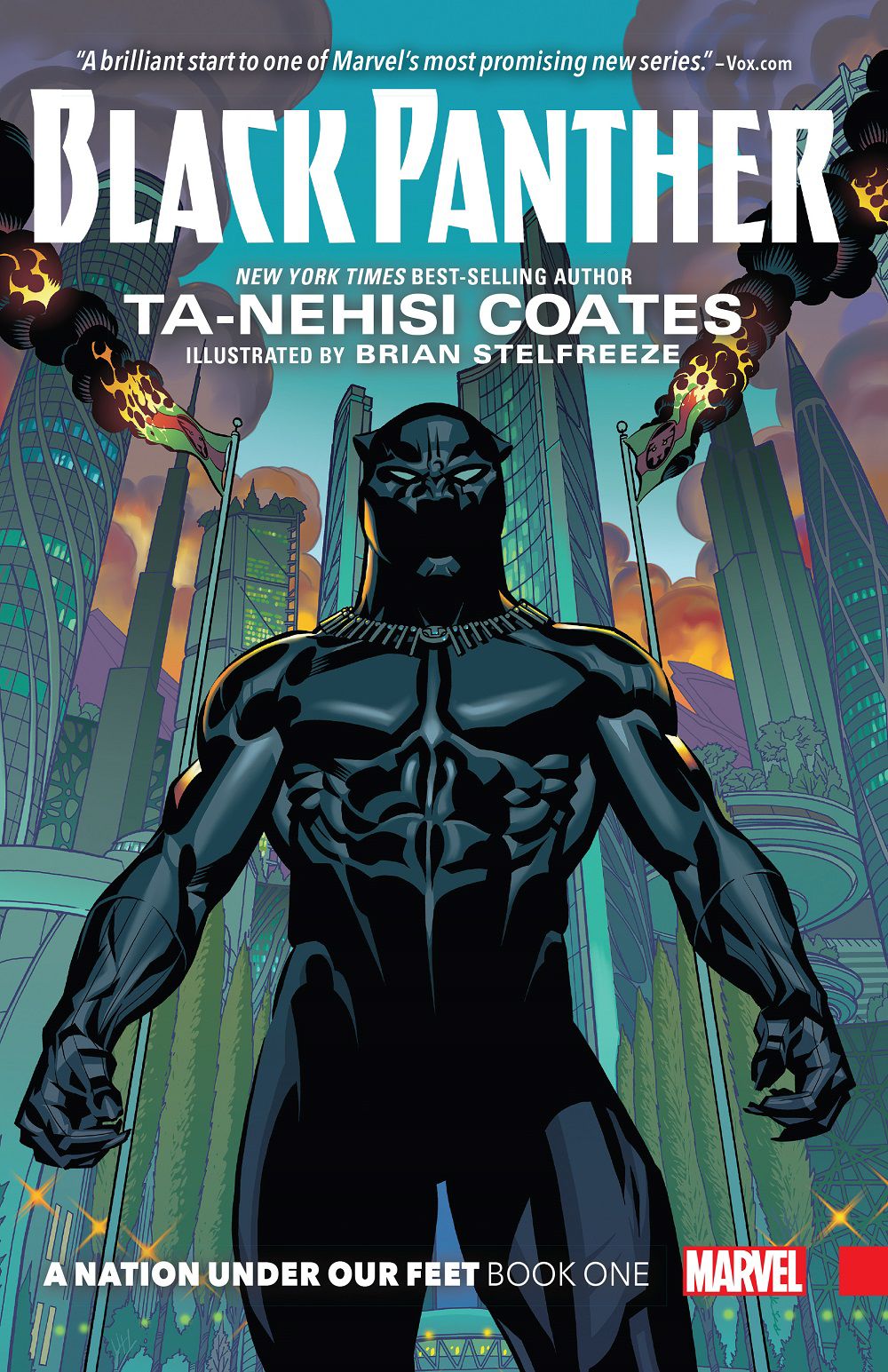
Black Panther, Volume 1: A Nation Under Our Feet, written by Ta-Nehisi Coates, illustrated by Brian Stelfreeze (Marvel)

I had heard good things about Black Panther and this creative team... but I was mostly lost in a story that didn't feel like it started with the first issue in this collection (which, yes, is issue #1). I only really connected with some of the side characters and was a bit lost as to recent events the plot seemed to hinge on.


So out of that list Paper Girls is the easy winner for me, followed by Ms Marvel and Saga. It was pretty close between Monstress and Vision, but the depth of Monstress and the promise of the developing story edged out Vision. Unsurprisingly, Black Panther comes last, mainly because it doesn't seem like the right place to start reading his story.


Saturday, 1 July 2017

Black Panther, Volume 1: A Nation Under Our Feet by Ta-Nehisi Coates and Brian Stelfreeze

Black Panther, Volume 1: A Nation Under Our Feet written by Ta-Nehisi Coates and illustrated by Brian Stelfreeze is the first collected volume of the current ongoing Black Panther comic book series from Marvel. It's not the first Black Panther series, but I believe it is the first to be both written and illustrated by black men.

A new era begins for the Black Panther! MacArthur Genius and National Book Award winner Ta-Nehisi Coates (Between the World and Me) takes the helm, confronting T'Challa with a dramatic upheaval in Wakanda that will make leading the African nation tougher than ever before. When a superhuman terrorist group that calls itself The People sparks a violent uprising, the land famed for its incredible technology and proud warrior traditions will be thrown into turmoil. If Wakanda is to survive, it must adapt--but can its monarch, one in a long line of Black Panthers, survive the necessary change? Heavy lies the head that wears the cowl!

You would think that this Volume One would be a good place to start reading Black Panther. It wasn't particularly and I'm not sure what would be a better place to start. I am not very familiar with the character — beyond his appearance in the latest Avengers movie — and my knowledge of Wakanda, his home country (that he is king of) is limited to references in other Marvel comics (and the aforementioned move).

A Nation Under Our Feet puts the reader in the middle of conflict and struggle in Wakanda and, to a degree, revolving around Black Panther. I was pretty lost for most of the book, not entirely sure of the who/what/why of the conflict and not strongly connecting with the titular character because I wasn't entirely sure what he was doing. I got the bit about wanting peace for Wakanda and looking for his sister, but I was fairly confused about the sister part.

The only characters I did feel I could get behind were the lesbian vigilantes, partly because we witnessed their origin story, more or less, and partly because who doesn't like lesbian vigilantes? Unfortunately, they didn't get an awful lot of page time, though I expect they would feature more in future issues/volumes. Although, I'm told they had a spinoff series that got cancelled after two issues, so, um. Well done, Marvel. 🤦‍♀️

I'm entirely sure who to recommend Black Panther to besides people already familiar with the character and location. My guess is that he has recently appeared in other comic book series too, but I have no idea which, other than not the ones I've been reading. It wasn't a bad comic book, but it didn't feel like a good place to start reading, unfortunately.

3.5 / 5 stars

First published: 2016, Marvel
Series: Black Panther, volume 1 of going series, containing issues #1–4
Format read: PDF with hideous watermark covering some of the text
Source: Hugo Voter Packet

Thursday, 29 June 2017

Paper Girls by Brian K Vaughan and Cliff Chiang

Paper Girls Volume 1 by written by Brian K Vaughan and illustrated by Cliff Chiang is the first book in what I believe is an ongoing series. I picked it up because it was shortlisted for a Hugo Award and conveniently presented to me in the Hugo voter packet, but I had previously heard good things about it and it was already on my radar to eventually buy. So yay Hugo packet. What I didn't realise until I was reading it was the genre. From the cover art of Volume 1 and the freaking blurb I was expecting something geeky and female-driven. And I mean, it is... but there are also very distinct speculative elements to it.

In the early hours after Halloween of 1988, four 12-year-old newspaper delivery girls uncover the most important story of all time. Suburban drama and otherworldly mysteries collide in this smash-hit series about nostalgia, first jobs, and the last days of childhood.

Which part of that blurb suggests anything about, like, aliens or time travel? NONE OF IT! And saying that here might be a bit of a spoiler, but I think not knowing would put potentially interested readers off more than I have spoiled just by saying that. So. Young girls, aged around twelve, in 1988, who deliver newspapers and encounter aliens and time travel. What's not to like?

The only downside of Paper Girls is that it's a volume 1 in an ongoing series, meaning that the story is in no way complete, many (most) questions are left unanswered and it ends in a cliffhanger. Happily, the second volume is already out and the third is coming relatively soon, so I am looking forward to continuing the story in the near future, just as soon as I get around to making a trip to the comic book shop.

I recommend Paper Girls to fans of nostalgia, girls and spec fic. I'm not entirely sure where the story is going, but I am very happy to continue along for the ride.

5 / 5 stars

First published: 2016, Image Comics
Series: Paper Girls, ongoing series, contains issues #1–5
Format read: watermarked PDF
Source: Hugo Voter Packet

Tuesday, 27 June 2017

Cetaganda by Lois McMaster Bujold

I am sorry all the Bujold covers are dreadful. It was this or a 
small, blurry, non-English one. (I would have gone with 
non-English if they were less uniformly of low resolution.) 
Cetaganda by Lois McMaster Bujold is chronologically the third novel about Miles Vorkosigan, though it was published ninth. Generally, I recommend reading it in chronological order after The Vor Game, which I recently reviewed. It almost stands alone — it's a complete story but many of the character implications and connections will be missed by someone who hasn't read the earlier books. It's also the source of some of the humour.

The latest installment in the adventures of Miles Vorkosigan. Miles and Cousin Ivan travel to Cetaganda to play the part of sprigs of nobility doing their diplomatic duty. But when the Empress of Cetaganda dies naturally, and her lifelong attendant dies unnaturally, Miles and Ivan finds themselves in the thick of it.

Cetaganda sees Miles and his cousin (That Idiot) Ivan sent on a diplomatic mission to attend the Dowager Empress of Cetaganda's funeral. It's not a complicated mission, but rather one that requires them to stand politely in the correct places, eat, and socialise. Miles has never been good and standing around, however, and trouble has a tendency to find him even when he doesn't go out of his way to seek it. And really, if he didn't take matters into his own hands, how could he prevent interplanetary war?

Apparently, last time I read Cetaganda I only gave it four stars (on Goodreads individually and on LibraryThing for the Miles, Mystery and Mayhem omnibus, although the latter could've been because Ethan of Athos came after it). I'm honestly not sure why since I laughed a lot reading it this time 'round and have thus promoted it to five stars. Only a small portion of that laughter was because I remembered how it ended.

I really enjoyed reading about Miles and Ivan. This is the most we've seen of Ivan in one book since I started rereading chronologically, so that was nice. It was also very interesting to see some of the details of the Cetagandan Empire which, until now (in the books, chronologically) has mainly been seen as a military threat. In Cetaganda we see a lot more of its art and culture. (The kitten tree, burned into my mind from the first read-through did not become more pleasant the second time around, however). Rereading, I think, also gave me more space to contemplate said culture rather than just rushing through to see what Miles would do or what would happen to Miles next.

I highly recommend this book to people who have read the earlier Vorkosigan books. If you haven't, then better to start with Shards of Honour or, at worst, The Warrior's Apprentice.

5 / 5 stars

First published: 1996, Baen
Series: Yes. Vorkosigan Saga. Book 5 chronologically out of 16 maybe, I think
Format read: ePub in Miles, Mystery and Mayhem omnibus
Source: Bought from Baen several years ago.

Sunday, 25 June 2017

Rosemary and Rue by Seanan McGuire

Rosemary and Rue by Seanan McGuire is the first book in the rather long (ten books and counting, not to mention a large pile of short fiction) October Daye series. I picked it up because the series has been shortlisted for the inaugural Best Series Hugo Award, and because I've been wanting to read more of McGuire's back catalogue.

October "Toby" Daye, a changeling who is half human and half fae, has been an outsider from birth. After getting burned by both sides of her heritage, Toby has denied the Faerie world, retreating to a "normal" life. Unfortunately for her, the Faerie world has other ideas...

The murder of Countess Evening Winterrose pulls Toby back into the fae world. Unable to resist Evening's dying curse, which binds her to investigate, Toby must resume her former position as knight errant and renew old alliances. As she steps back into fae society, dealing with a cast of characters not entirely good or evil, she realizes that more than her own life will be forfeited if she cannot find Evening's killer.

In many ways, this is a pretty standard kind of urban fantasy book; set in modern times, with a slightly but not too magical heroine who is (was) a private investigator and has to solve a supernatural murder. That doesn't mean it's a bad read and many of the details made this quite an enjoyable read for me. For one thing, there wasn't much of a romantic plot line, always a plus. (I still remember an urban fantasy I read where the hero apparently smelled of pine air-freshener and I am still not over the grossness.) It deals sensibly with themes of abuse and incorporates lots of different mythologies in the worldbuilding. I can see how there would be a lot of fodder for many more books in the series.

I also found it interesting that Toby isn't actually very young. It seems to me that these sorts of heroines often are, but although Toby looks relatively young, because of her half-faerie blood, she is past what would be middle-age for a human. That gives mer more scope in life experiences and allows her to take a more mature retrospective view of her past, and choices she made that other kids may now be making. She speaks frankly about negative aspects of her past, which I thought was good (introspection, etc) but which might also come off as heavy handed. I'm a little undecided, but I think it's ultimately better not to be too subtle about some of the issues involved.

Rosemary and Rue was a complete story but, of course, leaves the story open for Toby to have a lot more adventures because there will always be more problems in Faerie that need solving. I am keen to read more of the series but I expect I will end up spacing them out a bit due to too-many-books-too-little-time syndrome. (I have also been told by a couple of people that they really pick up from around book three, so hmm.)

4 / 5 stars

First published: 2009, DAW Books
Series: October Daye book 1 of ? (11 comes out later this year)
Format read: omnibus ePub
Source: Hugo voter packet