Sunday, 28 April 2019

#ReadShortStories, even if only because they're Hugo shortlisted (56–60)

I spent some of my weekend making a push on the Hugo ballot and the last three stories in this batch are the result. I've now finished the short story ballot, so a comparison of all the Hugo short story nominees will be coming soon. Stay tuned.


The Shadow We Cast Through Time by Indrapramit Das — A dark and fantastical take of a far future but lowish-tech colony on some alien planet. The story evoked a compelling mood, but I found it a bit too slow to draw me in effectively, for all that it was interesting during sufficiently long bursts of reading. Source: New Suns edited by Nisi Shawl

A Billion Dots of Light by Matt Thompson — Flash about a very dehumanised pod-generation ship. Pretty horrifying and with a bit of a clichéd ending. Source: https://www.nature.com/articles/d41586-019-01105-w

The Court Magician  by Sarah Pinsker — An unexpected but interesting story about a poor boy, street magic and the more powerful real magic he eventually learns about. I liked it. Source: http://www.lightspeedmagazine.com/fiction/the-court-magician

Nine Last Days on Planet Earth by Daryl Gregory — The story was OK but I found it a bit old fashioned. I’m also not sure that the title made sense in the end with the direction the story took, but I don’t want to spoil it by explaining. I was weirded out by how often the (gay!) protagonist described how beautiful his mother was. That was super weird, and only got more so with repetition. Overall, the science parts with the apocalypse were interesting, the rest was fine. Source: https://www.tor.com/2018/09/19/nine-last-days-on-planet-earth-daryl-gregory/

The Tale of the Three Beautiful Raptor Sisters, and the Prince Who Was Made of Meat by Brooke Bolander — I found this dinosaur-esque fairytale very entertaining. I even laughed a few times. From the chatter in the podcast around it, I gather the rest of the Uncanny dinosaur issue, which I haven’t read, is set in a shared world. But this story absolutely stood alone. It also wasn’t what I expected, since it also contained humans, not just raptors. And a witch. Anyway, very entertaining. Source: https://uncannymagazine.com/article/the-tale-of-the-three-beautiful-raptor-sisters-and-the-prince-who-was-made-of-meat/


Monday, 22 April 2019

The Disasters by M K England

The Disasters by M K England is a YA space adventure story, in which a group of teens are the only hope for most of humanity. It was mostly a fun read, but there were some physics issues that I found quite distracting.

Hotshot pilot Nax Hall has a history of making poor life choices. So it’s not exactly a surprise when he’s kicked out of the elite Ellis Station Academy in less than twenty-four hours.

But Nax’s one-way trip back to Earth is cut short when a terrorist group attacks the Academy. Nax and three other washouts escape—barely—but they’re also the sole witnesses to the biggest crime in the history of space colonization. And the perfect scapegoats.

On the run and framed for atrocities they didn’t commit, Nax and his fellow failures execute a dangerous heist to spread the truth about what happened at the Academy.

They may not be “Academy material,” and they may not get along, but they’re the only ones left to step up and fight.

In many ways this was a fun book. The characters were entertaining and diverse which was fairly refreshing to read. The narrating character, Nax, ends up being the de facto leader of the little team and being inside his head wasn't terrible. It was a good mix of uncertainty, some silly teenage stuff and world-saving plans.

The worldbuilding of this future was based on some sort of magically fast jump drives (that weren't described in detail), which allowed for the colonisation of several habitable planets spread around the galaxy. A bit confusingly, the law is that once someone leaves Earth they can never come back to the planet. The closest they can get is in orbit if they want to talk to their loved ones over live video chat. This wasn't really explained in depth and, while it seems like the kind of thing that might be subverted in this sort of book, it was not. A little baffling, overall.

The biggest problem I had with this book, however, was the complete disregard for the laws of physics. Starting with the part where the space ships had rudders (overall, they behaved a little too much like planes, even when they were in vacuum). There was just so much that didn't make sense on that front that I couldn't ignore it and I couldn't enjoy the book. Every action scene generated a lot of "WTF" for me. Very disappointing. Perhaps if the book overall had been a little bit tighter and faster-paced, I could have ignored more of the physics gaffes. But as it was, I did not enjoy The Disasters and dragged out my reading of it because I just wasn't keen to get back to it. Alas.

So I would recommend this to fans of YA and action adventures in space, but the physics was appalling and I can't recommend it on that front. Obviously, that's not something that will bother everyone, but since it's a YA book and potentially influencing the understanding of space and physics in young minds, I cannot approve.

3 / 5 stars

First published: 2018, HarperCollins
Series: I don't think so
Format read: eARC
Source: Publisher via NetGalley

Friday, 19 April 2019

#ReadShortStories for whatever reasons (51–55)


Some miscellaneous reading in this batch, somewhat driven by the Hugo shortlist. I will also be posting Hugo roundups by category once I get through an entire category. I am close to finishing short stories, but I am waiting for the Hugo packet for novellas and longer.


The Madness of Memory by Kameron Hurley — On a world with two races, not only the slave race is enslaved. But there are other problems for the ruling species. A thought provoking read with an expected resolution to an unexpected problem. Source: Kameron Hurley’s Patreon

The Secret Lives of the Nine Negro Teeth of George Washington by P. Djèlí Clark — A story told in nine snippets pertaining to the lives of nine black slaves, set in a parallel world where magic and magical creatures exist. It was an interesting read, but felt a little long/slow because of its structure. Source: https://firesidefiction.com/the-secret-lives-of-the-nine-negro-teeth-of-george-washington

STET by Sarah Gailey — Hands down, the most interesting thing about this story is the form in which it’s presented. The actual story is sad and all, but I do think the impact is lessened by the format. An interesting experiment but I didn’t feel as drawn into the story as I would a more conventional narrative, though it was still heartbreaking. Source: https://firesidefiction.com/stet

A Witch’s Guide to Escape: A Practical Compendium of Portal Fantasies by Alix E. Harrow — A lovely story about a witchy librarian, who just wants to help her patrons, and one patron in particular who hasn’t been dealt the best hand by fate. I quite enjoyed it. Source: https://www.apex-magazine.com/a-witchs-guide-to-escape-a-practical-compendium-of-portal-fantasies

Amped Life by John Cooper Hamilton — Creepy and sort of funny flash piece about astronauts kept awake for maximum productivity with pills. I liked the twist. Source: https://www.nature.com/articles/d41586-019-01042-8

Saturday, 13 April 2019

Atlas Alone by Emma Newman

Atlas Alone by Emma Newman is the latest standalone novel set in the Planetfall universe. In some ways it makes most sense as an almost-direct sequel to After Atlas, but it certainly stands alone just fine. There is a new protagonist, who did appear in After Atlas but whom I have very little memory of from that book. In fact, After Atlas is the book I remember least of the series (not entirely sure why) and despite that I had no problems getting into Atlas Alone. It does contain a pretty major spoiler for events that happen at the end of After Atlas and near the end of Before Mars, however, so beware on that front. That massive spoiler is also in the blurb below.

Six months after she left Earth, Dee is struggling to manage her rage toward the people who ordered the nuclear strike that destroyed the world. She’s trying to find those responsible, and to understand why the ship is keeping everyone divided into small groups, but she’s not getting very far alone.

A dedicated gamer, she throws herself into mersives to escape and is approached by a designer who asks her to play test his new game. It isn’t like any game she’s played before. Then a character she kills in the climax of the game turns out to bear a striking resemblance to a man who dies suddenly in the real world at exactly the same time. A man she discovers was one of those responsible for the death of millions on Earth.

Disturbed, but thinking it must be a coincidence, Dee pulls back from gaming and continues the hunt for information. But when she finds out the true plans for the future colony, she realizes that to save what is left of humanity, she may have to do something that risks losing her own.

This was an excellent book and different again from the earlier books in the series. The new protagonist, Dee, did show up in After Atlas and the events of that book are why she is now on an American-built starship following the Pathfinder on a twenty-year journey to another planet. What does one do to kill time on a space ship? Play lots of full-immersion games and try to get an idea of who else is on the ship. Then get an invite to a leet gaming server, get suspicious of the people on board and strike up a conversation with a game designer who does not respect personal boundaries.

At first I was surprised at how much of this story took place in immersive games, especially when I also realised how far I had gotten in terms of pages read. But then the true story became clear and turned out to not be quite what I had expected. (Trying not to spoil here.) Although I very much guessed something that wasn't revealed to the main character for some time, the story took a lot of unexpected turns, right up to the dramatic and powerful ending (which only caused me to loose a little sleep, thanks to the timing of when I got up to it). Overall, Atlas Alone was a remarkable book in what has been a remarkable series.

As I said in my preamble, Atlas Alone does follow most directly from After Atlas, and the other books in the series aren't required reading. But they are all excellent and I don't think reading them in publication order is a bad thing either. Also, I think After Atlas is the most depressing book (for all that I don't remember it too clearly) while I found the others more enjoyable reading. Don't get me wrong, this isn't exactly a "fun" series. It deals with some heavy issues, most notably death and mental illness. I laughed aloud a few times reading Atlas Alone, but that was more at sarcasm or outrageous developments than actual humour. None of which stops me from loving this series.

To reiterate, this continues to be an excellent series and I hope it gets some more recognition, preferably in the form of a Hugo nomination for Best Series (hint to Worldcon members who are eligible to nominate). I look forward to more Planetfall novels in the future. They have all had very different but deeply psychological takes on their protagonists and I would love to read more.

5 / 5 stars

First published: April 2019, Gollancz
Series: Planetfall, book 4 of 4 so far but sort of a direct sequel to After Atlas
Format read: eARC
Source: Publisher via NetGalley

Saturday, 6 April 2019

Perihelion Summer by Greg Egan

Perihelion Summer by Greg Egan is a standalone science fiction novella from Tor.com. The combination of author I like and imprint of consistently good novellas meant that I was definitely going to read this at some point. Happily I got an early copy, so I can share this review just before release.

Greg Egan's Perihelion Summer is a story of people struggling to adapt to a suddenly alien environment, and the friendships and alliances they forge as they try to find their way in a world where the old maps have lost their meaning.

Taraxippus is coming: a black hole one tenth the mass of the sun is about to enter the solar system.

Matt and his friends are taking no chances. They board a mobile aquaculture rig, the Mandjet, self-sustaining in food, power and fresh water, and decide to sit out the encounter off-shore. As Taraxippus draws nearer, new observations throw the original predictions for its trajectory into doubt, and by the time it leaves the solar system, the conditions of life across the globe will be changed forever.

The premise of this book is a fairly technical apocalypse, involving black holes. There are some maths and physics details near the start, but it’s not opaquely technical, in my opinion. Most of the story focuses on the characters dealing with the disaster and its aftermath and observing and interacting with others doing the same. There were a lot of thoughtful little bits included, which made the read more delightful. For example the headlines from various newspapers (which will be most appreciated by Australian and British readers, I think) and comments about Australian spying in Timor-Leste.

I found Matt’s relationship with his mother both interesting, in the difficulties it added to the book, and a bit incomprehensible, with regards to her attitude. I ended up thinking about her attitude a lot and I think it comes down to this: I can understand apocalypse-denial, but not once the apocalypse is actually happening. As a child of refugees, the idea of not leaving a doomed home to save yourself when you have the ability to just baffles me. I know the mother character’s feelings are reflecting real people’s attitudes but somehow it’s even worse when shown in such an extreme situation. Anyway, that part — Matt’s interactions with his family — gave me a lot of feelings, in the way that good books often do.

This was an excellent read and I couldn’t put it down, even though I had to sleep. I highly recommend it to fans of realistic (ish) apocalypse fiction and Greg Egan’s other books. It’s a brilliant combination of character dynamics and accessible science. I really must get around to reading more Greg Egan.

5 / 5 stars

First published: April 2019, Tor.com
Series: No.
Format read: Paper ARC *gasp*
Source: Won in a Twitter competition

Thursday, 4 April 2019

#ReadShortStories (46 to 50)

The milestone of reaching 50 short stories read for the year comes just as I begin my Hugo reading, with story number fifty coming from the short story shortlist. If you would like to join me in reading the Hugo nominated fiction (or non-fiction etc) then I draw your attention to this post on File 770, which goes through the short list and directs you to where you can read/watch/listen to everything for free or, at least, read an excerpt or watch a trailer.


Internal Investigations by Naomi Alderman — This story was interesting in so far as it looked at hacking the mind/body, but not exceptionally original in doing so. It was well written enough to be enjoyable and creepy, which counts for a lot. Source: https://www.bbc.co.uk/programmes/p00pbgrk

The Frequency of Compassion by A. Merc Rustad — There were too many very wrong throwaway statements about space/physics for me to enjoy this story. For me they overshadowed what was otherwise a nice story about an agender and neuroatypical protagonist making first contact at the edge of the solar system. Source: https://uncannymagazine.com/article/the-frequency-of-compassion/

The Stars Above by Katharine Duckett — An excellent story, my favourite in the issue so far. A small Kazakhstani village returns to nomadism and living off the grid after aliens invade. The protagonist being a foreigner worked well for the outsider view and the links to family back in the US. Source: https://uncannymagazine.com/article/the-stars-above/

The Things I Miss the Most by Nisi Shawl — An unexpected story essentially about a hallucination generated by a futuristic treatment for seizures. I found it touching and difficult to have a single opinion on, in a good way. Source: https://uncannymagazine.com/article/the-things-i-miss-the-most/

The Rose MacGregor Drinking and Admiration Society by T. Kingfisher — An amusing story about the tables turning on a group of fairies who usually get their way and enjoy leaving humans to pine after them. Short and sweet. Source: https://uncannymagazine.com/article/the-rose-macgregor-drinking-and-admiration-society/


Tuesday, 2 April 2019

#ReadShortStories (41 to 45)


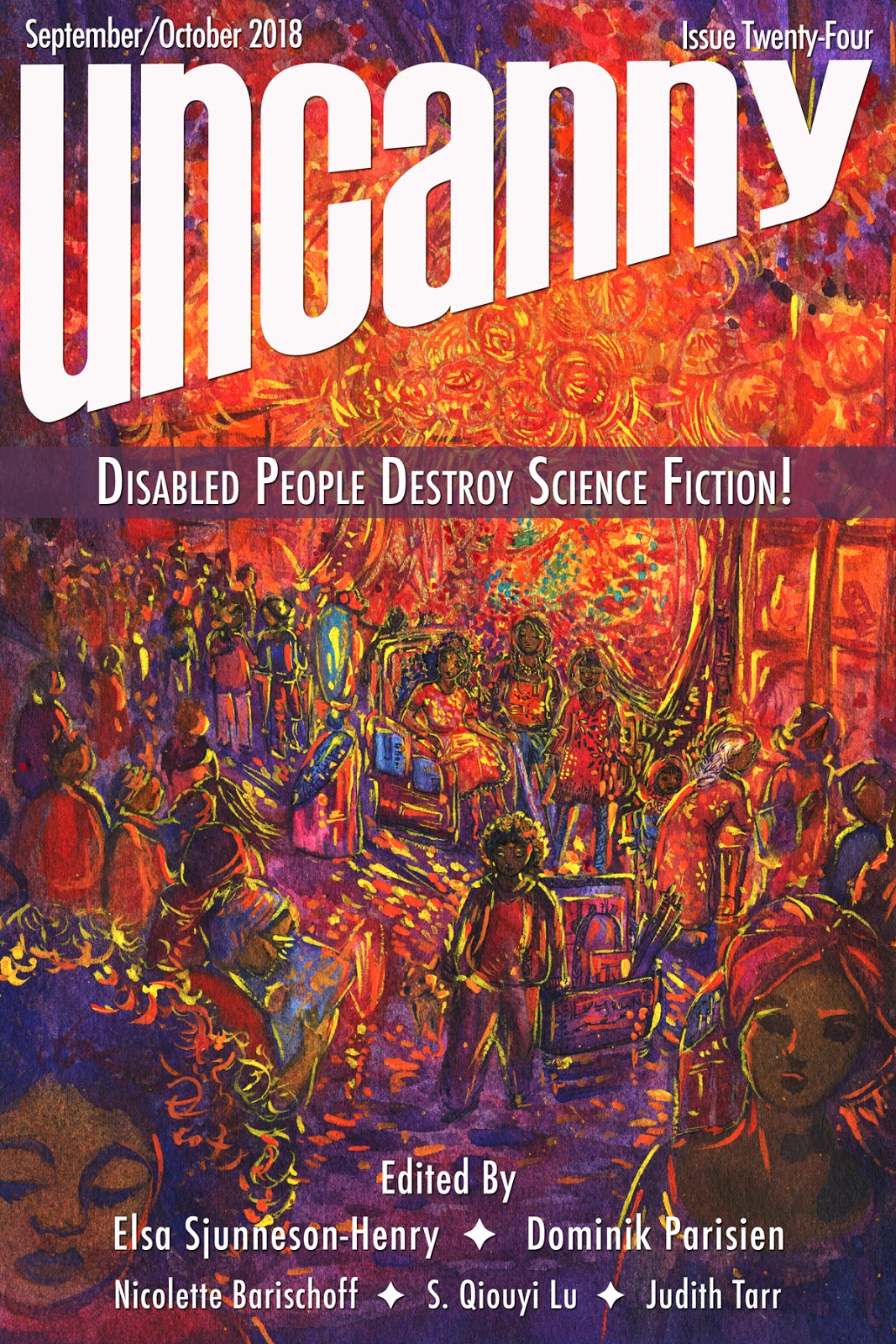
More disabled people destroying science fiction in this batch. And a couple of flash pieces from Nature Futures.

I have been too busy using up all of my brain spoons on various things (mostly work) so these preambles might continue to be short for the foreseeable future. Feel free to leave me a comment if you actually miss them.


Birthday Girl by Rachel Swirsky — A look at how approaches to mental illness/neurodiversity in children have changed over a generation. Highlighted by comparisons between the protagonist and her young niece. Source: https://uncannymagazine.com/article/birthday-girl/

An Open Letter to the Family by Jennifer Brozek — An epistolary story set in the far future. A woman tells her family of upcoming medical plans. It was a more interesting take than I expected from the opening paragraphs. Source: https://uncannymagazine.com/article/an-open-letter-to-the-family/

Heavy Lifting by A. T. Greenblatt — A coder/hacker girl working with her slightly douchey friend to tack down factory robots gone rogue in a (vague) post-apocalyptic world. A fun read.  Source: https://uncannymagazine.com/article/heavy-lifting/

A Picture is Worth by Beth Cato — An amusing flash piece about Martians who have severe ideological differences to the human race. Source: https://www.nature.com/articles/d41586-019-00884-6

The Librarian by Robert Dawson — A flash piece about a neglected library staffed only by a robotic librarian. I got an unnecessarily bitter vibe from it, though it wasn’t exactly a bad story. Source: https://www.nature.com/articles/d41586-019-00905-4

Saturday, 30 March 2019

#ReadShortStories (36 to 40)


A mixed bag here, from flash to long novella to getting back into New Suns to starting a new (to me) issue of Uncanny. I really enjoyed "Geometries of Belonging" by Rose Lemberg and I am definitely going to read more stories set in that universe. On the other hand, I was stuck part way through "Blood and Bells" for a long time which is one reason why my progress on New Suns has been so slow of late. The book is already out so I will try to get through the last few stories quickly and get my full review written up and posted soon.


Please [redacted] My Last E-mail by Kurt Pankau — A flash in the form of an email about an earlier email that was definitely not full of factual information about a robot army. Source: https://www.nature.com/articles/d41586-019-00797-4

Geometries of Belonging by Rose Lemberg 
Although I was warned, I was still surprised at how long this story was. It’s a novelette but it must be close to the upper limit. It took me a few days of reading in short- to medium-sized bursts to get through it. But I really enjoyed it. 

The world building is quite substantial so it did take me a little bit to get fully immersed in the world, but once I did I was hooked. The attitudes of the main character are deftly used to highlight the way the world works and even allow us to learn about other countries in this world. There were significant elements of both trans and autistic (I think) experiences, though not named as such, because fantasy world. I found these were presented in a very compelling way that left much scope to empathise with the protagonist. 

I gather there are other stories set in the same world and I am now very keen to read them and plan to track down what I can. 

Blood and Bells by Karin Lowachee — This story was a slog to get into and I ended up setting it aside for quite a while. When I came back to it and read further it was more interesting (to see the actual plot develop). Gang warfare and a father trying to protect his kid in the middle of a murder investigation. Source: New Suns edited by Nisi Shawl

Give Me Your Black Wings Oh Sister by Silvia Moreno-Garcia — An enticing story about a witch living in a city and attempting to lead a normal life. I enjoyed the time and writing style especially. Source: New Suns edited by Nisi Shawl

The House on the Moon by William Alexander — A mostly fun story but an unsubtle one. A kid with a cane on the moon, a field trip to a castle, some depressing recent (future) history. Quite readable, though the ending was a little confusing, with an element out of left field. Source: https://uncannymagazine.com/article/the-house-on-the-moon/

Wednesday, 27 March 2019

The True Queen by Zen Cho

The True Queen by Zen Cho is set after the events of Sorcerer to the Crown, but is not a direct sequel since it follows a different group of characters. I enjoyed Sorcerer to the Crown and generally recommend starting there to get a delightful introduction to the world, but if you can't get your hands on it, I don't see a problem with starting with The True Queen (especially if you don't mind being spoiled for the end state of Sorcerer to the Crown).

Fairyland’s future lies in doubt

The enchanted island of Janda Baik, in the Malay Archipelago, has long been home to witches. And Muna and her sister Sakti wake on its shores under a curse, which has quite stolen away their memories. Their only hope of salvation lies in distant Britain, where the Sorceress Royal runs a controversial academy for female magicians. But the pair travel via the formidable Fairy Queen’s realm, where Sakti simply disappears.

To save her sister, Muna must learn to navigate Regency London’s high society and trick the English into believing she’s a magical prodigy. But when the Sorceress Royal’s friends become accidentally embroiled in a plot – involving the Fairy Queen’s contentious succession – Muna is drawn right in. She must also find Sakti, break their curse and somehow stay out of trouble. But if fairyland’s true queen does finally return, trouble may find her first . . .

This was an excellent read. I had put off starting it for a little while because I wanted to finish other books I was part way through first. But (eventually) putting them aside and starting The True Queen was an excellent decision. I remember enjoying Sorcerer to the Crown very much when I read it, but that was a few years ago and in audiobook form, so my memory of it was hazier than I would have liked. I need not have worried, though since The True Queen follows a new character and gives us a good grounding in the world — and the Malaysian side of the world, at that — before introducing us to most of the recurring characters.

Muna starts off the book with no memory of who she is or why she washed up on a beach. She and her sister are taken in by a powerful local witch and, when little progress is made in curing them of the mysterious curse, they are sent to England to find out more. That's where things go wrong and also where the main connection to the earlier book lies.

I really enjoyed The True Queen. It made me laugh with its incidental humour and told an intriguing story which was captivating even though we, the reader, were given more than enough information to make connections that the protagonist overlooked for perfectly understandable reasons. And through the second most prominent character, Henrietta, we got a closer look at English society, the ways in which Prunella — the first Sorceress Royal — had changed society and the ways in which she hadn't.

I highly recommend The True Queen to anyone who enjoys fantasy with a dollop of humour or regcency-ish settings or Malaysian settings, for that matter. I continue to adore Zen Cho's writing (have you read her short stories?) and I will avidly read anything else of hers that I come across.

5 / 5 stars

First published: March 2019, Macmillan
Series: Sorcerer Royal, book 2 of 2 (so far)
Format read: eARC
Source: Publisher via NetGalley

Sunday, 24 March 2019

More Awards News - Aurealis Series and Tiptree


I am a little slow posting this news, but I didn't want it to pass without mention. Not long ago, I posted about the Aurealis Awards short list. The shortlist for the Sara Douglass series award came out a bit later and, though I missed it at the time, I wanted to share it with you all. This is only the second time the Best Series Aurealis will be awarded, so it's very interesting to look at the composition of the shortlist. (You can see the first shortlist at the bottom of this page.) I've included this year's shortlist below, and you can also see it here.

The other award which was recently announced is the Tiptree Award. This one is a bit unusual in that they announce the winner, an honour list and a long list all in one go. The winner this year is Gabriela Damián Miravete for her short story “They Will Dream In the Garden”. You can read the Honour and Long List at the Tiptree website.

2018 Sara Douglass Book Series Award shortlist


Blackthorn & Grim [Dreamer’s Pool (2014), Tower of Thorns (2015), Den of Wolves (2016)], Juliet Marillier (Pan Macmillan Australia)

Captive Prince [Captive Prince (2014), Prince’s Gambit (2014), Kings Rising (2016)], C S Pacat (Penguin Random House)

Electric Empire [The Diabolical Miss Hyde (2015), The Devious Dr Jekyll (2015), The Dastardly Miss Lizzie (2017)], Viola Carr (HarperCollins Publishers)

The Fire Sermon [The Fire Sermon (2015), The Map of Bones (2016), The Forever Ship (2017)], Francesca Haig (HarperCollins Publishers)

Zeroes [Zeroes (2015), Swarm (2016), Nexus (2017)], Deborah Biancotti, Margo Lanagan & Scott Westerfeld (Allen & Unwin)