iD by Madeline Ashby is the sequel to vN, which I reviewed last year. It picks up not too long after the first book ended and deals with the consequences of events in the first book. This review will contain some spoilers for vN but not for iD. It's also the kind of series you have to read in order for it to make sense; iD depends on a lot of worldbuilding laid down in vN.
iD starts with Amy and Javier, our two protagonists from vN, living a reasonably idyllic life with Javier's kid (from the first book) treating them both as his parents... and then of course, everything goes horribly wrong. The majority of the book follows Javier as he tries to fix things (like the world and his life). We also learn much more about his character — who was more of a friend/sidekick figure in book 1 — and about his past. Amy isn't in it very much.
The first book dealt a lot with sentience and humanity through Amy, a vN without a failsafe. (The failsafe being the coding which makes the vN shutdown/bluescreen/die if they harm a human or through inaction allow a human to come to harm.) By contrast, Javier has an intact failsafe and his story is more about exploring his identity independent of humans and interrelationally with humans. The reader is confronted more often with the reason why vN make good prostitutes/lovers — because the failsafe makes them want to make humans happy, they feel compelled to be good lovers even though they might not normally be interested. What constitutes rape when it's done to a robot? Is sentience enough to condemn it as a deplorable act or does the fact that the vN don't feel pain mean it isn't really rape? These and other interesting questions are addressed as we follow Javier's journey.
I have to say, I didn't enjoy reading Javier's character as much as Amy's. Not because he was badly written or anything, more just a matter of personal preference. I was interested to see what would happen next, what was going on in the world and how it was all going to turn out, but I felt ambivalent towards Javier. I can see why Amy wasn't the point of view character this time, but I do hope Javier isn't the focus of the next book. Maybe one of the kids will be.
I originally thought this was a duology, although in retrospect that's probably because I've read so many Angry Robot duologies recently rather than any specific marketing I saw. I did think it was going to wrap up until I got to the end and then BAM! Epilogue! So I'm fairly confident there'll be a sequel even if the internet won't confirm that. And I look forward to reading it. The epilogue set up a potentially very interesting book three.
I enjoyed iD and I definitely suggest reading it if you enjoyed vN. If you're new to the series, I highly recommend it to fans of science fiction and/or robots and suggest starting with book 1. I look forward to reading about this world and the characters in future books.
3.5 / 5 stars
First published: 25 June 2013, Angry Robot
Series: Machine Dynasty, book 2 of ?
Format read: eARC
Source: The publisher via NetGalley
Sunday, 16 June 2013
Friday, 14 June 2013
The Compay Articles of Edward Teach by Thoraiya Dyer / The Angælien Apocalypse by Matthew Chrulew
This book is a novella double from Twelfth Planet Press, printed so that the "front" cover has cover art for one novella and when you flip it over the "back" cover forms the front cover for the other novella.
The Company Articles of Edward Teach by Thoraiya Dyer is the first novella I read of the two. I've made no secret of admiring Dyer's work in the past, and this is no exception.
The story is about two disaffected teenagers, both of whom have zero desire to follow the paths their parents have in mind for them. Layla's parents want her to be a doctor, but she just wants to party, have fun, and make boys fall in love with her. Avi's parents want him to become a lawyer, but to avoid that fate he broke several driving laws so that his impending criminal record would prevent that future career.
At first I was a bit confused as to how Layla and Avi's lives matched the cover art and title, but then they both wander into a costume shop with a shifty shopkeeper and bam, magic costumes transport them back in time and into other bodies and also a pirate ship. The titular Edward Teach is Blackbeard the pirate (which some of you may have already known, but I didn't) and the two present day teens find themselves in the bodies of pirates with future and piratey memories warring inside their minds.
The story follows them as they learn how to function in this new world and try to survive. Dyer shows us a traumatic and life-changing experience for the teens in a brutal cut-throat (literally) world. I enjoyed reading about how each of them came to terms with their situation and their lives and how their experiences changed them.
The Company Articles of Edward Teach was an excellent read. I highly recommend it to fans of realistic pirates, fantasy and Dyer's work. It is worth buying this double just for this novella alone.
4.5 / 5 stars
The Angælien Apocalypse is the first work I've read by Matthew Chrulew and Goodreads leads me to believe it might be his longest work thus far (short stories in anthologies are also listed).
It's about the end of days in the Christian Rapture sense, except instead of what one might think of as conventional angels, the beings coming to Earth are aliens. Angelic aliens. Angæliens. And Demœliens. And the main characters get mixed up in the whole apocalypse thing.
And it was severely not my sort of thing. There wasn't anything specifically wrong with it that I can point to and say was done badly (well, except for the nitpicky thing where one of the characters', Joachim's, nickname, Joke, is pronounced like the noun not "yo-keh" as it ought to be). It was the combination of theme and content, I think. Possibly I'm a bit over stories which riff off biblical ideas in this way.
It wasn't badly written and there was a lot of action. I just felt my attention wandering a lot while I was reading and, as a result, it took me much longer to get through than the Dyer novella (a few days, interspersed with other reading compared with one evening). As I have said, I can't quite pinpoint why and I suspect your mileage may vary.
3 / 5 stars
First published: 2010, Twelfth Planet Press
Format read: Paper! Made from trees!
Source: Purchased at Continuum Convention
Challenges: Half of it goes towards the Australian Women Writers Challenge
~
The Company Articles of Edward Teach by Thoraiya Dyer is the first novella I read of the two. I've made no secret of admiring Dyer's work in the past, and this is no exception.
The story is about two disaffected teenagers, both of whom have zero desire to follow the paths their parents have in mind for them. Layla's parents want her to be a doctor, but she just wants to party, have fun, and make boys fall in love with her. Avi's parents want him to become a lawyer, but to avoid that fate he broke several driving laws so that his impending criminal record would prevent that future career.
At first I was a bit confused as to how Layla and Avi's lives matched the cover art and title, but then they both wander into a costume shop with a shifty shopkeeper and bam, magic costumes transport them back in time and into other bodies and also a pirate ship. The titular Edward Teach is Blackbeard the pirate (which some of you may have already known, but I didn't) and the two present day teens find themselves in the bodies of pirates with future and piratey memories warring inside their minds.
The story follows them as they learn how to function in this new world and try to survive. Dyer shows us a traumatic and life-changing experience for the teens in a brutal cut-throat (literally) world. I enjoyed reading about how each of them came to terms with their situation and their lives and how their experiences changed them.
The Company Articles of Edward Teach was an excellent read. I highly recommend it to fans of realistic pirates, fantasy and Dyer's work. It is worth buying this double just for this novella alone.
4.5 / 5 stars
~
The Angælien Apocalypse is the first work I've read by Matthew Chrulew and Goodreads leads me to believe it might be his longest work thus far (short stories in anthologies are also listed).
It's about the end of days in the Christian Rapture sense, except instead of what one might think of as conventional angels, the beings coming to Earth are aliens. Angelic aliens. Angæliens. And Demœliens. And the main characters get mixed up in the whole apocalypse thing.
And it was severely not my sort of thing. There wasn't anything specifically wrong with it that I can point to and say was done badly (well, except for the nitpicky thing where one of the characters', Joachim's, nickname, Joke, is pronounced like the noun not "yo-keh" as it ought to be). It was the combination of theme and content, I think. Possibly I'm a bit over stories which riff off biblical ideas in this way.
It wasn't badly written and there was a lot of action. I just felt my attention wandering a lot while I was reading and, as a result, it took me much longer to get through than the Dyer novella (a few days, interspersed with other reading compared with one evening). As I have said, I can't quite pinpoint why and I suspect your mileage may vary.
3 / 5 stars
~
First published: 2010, Twelfth Planet Press
Format read: Paper! Made from trees!
Source: Purchased at Continuum Convention
Challenges: Half of it goes towards the Australian Women Writers Challenge
Thursday, 13 June 2013
Continuum Wrap-up
Last weekend hubby and I went to Continuum, an annual spec fic convention held in Melbourne most years.
It started Friday night with (for us) the Opening Ceremony. The opening video was set to this amusing song (but with appropriate spec ficcy visuals, of course). Then, after introducing the various guests, it was pretty quickly on to the Chronos Awards. (I live tweeted them and, as it happened, seem to have been the only person to do so.) The Chronos Awards celebrate the best (as voted by Continuum members) fiction and fan work produced by Victorians in the previous year. This year's winners and shortlists (winner in bold, nabbed from here):
We headed home straight after the awards because we were exhausted from jetlag.
On Saturday morning we rocked up in time to have a nice chat with some friends, both new and old, before guest of honour Nora (NK) Jemisin's speech. It was a great speech, which you can read in full here.
Then, after lunch, we went to two panels: The Heroines of YA and Fighting Like a Girl, both interesting and on similar topics. And we headed home early again because of another commitment.
Sunday started early with me giving a talk about astro a room full of interested folk. Then it was the nomadic Plot 101 panel, which was probably my favourite panel of those I wasn't participating in myself. It was nomadic because the original room it was scheduled in was too small for the number of people who showed up. So we moved to a temporarily empty room... then got kicked out shortly thereafter when the guest of honour speech in the following session... and ended up setting up shop in the foyer. Good thing the authors on the panel had interesting things to say!
After lunch we went to the Silence in the Library panel about Doctor Who non-fiction and then it was time for my first panel, The Devil in the Details. Which went quite well, with Pete Aldin moderating, Richard Harland and me talking about what details we think are important, me talking about how violations of basic physics make me angry, and everyone generally coming to the agreement that you can have one or two big impossibilities (FTL travel, teleportation, giant world-shaking machines, etc) but should try to be as accurate as possible with the other mundane stuff in your story. And if you don't know enough of <insert field you're writing about> yourself, then try to learn or ask someone. As someone in the audience said, high school physics/chem/bio textbooks are a good place to start. An enjoyable panel.
Then it was time for the We Do This Stuff So You Can Write About It, a not-really-panel where the idea was people could ask the participants about the interesting/unusual things they do or know about. I liked the idea of this, but I thought the room was a bit small (a recurring theme during the con) and I saw some people turn away when they saw how cramped it was, even after we spilled out into the corridor as well.
Then early dinner and off to the book launch of Caution: Contains Small Parts by Kirstyn McDermott. Then it was time for my next panel, Spacetime and Spaceships which was probably my favourite participating-in panel. The four of us riffed on various spacey/astro-y topics. My favourite comment was from an audience member saying we were like the verbal equivalent of Wiki-drifting, lol. (Actually, he used a different phrase that escapes me now but it was along those lines.) It was a fun panel to be on and we probably could have gone for several more hours.
We were planning to go home not long after that panel, but instead ended up sitting in the bar talking for a few hours. Good times.
Monday was a bit of a haze of tiredness. It started early with us attending the Dark YA panel, in which the panellists decided that at least part of the reason darker things are finding their way into YA is because publishers like the marketing opportunities in YA more. And apparently, kids enjoy being depressed. As for how dark things are allowed to get, that's generally up to the publishers. Then we went to the Watching the New Who panel, which was, again, Doctor Who-y, as might be expected.
I have no recollection of what happened after that, except that it was followed by lunch. After lunch was my last panel Rise of the Dystopia, which had a lot of interesting discussion, but drifted off into who SF is generally bleaker now than it used to be. I was expecting it to be more about why YA dystopias are now so popular. Much more talk about 1984 (and Neuromancer) than I was expecting.
Then I went to the Adventures in Book Reviewing panel, in which many an amusing tale was told (and I sort of wished I was participating in it). And that was it. We skipped out before the Closing Ceremony due to exhaustion.
All in all, Continuum was a fun weekend. There was a nice atmosphere and everyone was very welcoming. The only low point was the venue, which wasn't terrible, but could definitely have been better. And of course, it was great to catch up with friends, old, new and from the internet (or combinations of the aforementioned).
It started Friday night with (for us) the Opening Ceremony. The opening video was set to this amusing song (but with appropriate spec ficcy visuals, of course). Then, after introducing the various guests, it was pretty quickly on to the Chronos Awards. (I live tweeted them and, as it happened, seem to have been the only person to do so.) The Chronos Awards celebrate the best (as voted by Continuum members) fiction and fan work produced by Victorians in the previous year. This year's winners and shortlists (winner in bold, nabbed from here):
Best Long Fiction
-
Bread and Circuses by Felicity Dowker (Ticonderoga Publications)
-
Salvage by Jason Nahrung (Twelfth Planet Press)
-
Walking Shadows by Narrelle M. Harris (Clan Destine Press)
-
Year’s Best Australian Fantasy & Horror 2011, edited by Liz Grzyb and Talie Helene (Ticonderoga Publications)
-
Dyson’s Drop by Paul Collins (Ford Street Publishing)
Best Short Fiction
-
"Five Ways to Start a War" by Sue Bursztynski in Light Touch Paper Stand Clear, edited by Edwina Harvey and Simon Petrie (Peggy Bright Books)
-
"The Mornington Ride" by Jason Nahrung in Epilogue, edited by Tehani Wessely (FableCroft Publishing)
-
"Nematalien" by LynC in The Narratorium (website), edited by David Grigg
-
"Fireflies" by Steve Cameron in Epilogue (FableCroft Publishing)
-
"The Dd" by Adam Browne in Light Touch Paper Stand Clear, edited by Edwina Harvey and Simon Petrie (Peggy Bright Books)
Best Fan Writer
-
Alexandra Pierce
-
Jason Nahrung
-
Nalini Haynes
-
Bruce Gillespie
-
Grant Watson
-
Steve Cameron
Best Fan Written Work
-
"Reviewing New Who" series by David McDonald, Tansy Rayner Roberts and Tehani Wessely
Best Fan Artist
-
Dick Jenssen
Best Fan Artwork
-
"The Entellechy" by Dick Jenssen, cover art for Interstellar Ramjet Scoop for ANZAPA 267 edited by Bill Wright
Best Fan Publication
-
Dark Matter Fanzine (http://www.darkmatterfanzine.com), by Nalini Hayes
-
SF Commentary (http://efanzines.com/SFC/), edited by Bruce Gillespie
-
Viewing Clutter, DVD and Blu-ray reviews blog (http://georgeivanoff.com.au/other-writing/reviews/viewing-clutter/), by George Ivanoff
Best Achievement
-
Continuum 8: Craftonomicon (51st Australian National SF Convention) Program by Julia Svaganovic, Emma Hespa Mann, and Caitlin Noble
-
"Snapshot 2012" by Alisa Krasnostein, Kathryn Linge, David McDonald, Helen Merrick, Ian Mond, Jason Nahrung, Alex Pierce, Tansy Rayner Roberts, Tehani Wessely and Sean Wright
We headed home straight after the awards because we were exhausted from jetlag.
On Saturday morning we rocked up in time to have a nice chat with some friends, both new and old, before guest of honour Nora (NK) Jemisin's speech. It was a great speech, which you can read in full here.
Then, after lunch, we went to two panels: The Heroines of YA and Fighting Like a Girl, both interesting and on similar topics. And we headed home early again because of another commitment.
Sunday started early with me giving a talk about astro a room full of interested folk. Then it was the nomadic Plot 101 panel, which was probably my favourite panel of those I wasn't participating in myself. It was nomadic because the original room it was scheduled in was too small for the number of people who showed up. So we moved to a temporarily empty room... then got kicked out shortly thereafter when the guest of honour speech in the following session... and ended up setting up shop in the foyer. Good thing the authors on the panel had interesting things to say!
After lunch we went to the Silence in the Library panel about Doctor Who non-fiction and then it was time for my first panel, The Devil in the Details. Which went quite well, with Pete Aldin moderating, Richard Harland and me talking about what details we think are important, me talking about how violations of basic physics make me angry, and everyone generally coming to the agreement that you can have one or two big impossibilities (FTL travel, teleportation, giant world-shaking machines, etc) but should try to be as accurate as possible with the other mundane stuff in your story. And if you don't know enough of <insert field you're writing about> yourself, then try to learn or ask someone. As someone in the audience said, high school physics/chem/bio textbooks are a good place to start. An enjoyable panel.
Then it was time for the We Do This Stuff So You Can Write About It, a not-really-panel where the idea was people could ask the participants about the interesting/unusual things they do or know about. I liked the idea of this, but I thought the room was a bit small (a recurring theme during the con) and I saw some people turn away when they saw how cramped it was, even after we spilled out into the corridor as well.
Then early dinner and off to the book launch of Caution: Contains Small Parts by Kirstyn McDermott. Then it was time for my next panel, Spacetime and Spaceships which was probably my favourite participating-in panel. The four of us riffed on various spacey/astro-y topics. My favourite comment was from an audience member saying we were like the verbal equivalent of Wiki-drifting, lol. (Actually, he used a different phrase that escapes me now but it was along those lines.) It was a fun panel to be on and we probably could have gone for several more hours.
We were planning to go home not long after that panel, but instead ended up sitting in the bar talking for a few hours. Good times.
Monday was a bit of a haze of tiredness. It started early with us attending the Dark YA panel, in which the panellists decided that at least part of the reason darker things are finding their way into YA is because publishers like the marketing opportunities in YA more. And apparently, kids enjoy being depressed. As for how dark things are allowed to get, that's generally up to the publishers. Then we went to the Watching the New Who panel, which was, again, Doctor Who-y, as might be expected.
I have no recollection of what happened after that, except that it was followed by lunch. After lunch was my last panel Rise of the Dystopia, which had a lot of interesting discussion, but drifted off into who SF is generally bleaker now than it used to be. I was expecting it to be more about why YA dystopias are now so popular. Much more talk about 1984 (and Neuromancer) than I was expecting.
Then I went to the Adventures in Book Reviewing panel, in which many an amusing tale was told (and I sort of wished I was participating in it). And that was it. We skipped out before the Closing Ceremony due to exhaustion.
All in all, Continuum was a fun weekend. There was a nice atmosphere and everyone was very welcoming. The only low point was the venue, which wasn't terrible, but could definitely have been better. And of course, it was great to catch up with friends, old, new and from the internet (or combinations of the aforementioned).
Monday, 10 June 2013
New Booksies, Continuum edition
I will do an actual con wrap-up post in the near future but for now I thought I'd start by posting my book haul, which takes much less brain effort. I am too tired to brain. And my book photos are a bit terrible because they were taken with my phone at night (as in indoor lighting << daylight). I also had a bunch of books waiting for me when I got back to Melbourne, that I'd ordered from Booktopia, but I'll include them in a later post.
Starting before Continuum, however, I picked up a few books in ordinary bookshops. I saw Madigan Mine by Kirstyn McDermott and, particularly since it's not available in ebook form, I couldn't resist it (and then I got it signed at Continuum, so yay). Then, with a bit more planning I picked up Black Sun Light My Way by Jo Spurrier, the sequel to Winter Be My Shield which I enjoyed immensely last year. While in the CBD Dymocks on Friday before the Continuum opening ceremony, my husband and I saw the display for Fairytales For Wilde Girls by Allyse Near complete with notification of the book launch in the evening. So I bought a copy and we went along to the launch and had a lovely chat with the author.
Then it was time for Continuum. I bought a bunch of books in the dealers' room over the weekend. I'd say I probably spent too much money on books, but at least I haven't been buying that many books lately in general so I suspect my bank account will survive the blow.
In the con bag, we all got a shiny copy of Words Next Door, an anthology from Fablecroft edited by Tehani Wessely. In the dealers' room I picked up:
And I also picked up two of Twelve Planet Press's novella doubles, which are double sided volumes.
Yay, books!
Starting before Continuum, however, I picked up a few books in ordinary bookshops. I saw Madigan Mine by Kirstyn McDermott and, particularly since it's not available in ebook form, I couldn't resist it (and then I got it signed at Continuum, so yay). Then, with a bit more planning I picked up Black Sun Light My Way by Jo Spurrier, the sequel to Winter Be My Shield which I enjoyed immensely last year. While in the CBD Dymocks on Friday before the Continuum opening ceremony, my husband and I saw the display for Fairytales For Wilde Girls by Allyse Near complete with notification of the book launch in the evening. So I bought a copy and we went along to the launch and had a lovely chat with the author.
Then it was time for Continuum. I bought a bunch of books in the dealers' room over the weekend. I'd say I probably spent too much money on books, but at least I haven't been buying that many books lately in general so I suspect my bank account will survive the blow.
In the con bag, we all got a shiny copy of Words Next Door, an anthology from Fablecroft edited by Tehani Wessely. In the dealers' room I picked up:
- Broken Kingdoms by NK Jemisin (the guest of honour)
- A New Kind of Death by Alison Goodman
- A Book of Endings by Deborah Biancotti, a short story collection
- Bood Stones, an anthology of dark fantasy edited by Amanda Pillar
- A Trifle Dead by Livia Day (aka Tansy Rayner Roberts, it's her first crime book)
And I also picked up two of Twelve Planet Press's novella doubles, which are double sided volumes.
- The Company Articles of Edward Teach by Thoraiya Dyer / The Angaelien Apocalypse by Matthew Chrulew
- Above by Stephanie Campisi / Below by Ben Peak
Yay, books!
Wednesday, 5 June 2013
Stuff and Things (AWW and Continuum)
AWW
- May (Adult-ish) Spec Fic Round-up
- April Spec Fic Round-up, mostly adult titles
- March 2013 (mostly adult) Speculative Fiction Round-up
- Jan-Feb Speculative Fiction Round-up
- 2012 AWW Challenge Speculative Fiction Wrap-up
Continuum
So if you're at Continuum come along and say "Hi", especially if you're interested in the astro talk, because talking to an empty room is depressing.
- Astronomy and Astrophysics: From the very big to the very small Sunday 10:30 until Sunday 11:00 (30 Minutes)
- The Devil in the Details Sunday 15:00 until Sunday 16:00 (60 Minutes)
- We Do This Stuff So You Can Write About It Sunday 16:00 until Sunday 17:00 (60 Minutes)
- Spacetime and Spaceships Sunday 19:00 until Sunday 20:00 (60 Minutes)
- Rise of the Dystopia Monday 14:00 until Monday 15:00 (60 Minutes)
Monday, 3 June 2013
Outcast by Adrienne Kress
Outcast by Adrienne Kress is a YA novel set in a small town in the southern US. The blurb was the factor that made me want to read it. Unfortunately, the blurb was also the high point of the entire book.
Outcast was severely overwritten. I felt that, with the possible exception of the dialogue, just about every second sentence could have been cut. Reilly's inner monologue is very repetitive, driving home statements far more than necessary. A direct consequence of this was an abundance of telling rather than showing (which isn't automatically a bad thing, but was in this case). It was very frustrating to read.
I mostly kept going because I was hoping for the big reveal regarding the angels and world building to be interesting. It was distinctly underwhelming. (But by the time it came around I was too close to the end to stop reading and sacrifice writing this review.) And the romantic resolution at the end was a bit odd <spoiler redacted>.
The one upside is that this is another book about angels (along with Rise of the Fallen) that did not annoy me because of the way the angels were treated (I get the feeling that without direct evidence of weird shit going on Riley might have been an atheist). Yay, "only" bad writing! Oh and most of the supporting characters were pretty good, especially the non-cookie-cutter cheerleader and the Catholic priest disenfranchised by the angels. Although I also thought that some of their interactions, notably at critical moments, could have been more complex in terms of motivation.
If you're the kind of person that notices when a book is poorly written, definitely give this one a miss (unless you're into that kind of thing). If you're not usually one to notice poor writing and the plot has got you interested, then by all means, give it a go, just don't set your expectations too high.
2.5 / 5 stars
First published: June 2013, Diversion Books
Series: no
Format read: eARC
Source: publisher, via NetGalley
After six years of “angels” coming out of the sky and taking people from her town, 16-year-old Riley Carver has just about had it living with the constant fear. When one decides to terrorize her in her own backyard, it’s the final straw. She takes her mother’s shotgun and shoots the thing. So it’s dead. Or … not? In place of the creature she shot, is a guy. A really hot guy. A really hot alive and breathing guy. Oh, and he’s totally naked.
Not sure what to do, she drags his unconscious body to the tool shed and ties him up. After all, he’s an angel and they have tricks. When he regains consciousness she’s all set to interrogate him about why the angels come to her town, and how to get back her best friend (and almost boyfriend) Chris, who was taken the year before. But it turns out the naked guy in her shed is just as confused about everything as she is.
He thinks it’s 1956.
Set in the deep south, OUTCAST is a story of love, trust, and coming of age. It’s also a story about the supernatural, a girl with a strange sense of humor who’s got wicked aim, a greaser from the 50’s, and an army of misfits coming together for one purpose: To kick some serious angel ass.
Outcast was severely overwritten. I felt that, with the possible exception of the dialogue, just about every second sentence could have been cut. Reilly's inner monologue is very repetitive, driving home statements far more than necessary. A direct consequence of this was an abundance of telling rather than showing (which isn't automatically a bad thing, but was in this case). It was very frustrating to read.
I mostly kept going because I was hoping for the big reveal regarding the angels and world building to be interesting. It was distinctly underwhelming. (But by the time it came around I was too close to the end to stop reading and sacrifice writing this review.) And the romantic resolution at the end was a bit odd <spoiler redacted>.
The one upside is that this is another book about angels (along with Rise of the Fallen) that did not annoy me because of the way the angels were treated (I get the feeling that without direct evidence of weird shit going on Riley might have been an atheist). Yay, "only" bad writing! Oh and most of the supporting characters were pretty good, especially the non-cookie-cutter cheerleader and the Catholic priest disenfranchised by the angels. Although I also thought that some of their interactions, notably at critical moments, could have been more complex in terms of motivation.
If you're the kind of person that notices when a book is poorly written, definitely give this one a miss (unless you're into that kind of thing). If you're not usually one to notice poor writing and the plot has got you interested, then by all means, give it a go, just don't set your expectations too high.
2.5 / 5 stars
First published: June 2013, Diversion Books
Series: no
Format read: eARC
Source: publisher, via NetGalley
Friday, 31 May 2013
Any Other Name by Emma Newman
Any Other Name by Emma Newman is the sequel to Between Two Thorns, which I reviewed earlier this year. Any Other Name picks up very soon after Between Two Thorns left off and depends very heavily on the first book. This review contains spoilers for Between Two Thorns but not for Any Other Name. I recommend not reading on if you haven't read book one.
You were warned.
Any Other Name opens on the day of Cathy's wedding to Will. She has been drugged by her family to prevent her doing anything crazy, like trying to run away and have a say in her own life. A lot of terrible things happen to Cathy throughout the book (but at least most of them aren't violent!) and I deeply sympathised with her predicament. Although I had hoped at the end of book one that Cathy and Will might realise they have more in common than each saw on the surface of the other, any desire I had to ship them quickly evaporated with Will's behaviour. Made worse, I think, because he often meant well and then utterly failed to do the "right" thing (scare quotes because of generalised moral ambiguity). Really, Cathy was the only Netherworld character in more than two or three scenes that I didn't end up hating for one reason or another. I enjoyed Cathy as a character and there were some promising things set up with her which I look forward to reading about in the next book.
The other major set of characters included Sam, the human who accidentally got caught up in the action in book one, Max, the arbiter, and the sorcerer. Mostly they plod along trying to solve the mass murders and associated issues from book one. There were some interesting revelations, particularly with Samthat I totally saw coming, but overall, while their story progressed the trilogy story arc, it was less exciting than what Cathy and Will were up to. (Apart from their ending.) I look forward to seeing how it all plays out — because right now it seems there are too many mysteries to be able to guess everything reliably — but I wouldn't have been disappointed if their sections had been fewer.
The last quarter or so of the book was a bit of an exercise in frustration for me. The reader knows what various factions are up to and then gets to watch as the wrong ones communicate and characters are manipulated into making matters worse. I'm not sure I was entirely in the mood for that kind of heckling-at-the-page-inducing writing, but that was for external reasons. Whether or not that's the sort of thing you like (I generally do) will mean your mileage will vary. (And if you're the kind to exclaim aloud or shake your fist at a book, maybe don't read it on public transport.)
On a non-literary note, I really love the covers for this series. Not only are they attractive (incidentally, it's the same artist as Cassandra Rose Clarke's Assassin's Curse books), but if you look closely you can see a lot of elements that pop up in the books. There's the more obvious things like the flowers and London, but if you look closely, every detail makes sense once you've read the book.
On the whole, this was a solid continuation of the series that brought more or less what I expected (after the slight shock of the opening), and not in a bad way. If you enjoyed Between Two Thorns, I definitely suggest reading Any Other Name. If you didn't, probably give this one a miss. It's also not the kind of sequel that can be read out of order. If you read this whole review without reading the first book, and you're a fantasy fan looking for something a little off the beaten track, I recommend giving this series a go.
4 / 5 stars
First published: June 2013, Angry Robot
Series: yes. Split Worlds, book 2 of 3
Format read: eARC on Kobo
Source: the publisher via NetGalley
You were warned.
Any Other Name opens on the day of Cathy's wedding to Will. She has been drugged by her family to prevent her doing anything crazy, like trying to run away and have a say in her own life. A lot of terrible things happen to Cathy throughout the book (but at least most of them aren't violent!) and I deeply sympathised with her predicament. Although I had hoped at the end of book one that Cathy and Will might realise they have more in common than each saw on the surface of the other, any desire I had to ship them quickly evaporated with Will's behaviour. Made worse, I think, because he often meant well and then utterly failed to do the "right" thing (scare quotes because of generalised moral ambiguity). Really, Cathy was the only Netherworld character in more than two or three scenes that I didn't end up hating for one reason or another. I enjoyed Cathy as a character and there were some promising things set up with her which I look forward to reading about in the next book.
The other major set of characters included Sam, the human who accidentally got caught up in the action in book one, Max, the arbiter, and the sorcerer. Mostly they plod along trying to solve the mass murders and associated issues from book one. There were some interesting revelations, particularly with Sam
The last quarter or so of the book was a bit of an exercise in frustration for me. The reader knows what various factions are up to and then gets to watch as the wrong ones communicate and characters are manipulated into making matters worse. I'm not sure I was entirely in the mood for that kind of heckling-at-the-page-inducing writing, but that was for external reasons. Whether or not that's the sort of thing you like (I generally do) will mean your mileage will vary. (And if you're the kind to exclaim aloud or shake your fist at a book, maybe don't read it on public transport.)
On a non-literary note, I really love the covers for this series. Not only are they attractive (incidentally, it's the same artist as Cassandra Rose Clarke's Assassin's Curse books), but if you look closely you can see a lot of elements that pop up in the books. There's the more obvious things like the flowers and London, but if you look closely, every detail makes sense once you've read the book.
On the whole, this was a solid continuation of the series that brought more or less what I expected (after the slight shock of the opening), and not in a bad way. If you enjoyed Between Two Thorns, I definitely suggest reading Any Other Name. If you didn't, probably give this one a miss. It's also not the kind of sequel that can be read out of order. If you read this whole review without reading the first book, and you're a fantasy fan looking for something a little off the beaten track, I recommend giving this series a go.
4 / 5 stars
First published: June 2013, Angry Robot
Series: yes. Split Worlds, book 2 of 3
Format read: eARC on Kobo
Source: the publisher via NetGalley
Monday, 27 May 2013
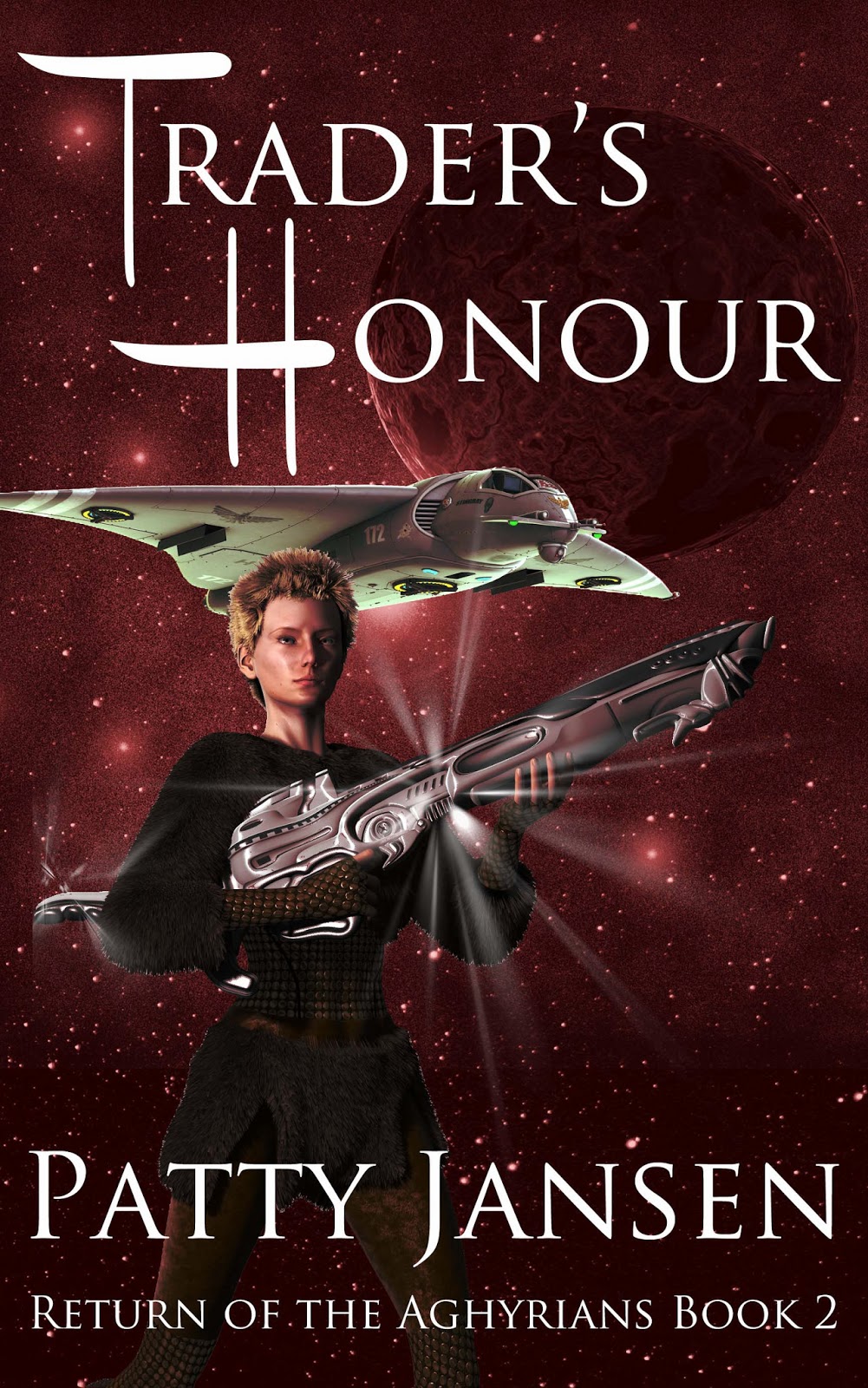
Trader's Honour by Patty Jansen
Trader's Honour by Patty Jansen is a sort of standalone sequel to Watcher's Web. It takes place mainly on the same planet and some of the same people make appearances, but the main character is new and the main part of her story is entirely separate to the character's from Watcher's Web. Abridged blurb (for length):
I enjoyed reading about Mikandra a lot. I was a bit hesitant to read Trader's Honour because I didn't enjoy Watcher's Web — I gave up about half way through mainly because I couldn't relate to the main character's reactions to her situation — but I decided to try the sample on SmashWords and was hooked. Mikandra is a very different character in a different situation. So if you haven't enjoyed Watcher's Web but the premise of Trader's Honour sounds like something you'd enjoy, I urge you to give it a shot.
Trader's Honour deals quite a bit with notions of how societies (should) work. The Mirani have two classes of people, the nobility (which includes Mikandra) and the working classes. The noble class not only limits the prospects of its women, but also believes that it's their duty to protect and care for the lower classes. As we learn quite early on, they don't do as good a job as they could. By contrast, Barresh, the other continent, is thought to be primitive and more or less useless. But when Mikandra arrives there she finds that, yes, it is very different (there's a bit of appropriate culture-shock on her part). Over time she learns that different does not mean worse, not the way the other nobles think, and starts to see a lot of potential around her. It made me think of biases against developing countries and how some are actually the world's fastest growing economies.
When the characters from Watcher's Web started showing up I felt a bit frustrated that I didn't have as much background information on them as if I'd finished the book, but it really wasn't necessary. It merely put me on the same level as Mikandra. And if I hadn't known there was another book, I'm pretty sure I wouldn't've cared.
Trader's Honour is an enjoyable science fiction read. It's low on technobabble and explicit sciencey stuff, although the worldbuilding is fairly solid. (If you're curious, Patty wrote about the worldbuilding here.) As such, I think it might also appeal to fantasy fans who don't mind a few aeroplanes and a spot of interplanetary travel in their fiction. I highly recommend it to science fiction fans.
4.5 / 5 stars
First published: April 2013, self-published
Series: Return of the Aghyrians book 2 of 2 so far, but it's a series of stand-alones.
Format read: ePub, mostly on my Kobo
Source: Review copy courtesy of the author (SmashWords link)
Disclaimer: Although Patty is a friend I have attempted to write an unbiased review
Challenges: Australian Women Writers Challenge, Australian Science Fiction Reading Challenge
Mikandra Bisumar is useless to her father: she carries the curse of infertility that plagues the Endri people of Miran. Forced to work in the hospital to pay her duty to her proud nation, she dreams of becoming a Trader, one of the people who bring great prosperity to Miran.Mikandra has guts, something I like in a character (to the surprise of no one, heh). Instead of continuing to sit around in what she sees as a broken society, she takes steps to change her situation. First she applies for the Trader Academy, going to another Miran Trader family when her Trader aunt won't take her as an apprentice. Then, when it looks like her dreams will fall through because her sponsor family is in trouble, instead of running back to the relative comforts of home (if an abusive father can really be called a comfort), she sets out to help her sponsor's family. Helping in this case, involves travelling to another continent, when she'd never left the city before, and trying to track down her recalcitrant sponsor. Her mission turns out to be harder than she'd assumed but she sticks it out, even after being robbed on her first day there.
To her surprise Iztho Andrahar, from the city's most prestigious Trading family, has agreed to take her on. That is where her troubles begin.
Her father is so angry with her that she has to leave her home. Worse, the Andrahar Traders have been accused of smuggling. Iztho has disappeared and the business license suspended.
Mikandra has nowhere to go, except try to help Iztho's brothers prove their innocence.
I enjoyed reading about Mikandra a lot. I was a bit hesitant to read Trader's Honour because I didn't enjoy Watcher's Web — I gave up about half way through mainly because I couldn't relate to the main character's reactions to her situation — but I decided to try the sample on SmashWords and was hooked. Mikandra is a very different character in a different situation. So if you haven't enjoyed Watcher's Web but the premise of Trader's Honour sounds like something you'd enjoy, I urge you to give it a shot.
Trader's Honour deals quite a bit with notions of how societies (should) work. The Mirani have two classes of people, the nobility (which includes Mikandra) and the working classes. The noble class not only limits the prospects of its women, but also believes that it's their duty to protect and care for the lower classes. As we learn quite early on, they don't do as good a job as they could. By contrast, Barresh, the other continent, is thought to be primitive and more or less useless. But when Mikandra arrives there she finds that, yes, it is very different (there's a bit of appropriate culture-shock on her part). Over time she learns that different does not mean worse, not the way the other nobles think, and starts to see a lot of potential around her. It made me think of biases against developing countries and how some are actually the world's fastest growing economies.
When the characters from Watcher's Web started showing up I felt a bit frustrated that I didn't have as much background information on them as if I'd finished the book, but it really wasn't necessary. It merely put me on the same level as Mikandra. And if I hadn't known there was another book, I'm pretty sure I wouldn't've cared.
Trader's Honour is an enjoyable science fiction read. It's low on technobabble and explicit sciencey stuff, although the worldbuilding is fairly solid. (If you're curious, Patty wrote about the worldbuilding here.) As such, I think it might also appeal to fantasy fans who don't mind a few aeroplanes and a spot of interplanetary travel in their fiction. I highly recommend it to science fiction fans.
4.5 / 5 stars
First published: April 2013, self-published
Series: Return of the Aghyrians book 2 of 2 so far, but it's a series of stand-alones.
Format read: ePub, mostly on my Kobo
Source: Review copy courtesy of the author (SmashWords link)
Disclaimer: Although Patty is a friend I have attempted to write an unbiased review
Challenges: Australian Women Writers Challenge, Australian Science Fiction Reading Challenge
Sunday, 26 May 2013
New Booksies
I have a tendency to put off doing New Booksies posts because it feels too recent since the last post. Since I don't have a set weekly day to post them, I try to wait until I've posted at least three reviews since the last one and have a handful of books to include. (I also like to think I don't acquire books at a terribly fast pace, haha.) But then I forget about it. I just checked and this year I've been consistently posting two of these a month, which I think is apt. Should I pick consistent days to post every month? I suspect no one really cares enough for me to bother trying to stick to that. Let me know in the comments if you do have an opinion.
Onwards to what you came for!
I have four new books this time, and they're all ARCs. The main reason for this is that in my read-three-buy-one book buying scheme I stopped counting eARCs as read because doing so really wasn't stemming the flow of new books onto my shelves/e-shelves. Paper ARCs (what few I get) still count because moving them from the TBR to the Read shelf (in real life) feels like an achievement. And all types of purchased books count, of course.
From Diversion Books, Harper Voyager Aus and Disney Book Group, via NetGalley, and from Patty Jansen, because she's cool, I recieved:
Yay, books!
Onwards to what you came for!
I have four new books this time, and they're all ARCs. The main reason for this is that in my read-three-buy-one book buying scheme I stopped counting eARCs as read because doing so really wasn't stemming the flow of new books onto my shelves/e-shelves. Paper ARCs (what few I get) still count because moving them from the TBR to the Read shelf (in real life) feels like an achievement. And all types of purchased books count, of course.
From Diversion Books, Harper Voyager Aus and Disney Book Group, via NetGalley, and from Patty Jansen, because she's cool, I recieved:
- Outcasts by Adrienne Kress — a YA book I couldn't resist because the blurb sounded so funny.
- Happy Endings by Will Elliott — a collection of short stories. I haven't read anything by Australian author Will Elliott before, so I'm hoping this will be a good way to sample his work.
- Rose Under Fire by Elizabeth Wein — a YA WWII thriller along the same lines as Code Name Verity (which I haven't read but want to, hopefully this'll be just as good as everyone says Code Name Verity is)
- Trader's Honour by Patty Jansen — a science fiction novel in the same universe as Watcher's Web but standing alone. I was hesitant at first because I didn't finish Watcher's Web, but reading the sample on SmashWords I was hooked. Review coming tomorrow.
Yay, books!
Saturday, 25 May 2013
Light Touch Paper, Stand Clear edited by Edwina Harvey and Simon Petrie
Light Touch Paper, Stand Clear is an unthemed anthology edited by Edwina Harvey and Simon Petrie. The anthology itself was shortlisted for a Ditmar award as was Joanne Anderton's story "The Bone Chime Song". Two stories were also shortlisted for Chronos Awards (the Victorian spec fic awards which will be announced at Continuum in a couple of weeks): “Five Ways to Start a War” by Sue Bursztynski and “The D_d” by Adam Browne.
Light Touch Paper, Stand Clear is quite a mixed bag as far as story content and style goes, not entirely surprising given that it's unthemed. When I was reading, it was impossible to guess what sort of story would come next.
My favourite stories were the quirkier ones. "History: Theory and Practice" by Dave Luckett and "The Travelling Salesman and the Farmer’s Daughter" by Katherine Cummings both involved a serious set up leading to more than initially met the eye. "Murder at the Tip" by Anna Tambour, "Mary Had a Unicorn" by Ripley Patton and "Hard Cases" by Sean McMullen took an offbeat premise and followed it through to the obvious conclusion without flinching. I particularly liked "Mary Had a Unicorn" although I can't say I'd want to live in that world with drugs so prevalent. On the other hand, "Hard Cases" gave me a bit more vicarious glee than is probably healthy.
Two other stories I quite liked (and which don't really fall in the quirky category) were "Faet's Fire" by Thoraiya Dyer, which had beautiful writing, and "Kindling" by Kathleen Jennings, which was a pleasant wander through the lives of bar patrons. I should also mention "Bone Chime Song" by Joanne Anderton, which is excellent, but which I skipped in Light Touch Paper, Stand Clear since I'd already read it.
More thoughts on each story, recorded as soon as I finished reading it, below. Overall, Light Touch Paper, Stand Clear is a diverse anthology which showcases a variety of stories and authors. I recommend it to fans of short fiction, perhaps looking for diverse reads in one single package.
~
"Bone Chime Song" by Joanne Anderton — previously read and reviewed, when I said "Eerie, well imagined. A complete world glimpsed through a short story."
"Five Ways to Start a War" by Sue Bursztynski — a tale of gods meddling in the lives of men and the real cause of the Trojan War. Interesting changes of perspective with each section.
"History: Theory and Practice" by Dave Luckett — Packed with a surprising amount of historical detail, an amusing story set in the Dark Ages. The protagonist is more than meets the eye. Enjoyed the reveal.
"D___d" by Adam Brown — exploration and industrialisation of hell. Sort of. Didn't quite do it for me (purely subjective reaction).
"The Travelling Salesman and the Farmer’s Daughter" by Katherine Cummings — Cute science fiction story with all the right elements. Travelling scout recruiting lost planets to the galactic empire. I expected a twist, but didn't quite pick it.
"Faet's Fire" by Thoraiya Dyer — A farm, a coal seam, a girl, a boy and Faet, a bird monster. Very well written and an enjoyable read, a little dark.
"Murder at the Tip" by Anna Tambour — About the horrors that could ensue were the irritating machines in our lives sentient and granted personhood. (Ironically, this was the story my Kobo chose to misbehave on.)
"The Subjunctive Case" by Robert Porteous — a detective story about a mysterious murder and a detective who can split himself into two parallel universe investigations.
"Mary Had a Unicorn" by Ripley Patton — a story set in a world in which drugs are particularly prevalent and unicorns have been genetically engineered to search and destroy them.
"Between the Lines" by Brenda Cooper — a story about conspiracies and hope in the future. I didn't find it entirely believable and it reminded me a bit of Cold War SF. Not a bad story, though.
"The Godbreaker and Unggubudh the Mountain" by Ian McHugh — a story of power struggles between fantasy creatures and mountain gods. Fight scenes a bit protracted for a short story.
"Hard Cases" by Sean McMullen — a story about a group of people taking a hard stand against the kind of people who refuse to believe in global warming. I enjoyed it, perhaps thanks to a bit of vicarious activism. Ahem.
"Kindling" by Kathleen Jennings — a story about paths crossing and diverging. A barmaid with a knack for bringing people together. I quite liked it.
First published: 2012, Peggy Bright Books
Series: no.
Format read: ePub on all the devices
Source: A review copy provided courtesy of the editors
Light Touch Paper, Stand Clear is quite a mixed bag as far as story content and style goes, not entirely surprising given that it's unthemed. When I was reading, it was impossible to guess what sort of story would come next.
My favourite stories were the quirkier ones. "History: Theory and Practice" by Dave Luckett and "The Travelling Salesman and the Farmer’s Daughter" by Katherine Cummings both involved a serious set up leading to more than initially met the eye. "Murder at the Tip" by Anna Tambour, "Mary Had a Unicorn" by Ripley Patton and "Hard Cases" by Sean McMullen took an offbeat premise and followed it through to the obvious conclusion without flinching. I particularly liked "Mary Had a Unicorn" although I can't say I'd want to live in that world with drugs so prevalent. On the other hand, "Hard Cases" gave me a bit more vicarious glee than is probably healthy.
Two other stories I quite liked (and which don't really fall in the quirky category) were "Faet's Fire" by Thoraiya Dyer, which had beautiful writing, and "Kindling" by Kathleen Jennings, which was a pleasant wander through the lives of bar patrons. I should also mention "Bone Chime Song" by Joanne Anderton, which is excellent, but which I skipped in Light Touch Paper, Stand Clear since I'd already read it.
More thoughts on each story, recorded as soon as I finished reading it, below. Overall, Light Touch Paper, Stand Clear is a diverse anthology which showcases a variety of stories and authors. I recommend it to fans of short fiction, perhaps looking for diverse reads in one single package.
"Bone Chime Song" by Joanne Anderton — previously read and reviewed, when I said "Eerie, well imagined. A complete world glimpsed through a short story."
"Five Ways to Start a War" by Sue Bursztynski — a tale of gods meddling in the lives of men and the real cause of the Trojan War. Interesting changes of perspective with each section.
"History: Theory and Practice" by Dave Luckett — Packed with a surprising amount of historical detail, an amusing story set in the Dark Ages. The protagonist is more than meets the eye. Enjoyed the reveal.
"D___d" by Adam Brown — exploration and industrialisation of hell. Sort of. Didn't quite do it for me (purely subjective reaction).
"The Travelling Salesman and the Farmer’s Daughter" by Katherine Cummings — Cute science fiction story with all the right elements. Travelling scout recruiting lost planets to the galactic empire. I expected a twist, but didn't quite pick it.
"Faet's Fire" by Thoraiya Dyer — A farm, a coal seam, a girl, a boy and Faet, a bird monster. Very well written and an enjoyable read, a little dark.
"Murder at the Tip" by Anna Tambour — About the horrors that could ensue were the irritating machines in our lives sentient and granted personhood. (Ironically, this was the story my Kobo chose to misbehave on.)
"The Subjunctive Case" by Robert Porteous — a detective story about a mysterious murder and a detective who can split himself into two parallel universe investigations.
"Mary Had a Unicorn" by Ripley Patton — a story set in a world in which drugs are particularly prevalent and unicorns have been genetically engineered to search and destroy them.
"Between the Lines" by Brenda Cooper — a story about conspiracies and hope in the future. I didn't find it entirely believable and it reminded me a bit of Cold War SF. Not a bad story, though.
"The Godbreaker and Unggubudh the Mountain" by Ian McHugh — a story of power struggles between fantasy creatures and mountain gods. Fight scenes a bit protracted for a short story.
"Hard Cases" by Sean McMullen — a story about a group of people taking a hard stand against the kind of people who refuse to believe in global warming. I enjoyed it, perhaps thanks to a bit of vicarious activism. Ahem.
"Kindling" by Kathleen Jennings — a story about paths crossing and diverging. A barmaid with a knack for bringing people together. I quite liked it.
First published: 2012, Peggy Bright Books
Series: no.
Format read: ePub on all the devices
Source: A review copy provided courtesy of the editors
Subscribe to:
Posts (Atom)