Showing posts with label 2 stars. Show all posts

Saturday, 29 April 2017

Gumtree Gargoyles by Rebecca Rosengrave

Gumtree Gargoyles by Rebecca Rosengrave was pitched to me as a fantasy novel set in Canberra. It's the author's first novel, aside from the fact that I wouldn't categorise it as a novel; length-wise it's more of a novella. Content-wise there are a lot of issues with it. If you can't be bothered reading the rest of this review, I'll save you having to scroll down to my summary paragraph and say this: I read this book so that you don't have to. You're welcome.

Most children inherit tangible gain when a parent passes. Property, memorabilia, money. The legacy of a loved one is more often than not, ancestral currency in some shape or form. This, wasn’t the case in Katie’s situation! Not that pawning the presence of a parent for cash was an aspiration, but Katie would have preferred inheriting anything other than what she actually did. In the space of a week, a mouldy old stamp collection, or indeed nothing at all, didn’t look too bad in comparison to what mental illness had bequeathed her. ​

In the wake of her father’s suicide, Katie inherited a responsibility. Her father’s sudden abdication from life bore consequences far greater than what she could have ever anticipated.

The deliberate absence of her older sister post family tragedy, meant that by default, Gargoyle Guardianship of the Australian Capital Territory fell straight into Katie’s lap. As the eldest child from the relevant family, who still resided in Canberra, Katie was the official beneficiary to a title that bore the burden of the Nation’s Capital!

Meet your new Gargoyle Guardian!

There were so many issues with this book that it's hard to know where to start. The only positives were the general premise of gargoyles guarding humanity from other supernatural beings — it wasn't well-executed, but it wasn't a bad idea — the setting, and the extra sleep the book helped me get on my recent international flight.

The thing that bothered me the most about this book was mostly confined to the opening. As the blurb suggests, the main character's father commits suicide, leaving her the hereditary family responsibility of supernatural guardianship. Then comes the confusing ableism. Katie and her siblings spend some time raging against the inadequate mental health system (fair) but then they'll turn around and say something ableist about a mentally ill person or someone who is perceived to be unusual. Violent criminals are "crazed" and the word "insanity" is thrown around in thrown around in a mental illness context, which, um, no? Especially given the press release I was sent stating "[the author] hopes to use this book to bring awareness to the failings of the current health system and how it has affected her own family in the most tragic way." Flippant ableism aside, said failings of the mental health system aren't explored in any depth in the book, so that seems like an odd goal.

The second most annoying aspect of the book, and the most persistent, was the poor writing. It's frightfully overwritten and under-edited, peppered with nonsensical sentences that were at least a source of baffled amusement. The author bludgeons the reader with every minor fact, entirely lacking in subtlety. The prologue is a boring infodump of history that could have easily been integrated into the story (although I'm not sure all the details were even necessary), which was full of "as you know, Bob"-isms as it was. We were witness to several key conversations between the protagonist and people she's known her whole life that one would expect to have happened earlier in their lives.

On the topic of the protagonist, she struck me as somewhat incompetent, even as she ultimately solved the problems put before her. It's true that in the context of the story she wasn't expecting to inherent her role. However, she seemed too ignorant of the supernatural world beyond just that. It was implied that her father used to share aspects of his work with her and her siblings, so why then does she not know much about the world she lives in? At one point her brother looks up supernatural stuff on Wikipedia! (Normal, human Wikipedia!) Katie's confidence at the end of the book that she is fully able to do her job seemed delusional, given how much she had put herself and her friends and family at risk throughout. Yes, they ultimately prevailed but there were some close calls and you'd think she'd at least want to improve on that.

Speaking of the danger she put her family and friends into, there was rather a lot of sexual assault and harassment of the teenage younger brother, which was played for laughs when it was women doing it and only sinister when it was an older man. Sigh.

Finally, a criticism of the plot: the mysterious cause of some attacks the protagonist had to investigate was blindingly obvious once she was given the first proper clue (in the form of a riddle, because of course). And yet, none of the characters worked it out despite actually living in a supernatural world, being Australian and having spoken with Australians multiple times in their lives. It was frustrating to wait way (too long) for the characters to be told the obvious cause.

Nothing about this book was satisfying aside from making notes for my impending review. If it weren't for the book being so short (and my having already watched my fill of movies on the plane) I would not have finished it. As it was, it was tempting to stop and write a DNF (did not finish) review. But that review would have been shorter and less precise since some of the above points did not come up until the latter parts of the book.

I do not recommend this book. The premise is sound, but it is not worth the effort, thanks to the subpar execution. It could've been refined down to a nice novella with a stronger editorial hand, but it wasn't.

2 / 5 stars

First published: April 2017, self-published
Series: Let's hope not. (There do seem to be some picture books set in the same world, I think? I couldn't find them on goodreads, though.)
Format read: eARC
Source: publicist
Challenges: Australian Women Writers Challenge

Saturday, 12 May 2012

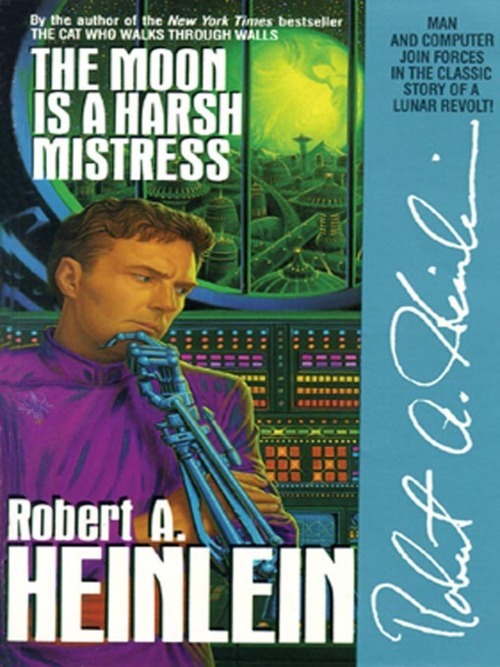
The Moon is a Harsh Mistress by Robert A Heinlein

I listened to the audiobook (from Audible) version The Moon is a Harsh Mistress by Robert A Heinlein. It wasn’t an especially pleasant experience and not just because it was so drawn out now that my commutes are only 25 minutes long.


The narrator had a really terrible accent for the main character (the book is in first person). At first I thought the character was supposed to be Italian, but that didn’t make sense in context and in the end I decided he was probably supposed to be Russian. I was able to tune out the confusing accent eventually (and he wasn’t too bad at the other voices, particularly the American and British men). ETA: Also, assuming he was supposed to be Russian, the grammatical mistakes were the wrong sort. The common mistake Russians make when speaking English is leaving out articles or the verb to be because these don’t exist in Russian. Manuel, however, was written as making different errors, which was just another grating thing I tuned out eventually.


What I had more difficulty tuning out were the casual (unintended) sexism, the politics and part of the underlying premise.


Let’s start with the premise. The moon is a penal colony; this part I don’t object to. While it would take up a lot of resources to send prisoners there, it’s not terribly different to sending them to Australia. That part’s OK. And once there, of course mining ice (for their own consumption) makes sense. What doesn’t make sense is using the moon to grow crops: mostly, but not exclusively, wheat. It’s a problem addressed in the actual story when they have issues with nutrients etc (although where the soil they’re growing in doesn’t come up, I don’t think). But the question of why start growing crops on the moon for any reason other than self-sufficiency is not addressed. Really, there’s no way it’s cheaper for Earth to do it this way.


The other part of the setup — the lunar penal colony being rule with an iron fist by a dictator-warden — I have no problem with. In those circumstances, a revolution seems inevitable sooner or later (and if they’d waited ‘til later, they would’ve run out of water to grow their crops with, among other possible issues).


As for the sexism I mentioned, it’s mostly nothing special, just a lot of “she was pretty good at [whatever] for/despite being a girl/woman”. Which got old. The societal structure of the penal colony was such that there were about twice as many men as women and this made the men more protective than usual of the women. There was no rape because if a man tried (or succeeded) to rape a woman, the other men would gang up on him, beat him, and throw him out an airlock. In a way, women had more power than real 1960s women but this was due to their scarcity rather than any inherent sense of equality of aptitudes. Unfortunate, since I think Heinlein was trying to progressive with this writing. For example, Manuel, the main character, is part of a line marriage. This is a system where more wives and husbands are added into a large family. I don’t remember exactly how big it was, but there were maybe 10 wives and “co-husbands”. (I like how the husbands had to have the co- prefix. You know, just in case they were accused of homesexuality or something, an orientation which was conspicuously absent.) The wives had more say over accepting new members into the family (they voted and in some families husbands didn’t get a say) but were still expected to do things like cook and all the housework, while the husbands had “manly work”, like farming or mining or whatnot.


The beginning of the story centres about the central control computer which has gained sentience, as Manuel discovers during his tech support duties. There are flaws in how the computer works, from a technical point of view, but given the book was published in 1966, I’m happy to ignore that. (And the fact that the physics is pretty good helps. And although some of the physiological effects of acceleration were a bit iffy, that’s another area which hadn’t been fully explored in 1966.)


After an activist peacefully-complain-about-the-warden meeting is interrupted by the warden’s men trying to kill everyone. Manuel, who was there only because the sentient computer was interested in the goings on (being a curious sentient, also interested in dissecting humour), is caught up in the crossfire and, with Wyoh, an activist from the other lunar city, escapes and goes underground. They make contact with the Professor, one of the only teachers in Luna City, and the three of them, with the computer, Mike, begin to mastermind a revolution. It ends up being managed on the line between terrorist and freedom-fighter, in my opinion. In terms of how it’s written, it’s very cerebral, with a lot of revolutionary theory and logistics thrown around.


Politically, I was a bit confused about what they wanted, other than to overthrow the warden. I mean, there was no question about overthrowing the warden, but what they wanted for a replacement government didn’t become apparent until after the revolution (which happens at roughly the half-way point). Afterwards — minor spoilers ahead, but really, not important ones — it transpired that the professor, one of the masterminds, was vehemently opposed to taxation which… yeah. I mean, sure, he was a “rational anarchist” but the whole thing, post-revolution, (not just the tax aspect) was a bit too anti-establishment for my taste. And they were a bit too blasé about bombing the Earth which didn’t seem to me to be the best way to gain recognition as a sovereign nation, but maybe that’s just my modern sensibilities talking.


The ending was kind of poignant, I’ll give it that.


Overall I wouldn’t recommend The Moon is a Harsh Mistress. I found it of interest only as a historic text and it has made me hesitant to read more Heinlein in the future. Perhaps I’ll have more luck with my next foray into new (to me) classic SF than I did with this one.


2 / 5 stars