Showing posts with label Dragons. Show all posts

Monday, 16 November 2020

Phoenix Extravagant by Yoon Ha Lee

Phoenix Extravagant
by Yoon Ha Lee is a fantasy book with a setting quite different to the author’s Hexarchate books. I enjoyed those very much as well, but if you didn’t, I suggest not writing off Phoenix Extravagant.

Dragons. Art. Revolution.

Gyen Jebi isn’t a fighter or a subversive. They just want to paint.

One day they’re jobless and desperate; the next, Jebi finds themself recruited by the Ministry of Armor to paint the mystical sigils that animate the occupying government’s automaton soldiers.

But when Jebi discovers the depths of the Razanei government’s horrifying crimes—and the awful source of the magical pigments they use—they find they can no longer stay out of politics.

What they can do is steal Arazi, the ministry’s mighty dragon automaton, and find a way to fight… 

Phoenix Extravagant is set in a secondary fantasy world that is based on Korea (here called Hwaguk) during the Japanese (Razanei) Occupation. The main difference being the existence of magic and magic-powered automata, and the broad acceptance of non-binary people in Hwaguk society. The protagonist, Jebi, is an artist struggling to earn money. Their friend is a collaborator and convinces them that working for the invaders is maybe not so bad if it means they get paid and out of debt. Of course, Jebi quickly gets in over their head and learns there’s more to the invaders’ automata than meets the eye.

I really enjoyed this book. It shows us an interesting mix of rebels, collaborators, traitors and invaders, and gives us the opportunity to understand the perspectives of each group. The world building is also very well done. I’m a fan of K-dramas (Korean TV series), so I had some familiarity with the time period being fantasified in Phoenix Extravagant. Lee goes beyond the standard expectations of just having a Real World Plus Magic setting, adding his own unique spin and hence giving readers a unique world to immerse themselves in. I also enjoyed how logical the magical elements were.

I hope there is another book in the series, so that we can find out what happens next to Jebi and to the nation of Hwaguk. While the ending tied up most of the loose ends in the story, there is definitely room for more, which I hope we'll get to read soon. Phoenix Extravagant was an excellent read and I highly recommend it to fantasy fans, especially those that enjoy any of: asian settings, rebellions, or dragons.

5 / 5 stars

First published: October 2020, Solaris
Series: I hope so...
Format read: eARC
Source: Publisher via NetGalley

Tuesday, 17 September 2019

The Princess Who Flew With Dragons by Stephanie Burgis

The Princess Who Flew With Dragons by Stephanie Burgis is the third book set in the same world as The Dragon With the Chocolate Heart and The Girl With the Dragon Heart. While the three books follow each other chronologically, they all feature different protagonists, so stand alone well.

Princess Sofia of Drachenheim is sick of being used for her older sister’s political gains. At twelve years old, she’s already been a hostage to invading dragons and a promised future fiancé to a wicked fairy. Her only comfort lies in writing letters to her pen pal and best friend--Jasper, a young dragon whom she's never even met.

When Sofia's older sister sends her on a diplomatic mission to far-off Villenne, she's meant to play the part of a charming, smiling princess. But when an accident leads to her exile from the city, Sofia is free to wander as she pleases for the first time in her life. And when Jasper's food-mage sister Aventurine turns him into a human boy, Sofia thinks life can't get any better. Until… the legendary ice giants of the north attack, trying to reclaim the territory that they lost centuries ago. With the dragons and royals frozen in ice, can Sofia and Jasper save their families and kingdom?

The protagonist of this book is Princess Sofia, who was a secondary character in the second book The Girl With the Dragon Heart. The main cast from the first two books don't make much of an appearance in this one and it mainly takes place outside Drachenheim. The new setting really enriches the world, not only by adding kobolds and ice giants but by also showing what other cities look like and what they think of Drachenheim and its denizens. (The last point is something I always find fun.)

I enjoyed reading about Sofia's adventures in Villenne. Back home she'd rather stay in her room reading philosophy books than go to any official state functions. On her adventure, we got to watch Sofia go from being a girl who is always stuffing up and is perpetually burdened by the expectations of her older sister coming out of her shell. As well as visiting the university and mingling with normal people (in goblin and kobold form), she is also given the opportunity to confront her privilege in a way that wasn't possible without a literal journey. Her newfound friends were funny and entertaining to meet and I loved her relationship with Jasper, the young dragon.

If you've enjoyed the other books in this series, I definitely recommend picking up The Princess Who Flew With Dragons. I got the feeling that this might be the end of the series, but I'd be happy to read more if more books were to appear.

4.5 / 5 stars

First published: August 2019, Bloomsbury
Series: Tales from the Chocolate Heart book 3 of 3
Format read: ePub
Source: Purchased from Kobo

Tuesday, 13 August 2019

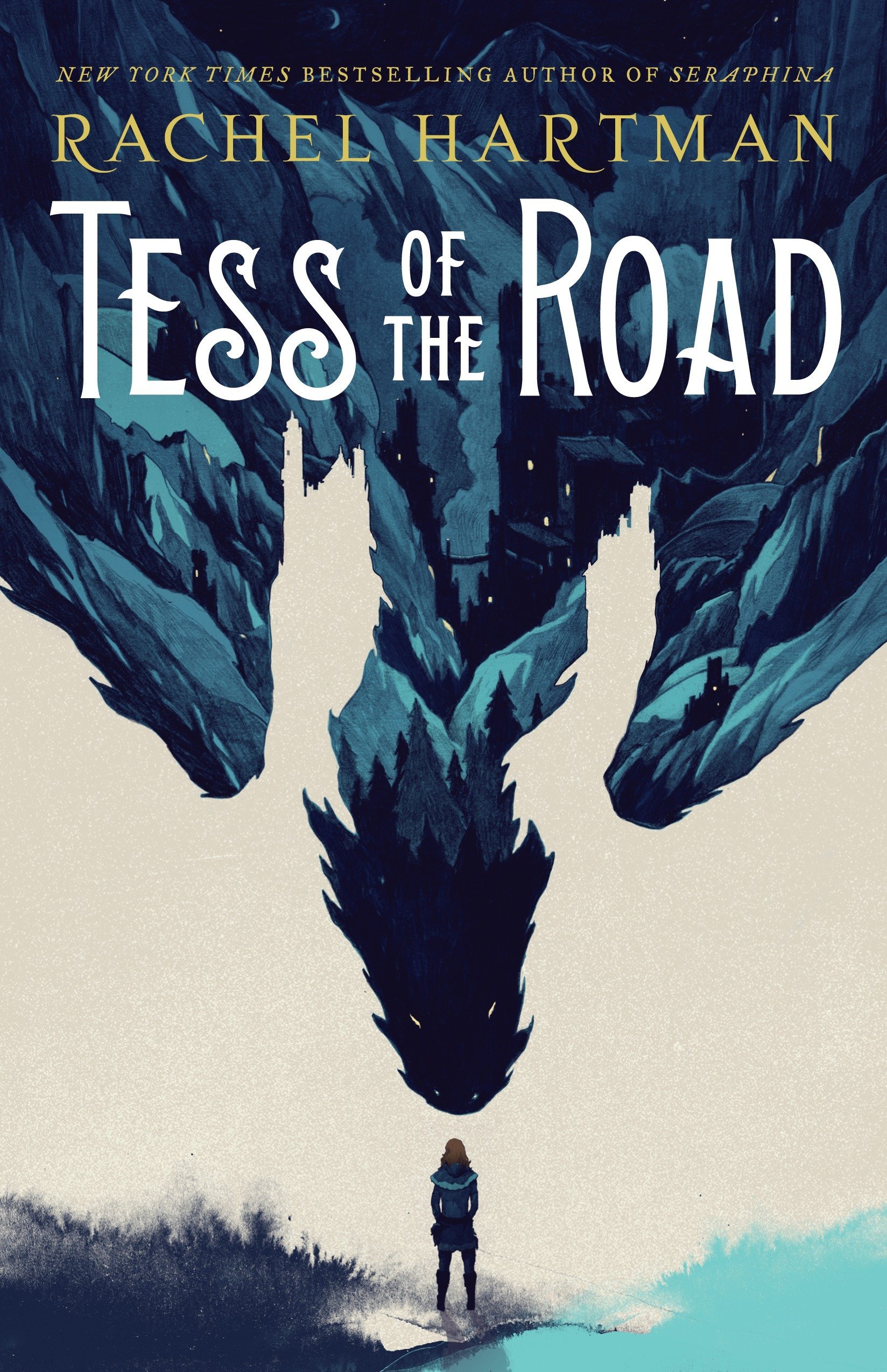
Tess of the Road by Rachel Hartman

Tess of the Road by Rachel Hartman was shortlisted for the inaugural YA Hugo award, to be awarded at the World Science Fiction Convention this weekend. That was the main reason I read it. Tess of the Road is a spin-off of a YA series that I was aware of, but which didn’t grab my attention (I think, based on what I now know, this was because the marketing and cover gave the wrong impression of the book). I started all the Hugo-nominated YA books but one, and Tess of the Road was the only one that interested me enough to keep reading (though I might come back to one or two of the others later).

In the medieval kingdom of Goredd, women are expected to be ladies, men are their protectors, and dragons get to be whomever they want. Tess, stubbornly, is a troublemaker. You can’t make a scene at your sister’s wedding and break a relative’s nose with one punch (no matter how pompous he is) and not suffer the consequences. As her family plans to send her to a nunnery, Tess yanks on her boots and sets out on a journey across the Southlands, alone and pretending to be a boy.

Where Tess is headed is a mystery, even to her. So when she runs into an old friend, it’s a stroke of luck. This friend is a quigutl—a subspecies of dragon—who gives her both a purpose and protection on the road. But Tess is guarding a troubling secret. Her tumultuous past is a heavy burden to carry, and the memories she’s tried to forget threaten to expose her to the world in more ways than one.

Tess is a teen in a world that expects people like her to be getting married and thinking of having babies. Because her family has fallen on hard times, she has spent the past couple of years working towards getting her twin sister a wealthy husband. Even though Tess is technically the older twin, scandalous events from her past have lead her family to pretend that honour falls on the other twin. This past and the way in which it was slowly explained throughout the book is what first grabbed my attention. What kept my attention was the world building and the interesting non-human races that feature.

As can be guessed from the title, Tess breaks free from the expectations of society and sets out on the road. She has a series of adventures, which make up the story and are tied together by a quest her (non-human) companion/childhood friend is undertaking. Throughout the book, we see Tess grow. She starts off as an alcoholic, but through walking and manual labour and a few other key events comes to confront and come to terms with her past.

As I said, I enjoyed this book, particularly the world building. It was on the long side and I felt it dragged a bit in the middle, exacerbating it’s length, however, it overall held my attention well, especially the opening chunk and the ending. The end made me think there might be a sequel, though I wasn’t sure if that would be the case until the very end. I would be interested in reading it. Also, having read this spin off, I am certainly considering going back to the original series about Seraphina, Tess’s sister, at some point. I recommend this book to fans of YA, coming of age stories and particularly the kind of YA which does not involve saving the world.

4 / 5 stars

First published: Random House, 2018
Series: Same world as the Seraphina series and the first book of a new series
Format read: eARC
Source: Hugo voter packet

Friday, 26 July 2019

Turning Darkness Into Light by Marie Brennan

Turning Darkness Into Light by Marie Brennan is a standalone book set in the world of The Memoirs of Lady Trent (A Natural History of Dragons and sequels). Rather than taking a naturalist view of dragons, like the earlier books, this one focusses on a significant translation of the Draconian language. I said it stands alone, but it does rather contain a spoiler for Within the Sanctuary of Wings, the fifth and final of the Memoirs of Lady Trent. So beware if you haven't read that book and want to remain unspoiled. Similarly, do not continue reading this review if you don't want to be spoiled for the end of the Memoirs of Lady Trent.

As the renowned granddaughter of Isabella Camherst (Lady Trent, of the riveting and daring Draconic adventure memoirs) Audrey Camherst has always known she, too, would want to make her scholarly mark upon a chosen field of study.

When Lord Gleinheigh recruits Audrey to decipher a series of ancient tablets holding the secrets of the ancient Draconean civilization, she has no idea that her research will plunge her into an intricate conspiracy, one meant to incite rebellion and invoke war. Alongside dearest childhood friend and fellow archeologist Kudshayn, must find proof of the conspiracy before it’s too late.

TURNING DARKNESS INTO LIGHT is a delightful fantasy of manners, the heir to the award-winning Natural History of Dragons series, a perfect stepping stone into an alternate Victorian-esque fantasy landscape.

This novel is told through a collection of diary entries, letters, and the translation in progress. Most of the narrative comes from Audrey's diary entries, with various letters, musings from Kudshayn's diary-like entries (but with more formality in mind on his part), and discussions in the footnotes of the translation flesh out the rest of the story. This does come with limitations, such that if something dramatic didn't happen to Audrey we didn't necessarily hear about it. That said, most of the dramatic moments did happen to Audrey and she was in a position to write about them afterwards, but that made some of the other media a bit lacklustre. For example, the first few religion-oriented musings from Kudshayn's journal were kind of dull to me, but I found his insights more interesting as we got closer to the end of the book. This style I think makes this book just slightly less compelling than the original Memoirs of Lady Trent series, because, while those books were written pseudo-autobiographically, they were written by the protagonist long after the events recounted in them. That makes them inherently feel a bit more coherent, while Turning Darkness Into Light is written in a much more immediate style, without any snarky comments added by an older protagonist looking back on her younger self. Putting it that way, perhaps it is just a matter of taste. And I want to stress that I still definitely enjoyed Turning Darkness Into Light and found myself hooked on the story. Even though a story about translating ancient tablets might sound boring, there were a lot of intriguing hooks to keep me interesting.

One does not need to have read the Memoirs of Lady Trent to enjoy Turning Darkness Into Light, but I think the reading experience is enhanced by greater familiarity with the world. Audrey, the protagonist, is the granddaughter of Lady Trent, and various members of her illustrious family make minor appearances in this book. I expect some of those references would be quite meaningless to readers unfamiliar with the earlier books, although the overarching story would still work.

I enjoyed Turning Darkness Into Light and I'm hoping there will be more books about Audrey or at least more books set in this world. I think there's plenty left to explore, even if this particular story was well-contained in this book. I recommend this book to fans of the Memoirs of Lady Trent (of course) and anyone interested by the topic of translation of a dead language in a fantasy world containing dragons.

4.5 / 5 stars

First published: August 2019, Tor Books
Series: Stands alone, but same world as The Memoirs of Lady Trent
Format read: eARC
Source: Publisher via NetGalley

Monday, 20 August 2018

The Girl With the Dragon Heart by Stephanie Burgis

The Girl With the Dragon Heart by Stephanie Burgis is a sequel to The Dragon With a Chocolate Heart, but the books are both quite self contained and could be read out of order, if one didn’t mind a few spoilers for the first book being contained in the second. As with the prequel, this is a book for younger readers (or middle grade) with the main character being only around 13 years old. However, it’s written in a sufficiently captivating way that I expect many older readers will also enjoy it, as I did.

Once upon a time, in a beautiful city famous for chocolate and protected by dragons, there was a girl so fearless that she dared to try to tell the greatest story of all: the truth.

Silke has always been good at spinning the truth and storytelling. So good that just years after arriving as a penniless orphan, she has found her way up to working for the most splendid chocolate makers in the city (oh, and becoming best friends with a dragon). Now her gift for weaving words has caught the eye of the royal family, who want to use her as a spy when the mysterious and dangerous fairy royal family announce they will visit the city. But Silke has her own dark, secret reasons for not trusting fairies ...

Can Silke find out the truth about the fairies while keeping her own secrets hidden?

This book follows Silke, who we met in the first book as the friend of Aventurine, the dragon who had been turned into a girl. In the first book we mainly saw her venture into the world of advertising to promote the chocolate shop with hand bills and slightly tall tails. In this book she gets her own story, which does involve the handbills but also a lot of family history and a new adventure/problem. We also see more of the crown princess who runs Drachenburg and get to know her younger sister.

The Girl With a Dragon Heart was a very enjoyable read and I highly recommend to people who enjoyed the first book or readers that enjoy cosy fantasy stories. This one had maybe a little bit more darkness than the first book (and also a bit less chocolate) but was still overall a very fun read.

4.5 / 5 stars

First published: August 2018, Bloomsbury
Series: Yes. Book 2 of 2 of the Tales From the Chocolate Heart
Format read: eARC
Source: Publisher via NetGalley

Monday, 30 July 2018

Within the Sanctuary of Wings by Marie Brennan

Within the Sanctuary of Wings by Marie Brennan is the fifth and final volume in the Memoirs of Lady Trent series. It is a marvellous conclusion to that series and I highly recommend readers that began the series persist until its conclusion. I picked this book up as soon as I finished the fourth instalment, In the Labyrinth of Drakes, and I devoured it in a day. This review contains minor spoilers for the earlier books in the series.

After nearly five decades (and, indeed, the same number of volumes), one might think they were well-acquainted with the Lady Isabella Trent--dragon naturalist, scandalous explorer, and perhaps as infamous for her company and feats of daring as she is famous for her discoveries and additions to the scientific field.

And yet--after her initial adventure in the mountains of Vystrana, and her exploits in the depths of war-torn Eriga, to the high seas aboard The Basilisk, and then to the inhospitable deserts of Akhia--the Lady Trent has captivated hearts along with fierce minds. This concluding volume will finally reveal the truths behind her most notorious adventure--scaling the tallest peak in the world, buried behind the territory of Scirland's enemies--and what she discovered there, within the Sanctuary of Wings.

What was really interesting, and clear from the beginning of this book, is that this series does not only tell the story of Isabella's life and dragon studies. It also tells the story of how the world changed over the course of her life and how she was a catalyst for a surprising amount of that change. From Isabella and friends' accidental discovery of dragon bone preservation in the first book, the world has come a long way to airships made of that substance. Not to mention the other events on the world stage that were set in motion from that discovery and the theft thereof. These events more than the elder memoirist's reminiscences of the state of the world at that time (in between the main events) highlights just how much the world — and Isabella herself, who is now 40 or so — has changed.

Within the Sanctuary of Wings starts similarly to the other books in the series, with Isabella presented with a draconic lure and planning a trip to the other side of the world. The story appears to progress along a similar template to her other adventures, this time as they travel to the not-Himalayas, but the usual progression of things is turned upside down earlier than expected. I have no intention of spoiling this book, but the discoveries made in this one are of world-shaking significance and, quite frankly, I am impressed that memoirist Isabella didn't even hint at them in the earlier books. Especially since she's writing from a future where the knowledge she has discovered has become commonplace. I applaud Brennan for resisting the urge to drop any hints earlier (or if she did, I didn't notice them until Isabella of the story did).

Overall, this was an excellent conclusion to a delightful series. I would not be surprised if I ended up rereading it in a few years and it will certainly go down as one of my favourite series. The combination of worldbuilding, the narrator's voice, and the very scientific way in which dragons were studied was the perfect combination for me. I feel like there should be a subgenre describing this kind of science-minded fantasy, but alas "science fantasy" conjures up magic in space rather than dragon scientists.

Within the Sanctuary of Wings was a brilliant read and I highly recommend it to anyone who has read the preceding books in the series. I said in my last review that these books are fairly self-contained. While that is more or less true, I definitely do not recommend reading Within the Sanctuary of Wings without having read the earlier four volumes. The marvel of it depends a lot upon knowledge of the previous books and would be significantly lessened without that buildup. Read it, but read the prequels first, starting with A Natural History of Dragons.

4.5 / 5 stars

First published: 2017, Tor Books
Series: The Memoirs of Lady Trent book 5 of 5
Format read: ePub
Source: Purchased from iBooks/Apple Books

Thursday, 26 July 2018

In the Labyrinth of Drakes by Marie Brennan

In the Labyrinth of Drakes by Marie Brennan is the third book in the five-book Memoirs of Lady Trent series. I have previously reviewed all the earlier books in the series: A Natural History of Dragons, The Tropic of Serpents, and Voyage of the Basilisk. This is a series I've been enjoying a lot and this fourth instalment does not deviate from that trend.

The thrilling new book in the acclaimed fantasy series from Marie Brennan, as the glamorous Lady Trent takes her adventurous explorations to the deserts of Akhia.

Even those who take no interest in the field of dragon naturalism have heard of Lady Trent's expedition to the inhospitable deserts of Akhia. Her discoveries there are the stuff of romantic legend, catapulting her from scholarly obscurity to worldwide fame. The details of her personal life during that time are hardly less private, having provided fodder for gossips in several countries.

As is so often the case in the career of this illustrious woman, the public story is far from complete. In this, the fourth volume of her memoirs, Lady Trent relates how she acquired her position with the Royal Scirling Army; how foreign saboteurs imperilled both her work and her well-being; and how her determined pursuit of knowledge took her into the deepest reaches of the Labyrinth of Drakes, where the chance action of a dragon set the stage for her greatest achievement yet.

I imagine it will come as no surprise to readers of this blog when I say that I found this book quite delightful, as I have the earlier instalments. This book sees Isabella and Tom sent off to Akhia to help the Scirling Army develop a dragon breeding programme. Isabella's brother, who joined the army at some point, features quite a lot in this one, and it was nice to get to know him better after having only met him in their youth in the first book (also, his presence turned out to be very convenient for several plot reasons). Since the book is set mostly Akhia, the homeland of a certain character we met in the previous book, I was suspicious of every Akhian we met, waiting for him to inevitably show up. Your mileage may vary.

One of the things I've liked most about this series is the very scientific approach to the study of dragons. I think I commented in one of my earlier reviews that they're showing a very 19th century approach to science too. The studies in this one follow the scientific method rather more rigorously than the previous books. Isabella and Tom aren't wandering around in the wilderness hoping to encounter dragons, but rather have a supply (more or less) of dragons that they are trying to study. I found it made quite compelling reading — and don't worry, there are still ill-advised jaunts out into the desert to observe dragons in their natural habitat.

I highly recommend this book to readers who have enjoyed the previous books. If the idea of scientific studies of dragons interests you, definitely give these books a go. While I wouldn't go so far as to say these books stand alone, their are more self-contained than other series often are and probably could be read out of order. That's not to say that I recommend doing so, since the story progresses quite nicely in chronological order, building on earlier events and discoveries. I intend to read the next book immediately, and only paused between books to write this review.

4.5 / 5 stars

First published: 2016, Tor Books
Series: The Memoirs of Lady Trent book 4 of 5
Format read: ePub
Source: Purchased on iBooks

Sunday, 1 July 2018

Voyage of the Basilisk by Marie Brennan

Voyage of the Basilisk by Marie Brennan is the third book in the Memoirs of Lady Trent series. I have previously read, reviewed and enjoyed the first two books: A Natural History of Dragons and The Tropic of Serpents. I have been enjoying the series so much that I have, so far, read the books in quick succession and, if anything, I enjoyed this third volume even more.

Devoted readers of Lady Trent’s earlier memoirs, A Natural History of Dragons and The Tropic of Serpents, may believe themselves already acquainted with the particulars of her historic voyage aboard the Royal Survey Ship Basilisk, but the true story of that illuminating, harrowing, and scandalous journey has never been revealed—until now. Six years after her perilous exploits in Eriga, Isabella embarks on her most ambitious expedition yet: a two-year trip around the world to study all manner of dragons in every place they might be found. From feathered serpents sunning themselves in the ruins of a fallen civilization to the mighty sea serpents of the tropics, these creatures are a source of both endless fascination and frequent peril. Accompanying her is not only her young son, Jake, but a chivalrous foreign archaeologist whose interests converge with Isabella’s in ways both professional and personal.

Science is, of course, the primary objective of the voyage, but Isabella’s life is rarely so simple. She must cope with storms, shipwrecks, intrigue, and warfare, even as she makes a discovery that offers a revolutionary new insight into the ancient history of dragons

This time we follow Isabella and friends as she makes a trip around the world to study dragons in diverse locales. The premise of this one grabbed me right from when Isabella suggested the journey at the end of the second book and the journey itself didn't disappoint. The expedition team visits a few new countries, studies many dragons and makes some exciting discoveries. (If you're wondering how a journey around the world fit into a single volume of this not overly doorstopper series, the answer is by skipping many of the parts in which nothing except science happened.)

I particularly liked the world building in this book. Brennan's world building isn't exactly new, since we've already seen other part of the world in the first two books, but she continues to handle the development of the secondary world well. There are still clear parallels with our world, but the map isn't just a renamed version of Earth and hence some different geopolitical situations play out across it.

As well as enjoying the characters, many of whom are new and most of whom I hope we'll meet again, I want to note something character related that Brennan has done a good job with. A lot of people try to excuse not dealing with QUILTBAG issues in historical fiction because these are perceived to be modern concerns. Brennan does a good job of bringing some of them into the narrative in quite natural ways without at all altering the Regency/Victorian feel of her books. That said, they are very minor aspects of the narrative as a whole, but I still like how these things were handled in this book and the previous volume (and I'm not being more specific because spoilers).

I enjoyed a lot about this book and I am very keen to read the next one in the series. As has been happening with all the book in the Memoirs of Lady Trent, new information about dragons has been revealed and the promise of further adventures awaits. And I really want to see what happens with one of the newly introduced characters, who must at least be mentioned in future books from the hints we got.

As you have probably gathered, I am very keen to read the next book in the series, In the Labyrinth of Drakes. I will be doing so as soon as I can. In the meantime, I highly recommend Voyage of the Basilisk to fans of the series who have enjoyed the previous books. I think this instalment is even more enjoyable than the first two, so let that guide you if you are wavering.

5 / 5 stars

First published: 2015, Tor Books
Series: Memoirs of Lady Trent book 3 of 5
Format read: ePub
Source: Purchased on iBooks

Thursday, 21 June 2018

The Tropic of Serpents by Marie Brennan

The Tropic of Serpents by Marie Brennan is the second book in the Memoirs of Lady Trent series, sequel to A Natural History of Dragons, which I read very recently. In fact, I enjoyed A Natural History of Dragons so much I started reading The Tropic of Serpents as as soon as I finished the first book. In case you're wondering, I also enjoyed The Tropic of Serpents enough to grab the third book, Voyage of the Basilisk, as soon as I had finished.

Attentive readers of Lady Trent’s earlier memoir, A Natural History of Dragons, are already familiar with how a bookish and determined young woman named Isabella first set out on the historic course that would one day lead her to becoming the world’s premier dragon naturalist. Now, in this remarkably candid second volume, Lady Trent looks back at the next stage of her illustrious (and occasionally scandalous) career.

Three years after her fateful journeys through the forbidding mountains of Vystrana, Mrs. Camherst defies family and convention to embark on an expedition to the war-torn continent of Eriga, home of such exotic draconian species as the grass-dwelling snakes of the savannah, arboreal tree snakes, and, most elusive of all, the legendary swamp-wyrms of the tropics.

The expedition is not an easy one. Accompanied by both an old associate and a runaway heiress, Isabella must brave oppressive heat, merciless fevers, palace intrigues, gossip, and other hazards in order to satisfy her boundless fascination with all things draconian, even if it means venturing deep into the forbidden jungle known as the Green Hell . . . where her courage, resourcefulness, and scientific curiosity will be tested as never before.

I was slightly surprised that The Tropic of Serpents started a couple of years after A Natural History of Dragons left off, but it makes sense given the structure of the narrative. It's more that A Natural History of Dragons ended on a life-changing note that I expected to be picked up straight-away in The Tropic of Serpents. But of course, these books are about Isabella's travels and studies of dragons, so it makes sense that it picks up the story just before her next trip. We get the important points from the intervening time filled in and get maximal dragon-centric story.

I say maximal dragons but I did find this one a little slow at times, especially near the start. It got very interesting in the middle and the end — and a lot of the political discussion near the start was essential for the end to make sense — but I found myself quite able to put the book down during the opening sections. On the other hand, I should stress I was never bored with it and generally didn't put it down for long (it was more that I had other books and stories to read too).

My favourite this about this instalment is the detail with which Brennan shows us a new civilisation as Isabella herself learns about it. The tropical swamp setting was not what I would have guessed going into the book (although maybe it would have been if I'd looked at the map more closely). Of course this is also an opportunity to tell us even more about dragons and the different varieties Isabella encounters in yet another part of the world.

It was also nice to see Natalie and the more minor female characters that appeared in this book. I was a little disappointed that Isabella didn't have very many women to talk to in A Natural History of Dragons (other than her difficult-to-understand maid) and I was glad that The Tropic of Serpents introduced another lady scientist and better yet (minor spoiler coming), one who appeared to be on the asexual spectrum, which was sort of relevant to the plot but not such that a big fuss was made over it. (And of course in pseudo-Victorian pseudo-England such words did not exist in the contexts they do now.)

Overall I enjoyed The Tropic of Serpents quite a lot. Perhaps a little less than A Natural History of Dragons, but I'm certainly enjoying the continuing story and I found the excitement of the end made up for the slowness of the start. I would highly recommend this book to anyone who enjoyed the first and this series to fans of dragons, lady scientists and secondary world fantasy.

4.5 / 5 stars

First published: 2014, Tor Books
Series: The Memoirs of Lady Trent book 2 of 5
Format read: ePub
Source: Purchased from iBooks

Saturday, 9 June 2018

A Natural History of Dragons by Marie Brennan

A Natural History of Dragons by Marie Brennan is the first book in The Memoirs of Lady Trent, which has become a surprisingly long (five book) series while I wasn't looking. I remember seeing A Natural History of Dragons around the time of it's initial release, but the blurb and cover didn't grab me so I passed it up at the time. Now that it's been shortlisted for the Hugo Award for Best Series, I thought I should at least give it a go. I started reading the sample and had to click "buy" because I couldn't put it down.

Marie Brennan begins a thrilling new fantasy series in A Natural History of Dragons, combining adventure with the inquisitive spirit of the Victorian Age.

You, dear reader, continue at your own risk. It is not for the faint of heart—no more so than the study of dragons itself. But such study offers rewards beyond compare: to stand in a dragon's presence, even for the briefest of moments—even at the risk of one's life—is a delight that, once experienced, can never be forgotten. . . .

All the world, from Scirland to the farthest reaches of Eriga, know Isabella, Lady Trent, to be the world's preeminent dragon naturalist. She is the remarkable woman who brought the study of dragons out of the misty shadows of myth and misunderstanding into the clear light of modern science. But before she became the illustrious figure we know today, there was a bookish young woman whose passion for learning, natural history, and, yes, dragons defied the stifling conventions of her day.

Here at last, in her own words, is the true story of a pioneering spirit who risked her reputation, her prospects, and her fragile flesh and bone to satisfy her scientific curiosity; of how she sought true love and happiness despite her lamentable eccentricities; and of her thrilling expedition to the perilous mountains of Vystrana, where she made the first of many historic discoveries that would change the world forever.

A Natural History of Dragons is set in a dragon-containing secondary world (with no other magic, as far as I can tell) with the country our protagonist is from based on Victorian England. I have to admit, part of the reason I delayed reading this book for so long was because historic fantasy plus dragons conjured up Temeraire by Naomi Novik in my mind (the Napoleonic era is not so distant in time from the Victorian) and I did not feel the need for another dry fantasy book with dragons. Happily, it is not a dry fantasy book, despite the diagram on the cover.

What I enjoyed most about this book was the protagonist's voice. It's written in first person in the style of a memoir from the point of view of a much older Isabella recounting events from her youth. This means that we get more snarky reflections than we would have if the book was told by the younger Isabella, as well as commentary along the lines of "I was young and stupid". It's also clear from the start that this is the first book in the series and that Isabella intends to recount additional adventures in future books, while dropping tantalising hints about them along the way. I may end up reading the next book immediately, even though that wasn't my original plan.

The approach to dragons in this book is pretty much as advertised. Isabella is very interested in the study of nature and pursues her studies of dragons very scientifically, albeit in a very nineteenth century way. We also see the ways in which being female hinders her ability to study, as well as the way in which her upper class does not. I also sort of expected it to be partly the story of her being stuck with a horrible husband after being expected to marry young, but that was not the direction the story took, avoiding that very common trope.

To my eye, Brennan presented a modified historical society well and the way in which dragons were studied and presented to the reader was quite believable and consistent — especially if you overlook the magical aspect of dragons' existence. It covers dissection, the difficulties of preservation and a journey to study dragons in their natural habitats. This was a very enjoyable read and I will definitely be reading the next book in the series, sooner or later. I recommend it to all fantasy fans, especially those who like dragons (but also don't find the prospect of reading about their dissection distressing.)

4.5 / 5 stars

First published: 2013, Tor Books
Series: The Memoirs of Lady Trent book 1 of 5
Format read: ePub
Source: Purchased from iBooks

Thursday, 9 February 2017

Dragon with a Chocolate Heart by Stephanie Burgis

Dragon with a Chocolate Heart by Stephanie Burgis is a children's novel (the main character is 12ish) about a young dragon that gets turned into a human girl and has to make it on her own in a strange new city. And also chocolate.

Aventurine is the fiercest, bravest dragon there is. And she's ready to prove it to her family by leaving the safety of their mountain cave and capturing the most dangerous prey of all: a human. But when the human she finds tricks her into drinking enchanted hot chocolate, Aventurine is transformed into a puny human girl with tiny blunt teeth, no fire, and not one single claw.

But she's still the fiercest creature in the mountains -- and now she's found her true passion: chocolate! All she has to do is get herself an apprenticeship (whatever that is) in a chocolate house (which sounds delicious), and she'll be conquering new territory in no time...won't she?

This was a delightful read. Sometimes I, as an adult, find books for younger readers a bit too condescending or talking-down to the reader too much, in a way that probably wouldn't have bothered me when I was closer to the intended age bracket. This is absolutely not the case with Dragon with a Chocolate Heart. It's a lovely book that will be enjoyed by children and adults alike.

The story follows Aventurine, a young dragon who's sick of being stuck in her family cave, waiting to  grow up so she can safely hunt and fly around outside. One day she decides to experiment with going outside and the first human she meets transforms her from a dragon into a human girl. As well as being traumatic, the transformation, which hinged on an enchanted hot chocolate, awakens Aventurine's love of chocolate. As well as working out how to live as a human, Aventurine becomes fixated on tasting chocolate again.

This book has a lot of delicious chocolate descriptions in it, which made me a bit sad not to be having any chocolate when I read the book. Recommendation for reading: consume with hot chocolate. The setting is a vague Germanic medieval fantasy world, which we don't see much of beyond the city and the mountains. We hear a bit about a few other cities too. The main focus is definitely on the characters: Aventurine and her friends, family and other people she encounters.

Dragon with a Chocolate Heart was the kind of story in which the bad guys are merely annoying rather than actually evil, which was refreshing, especially coming out of having read a few more dire books. It's not that everything always goes well for Aventurine, but nothing especially dire happens and overall this was a very feel-good book. Highly recommended for people looking for a heartwarming read.

I highly recommend this book to all fans of fantasy, dragons and books for younger readers. It is, like I said, written for a younger age group than YA usually is, and I'm not sure that all teens will necessarily enjoy reading about a twelve-year-old. But I think it can be enjoyed equally as much (if not more) but adults (and maybe teens who are less self-conscious).

4.5 / 5 stars

First published: February 2016, Bloomsbury (UK/ANZ)
Series: No.
Format read: eARC
Source: Publisher via NetGalley

Monday, 13 July 2015

Drachengott: Earth by KJ Taylor

Drachengott: Earth by KJ Taylor is the second book in the Drachengott series. It follows on from the first book in the series, Wind, which I have already reviewed. This sequel follows on from the events in the first book but does so by focussing on a different protagonist. The book almost stands alone, but I think the overarching plot would be completely lost without reading the earlier book, as would some of the complexity of the world Taylor has created.

Elynor von Augenstein is a Junger - a faithful worshipper of the mysterious Drachengott, with a faithful dragon servant of her own. But Elynor has secrets, and soon they will take everything from her.

A fugitive with no place to turn, Elynor sees only death in her future - but then a mysterious and beautiful woman comes into her life. A woman who is more than she seems to be, with secrets of her own - a woman who calls herself a friend to the famous Rutger Dragonsbane, and an enemy to the Drachengott himself ...

In Wind, the previous book, the instigating character leads and actively teaches Rutger for most of the story. In Earth, the instigating character more or less pushes Elynor in the right direction and leaves her to do the rest on her own. Elynor starts off as a Jünger, a magic user and follower of the Drachengott, but when she's condemned for not sticking to the whole Jünger celibacy thing, she starts to make her own way. She's also a shapeshifter, and, quite frankly, doesn't need anyone else to teach her how to do magic. Well, apart from one spell which she covets, but explaining that would be a spoiler. My point is, Elynor is a very independent and capable character from the start.

Unfortunately, that means she doesn't get to grow and evolve quite as much as a character/person throughout the story. The focus is not so much on her learning who she is (although there is an element of her working out what she believes in) but her having a goal and working towards it. In some ways that makes her feel a little underdeveloped, but I do think it makes sense given her role in the overarching story. I did feel this most keenly when [spoiler redacted] and she just goes along with it. There was a reasonable explanation, but I would have liked to have seen it explored more. (Apologies for cryptic end to paragraph there.)

Like the prequel, Earth is a quick read, telling one quarter of a larger, more epic story. I enjoyed it, with my favourite bits the random appearances of a certain character readers will recognise if they've read Wind. That more than anything, I think, served to remind me that what I was reading was a piece of a bigger picture and not quite an entire story by itself. (When it's complete I would kind of like to see this series printed in a single volume. It would feel... neat.)

I recommend Earth to readers who enjoyed Wind and want to read more of the world. If you liked Wind but didn't, for example, like the characters, then I would still recommend giving Earth a shot. On the other hand, if you want a long complex read with many layers to the characterisation etc, this is not the series for you. Go read KJ Taylor's griffin books instead. Dracchengott is very much characterised by brief and fun reads.

4 / 5 stars

First published: June 2015, Harper Collins
Series: Drachengott, book 2 of 4
Format read: eARC
Source: Publisher via NetGalley
Challenges: Australian Women Writers Challenge

Sunday, 25 August 2013

Blood of Tyrants by Naomi Novik

Blood of Tyrants by Naomi Novik is the penultimate book in the Temeraire series. I recently reviewed the previous book, Crucible of Gold. This review contains minor spoilers for the earlier books and, in my opinion, the premise of this one is a bit of a spoiler by itself, even though it's the first thing we learn on page one. If you've read the earlier books and want to be surprised, maybe skip this review (enough  to say I enjoyed it), and skip all the blurbs too. The only spoilers for Blood of Tyrants in this review involve historical events that actually happened and thus aren't really spoilers. But you've been warned. The slightly misleading blurb follows:
Shipwrecked and cast ashore in Japan with no memory of Temeraire or his own experiences as an English aviator, Laurence finds himself tangled in deadly political intrigues that threaten not only his own life but England’s already precarious position in the Far East. Age-old enmities and suspicions have turned the entire region into a powder keg ready to erupt at the slightest spark—a spark that Laurence and Temeraire may unwittingly provide, leaving Britain faced with new enemies just when they most desperately need allies instead.

For to the west, another, wider conflagration looms. Napoleon has turned on his former ally, the emperor Alexander of Russia, and is even now leading the largest army the world has ever seen to add that country to his list of conquests. It is there, outside the gates of Moscow, that a reunited Laurence and Temeraire—along with some unexpected allies and old friends—will face their ultimate challenge...and learn whether or not there are stronger ties than memory.

Blood of Tyrants was much more enjoyable than the previous book in the series. It took a different direction and I found that I did not grow tired of it nearly as easily. The beginning is very fresh and different, especially coming to it, as I did, soon after Crucible of Gold. The three parts of the novel are fairly distinct, with part one being set in Japan, part two in China and part three in Russia.

I was quite taken with the Japanese dragons Novik introduced and the way the narrative jumped between Laurence and Temeraire was particularly effective since their stories are quite disparate. It was interesting to see the way yet another culture interacts with dragons. In this case similarly to the Chinese but not identically, partly because the dragons themselves are physically different. There was also a bit of dragon-based historical animosity mentioned between Japan and China, which I would have liked to hear more about. When it came to Laurence sword-fighting with a Japanese character, I thought the way Novik described Laurence's reaction to the difference in English versus Japanese sword techniques believable. Too often I've seen authors get a little too specific about the Japanese techniques in a way that their characters are unlikely to fully process in the heat of battle.

Part two takes us back to China for what I would think of as the main plot of this novel, despite it not directly involving Napoleon at all. Their goal from the end of the previous book was to secure China's allegiance against the French empire and they are faced with some unexpected trials on the journey to achieving this. I felt that the book could easily have ended at the end of part two (perhaps with a little fleshing out, but not much would have been needed), especially given the strong resolutions of the Chinese story lines.

Because then there was the third part. In Russia. With terribly portrayed Russians. Which would not have been so bad if it weren't for the fact that every other piece of American media does the same thing, usually worse. Especially Hollywood. The evil/horrible/pick-a-negative-descriptor Russians is a trope that I am VERY MUCH OVER and would not be sad to never see again. Really. The Cold War is over. It's been over for more than two decades. Not to mention that in the context of the Napoleonic Wars, it hasn't even started. Can you tell I'm angry? Sure, I'm also biased, but that doesn't make my anger less justified. And no, this is not the worst portrayal of Russians in a piece of Western literature, but this camel's back was long ago broken beyond veterinary help. It's also not the only culture Novik hasn't done justice to (the Indigenous Australians in Tongues of Serpents spring immediately to mind) but it's the one that pissed me off personally. The negative portrayal, by the way, involves the brutal (and illogical given the events of earlier books!) treatment of Russian dragons. To the Russian army's detriment, of course. What would be the point if Laurence couldn't be set up to save them in multiple ways?

Also, the one Russian phrase used was both transliterated wrongly (in the sense that it did not follow the standard conventions) and grammatically incorrect. Whoo. (Google Translate, while still grammatically off, does a better job in terms of word choice too, which is worrying.) It's not really an important point, but still.

Ahem. So the last part aside, I quite enjoyed Blood of Tyrants. As the penultimate book, there was some expectation of it setting up the final resolution of the Napoleonic Wars for the last book. Which it did when it ended on a bit of a cliff-hanger. Without knowing exactly what will happen in the last book (I can only assume Napoleon's forces will be significantly diminished by the coming Russian winter, since real life, thus leading to a glorious victory for Laurence and the British and presumably their allies though it's hard to be sure on the last point), I still think Blood of Tyrants would have worked better ending as they leave China, putting the entire Russian part into a single volume, instead of spread across two. It would also have allowed more exposition of those events and, for example, leant more emotional impact to the burning of Moscow, which I found a little underdone.

Anyway, Blood of Tyrants was a much more enjoyable read than Crucible of Gold. Despite my reservations, I look forward to the concluding volume in the Temeraire saga, which will hopefully come out next year (but I couldn't find any announcements). For fans of the series, Blood of Tyrants is a must read. For those who were a bit hesitant to pick it up after Crucible of Gold, I strongly recommend giving Blood of Tyrants a go.

4 / 5 stars

First published: August 2013, Del Rey (US edition)
Series: Temeraire, book 8 of 9
Format read: eARC
Source: Publisher, via NetGalley

Friday, 9 August 2013

Crucible of Gold by Naomi Novik

Crucible of Gold by Naomi Novik is the seventh book in the Temeraire series. Yes, seventh. The series started with Temeraire (in the UK/ANZ, but published as His Majesty's Dragon in the US) and is set during the time of the Napoleonic wars, in an alternate universe where dragons exist, are intelligent and team up with humans.
Former Aerial Corps captain Will Laurence and his faithful dragon, Temeraire, have been put out to pasture in Australia—and it seems their part in the war has ended just when they are needed most. The French have invaded Spain, forged an alliance with Africa’s powerful Tswana empire, and brought revolution to Brazil. With Britain’s last desperate hope of defeating Napoleon in peril, the government that sidelined Laurence swiftly offers to reinstate him, convinced that he’s the best man to enter the fray and negotiate peace. So the pair embark for Brazil, only to meet with a string of unmitigated disasters that forces them to make an unexpected landing in the hostile territory of the Incan empire. With the success of the mission balanced on a razor’s edge, an old enemy appears and threatens to tip the scales toward ruin. Yet even in the midst of disaster, opportunity may lurk—for one bold enough to grasp it.
It's been around three years since I read the sixth book in the series, Tongues of Serpents (I had been foolishly waiting first for an Australian edition then, when I realised it wasn't coming, the US paperback, since hardcovers are silly and more expensive). As a result, I was a bit foggy on some of the characters. Particularly the one which I think we haven't seen much of since book 2 (Throne of Jade) which I read around when it came out in 2006. Honestly, a little bit more back story, particularly for the aforementioned character, Hammond, would have been nice. That said, I wasn't lost per se, there was just a lot of "who is this guy again, and why do I care?" at the start.

From memory, I think some of the Temeraire books can be read as standalones or out of order (albeit with sustained spoilers for earlier books), but the same cannot be said for Crucible of Gold. Not so much because the plot relies very heavily on previous events, but because there were a lot of slow bits, and it was only my caring about the characters that made me keep picking it up to continue reading. As it was, it almost took me two weeks to get through it (a large part of the reason blogging's been slow, sorry) and I got distracted by two other books in the meantime.

The prose, which I remember enjoying in the earlier books, did not help with the pacing. It's written in a sort of early nineteenth century style with lots of archaic words and phrases and a restraint which reflects Laurence's stiff upper-lip. (Although, actually, Laurence is rather liberal for the time period.) I found some of the action scenes were duller than they could have been (I only really found one of them exciting and that was, arguably, the least consequential).

By contrast, there were several hilarious sections, which were easily my favourites. The humour was mostly situational, often arising from the dragons' misunderstandings of human politicking. I also enjoyed the development whereby Laurence (and Granby) realised what we readers have known for some time now; that they do not own their dragons, their dragons own them. Although I did find it mildly problematic that it was Incan and Tswanan (southern African) people who had more of a sense of belonging to their dragons, compared with the European attitudes of owning dragons and commanding them like ships (and the Chinese attitude of treating them as equal). On the other hand, I did feel that once we learnt more about the former cultures, it turned out to be less troubling than it appeared on the surface. But your mileage may vary.

On an entirely different note, after reading some article about queer representation in books, I was wracking my brain, trying to remember if a gay character had appeared in earlier books (I think not?), and then, not two pages later, someone came out as gay in Crucible of Gold. I shan't reveal whom, but I will say a big fuss was not made, aside from the come-out-ee being surprised and having to come to terms with it. And of course the sheer taboo for the time period was a big factor. I will be quite interested to see if Novik does anything further with the information in the last two books.

Crucible of Gold contains tragedy, adventure, hilarity and dragons. And of course several beloved characters from earlier books. I definitely don't suggest starting from this book if you haven't read any of Novik's work before. However, I definitely recommend the Temeraire series as a whole to all readers of historic fantasy. As well as fighting the Napoleonic Wars, the series takes Temeraire and Laurence across five continents (not Antarctica and not North America), reimagined in the presence of dragons. To readers who have read the earlier books in the series, this isn't the best of the bunch, but I still recommend reading it, if only for a few significant events that take place. (And really, if you've gotten this far, don't you want to push through to the end?)

3.5 / 5 stars

First published: 2012, Del Rey
Series: Temeraire, book 7 of 9
Format read: Paper! Paperback!
Source: US edition ordered off Book Depository since only the first 6 are available in the UK/ANZ :-/

Saturday, 28 January 2012

Eon & Eona by Alison Goodman

Cross-posted from here.


I’m going to combine the reviews for this duology, because they really are two halves of the same story and I don’t think it’s fair to review them separately. You shouldn’t read the second one without reading the first.


Eon by Alison Goodman


5 / 5 stars


(Winner of an Aurealis Award for best Fantasy Novel)

Eon is set in an oriental-inspired fantasy world where dragons are required to protect the land from monsoons and ensure bountiful harvests. Each year, a different dragon (out of twelve) “ascends”, increasing the power of the lord bound to that dragon and ushering in a new apprentice for that lord.


Eon is one of a handful of candidates vying to be the next year’s apprentice. He is supposedly a crippled eunuch, so no one particularly expects him to be chosen by the dragon. In fact, the only reason he is even under consideration is because he has an unusually strong affinity for being able to see the dragons (they are invisible to normal people most of the time). He is also secretly a girl.


This starts off as a “girl dresses up as boy because girls aren’t allowed to do anything cool” story, but quickly moves on to addressing deeper issues besides female oppression. On the one hand, being a cripple in a land where deformities are considered unclean and unlucky puts her at a further disadvantage, on the other this ends up helping her deception thanks to segregation. It also fosters a strong sense (in the reader) of “she can’t do it as well because of her leg” rather than “she is struggling because she is female” which is sort of refreshing.


Unlike the Alana books by Tamora Pierce, which more or less culminate in Alana achieving her goal of being a knight, Eon’s choosing ceremony takes place at the start of the book, and the story is of her journey afterwards, not leading up to it. (Needless to say, the ceremony doesn’t quite go according to anyone’s plans. What a surprise.) A lot of the subsequent plot revolves around political intrigue and dastardly plots, which I don’t want to give away.


Then there is the stellar cast of supporting characters. There is the master who gambols everything on a girl candidate (if she is discovered, they will both be put do death) in the hopes that she will succeed and bring them both wealth and power. He’s not the most lovable of characters, but I retrospectively found his faith in her endearing. There is Lady Dela who, we quickly learn, is a woman in a man’s body. (“Why would you want to dress as a woman?” asks Eon. “Women have no power!”) And a few other allies who help her along the way.


One thing I found refreshing about this book is that there is no love interest or romantic plot. Eon does spare a few thoughts for some of the men around her, but they are questioning thoughts, rather than wishful ones. The romantic storyline shows up in book two and, the way the world and plot are structured there is no sensible way for it to have started in the first book, so I’m glad the author didn’t force it in.


When, inevitably, people start to find out the truth about her, their reactions are interesting and broad (well, once they get past the initial shock), but I don’t want to spoil the entire spectrum here.


The book ends on a cliffhanger, and you will probably want to have the second book on hand when you finish the first.


~


I want to make a comment about both books together before moving on to the slightly spoilery review of book two.


These books were published by HC’s YA imprint and hence — presumably — marketed at YA. I’m not sure why. I don’t mean that I thought they were inappropriate or anything like that. In fact, I almost feel like it was the 16 year old protagonist and the lack of explicit sex that led them to be classed as YA. And, as a consequence, which led me to not read them until now. I only really read the really big YA books, or ones explicitly recommended to me, so this escaped my notice when it was release. I can’t help but feel that if it had been published by HC’s fantasy imprint (Voyager) I would have noticed when it came out and would have read it then.


I’ve read other non-YA fantasy books with YA-aged protagonists, so what makes this one YA? Marketing?


Anyway, moving on.


*


**** SPOILERS ****


WARNING: REVIEW FOR EONA CONTAINS SPOILERS FOR EON


**** YOU HAVE BEEN SPOILER-WARNED ******


*


*


*


*


*


Eona by Alison Goodman


4.5/5 stars
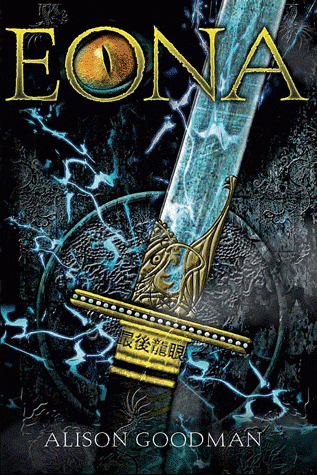

Picking up almost immediately where Eon left off, Eona continues the story of the girl Dragoneye caught up in court politics and a power-play by the late Emperor’s half-brother. Most of the story revolves around the resistance fighters (who want to put the rightful heir on the throne for a variety of reasons, including him not being a sadistic bastard) Eona coming to learn about her powers (or realising how much she doesn’t know) and the delightfully morally ambiguous other surviving Dragoneye who was positioned as the bad guy in book one.


Now that Eona has given up trying to hide her gender, she still has to come to terms with what being a girl means. People treat her differently (useful when they assume she can’t use the swords she’s holding), she faces different risks, and she finds that she has to “learn to be a girl”. I found it delightful that Lady Dela (the woman in a man’s body) felt even more uncomfortable in man clothes (part of their disguise) than Eona did in a dress. Mostly Eona just complained that skirts were silly. More could have been done with this, but she did rather have other things on her mind.


A small gripe I had was the amount of “as you recall from book one” writing at the start. I mean, it wasn’t particularly badly done, but having picked this book up straight away, the reminders felt a bit clunky and could have perhaps been a bit more integrated. That said, if you were unfortunate enough to have a longer gap between the two books, I doubt this would be a problem.


There was a lot more angst for Eona in this book. In the first book, she knew what she had to do (be Eon) even when she didn’t really know what she was doing. And for most of the book, people expected her to flail a bit because she was new to her situation. In this book, a lot of people are relying on her and there’s a looming issue of having to save the kingdom from natural disasters as well as from civil war. She angsts and makes some poor choices which made me want to slap her. (Luckily, one of her friends slaps her every now and then, which was a bit mollifying.) While it was at times frustrating to read, that sort of connection and caring for the characters takes some good writing, which the author pulls off. I just wish she’d been slightly less of an idiot at times, even if it was justifyable in terms of where she was coming from as a character. (If you’re wondering, this frustration is the main reason I rated this book less highly than the first one.)


The ending was nicely conclusive and tied up all the loose ends. It did end rather abruptly exactly as soon as said ends were tied up, however. I was left wanting to know what happened next as they picked up the pieces of the world-almost-ending-incident. I thought an epilogue set some time afterwards would have been nice. However, on reflection, such an epilogue would have made it harder for a particular point of ambiguity remaining ambiguous. Given how that point ought to play out, perhaps this isn’t such a bad thing. (What? I don’t want to spoil ALL the things.)