Showing posts with label 2.5 stars. Show all posts

Tuesday, 12 May 2020

T.I.M.E Stories by Christophe Lambert

A bit of a change of pace for this review. Some time ago, I reviewed a story-based board game called T.I.M.E Stories, or, more accurately, the first scenario in the T.I.M.E Stories series. Since then, my husband and I have played through all the T.I.M.E Stories scenarios as they were released. We liked some more than others and are moderately invested in the overarching story — we would be even more invested if it were better written and plotted. That's theoretically where today's book review comes in. To go with a reboot/upgrade of the game story (the gaming system changed), there is a new novelisation of the story. I was a bit sceptical of it when I first heard about it, since the writing in the games itself has been patchily translated (from French, as has this book). But my husband was very enthused and wanted to read it, so I have let him write the review, which is what you'll find in the rest of this post.

It is the year 2468. Spotted by a recruiter, Tess Haiden passed the many tests required to join a highly secretive organisation with flying colours. But she is in for a shock: T.I.M.E Agency has been sending agents through time for several years. Thanks to considerable resources, they prevent anomalies and paradoxes by dispatching their agents to different eras and places around the world. But over the course of her many missions, Tess learns that they are not the only ones using these time corridors, and she begins to wonder about the true nature of the T.I.M.E agency… 

This book is based on the Time stories series of board games. Some background is necessary here, the games are classic adventure games in a box, where the players travel back in time to a scenario where they have to solve problems with the timeline. A number of adventures have been released and the developers recently changed the system, separating the old games into what they call the white cycle and starting the new white cycle.

The main draw of this book is that it helps bridge the gap between the white cycle and the blue cycle of the board game time stories. It mostly serves to introduce the main characters in the new cycle, while explaining some of the unexplained mysteries. If you want to know who all the new characters are in the new games, read this book. If you haven’t played time stories or don’t care enough about the storyline, probably give this book a pass.

The prose is a little strange, with excessive detail used when setting the scene. This is useful in a game where these details are clues, but just slow down the book. There were often asides that didn’t add anything to either the story or the characters.

When the characters were time travelling, a lot of the pressure came from the arbitrary time limit enforced on time travel missions. This is an important part of the game, but doesn’t work so well in a book. A lot of the first mission in particular had the characters constantly updating each other on how much time was left rather than what they were doing.

I’m happy I read this book to get a better understanding of the time stories setting, but that’s the only reason I have to recommend this book.

2.5 / 5 stars

First published: May 2020, Angry Robot
Series: Not yet
Format read: eARC
Source: Publisher via NetGalley

Saturday, 24 November 2018

The Subjugate by Amanda Bridgeman

The Subjugate by Amanda Bridgeman is a science fiction crime novel and the first book of the author's that I've read. Although it has intrinsic science fiction elements, it felt a more like a crime book with most of the story revolving around a series of religiously-charged rape-and-murders of women.

Two troubled homicide detectives race to find a serial killer in a town filled with surgically reformed murderers, in this captivating near-future SF thriller.

In a small religious community rocked by a spree of shocking murders, Detectives Salvi Brentt and Mitch Grenville find themselves surrounded by suspects. The Children of Christ have a tight grip on their people, and the Solme Complex neurally edit violent criminals - Subjugates - into placid servants called Serenes. In a town where purity and sin, temptation and repression live side by side, everyone has a motive. But as the bodies mount up, the frustrated detectives begin to crack under the pressure: their demons are coming to light, and who knows where that blurred line between man and monster truly lies.

This was very much a crime novel with the trappings of science fiction. Yes, some of the science fictional elements were essential parts of the plot, but the murder-solving part of the story would have worked just as well without them, with only minor tweaks. The premise of religiously-motivated murders in a small and insular religious town would have worked just as easily with an ordinary prison next door instead of a brain-washing facility. The idea of brain washing criminals to make them contributing members of society is an interesting one to explore, but I didn't feel that this book explored it in much depth. The impracticality of the system was only touched upon, ditto the morality. In the end it felt more like window-dressing than an integral part of the story.

When I was reading, I thought this book started out OK with a tolerably interesting premise an a seemingly rapid pace. But it wasn't long before I started to feel bogged down in the repetitive writing style (a lot of people spent a lot of time looking at things and each other in various ways) and not that interested in the plot. Sure, the murders needed to be solved and the culprit wasn't super obvious (there was a small pool of possibilities but it seemed like they all had roughly equal means and opportunity for much of the book), but the protagonist spent a lot of time being distracted by less likely possibilities and also her own past problems.

(Also, a thing that annoyed me quite a bit was that the author talked about AR (augmented reality) and VR (virtual reality) but then fixated on AR when it was quite clear from the story that VR was what was actually happening. And then there were the haptic VR suits which made no sense as described. The gory details of how they could even function as described were completely skipped over (and given how many other extraneous details we got, that seemed particularly egregious). The whole section with the detectives investigating in "AR" struck me as both sloppy writing and a bit gratuitous.)

As you can probably surmise from the rest of this review, I did not enjoy this book. By the end, it was a trial to finish. Even ignoring the plot and science fictional aspects I mentioned above, a stronger editorial hand would have made a big difference. I can't recommend this book, but I'm sure less picky readers who enjoy reading crime could find something to enjoy.

2.5 / 5 stars

First published: November 2018, Angry Robot
Series: Don't think so
Format read: eARC
Source: Publisher via NetGalley

Thursday, 22 June 2017

The Dream-Quest of Vellitt Boe by Kij Johnson

The Dream-Quest of Vellitt Boe by Kij Johnson is a Hugo-shortlisted novella, which is why I picked it up. The last time I read a Kij Johnson story, it was "Spar", which was shortlisted for a Hugo Award in 2010, the year of Aussiecon 4. As you might guess from my referencing it seven years later, it was a little burned into my brain, and not in a good way. So I was a little wary approaching The Dream-Quest of Vellitt Boe, but that turned out to have zero weird alien sex, so bonus!

Professor Vellitt Boe teaches at the prestigious Ulthar Women’s College. When one of her most gifted students elopes with a dreamer from the waking world, Vellitt must retrieve her.

But the journey sends her on a quest across the Dreamlands and into her own mysterious past, where some secrets were never meant to surface.

So I didn't enjoy this novella. The start was kind of interesting and the ending was OK. The middle mostly consisted of endless travel and descriptions of scenery, both somewhat surreal and completely weird. At one point I had some theories about twists we might see for the ending, but the gruelling middle pushed them out of my memory.

The thing is, the story isn't badly written (unless your definition of "well written" perforce encompasses "not boring") and there are several interesting elements like the main character — a mature university professor who had travelled in her youth and now finds herself on a quest to save her university and town — a cat that follows her, the concept of the dream world, and the prose is smooth. But so many words are spent on describing the lands Vellitt travels through, most of them not directly relevant to the interesting parts of the overall plot, that I had a lot of difficulty staying interested in the novella. I put it aside for a little while because of that and because I just kept falling asleep when I tried to read it in bed. The only reason I bothered finishing it was because I wanted to write as many reviews of Hugo shortlisted works as I could.

I was told, when I was around halfway through The Dream-Quest of Vellitt Boe that it was written in conversation with an HP Lovecraft novella. I haven't read any Lovecraft and have no intention of doing so, so that didn't really help. I will note that the afterword from the author explained this a little more; Johnson had loved the Lovecraft novella as a ten year old and wanted to reinterpret the original sexist and racist work as an adult.

I don't particularly recommend this novel except to people interested in comparing it with the original Lovecraft novella or who are interested in, er, stories about journeys, I suppose. While it wasn't as memorable as "Spar", it hasn't encouraged me to try further Kij Johnson stories in the future. I don't expect I'll be reading any unless they're shortlisted for future Hugo Awards I have voting rights for.

2.5 / 5 stars

First published: 2016, Tor.com
Series: I don't think so
Format read: ePub
Source: Hugo voter packet

Thursday, 14 January 2016

Star Trek Voyager: The Farther Shore by Christie Golden

Star Trek Voyager: The Farther Shore by Christie Golden is the direct sequel to Homecoming, and together the two books form a duology. They are more like one longer book that was split in two, however, and neither of them stand alone. This review contains spoilers for Homecoming, and probably some for The Farther Shore, too, but I will put those under a spoiler shield thingy unless they are very minor.

When the long-lost Starship Voyager returned home to Earth, did Kathryn Janeway and her crew unwittingly bring with them a deadly Borg infection from the heart of the Delta Quadrant? Many in Starfleet think so, and Seven of Nine finds herself the prime suspect as the carrier of the plague. Now, following the events of Homecoming, Admiral Janeway must reunite her crew in a desperate attempt to discover the source of the contagion -- and save the people of Earth from total assimilation into a voracious Borg collective.

This book made me pretty angry. There were two main elements which led to this. First, the prologue and a bunch of out-take type scenes in Homecoming featured extensive violent and sexual child abuse over many years of the victim's life. I had no idea where those scenes were going in the first book, so I largely filed them away in the "will probably be relevant later" draw. In The Farther Shore their purpose was revealed: the child abuse existed to motive the villain being a villain. There are so many things wrong with this, I don't even know where to start. Let's start with the obvious that most victims of domestic violence don't go on to pursue world domination. Also, while domestic violence is endemic in our society, it really seems like the sort of thing the Star Trek future should have largely dealt with and mostly eliminated. Certainly, I find it implausible that it continued for her entire childhood without the future having given her mother the tools to get herself and the child out of the situation. But more importantly, the whole being repeatedly raped as a child making someone a villain and turning into a literal monster is a very damaging trope. I was very annoyed to find it a pivotal plot element.

The other thing that really annoyed me was a bit of a spoiler, so it is under a spoiler shield.
There was scene where revolting holograms kidnap a bunch of people, choosing mainly based on convenience regarding where they worked. Then, to emphasise how much holograms have been treated as slaves (a point, I might add, that is explored much better in the actual series), the people are beaten and threatened with rape. We see things from the point of view of a male security guard and he surmises that, since the holograms have apparently gone mad and started whipping him, a woman that got carried off by angry holograms might get raped. To be fair, we only see things from this one guard's point of view and by the end it seems likely that she probably wasn't raped (or possibly wasn't real) but it was such an extreme and misplaced way of punishing a few randomly chosen humans for the apparent crime of conforming to society's view on holograms that it pissed me off. Rape as punishment is never OK. Even less so in this context. So that pissed me off.

Overall, there were minimal redeeming plot qualities but the rest of the book wasn't terrible. The hologram revolt sort of fizzled out and the Borg threat was, predictably, stopped by our main characters. The characterisation was all right, but the characters weren't exactly put in optimal situations. Even the well-meaning but mislead character who kept standing in their way had an unsatisfactory about-turn. Libby, a new character who I liked in the first book, still played a pivotal role but did not get enough page time in the resolution. B'Ellana's story line was completely separate from the main elements of the plot. Although it wasn't bad, it really could have been removed without ruining anything. The only relevant part was that she was off elsewhere while Tom was with the other main characters. I assume it's purpose was to set up some future book, but, well, meh.

I have been a bit harsh, though. The first part of The Farther Shore wasn't too bad. Aside from the specific things I singled out above, only the ending was a bit disappointing. On the other hand, from about half-way through my desire to get through it so I could write an angry review, which I have now done, started to outweigh my desire to find out what happened next. The latter, however, is why I didn't just put it down. (Also because it's not that long.)

I don't particularly recommend this book to anyone. Which is unfortunate, because the previous book wasn't bad, but definitely doesn't stand alone. Part of me wants to know more of what happens to these characters, but I think it will be a while before I pick up another Voyager book, alas. (But my TBR rejoices at not having the competition.)

2.5 / 5 stars

First published: 2003, Pocket Books
Series: Star Trek Voyager licensed fiction, book 2 of 2 in the Homecoming duology
Format read: ePub
Source: Purchased from Google Play

Saturday, 7 June 2014

Uprising by Sarah Cawkwell

Uprising by Sarah Cawkwell is the first book in the Heirs of the Demon King series. It's set in an alternate historical timeline where magic and demons cause changes to English history as we know it. The blurb from goodreads:
Epic fantasy meets alternate history in a sweeping saga that crosses the medieval world. Matthias Eynon must escape the clutches the Witchhunters and locate the masters of the four magic arts to overthrow the tyrannical Demon King, descendant of the twisted Richard III.

Mathias Eynon's dreams were small. A dabbler in magic, and son of a magician, he expected to live in obscurity in his home in the Welsh hills, quietly conducting his experiments and hoping not to draw too much attention to himself.

But fate has other plans for him. It is the Year of Our Lord Fifteen-Ninety, and a revolution is quietly brewing, here and further abroad. Richard V has overstayed his rule, some say; others whisper that the whole line of Demon Kings must be burned out. Mathias son of a man executed for the practice of magic, forbidden by the paranoid king is set to become a symbol, and a leader.

And to do that, he needs champions. A wise woman sends him to the corners of the known world to the frozen lands of the Danes, to the pirate-haunted ports of Spain, to the mountains of the German Empire, to the burning sands of the Holy Land to bring back masters of the four magic arts. With the best and brightest of Richard's Witch Hunters on his heels, he sets out to gather his allies.
It's a long blurb, but I wanted to include it because Uprising has two main characters Mathias, who is mentioned above at length and Tagan, who maybe doesn't get as many as many point-of-view scenes, but is just as important to the plot. She's not even mentioned in the blurb as a love interest (which she also is)! I didn't like Tagan as a character, but now I'm outraged on her behalf. Poor Tagan. Moving on.

Uprising diverges from real-world historical events thusly: Richard the Lionhearted brings magic back from the Crusades (then dies). Magic spreads throughout England (and Wales) and is eventually outlawed more or less because the peasants were getting too uppity. When the War of the Roses comes along and Richard III is about to be defeated, he makes a pact with a demon to win. So Henry Tudor is defeated and Richard III's offspring get lumped with the demon curse/pact. The actual action is set in the time of Richard V. Mathias and Tagan go on a quest to save the world. Most of the story is their journey and their being surprised at how different everything is from Wales. Also, we are repeatedly reminded that they're Welsh (actually, that was mostly amusing).

This was not the worst book I've ever read. But it was far from the best. I chose to read it because I thought I should branch out from my usual fare of Aussie-authored fantasy; a decision I now regret. It was a hard slog to read. This was not helped by the fact that it essentially had two prologues: an excerpt from a history book followed by Richard III making his pact with a demon, the latter taking place about 100 years before the main action. It was not a short prologue and I was already finding the book tedious by the time I got to chapter one. I had hoped that things would pick up then, but they did not. I have to admit, I ended up making my iPad read the book to me while I did something else with my hands. If I hadn't had that option, I probably wouldn't've finished it.

The main problems are that the prose just isn't interestingly written. There's more telling than there should be (rather than showing). Then, even when interesting things were happening, I found myself getting annoyed at mainly Tagan and Mathias for being naïve and shocked easily. Tagan, especially, was often patronised and — unrelatedly — set her jaw determinedly an awful lot. I also didn't like their courtship at the start (they were betrothed for most of the book, I think from the very start) which was a bit stilted, awkward and patronising, none of those in an endearing way.

So, to summarise, I did not like Uprising and I will definitely not be suffering through the sequel. I am a bit torn as to how many stars to give it, though, since it was technically not so bad (Cawkwell can string sentences together competently, that was never an issue); it's main flaw was not being engagingly written. I suppose since I'm tossing up between 2 and 3 stars I'll split the difference. Suffice to say, I don't recommend this book. If anything, it has confirmed my fears about branching out geographically to new BFF authors.

2.5 / 5 stars

First published: June 2014, Abaddon Books
Series: Heirs of the Demon King book 1 of (I'm assuimg) 3
Format read: eARC
Source: Review copy from the publisher

Monday, 3 June 2013

Outcast by Adrienne Kress

Outcast by Adrienne Kress is a YA novel set in a small town in the southern US. The blurb  was the factor that made me want to read it. Unfortunately, the blurb was also the high point of the entire book.

After six years of “angels” coming out of the sky and taking people from her town, 16-year-old Riley Carver has just about had it living with the constant fear. When one decides to terrorize her in her own backyard, it’s the final straw. She takes her mother’s shotgun and shoots the thing. So it’s dead. Or … not? In place of the creature she shot, is a guy. A really hot guy. A really hot alive and breathing guy. Oh, and he’s totally naked.

Not sure what to do, she drags his unconscious body to the tool shed and ties him up. After all, he’s an angel and they have tricks. When he regains consciousness she’s all set to interrogate him about why the angels come to her town, and how to get back her best friend (and almost boyfriend) Chris, who was taken the year before. But it turns out the naked guy in her shed is just as confused about everything as she is.

He thinks it’s 1956.

Set in the deep south, OUTCAST is a story of love, trust, and coming of age. It’s also a story about the supernatural, a girl with a strange sense of humor who’s got wicked aim, a greaser from the 50’s, and an army of misfits coming together for one purpose: To kick some serious angel ass.

Outcast was severely overwritten. I felt that, with the possible exception of the dialogue, just about every second sentence could have been cut. Reilly's inner monologue is very repetitive, driving home statements far more than necessary. A direct consequence of this was an abundance of telling rather than showing (which isn't automatically a bad thing, but was in this case). It was very frustrating to read.

I mostly kept going because I was hoping for the big reveal regarding the angels and world building to be interesting.  It was distinctly underwhelming. (But by the time it came around I was too close to the end to stop reading and sacrifice writing this review.) And the romantic resolution at the end was a bit odd <spoiler redacted>.

The one upside is that this is another book about angels (along with Rise of the Fallen) that did not annoy me because of the way the angels were treated (I get the feeling that without direct evidence of weird shit going on Riley might have been an atheist). Yay, "only" bad writing! Oh and most of the supporting characters were pretty good, especially the non-cookie-cutter cheerleader and the Catholic priest disenfranchised by the angels. Although I also thought that some of their interactions, notably at critical moments,  could have been more complex in terms of motivation.

If you're the kind of person that notices when a book is poorly written, definitely give this one a miss (unless you're into that kind of thing). If you're not usually one to notice poor writing and the plot has got you interested,  then by all means,  give it a go, just don't set your expectations too high.

2.5 / 5 stars

First published: June 2013, Diversion Books
Series: no
Format read: eARC
Source: publisher, via NetGalley

Thursday, 23 August 2012

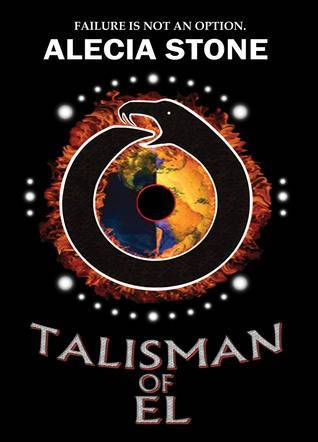
Talisman of El by Alecia Stone

Talisman of El is Alecia Stone’s first novel and the first book published by Centrinian Press. I received a review copy through Netgalley. It’s marketed as YA, but the protagonists are on the younger side for YA (14 years old), so I expect a younger reader would enjoy it more than a 16-18 year old.
Blurb nabbed from Goodreads:
WHAT IF YOUR WHOLE LIFE WAS A LIE?

One Planet.

Two Worlds.

Population: Human … 7 billion.
Others … unknown.


When 14-year-old Charlie Blake wakes up sweating and gasping for air in the middle of the night, he knows it is happening again. This time he witnesses a brutal murder. He’s afraid to tell anyone. No one would believe him … because it was a dream. Just like the one he had four years ago - the day before his dad died.

Charlie doesn’t know why this is happening. He would give anything to have an ordinary life. The problem: he doesn’t belong in the world he knows as home.

He belongs with the others.

Plot-wise, I was hoping for a fun read with some adventure thrown in. It started promisingly with Charlie, an orphan, living with his new foster-father. At the start he’s mostly concerned with fitting in at school and the adoption going well. That is until the social worker’s back is turned and his new guardian abruptly turns nasty. Then confusing dreams and mysterious strangers lead Charlie and his friends on a quest to find a mysterious world hidden inside the Earth (a la Journey to the Centre of the Earth by Jules Verne but with more magic).

The writing is clunky and unpolished. At times there were completely wrong word choices (more than just typos, I mean), but the main thing was the lack of flow in the prose, sometimes within individual sentences. Also, the dialogue was unnatural and at times awkward. In the middle, large chunks of dialogue were info-dumps. A stronger editorial hand might have improved the writing, but on the other hand, a crit group might also have helped. As it was, I wanted to get a red pen and start scribbling on my Kobo. Your mileage and sensitivity to language may vary.

The plot started out all right, and I liked Charlie’s grungy friend Alex. She added contrast to both the school bullies and the other girls who liked Charlie (but of whom he was oblivious).

Once the weird things started happening, I didn’t feel that the story hung together as well, most notably the section set in the other world. I liked the way in which Charlie’s abandonment issues are explored in relation to Derkein, an adult that gets involved in the magic quest.

Overall, the book started all right, flagged in the middle and the ending was nice. It had potential but didn’t quite reach it.

2.5 / 5 stars

Tuesday, 22 May 2012

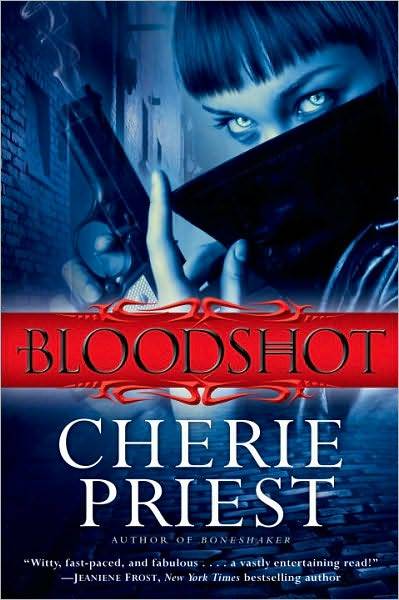
Bloodshot by Cherie Priest

Bloodshot by Cherie Priest is not the first book of Priest’s that I’ve read. If it had been, I don’t know that I’d be convinced to pick up another of her books in the future. (I read Boneshaker when it was on the AussieCon Hugo ballot and enjoyed it.) It’s the kind of book that makes me glad I didn’t pay full price for it and assuages some of my “buying all the discount books when Borders was dying” guilt.


Raylene is a vampire for hire. Usually she’s hired to steal things — art, archaeological artifacts, home made porn… — and this time is no different. A mysterious vampire client (where her usual clients are human) hires her to steal some paperwork from a classified military operation. It’s a fairly simple story in which she sneaks around, trying to avoid the people suddenly out to kill her and completes the mission in a more roundabout way than they all initially suspected. Fine. It wasn’t a plot made of deep but it was the part I didn’t have a problem with. If it sounds like the kind of urban fantasy you might enjoy, then by all means, don’t let me ruin it for you by reading what I disliked in the rest of the review.


First, Raylene is fairly unlikeable. She’s somewhere between kickarse and paranoid and she talks too much. Some of the talking too much can be attributed to her personality/character development, but some of it was just poor writing. Many statements are rehashed or irrelevant details are harped upon in painstaking detail. There was so much justifying of her comments it felt as though the author was working too hard to point out the blindingly obvious to the reader. It very much could have done with more subtlety. Here is a random example from near the start:


I’m white as a compact fluorescent bulb, which you might expect from a woman who avoids the sun to the best of her ability, and my teeth… well, I try not to show them when I smile.


They’re not all incriminatingly pointy, don’t get me wrong. When I yawn I’m not flashing a row of shark’s choppers, but my canines are decidedly pokey. Thank God they don’t hang down as long as they once did. (I know a guy. He filed them or me.) These days they may be short, but they’re still sharp enough to puncture an oilcan, and that’s how I like it.


My hair is more or less the same as it always was, a shade of black that doesn’t require any further descriptors.


And so on. Bolding mine. It’s all overwritten in a similar vein. That particular sentence at the end made me angry when I read it because if it doesn’t require descriptors why put the descriptor in?


At times the characters talk in a stilted way, which would have bothered me more if I hadn’t given up and started skimming at that point. To be fair, not all the conversations were stilted, but enough to bother me. Too often the action scenes (which were numerous, it’s that kind of book and that isn’t a bad thing) were broken up by gratuitous description which made the situations less tense and caused me to skim down the page.


The final thing that bothered me relates back to Raylene being unlikeable. She’s a bit everything-ist, which is OK except once you stop and think just how much worse it would sound if she was male. Yeah. And then there was a drag queen character who I didn’t think was handled very well. There were some cringe-worthy aspects. (I’d be more specific, but they do actually involve spoilers.)


So yeah. I wouldn’t recommend this book. I won’t be reading the sequel. I might read Cherie Priest’s steampunk books — on the assumption that they’re more like Boneshaker than Bloodshot — and I have Four and Twenty Blackbirds (which is apparently southern gothic, though I’m not sure what that means) which I’ll still get to eventually. I’ve read worse books and I’ve read worse writing, but I couldn’t enjoy Bloodshot.


2.5 / 5 stars