Showing posts with label new zealand. Show all posts

Tuesday, 24 June 2014

Use Only As Directed edited by Simon Petrie and Edwina Harvey

Use Only As Directed, edited by Simon Petrie and Edwina Harvey, is the latest anthology to come out of Peggy Bright Books. I have previously reviewed Light Touch Paper, Stand Clear by the same editors and I think Use Only As Directed improves upon the earlier anthology. I particularly liked that there was a clear theme to the anthology — basically, what it says on the bottle cannister.

Although not all of the stories were necessarily cheery, I found the anthology relatively up-beat on the whole. (Having said that and looked over the stories, perhaps that's as much a commentary on other things I've been consuming lately...) There is a wide variety of stories contained within; every story sticks to the theme, but there are a lot of very different interpretations. I appreciate the lack of homogeneity and the novelty of getting something completely different each time I picked up the anthology.

My favourite stories were "The Blue Djinn’s Wish" by Leife Shallcross, "Future Perfect" by Janeen Webb and "Home Sick" by M Darusha Wehm. There is basically nothing these three stories have in common. The first is a genie story, the second is sort of almost hard SF and the third is, I suppose, more ecological near-future SF with a huge pile of refined rubbish. I also quite enjoyed "Yard" by Claire McKenna, which was a bit darker but ultimately satisfying.

Basically, I think there's something in this anthology for everyone. You may not like every story but, assuming you like any spec fic (and I'm not sure why you're reading this blog if you don't), there will probably be a story you enjoy in Use Only As Directed. As usual, I have some brief thoughts on each story below. If you haven't yet sampled a Petrie and Harvey anthology, this one would be a good place to start.

~

Dellinger (Charlotte Nash) — A tale of cyborgs and sentient space ships. I liked the ideas explored. What happens when you create an artificial sentience based on a human mind then set it to controlling a ship?

The Blue Djinn’s Wish (Leife Shallcross) — Easily the best genie story I've ever read. The princess who finds the magic bottle is happy and already has everything she could wish for, but will that last?

The Kind Neighbours of Hell (Alex Isle) — A grimoire and a demon summoning... But as the grimoire used correctly?

Mister Lucky (Ian Nichols) — the protagonist has the ability to control luck (more or less). An amusing, fast-paced read.

Home Sick (M Darusha Wehm) — set on the floating island of rubbish in the Pacific. Climate refugees from a submerged Pacific nation are sent there by the New Zealand government and the main character chooses to go with them. An interesting story that I enjoyed.

Always Falling Up (Grant Stone) — Interesting take on clone soldiers and the man who provided the template for their minds. Fits the theme very obviously, but it's a bit more of a philosophical take, I thought.

Yard (Claire McKenna) — Although it didn't start promisingly (violence that I wasn't in the mood for), I really liked where this one went. And the main character, and her yard.

Never More (Dave Freer) — An amusing tale of a wizard's apprentice who used to be a cat. And his quest to become acceptable to a girl-cat. Also a raven.

Fetch Me Down My Gun (Lyn McConchie) — Interesting but a bit heavy handed. I didn't love the first half, but the second half improved it with added meaning.

Uncle Darwin’s Bazooka (Douglas A Van Belle) — A bit slow to start, but then it gets to the bit combining genetics and fairies, so what’s not to like? The ending was a bit predictable though.

The Climbing Tree (Michelle Goldsmith) — A story about disappearing children. Not bad, but not as creepy as intended, I think.

Large Friendly Letters (Stephen Dedman) — A post-apocalyptic setting, some feral teenagers and a munitions trader. What could possibly go wrong?

Future Perfect (Janeen Webb) — One of my favourites in this anthology. The story was up-beat (albeit not exactly cheery) and made me think. Admittedly, it mostly made me think about incorrect interpretations of the many worlds hypothesis, but it’s never bad to think extra thoughts about quantum mechanics.

The Eighth Day (Dirk Flinthart) — I couldn’t not read this in church singy-monotone, which was a little off-putting and induced confusing flashbacks. Also, the pay-off wasn’t as good as I was hoping, given the aforementioned monotone in my head.

4 / 5 stars

First published: June 2014, Peggy Bright Books
Series: no
Format read: eARC
Source: Review copy provided by the editors

Thursday, 6 February 2014

The Prince of Soul and the Lighthouse by Fredrik Brounéus

The Prince of Soul and the Lighthouse by Fredrik Brounéus is the first novel published in English by the Swedish author who now lives in New Zealand. I didn't realise until I started reading, but it's actually a YA book. Obviously I missed the main character's age in the blurb... that or I forgot the blurb to a greater extent than I usually do.
What happens when we die?

This has been the third question on mankind’s FAQ list since the dawn of time (numbers one and two being: Is this edible? and Excuse me, would you care to breed?).
I know what happens. Believe me, I’d rather not. But I do.

There is a lighthouse, and it guides our souls along the narrow path to being reborn as humans. It’s the light at the end of the tunnel. Unfortunately, as my undead granddad and the Tibetan special mission monk in my kitchen have kindly told me, there’s a problem with the lighthouse. And if the world is to be saved, someone needs to fix it.

Which is where I come in: George Larson, eighteen years old. Who could possibly be better suited to save the world?

Well, almost anyone. Especially as being a teenage guy is nothing at all about question three but all about questions one and two.

And really, that's complicated enough as it is.
This was an engaging read. George is an ordinary teenager who wants to be a famous musician and get the girl. Then a spider communicates with him and he starts to have weird dreams in which his recently deceased grandfather visits him to drink coffee and smoke. When his mother finds a cigarette butt and some ants spell out SOS, he starts to really freak out. Things don't get less weird from there.

The Prince of Soul and the Lighthouse might have a long title, but it was a pretty short novel. Most of the story is taken up by George and associates gallivanting around New Zealand on a quest given to him by a monk (and also, like, the universe). The writing style is well paced and quirky, with several conversations occurring between various body parts of George's. The style also felt quick to read (which may just be me) so that it felt like I was turning pages quite quickly. It also made me giggle at times.

In terms of weird happenings, the plot is the sort where it's not easy to guess what's going on until someone explains it to the main character — and the monk spends a lot of time not explaining anything. But this does add to the tension and excitement. And confusion, both for the George and the reader, but not in a bad way. It kept me turning the pages despite some of the odder plot twists.

I want to mention the ending because it was sort of unusual. It definitely fit with the story and it wasn't a surprise per se, but looking back, it was pretty, well, un-Hollywood. I want to say un-USian, but given that there are yanks in the story in opposition to George, that's less specific. What I'm trying to say is that the Swedish/New Zealish author wrote a story that probably would not have been framed the same way if it had been written by a yank. (The portrayal of the bad guys notwithstanding.) I would be interested to hear if anyone else who's read The Prince of Soul and the Lighthouse feels similarly.

I have to say there were a few plot-y revelations that I felt sceptical of, but overall it was a fun read. I would recommend The Prince of Soul and the Lighthouse to readers looking for a slightly unconventional and humorous YA novel. It's a quick read and I think fans of adult quirky books will also enjoy it. Oh, also, there are a few illustrations scattered throughout, if that's your kind of thing.

4 / 5 stars

First published: 2012, Steam Press
Series: Nope.
Format read: ePub
Source: Review copy courtesy of the publisher

Sunday, 22 April 2012

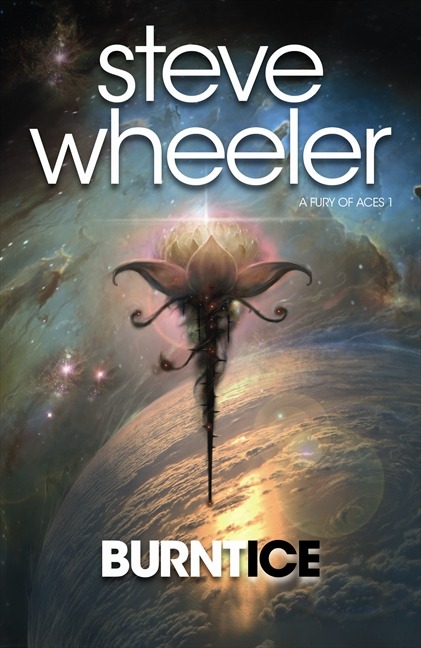
Burnt Ice by Steve Wheeler

Burnt Ice, the first in the A Fury of Aces series, is Steve Wheeler’s debut novel. I was really excited to read a new ANZ science fiction novel since there are so few of them being published, especially by large publishers (this one is from Harper Voyager, if you’re wondering). And it has such a lovely cover, too (so much SF coming out of the US has unappealing covers with artwork ruined, in my opinion, by unpleasant typography).


When I picked up Burnt Ice, I was expecting something like a Sean Williams and/or Shane Dix novel, but that wasn’t what I got.


Burnt Ice follows the adventures and misadventures of a military engineering crew in a distant future where wars are called “conflicts” and are sanctioned by the ever-watching Games Board. Of course, only part of the story revolves around the Games Board. The novel is actually structured as four almost self-contained stories with different but related missions at their centre. The over-arching plot holds everything together, even if at times it’s not obvious how the current conflict connects.


The plot was solid and fast-paced without a dull moment. New dangers kept arising and the crew’s missions took them to interesting places. The world building was also fairly strong, especially the planet at the start, which I enjoyed reading about. I also liked that there were aliens they didn’t know much about that popped up to cause trouble every now and then.


The writing was heavy on the technobabble, which I didn’t mind, although at times every new procedure was described in a bit too much technical detail. It didn’t bother me at first, but it got a bit much towards the end. On the other hand, the science and pseudoscience didn’t make me angry with it’s lack of credibility (as in, it was mostly correct and at least semi-viable), so that’s always a plus.


There were some things that did bother me, however. The characters were not very well developed and, especially in the first half or so when the focus was on the core crew, it wasn’t that easy to distinguish between them. The characters that stood out were basically Marko, the mainest character, Fritz, The Oddball Genius, and Jan, The (Mysterious) Girl. The other two crew members didn’t read terribly differently to Marko. Very little time was spent developing the personalities and relationships between them to the point where, for example, we’re told when there’s a romantic connection but no reason is really given for it and I was left wondering why those two would even want to hook up. The characters that came along later on were more distinct and interesting, but they weren’t further developed either. It would have been a stronger novel if some of the technobabble were exchanged for some character development.


Easily my favourite character was the sentient ACE (Artificially Created Entity) soft-of-pet Marko built for himself in the latter half of the book. Basically an animal cyborg, it’s quirky lack of understanding of human idioms gave me a couple of laughs. It wouldn’t really have meshed with the plot earlier on, but I do wish it had come along sooner.


The other thing that bothered me was the unnecessary (and I assume unconscious) use of gendered slurs. For example “arrogant woman/bitch” was used two too many times. In an ostensibly gender-equal world, it felt like everyone who screwed up and more than half the dodgy people (as in bad guys, but there were shades of grey and mystery to some of them) were female or AIs. I was particularly offended when someone called the suddenly rogue AI a f*cking bitch (the swearing I don’t object to because the AI was trying to kill them). Even though the AIs were loosely gendered, you can’t get much more asexual than a computer so you’d think notions of gender would have been redefined by that distant future point. As I said, I very much doubt it was intentional sexism, but that doesn’t mean it didn’t bother me.


The ending was very much an ending to part one in a series. There were a lot of unanswered questions, including some mysterious new characters who showed up towards the end and promised (the reader, not so much the other characters, which isn’t a bad thing) some answers as well as more interesting questions. If the characterisation hadn’t bothered me so much I would be interested in reading what happens next. As is, I’m not sure that I will be picking up the next in the (possibly ten book long) series.


3 / 5 stars