Showing posts with label space adventure. Show all posts

Sunday, 15 December 2019

Dragon Pearl by Yoon Ha Lee

Dragon Pearl by Yoon Ha Lee is a space fantasy book aimed at younger readers. It's the first in a series and is entirely unrelated to Yoon Ha Lee's other books, which are adult science fiction. I don't generally read much middle grade, but I picked this one up mainly because of the author. I'd say its also at the older end of the category: the protagonist is thirteen years old, but spends much of the book pretending to be sixteen, so there is a bit of a YA feel to it as well.

THIRTEEN-YEAR-OLD MIN comes from a long line of fox spirits. But you'd never know it by looking at her. To keep the family safe, Min’s mother insists that none of them use any fox-magic, such as Charm or shape-shifting. They must appear human at all times.

Min feels hemmed in by the household rules and resents the endless chores, the cousins who crowd her, and the aunties who judge her. She would like nothing more than to escape Jinju, her neglected, dust-ridden, and impoverished planet. She’s counting the days until she can follow her older brother, Jun, into the Space Forces and see more of the Thousand Worlds.

When word arrives that Jun is suspected of leaving his post to go in search of the Dragon Pearl, Min knows that something is wrong. Jun would never desert his battle cruiser, even for a mystical object rumored to have tremendous power. She decides to run away to find him and clear his name.

Min’s quest will have her meeting gamblers, pirates, and vengeful ghosts. It will involve deception, lies, and sabotage. She will be forced to use more fox-magic than ever before, and to rely on all of her cleverness and bravery. The outcome may not be what she had hoped, but it has the potential to exceed her wildest dreams.

Dragon Pearl follows Min as she sets out on an illicit adventure to find out what really happened to her brother. She sets off with almost nothing other than her fox-based shape-shifting magic and magical Charm, and finds herself very far away from her home planet. It was a fun space adventure involving morally ambiguous adults, new friends and dangerous situations. I enjoyed it a lot and I look forward to any sequels that may be forthcoming. Although the story is quite self-contained, it sets up a possible series and I definitely want to read those other stories.

As well as not being a big middle-grade reader, I also tend to steer away from space fantasy books, having been burned a few times before. To be honest, I wasn't sure how strong the fantasy element would be before I started reading, but I was assuming it would mostly be science fiction. It is set on other planets and in space, so it's science fiction if that's your definition of it. But the world building is very deeply steeped in Korean folklore and the associated magic. The story very prominently involves shapeshifting supernaturals and ghosts, and the titular pearl is a magical terraforming device. This worldbuilding worked for me very well. It felt very consistent — perhaps because it's directly based on real mythology rather than being entirely fictional. (I am trying very hard not to name the authors that previously ruined magic in space for me, can you tell?)

I highly recommend Dragon Pearl to fans of science fiction and fantasy, especially space adventures. Readers who are already fans of Korean folklore, or just want to learn more about it, will also find much to like here. I hope I will have the opportunity to give this book to my niece before she outgrows it.

4.5 / 5 stars

First published: January 2019,  Rick Riordan Presents (Disney)
Series: book 1 of ? (I thought I saw the second book announced, but I am failing to find any info right now)
Format read: ePub
Source: Purchased from Kobo store

Friday, 10 May 2019

Walking to Aldebaran by Adrian Tchaikovsky

Walking to Aldebaran by Adrian Tchaikovsky is a standalone novella centred around a “big dumb object” in a science fictional sense. I haven’t read any of the author’s novels, but apparently did read his novella in Monstrous Little Voices, which was not very memorable. I think Walking to Aldebaran is a definite improvement on memorability, if nothing else.

My name is Gary Rendell. I’m an astronaut. When they asked me as a kid what I wanted to be when I grew up, I said, “astronaut, please!” I dreamed astronaut, I worked astronaut, I studied astronaut.

I got lucky; when a probe sent out to explore the Oort Cloud found a strange alien rock and an international team of scientists was put together to go and look at it, I made the draw.

I got even luckier. When disaster hit and our team was split up, scattered through the endless cold tunnels, I somehow survived.

Now I’m lost, and alone, and scared, and there’s something horrible in here.

Lucky me.

Lucky, lucky, lucky.

This book starts a little slowly with our first person protagonist walking through crypt-like passages in space. We get a feel for the crypts and the backstory is slowly meted out over the course of the novella. At one point I started to wonder whether there would be much plot to it or whether we would just a description of the space-bending alien artefact from the inside. But then we get some fresh hints about backstory still to come and the plot progresses. By the end, I found myself enjoying the book more than I expected to.

We get a reasonably detailed description of the crypts and the weird physics inside them. We get enough backstory to understand why the astronauts went there and (eventually) why Gary ends up alone. There was a reveal that came right after I thought “wait, was that <spoiler redacted>?” But another similar thought was not followed up my confirmation either way, since it’s not something Gary could have known and was not in a position to guess. Things like that open the text up for a lot more discussion and speculation than I would have expected, making this all the more satisfying a read.

Overall, Walking to Aldebaran was an interesting read, exploring a nifty alien artefact. Where it shines is towards the end, where the true story is revealed and we see Gary’s journey as a whole. I found myself pleasantly surprised although I wasn’t bored by the first half of the book either. I recommend Walking to Aldebaran to fans of philosophical science fiction or fans of big dumb objects.

4.5 / 5 stars

First published: May 2019, Rebellion
Series: No
Format read: eARC
Source: publisher via NetGalley

Monday, 22 April 2019

The Disasters by M K England

The Disasters by M K England is a YA space adventure story, in which a group of teens are the only hope for most of humanity. It was mostly a fun read, but there were some physics issues that I found quite distracting.

Hotshot pilot Nax Hall has a history of making poor life choices. So it’s not exactly a surprise when he’s kicked out of the elite Ellis Station Academy in less than twenty-four hours.

But Nax’s one-way trip back to Earth is cut short when a terrorist group attacks the Academy. Nax and three other washouts escape—barely—but they’re also the sole witnesses to the biggest crime in the history of space colonization. And the perfect scapegoats.

On the run and framed for atrocities they didn’t commit, Nax and his fellow failures execute a dangerous heist to spread the truth about what happened at the Academy.

They may not be “Academy material,” and they may not get along, but they’re the only ones left to step up and fight.

In many ways this was a fun book. The characters were entertaining and diverse which was fairly refreshing to read. The narrating character, Nax, ends up being the de facto leader of the little team and being inside his head wasn't terrible. It was a good mix of uncertainty, some silly teenage stuff and world-saving plans.

The worldbuilding of this future was based on some sort of magically fast jump drives (that weren't described in detail), which allowed for the colonisation of several habitable planets spread around the galaxy. A bit confusingly, the law is that once someone leaves Earth they can never come back to the planet. The closest they can get is in orbit if they want to talk to their loved ones over live video chat. This wasn't really explained in depth and, while it seems like the kind of thing that might be subverted in this sort of book, it was not. A little baffling, overall.

The biggest problem I had with this book, however, was the complete disregard for the laws of physics. Starting with the part where the space ships had rudders (overall, they behaved a little too much like planes, even when they were in vacuum). There was just so much that didn't make sense on that front that I couldn't ignore it and I couldn't enjoy the book. Every action scene generated a lot of "WTF" for me. Very disappointing. Perhaps if the book overall had been a little bit tighter and faster-paced, I could have ignored more of the physics gaffes. But as it was, I did not enjoy The Disasters and dragged out my reading of it because I just wasn't keen to get back to it. Alas.

So I would recommend this to fans of YA and action adventures in space, but the physics was appalling and I can't recommend it on that front. Obviously, that's not something that will bother everyone, but since it's a YA book and potentially influencing the understanding of space and physics in young minds, I cannot approve.

3 / 5 stars

First published: 2018, HarperCollins
Series: I don't think so
Format read: eARC
Source: Publisher via NetGalley

Saturday, 29 July 2017

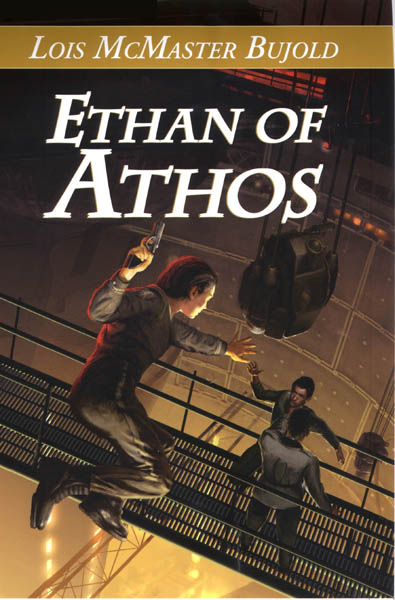
Ethan of Athos by Lois McMaster Bujold

Ethan of Athos by Lois McMaster Bujold continues by rereading of the Vorkosigan books in internal chronological order. The effect of privileging chronology over publication order is particularly interesting in this case since Ethan of Athos was published in the same year as Shards of Honour and The Warrior's Apprentice but is set after Cetaganda. It was a little weird to read about Cetagandan bad guys and genetics on a so much shallower level than what we got in Cetaganda. But, that said, I had forgotten a lot about Ethan of Athos since my first read of it sixish years ago. The first time around I think I dismissed it as "OK, but insufficient Miles". This second time around I enjoyed it more than I expected to.

The familiar old SF "planet of women" chestnut is reversed in the planet of Athos — an all-male planet made possible by the invention of the uterine replicator. Ethan, drawn out of his beloved Athos by a quest, finds himself an alien in more mainstream human society, and cannot help but find women disturbing aliens as well, especially the ultra-competent, ultra-beautiful Elli.

Ethan of Athos is Lois McMaster Bujold's third novel. It departs from the concerns of the Vorkosigan family to explore the ramifications of advanced biotechnology, turning many a cliché on its head along the way.

The basic premise, and the part I remembered most clearly, of Ethan of Athos is that Athos is a planet with only men living on it, who reproduce using science and uterine replicators. Their ovarian cultures, which they need to keep making more babies, are failing and the new shipment they ordered turns out to be rubbish so Ethan has to go procure a new one. I also remembered Ellie Quinn being around (who first appeared in Warrior's Apprentice) but had completely forgotten what she was up to until I read it again.

Overall this was a more enjoyable read than I remembered and I found the book more interesting than I expected. That said, this was still a book written in the 80s and a lot of the general society people who I would expect to be more progressive than modern society (because they're presumably modern society taken into the future), weren't. There was a general negative perception towards queer people (queer men specifically) among non-Athosians, which I was a bit disappointed by. Given the big deal made about how socially backwards Barrayar is compared with Galactics, I had higher expectations. (To be fair, a lot of the comparisons were specifically with Beta Colony, which seems to be especially progressive, but still.) So there were a few cringe-worthy moments but not too many.

I think this is an oft-overlooked entry in the Vorkosigan Saga but worth reading despite the lack of an actual Vorkosigan walking onto the page. Also, Ellie Quinn is great and I like that we get to know her better in this book than we did when we first met her in The Warrior's Apprentice. I recommend Ethan of Athos to fans of Bujold's other books but also to people who haven't read any other Vorkosigan books. Although a small number of amusing references will be lost, this is a pretty feasible place to start reading the series. I mean, it's not my top recommended starting place for the series, but it's a book that stands alone well and gives a bit of an introduction to the story universe. The only disappointment is that there is no sequel or follow up, so we are left to fill in the post-ending   story ourselves.

4.5 / 5 stars

First published: 1986, Baen
Series: Vorkosigan Saga, book 3 in publication order, book 7 in internal chronological order (more or less)
Format read: ePub as part of the Miles, Mystery & Mayhem omnibus
Source: Purchased several years ago direct from Baen

Sunday, 22 January 2017

Gemina by Amie Kaufman and Jay Kristoff

Gemina by Amie Kaufman and Jay Kristoff is the second book in the Illuminae Files trilogy. I previously reviewed the first book, Illuminae, here. The sequel maintains the found footage/documents format of the first book and is a relatively quick read because of it, despite clocking in at 659 pages in my edition. I should also mention that I checked the science for this book so this wasn't my first read through, although it was my first experience of the final copy in all its artistic glory.

Moving to a space station at the edge of the galaxy was always going to be the death of Hanna’s social life. Nobody said it might actually get her killed.

The saga that began with Illuminae continues on board the space station Heimdall, where two new characters will confront the next wave of BeiTech’s assault. Hanna is the station captain’s pampered daughter, Nik the reluctant member of a notorious crime family. But while the pair are struggling with the realities of life aboard the galaxy’s most boring space station, little do they know that Kady Grant and the Hypatia are headed right toward Heimdall, carrying news of the Kerenza invasion.

When an elite BeiTech team invades the station, Hanna and Nik are thrown together to defend their home. But alien predators are picking off the station residents one by one, and a malfunction in the station’s wormhole means the space-time continuum may be ripped in two before dinner. Soon Hanna and Nik aren’t just fighting for their own survival. The fate of everyone on the Hypatia—and possibly the known universe—is in their hands.

But relax. They’ve totally got this. They hope.

I enjoyed Gemina more than Illuminae. I think partly because now, with the second book, the authors and the production team have really gotten into their stride with the found documents format. Also, I just liked parts of the storyline more (no space zombies, for example). Also, a lot more of the overarching plot becomes apparent in this book. While there is still some mystery about exactly what's going on and why, we are much less in the dark by the end of this book than we were by the end of the first. (Which is how it should be, obviously.)

I was also quite fond of both protagonists in Gemina: Hanna, the daughter of the station chief and a girl who can kick anyone's arse; and Nik, the drug-dealing scion of a big organised crime family from space-Russia. And they already knew each other before the book started, which adds some layers to their story. Also, I can't write a review without mentioning Nik's cousin Ella, one of the most prominent secondary characters. She's an awesome hacker who contributes significantly to the story and is also pretty decent disability representation. Yes, she has/had a fictional disease but the mobility and respiratory consequences of it have real-world counterparts. The best thing is she's allowed to do her thing without much of a big deal being made of her physical limitations.

I recommend Gemina to fans of science fiction and YA SF. If you enjoyed Illuminae then I definitely recommend continuing on to Gemina, which I enjoyed more. Gemina almost stands alone but I don't suggest reading it on its own because the bits that tie in with the overarching plot and the events of the earlier book won't make much sense. And will kind of spoil the effect. I am definitely keen to read the last book and find out how everything is resolved.

4.5 / 5 stars

First published: October 2016, Knopf (US) and Allen & Unwin (Aus)
Series: Illuminae Files book 2 of 3
Format read: US hardcover
Source: Authors
Disclaimer: I did some science-checking for the authors (and hence also read an earlier version of the MS)
Challenges: Australian Women Writers Challenge, Aussie SF Reading Challenge

Thursday, 7 July 2016

Long Way to a Small Angry Planet by Becky Chambers

Long Way to a Small Angry Planet by Becky Chambers is a debut science fiction novel by a new-to-me author. It's a standalone book, although I hear a companion novel is on the way.

When Rosemary Harper joins the crew of the Wayfarer, she isn't expecting much. The Wayfarer, a patched-up ship that's seen better days, offers her everything she could possibly want: a small, quiet spot to call home for a while, adventure in far-off corners of the galaxy, and distance from her troubled past.

But Rosemary gets more than she bargained for with the Wayfarer. The crew is a mishmash of species and personalities, from Sissix, the friendly reptillian pilot, to Kizzy and Jenks, the constantly sparring engineers who keep the ship running. Life on board is chaotic, but more or less peaceful - exactly what Rosemary wants.

Until the crew are offered the job of a lifetime: the chance to build a hyperspace tunnel to a distant planet. They'll earn enough money to live comfortably for years... if they survive the long trip through war-torn interstellar space without endangering any of the fragile alliances that keep the galaxy peaceful.

But Rosemary isn't the only person on board with secrets to hide, and the crew will soon discover that space may be vast, but spaceships are very small indeed.

I had heard a lot of comparisons of this book to Firefly, and also how the cover, while pretty, was not representative of that. That commentary was part of what made me pick this book up sooner rather than later (a friend gushing and a sale are what led me to buy it). However, aside from being an ensemble cast on a spaceship in the distant future, there really aren't many similarities to Firefly. I'd argue that the significance of each character in Long Way to a Small Angry Planet is more evenly spread than in Firefly, too. And then there's the plethora of alien races, the lack of criminal activity on the part of the crew as a whole, no fugitive magical girls... The differences are endless.

It probably will appeal to a similar demographic, though.

The plot in Long Way to a Small Angry Planet is less direct than in most of the books I've read lately, possibly because I've been reading a lot of YA and comics. Each crew member has their own goals as well as the common goal of doing their jobs and not dying in the process. At the start, we probably get a bit more of Rosemary's perspective since she's the new arrival and a good in for the audience. But we also see a lot of Captain Ashby's point of view to set the scene. As the story progresses, we learn backstories for all the characters, which are diverse and interesting.

The title comes from a key job the crew takes on, which takes a significant portion of the book to complete and does contribute to the climax. But it's not the only significant thing happening to the characters and I liked that.

I read this book on a transcontinental flight and I'd rank it as one of my better-chosen plane reads. I don't think I enjoyed it less for the severe sleep deprivation I was experiencing and I actively wanted to come back to it when I wasn't dozing. So much so that I ended up not watching any movies, not even during meals.

I highly recommend Long Way to a Small Angry Planet to all science fiction fans. I think it's a book with broad appeal with both fun and serious moments. The cast of characters is also broad enough that even if you're not interested in one character, there will be others to pick up the slack (I found all the stories interesting, however).

5 / 5 stars

First published: 2014, self-pub (Kickstarter was involved) then picked up by a couple of large publishers for the edition I read
Series: Standalone but another book in the same world ("Wayfarers") is on the way
Format read: ePub on Kobo
Source: Purchased from Google Play

Wednesday, 1 June 2016

Binti by Nnedi Okorafor

Binti by Nnedi Okorafor is a novella that was on my radar for a while, but particularly came to my attention when it was shortlisted for ALL THE AWARDS this year. I purchased it for being the most interesting-seeming novella on the Hugo shortlist.

Her name is Binti, and she is the first of the Himba people ever to be offered a place at Oomza University, the finest institution of higher learning in the galaxy. But to accept the offer will mean giving up her place in her family to travel between the stars among strangers who do not share her ways or respect her customs.

Knowledge comes at a cost, one that Binti is willing to pay, but her journey will not be easy. The world she seeks to enter has long warred with the Meduse, an alien race that has become the stuff of nightmares. Oomza University has wronged the Meduse, and Binti's stellar travel will bring her within their deadly reach.

If Binti hopes to survive the legacy of a war not of her making, she will need both the gifts of her people and the wisdom enshrined within the University, itself - but first she has to make it there, alive.

Binti starts off as a lovely story about a young woman with strong cultural ties stepping outside of her comfort zone and leaving her planet and her home for the first time. Leaving her family behind is difficult and she knows they will be angry with her for going. But she holds onto her heritage, taking her traditions with her when she leaves Earth. Although Binti begins as a story of adjusting to new experiences and being surrounded by new people, all of them from different cultures, it takes a sharp turn for the dire, partway through Binti's journey to university.

The story of Binti's belonging — or not belonging — turns from a story of potential social awkwardness into one of survival when Binti is confronted by hostile aliens. I quite liked that Binti was physically changed by her traumatic and otherwise life-changing experience.

I have to admit, I wasn't expecting this shift in story, but it definitely made for an interesting read. In particular, the final resolution was not entirely expected, but was very satisfying. That said, I would've loved to have read the conversation Binti has just after the close of the novella! Perhaps if there are more stories set in the same world (which I have heard may be the case), we can find out how that played out.

I highly recommend Binti to all fans of science fiction, novellas, and stories about diverse cultures. It's not a long tale — I read it in a single sitting — but an engrossing and exciting one. I will certainly be keeping an eye out for more of Okorafor's work, which this was my example of.

4.5 / 5 stars

First published: 2015, Tor.com novella
Series: Apparently more stories in this world are forthcoming
Format read: ePub
Source: Purchased from iBooks

Thursday, 25 February 2016

Kaptara Vol 1: Fear Not, Tiny Alien by Chip Zdarsky and Kagan McLeod

Kaptara Vol 1: Fear Not, Tiny Alien written by Chip Zdarsky and illustrated by Kagan McLeod is a surprisingly funny and weird space fantasy comic. I would not have known about it if it hadn't been listed on NetGalley and it caught my eye due to being written by Chip Zdarsky (aka the illustrator of Sex Criminals), and drew me in because of the (admittedly very short) blurb.

Keith Kanga crash lands on KAPTARA, a world filled with danger and weird danger and dangerous weirdos! And if he can't survive, then Earth, the place where YOU live, is doomed!

The premise here is basically a group of astronauts on their way to Mars end up going through a wormhole-type thing and crash land on a fantasy alien planet. The main character, Keith, illustrated on the cover, is a gay bio-engineer/environmental scientist whose defining characteristics are not being physically strong and running away from trouble. The latter is particularly useful when things on the alien planet start trying to eat him.

Keith meets up with some of the varied inhabitants of the planet, who are quick to inform him that the Earth needs saving. But Keith would rather stay here where people are nice to him... The story seemed to me to be a mix of pre-Golden Age SF ideas (stories about alien planets with the merest nod towards the science part of SF) and very now, kind of internetty elements. It was weird and quite funny at times.

I would recommend Kaptara to anyone with a sense of humour to whom any of the above appeals. I am looking forward to reading more when the next volume is released. Will the Earth be saved? Who knows!

4 / 5 stars

First published: January 2016, Image Comics
Series: Yes, vol 1 of ongoing series, collecting issues #1–5
Format read: eARC
Source: NetGalley

Thursday, 31 December 2015

Gentleman Jole and the Red Queen by Lois McMaster Bujold

Gentleman Jole and the Red Queen by Lois McMaster Bujold is the latest instalment in Bujold's extensive Vorkosigan saga. It is, to date, the most latterly set and features Cordelia Vorkosigan and Oliver Jole as the main characters. Cordelia, of course, being Miles's mother, and Jole having formerly been the late Count Aral's senior subordinate. Among other things. I read most of the Vorkosigan books shortly before starting this blog, but I did review the second most recent, Captain Vorpatril's Alliance, when it came out in late 2012.

Three years after her famous husband's death, Cordelia Vorkosigan, widowed Vicereine of Sergyar, stands ready to spin her life in a new direction. Oliver Jole, Admiral, Sergyar Fleet, finds himself caught up in her web of plans in ways he'd never imagined, bringing him to an unexpected crossroads in his life.

Meanwhile, Miles Vorkosigan, one of Emperor Gregor's key investigators, this time dispatches himself on a mission of inquiry, into a mystery he never anticipated; his own mother.

Plans, wills, and expectations collide in this sparkling science-fiction social comedy, as the impact of galactic technology on the range of the possible changes all the old rules, and Miles learns that not only is the future not what he expects, neither is the past.

The first thing I want to say is: this is a romance book. Surprisingly little happened that wasn't at least romance-adjacent, for all that there were some political and logistical things going on in the background. And unlike A Civil Campaign, it is not a comedy of errors. It has it's funny laugh-out-loud moments, but does not compare with some of Bujold's earlier books as far as humour goes. The blurb, which was at the front of my edition, encouraging me to read it when I normally wouldn't, is also quite misleading. It suggests significantly more intrigue than is actually present.

None of which is to say that I didn't enjoy Gentleman Jole and the Red Queen. I had two or three later-than-intended nights because of it. But I do kind of wish the blurb had been more up-front about the fact that this was a romance. I kept expecting Miles to show up and there to be some sort of plot somewhere, possibly involving Cetagandans. But Miles didn't appear in the first half of the book at all and when he did come along he was very much a minor character. Which worked quite well in a book about Cordelia and Jole. I think the moral of this story is to not read blurbs when you know you're going to read the book anyway.

One of the more unexpectedly interesting things in this book are the descriptions and encounters with Sergyar fauna and flora (but mostly fauna). As well as Jole himself becoming increasingly interested in the more exotic wildlife, there are several encounters with more mundane species, like the local equivalent of mosquitoes. (Not actually a type of insect and involved in the most memorable line in the book, which involved "flaming snot". There was much laughing on my part.)

This is a book for fans of the Vorkosigan universe and, particularly, fans of Cordelia. I wouldn't recommend it as a starting point for the series, mainly because it isn't all that representative of most of the other books. However, if you have read at least some of the other books (and don't mind spoilers for certain life events of Miles's and Cordelia'a), then this is an enjoyable read. I would generally recommend having read the Cordelia books (Cordelia's Honour, which contains Shards of Honour and Barrayar) and The Vor Game to get the majority of the older references and reminiscences in Gentleman Jole and the Red Queen.

4 / 5 stars

First published: February 2016, Baen
Series: Vorkosigan saga, book 16 in both publication and current chronological order
Format read: eARC
Source: Publisher via Edelweiss

Monday, 21 September 2015

Captain Marvel Vol 3: Alis Volat Propriis by Kelly Sue DeConnick

Captain Marvel Vol 3: Alis Volat Propriis by Kelly Sue DeConnick and illustrated by David Lopez is the third collected volume of Captain Marvel comics (well, or the 5th or 6th depending on how you want to count, but there is a "3" on a spine) that started with issue #1 in 2014 (see my reviews of Vol 1 and Vol 2). It's also the collection of the last comic issues before the Secret Wars mega event, when the Captain Marvel series is replaced by Captain Marvel & The Carol Corps.

Captain Marvel's time as an astronomical avenger has pitted her against some of the worst the galaxy has to offer (lookin' at you J'Son). The Haffensye Consortium has been tracking Captain Marvel and Tic for weeks. Now, they've finally caught up to them both! Captain Marvel was barely able to survive the last time she squared-off against the Haffensye - think she'll be so lucky again?

Because this is the last normal collected volume of Captain Marvel of this run, it's a bit shorter than usual, comprising of only four issues. The first two form an arc that's mostly about Chewie the cat (and I suppose somewhat crucially ties up Tic's storyline). Aside from the recurring issues Marvel has with plausibility of space physics — Astrophysics: Marvel's one weakness! — I really loved this story. Partly because Chewie had a bit of a Mad Max moment and partly because I think I finally understand how Carol's suit works in space. So that was issues #12–13 and they were a nice way to tie up Carol's time in space.

However, issue #14 was a dud. It was part of some sort of cross-over event ("The Black Vortex") which has apparently mainly taken place in a bunch of other series. The story only made borderline sense and did not end with an actual conclusion, which was disappointing. I took half a star off the volume's rating for issue #14 being such a nonsensically incomplete story. (Would it have killed them to add in another issue to round things off, especially given how short the volume is?)

The last issue was lovely though. Carol goes back to Earth and the story ties up the loose ends of her relationship with Tracy, who has been a constant background presence throughout DeConnick's entire time on Captain Marvel. It was bittersweet but a really nice way to leave things. I love it.

If you've been enjoying Captain Marvel thus far, I strongly recommend picking up this volume, even if you're a bit put off by its shortness. That said, if you have the option to grab just issues 12, 13 and 15, then that's probably a satisfactory alternative. In the meantime, I am eagerly awaiting the collected Captain Marvel & The Carol Corps and also A-Force.

4 / 5 stars

First published: September 2015, Marvel
Series: Captain Marvel (2014) Volume 3 and the end of the run, though it is followed by Captain Marvel & The Carol Corps
Format read: Trade paperback
Source: Non-Amazon online book shop

Sunday, 6 September 2015

The Starry Rift by James Tiptree Jr

The Starry Rift by James Tiptree Jr is one of only two collections of short stories readily available as ebooks. I admit I chose to buy it first partly because it was only $3 and partly because it was shorter and I could more easily fit it in before getting to Letters to Tiptree.

These are the heroes of the Starry Rift, a dark river of night that flows between the arms of our galaxy: A headstrong teenaged runaway who makes first contact with a strange alien race. A young officer on a deep-space salvage mission who discovers an exact double of a woman he thought he'd lost. The crew of an exploration ship who must plead for the human race to avert an interstellar war.

The Starry Rift is set up with a framing narrative about two students seeking library materials for class. The books the librarian gives them form the three stories contained within this collection. The stories are all set around the same general region of space: Federation Base 900, the frontier outpost on the edge of the Rift. (Hence the title.) The Rift is an area of space devoid of stars, apparently not quite in between spiral arms of the Milky Way, but something like that.

I have to say, the science in this book was a bit off. Some of it was quaint — as in, not up to date, as would be expected of an older book like this — and some of it did not entirely make sense. I was a bit confused about the relativistic and also normal time passing effects of space travel which didn't seem to be addressed in the first story but were explained more in the third. On the other hand, the scientific points in these stories were generally not dwelt upon, decreasing the likelihood of an egregious error. None of the stories were about new inventions; they were all, first and foremost, about characters in unusual situations. (But aliens who have FTL comms but not pretty fundamental chemistry? Come on!)

Anyway, as per usual I have made comments on the individual stories which you can find below. In general, I would recommend this collection as a good example of classic SF. While the science may not have stood the test of time, the concepts explored in the stories mostly have.

The Only Neat Thing to Do — A fourteen year old girl (with rich parents) gets a space coupe from her parents, tricks it out with extra fuel tanks and goes exploring to the edge of Human-explored space. It started out as a fun adventure, if a little unlikely since fourteen year olds can't have cars, and took some interesting and then emotional turns. (I really wasn't expecting the sort of ending it had.) There were a few weird science-related moments but they weren't dwelled on by the narrative, so I found them easier to skip over than in most books. (Why do so many books use bad science as a lynchpin?) As a first introduction to Tiptree, I found it a solid story. (Coming back after finishing the collection, this was my favourite of the three.)

Good Night, Sweethearts — A space salvager/repairman/portable refueller comes across a stranded ship that's out of fuel. It transpires that it contains someone from his past. A past that, almost interestingly (it could have been explored further), he doesn't remember due to what I gathered to be PTSD-type treatment he received after being in a war. Some external action provides excitement and the climax and the main character is left with some difficult decisions. I was disappointed with how much these objectified the female characters. I also found his final choice baffling, though perhaps less so, given some of what I've recently learnt about the author's life.

Collision — This is the story of first (well, second) contact between the human Federation and a large alien empire. Told from points of view on both sides, we learn a lot about the culture and unusual biology of the aliens before the human protagonists come across them. The biological procedure of reproduction was very unusual — honestly it struck me as a bit inefficient — for all that the aliens resemble kangaroos in superficial ways. I liked that after explaining the mechanics of it, the notion turned out to be relevant to the plot in an unexpected way. On the human side of things, the story starts off being told through long-delayed communications capsules. We listen to the story along with the people at base, knowing only that the explorers survive long enough to send the capsule, but nit whether there'll be another capsule. Although this is actually a relatively cheery story in the end, there is still some death, notably of the only two human women (although they didn't die because they were women). It's still less bleak than the first story in this collection.

4 / 5 stars

First published: 1986, this edition SF Gateway
Series: Well, not really but there are other stories and a novel set in the same universe
Format read: eBook
Source: Purchased on iBooks

Sunday, 23 August 2015

Illuminae by Amie Kaufman and Jay Kristoff

Illuminae by Amie Kaufman and Jay Kristoff is a book I've had an unusual relationship with. The authors asked me to check their science/physics which meant I read an earlier version of the manuscript last year. I've now also read the final ARC with the proper typesetting. This is sort of a review, but not really a proper one. I can't be impartial since I've read and dissected an earlier version and even reading the final version in a more relaxed way, it's impossible to form the usual sort of opinion.

One moment, Kady Grant and Ezra Mason have nothing bigger to worry about than each other. Specifically, avoiding each other in the wake of their messy break-up. In the next second, their entire world falls apart.

The year is 2375 and one of the mega-corporations that control much of deep space has just fired the opening salvo in an intergalactic war, destroying Kady and Ezra's planet. Forced to flee on a small fleet of crippled rescue ships alongside thousands of other refugees, the fear of enemy warships chasing them down is at first all-consuming but soon becomes the least of their worries. A deadly plague is ravaging the refugees on the ships; the fleet's AI, which should be protecting them, may actually be an enemy; and High Command is refusing to acknowledge that there may be a serious problem. As Kady plunges into a tangled web of data in search of the truth, she realises that Ezra is possibly the only person who can help her save the refugees before it's too late.

Illuminae is an epistolary novel in the modern sense. Rather than containing any letters (well, there are some emails), it's composed of transcripts of interviews and security footage, chat messages, data dumps from the computer (which are much more readable than they sound like they should be), military reports, and a lot of creative topography. There's not a lot of traditional narrative — about half the forms I just listed might fall into that category — and the story is moved along through information being revealed in a judicious order. It's not a random order; obviously this is a book that was planned and intentionally written. But there are also plot reasons for the information appearing in the order that it does.

If you like spaceships, conspiracies, zombie-like plagues and explosions, this is possibly the book for you. If the idea of the the format tickles your fancy then also definitely pick this one up. On the other hand, if you hate text messages and non-linear typography, this might not quite be a book you'll enjoy. It's definitely different to a lot of YA I've read of late (in format, above all), and hey, I approve of the science. ;-p

First published: October 2015, Random House (US), Allen & Unwin (AU)
Series: Yes. Book 1 of 3 in the Illuminae Files
Format read: Um. Most recently a US ARC (in actual hard-covered paper), but also an earlier draft last year for science-checking/advising purposes
Source: The authors, see above
Disclaimer: I read an earlier draft to provide science advice, see above.
Challenges: Australian Science Fiction Reading Challenge, Australian Women Writers Challenge

Saturday, 31 January 2015

Space Dogs by Sophia Parsons Cope

Space Dogs by Sophia Parsons Cope is a comic drawn and written by an independent artist living in Melbourne (who also happens to be a friend of mine). Friendship or not, I was drawn to the idea of experimental space dogs getting up to things on their own (y'know, instead of dying or coming back).
SPACE DOGS is a comic about dogs in space- more accurately, it's speculative fiction about the last soviet space dog experiment... but let's face it, "dogs in space" sounds way cooler.
So this is very much a first issue. It has its own little story arc, but it seemed to me to be mainly working through the premise to set up future stories. I believe the plan is for there to be more issues if this first one does well enough (so go buy it — space and dogs, what more do you want?).

The first halfish of the story is set on Earth (in the USSR because, well, Soviet space dogs) but because the main doggy character, Raketochka, doesn't speak much Human, there are a lot of talking bubbles with floating Cyrillic characters, with the story told primarily through pictures. I thought that was a really cute way of doing it. Later, when Raketochka talks to other dogs, their speech bubbles are in English.

The art style is kind of similar to the front cover except not quite because the interior is all black and white. As I lack any sort of expertise in art, here is a small panel on the left to give you an idea. It's all very cute, anyway. If you're interested, you can see some "work in progress" pics on the creator's Instagram and Tumblr (go back about a month).

Space Dogs is a cute comic that delivers exactly what it promises. I would recommend it to fans of dogs, space and comics. But seriously, if the idea of dogs in space appeals to you, definitely give this a try. I read it as a PDF which looked quite good on my (admittedly also quite good) computer screen. There will be a print version eventually, but why wait? Space. Dogs.

4.5 / 5 stars

First published: January 2014, self-published
Series: Hopefully. Issue #1
Format read: PDF
Source: Gumroad
Disclaimer: The creator is a friend of mine but I'd like to think this review is mostly unbiased.

Saturday, 15 November 2014

This Shattered World by Amie Kaufman and Meagan Spooner

This Shattered World by Amie Kaufman and Meagan Spooner is the sequel to These Broken Stars, which won an Aurealis Award this year. It is about a different set of characters on a completely different planet and the connection with the first book does not become apparent until about half way through.
Jubilee Chase and Flynn Cormac should never have met.

Lee is captain of the forces sent to Avon to crush the terraformed planet's rebellious colonists, but she has her own reasons for hating the insurgents.

Rebellion is in Flynn's blood. Terraforming corporations make their fortune by recruiting colonists to make the inhospitable planets livable, with the promise of a better life for their children. But they never fulfilled their promise on Avon, and decades later, Flynn is leading the rebellion.

Desperate for any advantage in a bloody and unrelentingly war, Flynn does the only thing that makes sense when he and Lee cross paths: he returns to base with her as prisoner. But as his fellow rebels prepare to execute this tough-talking girl with nerves of steel, Flynn makes another choice that will change him forever. He and Lee escape the rebel base together, caught between two sides of a senseless war.
I liked that the basic premise from the first book — soldier plus civilian — was gender-flipped in this one. Lee is a captain in the military and has been station on Avon for two years, an unusually long time since most soldiers only last a few months before they're infected by the Fury (go mad and try to kill people) and get sent home. Lee is smart and capable and I had no trouble believing in her training and resourcefulness.

On the other side of the swamp we have Flynn, a prominent rebel (I hesitate to say rebel leader because things are a little more complicated than that) who accidentally gets more involved in things at the military base than he originally planned. His encounter with Lee brings the two of them together but it takes a while before the two of them don't hate each other, which is refreshing (because why would you not hate a dangerous enemy?). Flynn is intimately linked to the rebels; not only do they look up to him but they are also his stand-in family, making some of his decisions harder and more fraught with conflict.

Although definitely linked by an over-arching plot (which isn't immediately obvious) This Shattered World is quite different to These Broken Stars. The main source of commonality is the military backgrounds of a character per book and, of course, the very engaging writing. Initially, I thought I might be disappointed that the character set have changed but this turned out not to be the case as the new characters Were just as compelling as the ones in These Broken Stars.

The only thing I was little bit disappointed with — actually disappointed isn't the right word. There anything I thought was a bit strange is that really a lot of the plot and especially character backgrounds would make more sense, I think, if the characters were a bit older than they currently are. That would put them outside of the YA bracket but I think it's pushing it to have eighteen(ish) year olds being quite so experienced. That said having the book as way a probably does opened up to a larger audience which is not a bad thing.

Overall I highly recommend this series. If you haven't read These Broken Stars then there's no reason that you can't read This Shattered World first. The reading experience would be better starting from the start since the over arching storyline plays out in that order, but I think the books will stand alone reasonably well. I really like with the authors are doing with this series and with their brand of YA SF in general. I'm very much looking forward to seeing what they do next, starting with book three.

4.5 / 5 stars

First published: December 2014 (US) Hyperion, November 2014 (Aus) Allen & Unwin
Series: Starbound book 2 of 3(?)
Format read: eARC
Source: NetGalley courtesy of the (US) publisher
Challenges: Australian Science Fiction Reading Challenge, Australian Women Writers Challenge

Tuesday, 19 August 2014

Angel Rising by Dirk Flinthart

Angel Rising by Dirk Flinthart is a short novella set in the New Ceres universe. It's actually only the second New Ceres story I've read — the first was in The Bride Price by Cat Sparks — although the New Ceres Nights anthology is waiting on my eTBR.
The New Ceres planetary charter forbids the use of all modern technology. Law confines the people to the ways of 18th Century Earth. But beneath the surface, rebellion and revolution simmer constantly.

Proctor George Gordon, a hidden protector of New Ceres, knows all too well how easily these can bubble over, but nothing can prepare him for interstellar warfare in his own technologically challenged backyard.

What odd coincidence brings him to the Sunrise Isles to be confronted by ninja and warrior nuns? Who is the strange but compelling amnesiac girl he finds in the convent, and what do the offworld nations want with her? And how can he really be sure who to trust?
This novella is action-heavy with some really cool fight scenes. The main character, George Gordon, has a fancy future-tech sword that can cut through almost anything and the proliferation of samurai and ninjas in the story gives him ample opportunity to demonstrate it's features.

But of course, the sword  and the fighting aren't the whole story. Gordon is called out on a job which proves to be a little mysterious both to him and to the reader. Also there are fighting nuns. (I thought that should be mentioned.)

I enjoyed Angel Rising and, although it was short, it was a pleasant way to pass an otherwise boring (and, frankly, chilly) train ride. It showed me a very different corner of the New Ceres world to the Cat Sparks story and I am curious to see what other authors have done with it.

Whether you're curious about the New Ceres world or just want to read a good story with space ninjas, samurai and nuns, I can highly recommend Angel Rising. It's certainly moved New Ceres Nights up in my TBR queue.

4 / 5 stars

First published: 2008, Twelfth Planet Press
Series: New Ceres universe (stand alone)
Format read: Paper!
Source: TPP stall at WorldCon (LonCon3)
Disclaimer: While I have endevoured to give an impartial review, I can't claim a neutral relationship with Twelfth Planet Press in general
Challenges: Australian Science Fiction Reading Challenge

Tuesday, 27 May 2014

Crudrat by Gail Carriger

Crudrat by Gail Carriger is a Kickstarted audiobook that I backed last year. It will soon be available to non-Kickstarter backers in both audio and ebook forms. Although I got both ebook and audiobook versions for backing, I consumed the audiobook version and I've only opened the ebook to check name spellings. Oh, and it's not in any way related to Gail Carriger's steampunk novels.
The Progenitors of The Wheel live high up above the sky, amongst the stars, removed from the petty concerns of mere mortals. Each one designed, engineered, perfect; their imperfect children get left to die.

Ghosts. Cyphers. They do not exist. A lucky few, the Crudrats, scrape out a perilous living cleaning the toxic wastes from the great machines that power the station.

Meet Maura. Cypher. Crudrat. Grown too tall, alone in a spaceport with no use for her, doomed to starve. With only her crud-eating murmel and an alien monster to help her, she must find a way to survive, or escape, before they catch her and blow what’s left of her life, and her companions, into space.
As I said, this was a very different book to Gail Carriger's other work. It's science fiction and not a comedy. Also, the main character is twelve or thirteen, which I think is even younger than the Finishing School characters. She does have a cute pet, though, but I think that's the only common element. Maura's life starts off as bleak as a Dickensian orphan's until a luck and a chance encounter basically save her life and allow her to get off the space station she was born on and to a better society where she has a chance to, well, not be dead within a year.

I'm a big fan of Carriger's other books, but this one took me longer to get into than I expected. I think there are a few contributing factors. First up, I'm not used to listening to audiobooks with special effects and — especially — background music. In the opening scene, especially, the music was louder than I would've liked — relative to the words — and a bit much when trying to first get my bearings in a new story with setting and characters to learn. I think there were similarly directed scenes later on which didn't bother me in the same way.

Another thing that bothered me was the dialect of the crudrats speak. It just grated. I suspect the reason I enjoyed the second half of the book more was because Maura was in a different setting, trying to fit in (to a degree), and the people around her spoke in a different dialogue that didn't bother me.

What I liked was the view Carriger gave us of different societies and, particularly completely different societal systems. Showing the difference between an urchin and aristocrats (or their equivalents) is one thing, but then showing us a society where neither concepts exist is another thing entirely. Furthermore, everyone in Crudrat is a genetically engineered human (or their antecedents were genetically engineered), even the people Maura thinks are aliens. I was left wondering whether the particularly broad selection of phenotypes was a stand-in for race. Probably not. On the Wheel phenotype seemed more indicative of social class with crudrats being stained blue because of the dangerous work they do (they clean crud off shafts with blades slicing through them, a construct that initially reminded me of Galaxy Quest and the urge to make SF settings dangerous for purposes of entertainment) and the upper classes are selectively bread. But on the other hand, the society Maura encounters after leaving the Wheel has humans from different "original" habitats living together in equality (or meritocracy, at least).

I enjoyed Maura's disbelief at how the society worked. Not only did it work well for setting the scene, but the complete lack of mutual understanding was entertaining, especially when no one believed her about her previous job. (Because why would you power a space station with giant blades and use orphans to clean them?) I also really liked that some cursory attention was paid to the laws of physics, though I can see why my talk of giant blades — which are part of dark matter engines — may not lead you to think so. It's certainly not hard SF, but there were no stupid errors/misconceptions that made me want to punch things, so that's automatically a win.

Anyway, Crudrat was ultimately enjoyable and I would read a sequel (although I'm not sure that one is forthcoming). I recommend it to fans of adventure-style SF and coming of age stories. I highly recommend not going into it expecting something like Soulless, because your expectations will not be met in the slightest. If you like full-cast audiobooks/productions then definitely get a hold of the Crudrat audiobook.

4 / 5 stars

First published: March 2014, ArtisticWhispers Productions (Kickstarter edition)
Series: No... (but it is listed as The Tinkered Stars, Book 1)
Format read: Audiobook
Source: Kickstarter campaign (it should be available commercially somewhere

Friday, 28 March 2014

Interview with Christian Schoon (+ extract + giveaway)


Today I have an interview with Christian Schoon, author of Zenn Scarlett and the newly-released Under Nameless Stars. As part of the blog tour organised by Strange Chemistry (the publisher, aka the YA imprint of Angry Robot), I also have an extract of Under Nameless Stars to share and you can enter to win copies of the books (ebook or physical, whichever is your preference, open worldwide) and a Name Your Own Star Gift Package. Interview is first, and scroll down for the extract and the competition.

Enjoy!

Interview


Zenn Scarlett is set on Mars, while for Under Nameless Stars Zenn spends most of her time in space. Why Mars and was it always your intention to split the story into two books with very distinct settings?

First off, thanks for letting me drop in and hang around here on the blog. A little daunting, of course. You: Spacer Guild-certified astrophysicist. Me: author pretending to know something about space/ exoplanets/Alcubierre quantum bubbles as generated by a living biological system. But I’m hoping you’ll be gentle… So, the original book was a long, single arc. I wrote it without spending any time worrying about word count (I suspected I’d need to address the length issue eventually, but I let the initial manuscript be as long as it wanted to be.)

When it came time to put the beast onto the market, it was clear that it needed to be broken into two books. The logical dotted line to cut along in order to separate the two novels, as you’ve noted, wasn’t hard to spot: Mars… Not Mars. Why Mars? It’s had its ruddy finger tapping me on the shoulder ever since reading Edgar Rice Burroughs in grade school. Also, I’d always loved an old, under-appreciated classic sci-fi flick called Robinson Crusoe on Mars, directed by Byron Haskin (who also directed Disney’s original Treasure Island, a book that worked its way into Under Nameless Stars in the character of my chimpish Loepith, Charlie; he has more than a bit of the shipwrecked Ben Gunn about him. Thanks, Mr. Stevenson.) And, many of the alien life forms being treated at the Ciscan Cloister exovet clinic on Mars are big. Really big. Too big to get around in Earther gravity. The lower gravity on Mars gave a little added plot-motive to have such a facility located there (plus, a number of the big critters are aquatic, which also helps).

Zenn is a novice exoveterinarian, a profession that I don't think I've read about before. Where did the inspiration for this come from?

I hadn’t run into any other exovets in sci fi either, though there were a few exobiologists. As for Zenn, after leaving LA where I’d written film studio ad copy and scripts for teen/tween TV shows, my wife and I moved to the Midwest (where I had other family members), bought a farm, and started hosting various animals in various barns, sheds and pastures. Ended up volunteering with equine and wildlife rescue groups. Have had everything from mountain lions and black bears to draft horses and ferrets on the farm and, in connection with that activity, have met and gotten to know a number of small and large-animal veterinarians. One of these, our personal vet, impressed me with her utter fearlessness working with exotics like 17-foot Burmese pythons, cobras, rattlesnakes and water moccasins (her husband’s a herpetologist). Mix in my life-long fascination with space travel, evolution, exobiology and sci fi adventure tales, and, as if by magic: a 17-year-old novice exoveterinarian studying at a science-based cloister on a future, borderline-dystopian Mars.

Zenn deals with all sorts of unusual alien-animals — and aliens! — in the series. How much biological research did you have to do to be able to write about them?

Actually, I’m glad to say that the above mentioned interaction with animals and their caretakers/vets supplied me with a working knowledge of the basic biology needed in writing the books. That and a stint as a writer for a med school paper during college years. Plus, I’ve just always been interested in biology, wild animals, anthropology and evolution and have read a gazillion books on these and related topics. And, finally, I just fill in the gaps by making up the stuff I don’t already know and try to make it all sound credible.  Take an alien like the Cepheian ambassador. She’s basically a sort of crustacean suspended beneath a shell-like envelope full of methane and other nasty smelling, internally generated, lighter-than-air gases. Because Cepheians inhabit the sparsely populated upper atmosphere of a gas giant planet, females of her species rarely encounter a male member of the species. So, her male “consorts” are permanently attached to her and float in small, fluid-filled translucent globes girdling her body. Totally outlandish? Yeah, but there are abyssal fish here on Earth that have evolved exactly this solution to the problem of finding a mate in the vast and mostly empty undersea realm they inhabit. So, while the aliens and alien animals in both books are often bizarre, I generally try to somehow blend the out-there sci fi/speculative elements with something familiar to give my Earther readers some solid footing to stand on.

Are we going to see any more stories set in this world? What are you currently working on / what can we expect to see from you next?

I’ve roughed out the outline of Zenn’s next adventure. It involves the world where the Kirans have built their palaces and villages on the backs of humongous drifting sunkillers. But that book is having a cage fight right now with a few other projects I’ve got in the works, all involving sci fi worlds or Earth-bound monsters.

Finally, you have two very awesome covers for these books. Is there a story behind them? Did you get to have any input?

The cover art for both books got a lot of love from readers. I’d like to say they were both my idea, but… nope. As a debut author, I had very little input. I made some suggestions for the first book. These were ignored. And that turned out for the best. For Under Nameless Stars, I made suggestions based on the image for book one, and one of those suggestions was accepted, but since it grew out of the first cover, I can’t claim it as mine. I’m just glad the art-elves at Strange Chemistry are as talented as they are.

Thank-you for taking the time to answer my questions!

It was great to have a chance to share some author/book/science fictional stuff with your readers. Zenn very much appreciates. Cheers!


Read an Extract


Read and Share via Issuu.com


Giveaway


For a chance to win a copy (ebook or physical – your choice!) of both Zenn Scarlett and Under Nameless Stars PLUS a Name Your Own Star Gift Package*, answer the following question:

15. Dr. Mai Scarlett’s lab tech assistant’s name was
  1. Vremya
  2. Sophie
  3. Svetlana
  4. Cher

Write your answer in the Rafflecopter widget below.

a Rafflecopter giveaway

* As an astrophysicist I have to include the disclaimer that naming your own star gives you an entry in a database (and a certificate and other stuff) and will not affect any official IAU (International Astronomical Union) designations. Here's some more info from the gift pack given away in a competition for the first Zenn Scarlett book.

Wednesday, 5 March 2014

Under Nameless Stars by Christian Schoon

Under Nameless Stars by Christian Schoon is the sequel to Zenn Scarlett and continues that story immediately where it left off. As such, I definitely do not recommend reading Under Nameless Stars without reading Zenn Scarlett first. This review will also contain spoilers for the first book, as the set-up is crucial to understanding the context (the blurb also spoils the ending of the first book). I'll also have a review with Christian Schoon at the end of the month, so keep an eye out for that.
Zenn Scarlett’s novice year of exoveterinarian training on Mars isn’t quite going to plan…

After barely surviving a plot to destroy her school and its menagerie of alien patients, could things at the Ciscan cloister get any worse? Yes. Yes they could: Zenn’s absent father Warra Scarlett has suddenly ceased all communication with her. Desperate to learn what’s become of him, Zenn stows away aboard the Helen of Troy, a starliner powered by one of the immense, dimension-jumping beasts known as Indra.

With her is Liam Tucker, a towner boy who is either very fond of her, very dangerous to her, or both. On the verge of learning the truth about her dad, Zenn’s quest suddenly catapults her and Liam thousands of light years beyond known space, and into the dark heart of a monstrous conspiracy. Braving a gauntlet of lethal environments and unearthly life forms, her courage and exovet skills will now be tested as never before.

With the fate of entire worlds hanging in the balance, Zenn is racing headlong into trouble… again.
I enjoyed Zenn Scarlett as I was reading it (apart from some minor weird physics) but it didn't stand up all that well to retrospective contemplation and discussion. The redneck Martian farmers, particularly, continued to bother me. Happily, Under Nameless Stars isn't set on Mars at all, so the closest thing to a redneck is Liam, Zenn's sort-of love interest. I say sort of, because they spend most of the story apart and the ending very much emphasises that there are more important things to teenage girls than finding and settling down with a boy. That made me very happy.

Back to the setting, though. Picking up right where the first book left off, Zenn and Liam find themselves in a container on an interstellar spaceship. Most of the book, then, is set in space on ships among a variety of sentient alien species, a few humans and some alien animals (for Zenn, exo-vetinarian to heal, of course). My favourite character in Under Nameless Stars was Jules, a dolphin (yes, from Earth) who spends most of his time in a "walksuit", which is basically what it sounds like. I was actually a bit sceptical of him at first, until it was revealed that he was only 18 — calibrated in Earth/human years, as far as I could tell — and hence allowed to be a bit of an idiot. I say that in the nicest possible way, however. He's very into mystery and adventure novels and frequently orients his expectations based on popular tropes. It comes across as so ridiculous as to be funny, which is part of what made me like the character. The only thing that could have improved him further, in my opinion, is a more in-depth exploration of the walksuit as a "blending in with other sentient life-forms" aid and more time spent dealing with swimming vs walking.

Ultimately, I would characterise Under Nameless Stars as an action-packed space adventure story. It doesn't take itself too seriously and Zenn gets into strife very frequently. It was an engaging read and, unlike some books, I found myself not bothered by the physics of it all, mostly because all the physics — including the quantum tunnelling space horses — was pretty hand-wave-y and not specific enough to be problematic.

That said, I wouldn't recommend it to readers after a hard science fiction novel. It's probably closer to space opera, although I admit I'm a little hazy on that definition. I recommend it to anyone looking for a fun space adventure and, of course, to anyone who enjoyed the first book. As I said at the start, I definitely wouldn't recommend reading Under Nameless Stars without reading Zenn Scarlett first. And don't forget to keep an eye out for my interview with the author in a few weeks!

4 / 5 stars

First published: April 2014, Strange Chemistry
Series: Yes. Book 2 of 2.
Format read: eARC
Source: Publisher via NetGalley

Saturday, 28 December 2013

These Broken Stars by Amie Kaufman & Meagan Spooner

These Broken Stars by Amie Kaufman & Meagan Spooner is Kaufman's début and the first book I've read by either author. I have to admit, the pretty cover and the fact that Kaufman is Australian swayed me to give this one a shot, since the blurb did not sound all that promising to me (or, more accurately, sounded like it could be all romance and not much else). But happily, that was not the case. Blurb:
It's a night like any other on board the Icarus. Then, catastrophe strikes: the massive luxury spaceliner is yanked out of hyperspace and plummets to the nearest planet. Lilac LaRoux and Tarver Merendsen survive. And they seem to be alone.

Lilac is the daughter of the richest man in the universe. Tarver comes from nothing, a young war hero who learned long ago that girls like Lilac are more trouble than they're worth. But with only each other to rely on, Lilac and Tarver must work together, making a tortuous journey across the eerie, deserted terrain to seek help.

Then, against all odds, Lilac and Tarver find a strange blessing in the tragedy that has thrown them into each other's arms. Without the hope of a future together in their own world, they begin to wonder - would they be better off staying in this place forever?
In some ways These Broken Stars reminded me of the Andre Norton book I read earlier this year, Storm Over Warlock. Not stylistically at all, but thematically. Both books are about survival on a mostly empty planet with a "not quite what it seems" vibe. The biggest difference is the modern style of These Broken Stars, which I find considerably more readable than most of ye olde SF. And, honestly, These Broken Stars made more sense.

Although the romantic plot line is prominent, it doesn't really start until maybe half-way through (or a bit more). In the immediate aftermath of crashing on a mysterious planet, both Lilac and Tarver are more concerned with survival and rescue than anything else. And although Tarver is the one with military survival training, Lilac is very knowledgeable about computers, electronics and physics. Their different skill sets mean that both of them save the other a few times throughout the story, which I absolutely loved. Lilac was definitely not a damsel in distress, which was pleasing (and that really is one of my least favourite character archetypes ever).

Although I probably wouldn't go so far as to call the book hard science fiction — since most of it was about on-planet survival and not tech or science — what science was present was accurate or plausible. There were no scientific faux pas to jolt me out of the story, which was a pleasant change, as far as far-future YA SF goes. In fact, the only thing that made me thing "hmm, that's a bit odd" was that backstory about colonies rebelling a lot. We don't really have enough information (and perhaps its forthcoming in later books), but from what we were told, I was thinking that maybe they should rethink their colonisation strategies. This was very much a minor background thing, though.

In terms of plot, we know upfront that rescue will come because the chapters are interspersed with snippets of Tarver being debriefed back in civilisation. Since romance is also somewhat inevitable, you'd think there wouldn't be many surprises left, mysterious nature of the planet notwithstanding. But, quite refreshingly, there was one significant event I didn't see coming, which is all I'll say because spoilers. In short, this is not a "by-the-numbers" YA read. It's thoughtful and genuine and I can't wait to read more. If this book is an example of the future of science fiction, bring it on.

This was an engaging and enjoyable read. The authors combine plausible science with a balanced romantic storyline and a plot which kept me keenly turning pages. I highly recommend These Broken Stars to fans of YA and science fiction, or one or the other. It wouldn't make a terrible introduction to YA for a SF fan and would be an excellent introduction to SF for a YA fan, particularly one who hasn't read much SF (outside of the dystopia subgenre). I am looking forward to getting my hands on the next book, This Shattered World, when it comes out.

4.5 / 5 stars


First published: December 2013, Disney-Hyperion (US) / Allen & Unwin (Aus)
Series: The Starbound Trilogy, book 1
Format read: eARC and paperback (I really was swapping between them)
Source: publisher via NetGalley and purchased from Dymocks (signed by both authors!), respectively
Challenges: Australian Women Writers Challenge, Aussie Science Fiction Reading Challenge

Tuesday, 8 October 2013

Storm Over Warlock by Andre Norton

Warning: this is not a proper review. This post is basically my reward for listening to this book all the way through. There are spoilers, but not huge ones.

Storm Over Warlock is the first book by Andre Norton that I've read. I don't think it will be the last either, but that's more because I'm interested in experiencing other things she wrote, than because I enjoyed Storm Over Warlock. I didn't hate it, it didn't annoy me, but — and I think part of this is definitely due to consuming it in audiobook form — I just found it boring. And dated.
The Throg task force struck the Terran survey camp a few minutes after dawn, without warning, and with a deadly precision which argued that the aliens had fully reconnoitered and prepared that attack. Eye-searing lances of energy lashed back and forth across the base with methodical accuracy. And a single cowering witness, flattened on a ledge in the heights above, knew that when the last of those yellow-red bolts fell, nothing human would be left alive down there. And so Shann Lantee, most menial of the Terrans attached to the camp on the planet Warlock, was left alone and weaponless in the strange, hostile world, the human prey of the aliens from space and the aliens on the ground alike.

I listened to it on my drive to and from work (so in chunks of no more than twenty-five minutes at a time) and my mind kept wandering. I'd try to pay attention when I realised I was doing it, but I definitely missed chunks. There were several "wait, how did they get over there?" moments. There were also quite a few interesting issues raised that I wished were explored more deeply (yes, yes, I know I've admitted to zoning out, but it wasn't for that long at a stretch.

I found it interesting that although the main character and the other human came from a fairly patriarchal society, the Warlockian aliens they encounter were aggressively matriarchal, to the point of males belonging to the females and not being able to think for themselves. I liked that Norton included that, although it's definitely one of the aspects I would've liked to see explored in more detail.

There was also some promising things happening with mind control and psychic communication. It made the story a bit more trippy, but that actually worked with the zoning out (confusion for all!). At one point, near the start, Shann makes a reference to having seen "mind-controlled" people before coming to Warlock and I kind of want to know more about that. On the other hand, it's entirely possible more was divulged while I was thinking about what to have for lunch the next day.

I strongly suspect that I would have absorbed more of this book if I'd read it with my eyes rather than my ears. I probably still wouldn't have found it particularly exciting (despite the interplanetary war...) but at least I would have taken it in more coherently. For audiobooks to work for me, I need them to keep me interested the entire time. I've mostly had good luck with that in the past, but not with Storm Over Warlock, unfortunately.

So does anyone have any suggestions of other Andre Norton books for me to try reading? I'm thinking of trying Star Hunter next but I'm open to suggestions.

First published: 1960
Series: Apparently book 1 of 5.
Format read: Audiobook
Source: Librivox.