Showing posts with label audiobook. Show all posts

Wednesday, 9 January 2019

Fangirl by Rainbow Rowell

Fangirl by Rainbow Rowell is a book I've been meaning to read for a while. Some time ago (within the past two years, I think) I acquired the audiobook and now, this past week, I finally had a long car journey in which to listen to it. If you were wondering, the round-trip of driving was only about 41 minutes short of the whole book, so that's pretty convenient.

Cath is a Simon Snow fan.

Okay, the whole world is a Simon Snow fan..

But for Cath, being a fan is her life—and she’s really good at it. She and her twin sister, Wren, ensconced themselves in the Simon Snow series when they were just kids; it’s what got them through their mother leaving. Reading. Rereading. Hanging out in Simon Snow forums, writing Simon Snow fan fiction, dressing up like the characters for every movie premiere.

Cath’s sister has mostly grown away from fandom, but Cath can’t let go. She doesn’t want to.

Now that they’re going to college, Wren has told Cath she doesn’t want to be roommates. Cath is on her own, completely outside of her comfort zone. She’s got a surly roommate with a charming, always-around boyfriend, a fiction-writing professor who thinks fan fiction is the end of the civilized world, a handsome classmate who only wants to talk about words... And she can’t stop worrying about her dad, who’s loving and fragile and has never really been alone.

For Cath, the question is: Can she do this? Can she make it without Wren holding her hand? Is she ready to start living her own life? Writing her own stories?

And does she even want to move on if it means leaving Simon Snow behind?

So. This is a YA (or new adult, perhaps, since it's set in college) novel about a girl who writes fanfiction starting college and navigating that while also dealing with various family and fandom issues. The original work she writes fanfiction of clearly inspired by Harry Potter, as is the general structure of the fandom community. And using that analogy, Cath writes immensely popular Harry/Draco slash and Fangirl is set just before the last book in the series comes out. (Actually, one thing that really bothered me was a throwaway mention of Harry Potter which absolutely cannot coexist in the same world as Simon Snow. The world cannot support both fandom in the same way. Anyway. Throwaway line, as I said, but one that definitely should have been edited out.)

Overall this is a contemporary romance story, dotted with a lot of geekiness. It's also a coming-of-age story about the first year of college for Cath and her twin sister Ren (but mostly focussing on Cath as the only point of view character). It dealt with some hard-hitting issues, liberally interspersed with fanfic-writing issues, which could easily be seen as trivial, but were clearly very important to Cath. The way in which all the issues were presented worked together to make this a book that was sufficiently upbeat (without being saccharine) to listen to on a long car journey. I'm sure I would have also enjoyed it in paper (and probably gotten through it in fewer hours) but it worked well as an audiobook.

I recommend Fangirl to geeky YA readers, especially those with at least a passing awareness of Harry Potter fandom. (That's how I'd classify myself, by the way. I have never gotten into reading or writing fanfiction, but most of my friends have at one point or another, and I'm pretty sure I got all the jokes.) On the other hand, my mother, who was forced to also listen to Fangirl in the car, had no knowledge of fanfiction and still enjoyed the book. It has broad appeal. I am somewhat interested in reading Carry On, a book based on the fic Cath was writing in Fangirl, but not enough to rush out and buy it immediately.

4 / 5 stars

First published: 2013, St Martin's Press
Series: No, although there is a related book (Carry On, supposedly the fanfic Cath is writing in Fangirl, which has spawned its own series)
Format read: Audiobook
Source: Audible (freebie for signing up)

Tuesday, 12 January 2016

Night Terrace Season Two

Night Terrace Season Two is the second season (obviously) of the Night Terrace audio drama. I received it after backing their Kickstarter, as I did with Season One. I believe the general release is scheduled for February. The blurb below is taken from their Kickstarter page.

Scientist Anastasia Black had retired from her job saving the world, preferring the adventure of a good book and a pot of tea. Then her house unexpectedly began travelling randomly through time and space, taking with it hapless university student Eddie Jones. From the far future on other worlds to the distant past of Earth, Anastasia and Eddie have faced deadly monsters, evil corporations and a sinister disco, before finally discovering the origins of the house's strange power.

But with no way to direct the house back home, there are even stranger adventures awaiting the tenants of "Night Terrace": impossible spaceships, unlikely quests, ghosts of the past and the most terrible peril of all: a new housemate...

The season, so far (there should be a ninth episode coming because of a stretch goal), consists of eight episodes, around half an hour in length each. They are all self-contained stories, but there is an overarching plot linking them. It's been more than a year since I listened to Season One, so it did take me an episode or so to re-orient myself with the characters. But that just made me want to re-listen to both seasons in one stretch.

The tone, as with the first season, is somewhere between Douglas Adams and Doctor Who, but much more Australian. I was laughing out loud on several occasions. This season focuses a bit more on why the house is travelling through time and the, er, consequences of the reason.

Night Terrace is excellent, hilarious, and very Australian. I highly recommend it to everyone, especially to fans of Douglas Adams and humorous science fiction in general. I am very much hoping they will go on to make a third season and more.

4.5 / 5 stars

First published: February 2016
Series: Night Terrace season 2 of hopefully many more
Format read: With my ears, because it's an audio drama (like a radio play, but without the radio part)
Source: Kickstarter! But check out their website to buy.

Saturday, 28 March 2015

Fortunately the Milk by Neil Gaiman

Fortunately the Milk by Neil Gaiman is a children's illustrated book (more text than a picture book) that I read in audiobook form. That may seem like a strange choice, but I saw it was added to the library lending system and it was too tempting not to reserve it. The chances of me stumbling across the paper version in a convenient location seem pretty low anyway.

While picking up milk for his children's cereal, a father is abducted by aliens and finds himself on a wild adventure through time and space.

Since I didn't experience this book with any pictures, it felt more like a short story than anything else. Although it may have been written for children, the story is designed to be enjoyed by people of all ages. I certainly didn't feel like it was talking down to the reader.

The premise is simple: the children's mother goes away, leaving them with a lot of frozen food and detailed instructions for the father. Despite aforementioned instructions, the father forgets to buy milk until it's breakfast time and there's nothing for the children to pour on their cereal. Realising this also means there's no milk for his tea, the father sets out for the corner store.

Some extended period of time later, he returns and, when the children demand to know what took him so long, he regales them with tales of aliens and time travel with a dinosaur. That account forms the bulk of the story, with a few interjections from the children.

It was funny and a quick listen, clocking in at about an hour. I would be interested in seeing the illustrated version, but I didn't feel the story was at all diminished by the lack of pictures. So if you're interested in a fun and light-hearted yarn — especially if you're also trying to keep some kids amused — this is a good choice. And it should go without saying that I'd recommend it to all fans of Neil Gaiman's books, especially his works for younger readers.

4.5 / 5 stars

First published: 2013, this edition Bolinda Audio (same as Audible edition)
Series: No.
Format read: Audiobook
Source: Library e-loan

Tuesday, 18 November 2014

How to Ditch Your Fairy by Justine Larbalestier

How to Ditch Your Fairy by Justine Larbalestier is a book I've been meaning to read for a while but have had trouble finding at the right moments (ie when I was looking to buy a book). I ended up borrowing the audiobook from the library, having finally set up that whole thing.
"Rochelle gets a clothes-shopping fairy and is always well attired; I get a parking fairy and always smell faintly of petrol. How fair is that?"
For Charlie, having a parking fairy is worse than having nothing at all - especially since she's not old enough to drive. Enter The Plan: swap fairies with her archenemy! But Charlie discovers that you ought to be careful what you wish for - and she'll have to resort to extraordinary measures to set things right.

From the author of the acclaimed Magic or Madness trilogy, this is a delightful story of friendships, fairies, and figuring out how to make your own magic.
I found this to be a really fun read. It's a book for younger readers (as in, the younger end of YA or lower) with the main character only fourteen years old. She — Charlie — has a fairly frivolous voice and generally acts like a fourteen year old with a crush and a keen interest in sport. But the book itself turned out to be much less frivolous than I expected. For example, there are some issues like the "make all the boys like you fairy" and the very clear problems that poses. There's also a lot of background world-building weirdness, some of which is discussed, some of which really isn't.

Kids in this world (or at least this city) can go to high schools tailored to their interests. So Charlie and most of the characters go to what I would otherwise call a sporting academy and her sister goes to an arts school. Some of the more disturbing aspects of Charlie's life — like how she and her peers all had to log calories and protein eaten — are a specific product of her sport-oriented schooling. But other aspects — like how PR (public relations) and sporting match statistics are part of the education system — are alarmingly unexamined. I strongly felt that these less expected aspects of the world-building added extra depth to the story.

As a final side-note I was amused that while a significant portion of the slang words in the glossary were made up/repurposed a lot were just Australian. I suppose that fits with the foreword which tells us that the setting is a parallel world with a country that's a vague amalgamation of Australia and the US (I felt it was mostly more Australian, although not completely).

I really enjoyed How to Ditch Your Fairy. I would recommend it to younger readers who maybe haven't yet gotten into the slew of darker YA with older main characters which is popular at the moment. Unlike some younger readers' books I've read, I didn't feel How to Ditch Your Fairy was talking down to its audience or was unnecessarily simplified. For those reasons I would also recommend it to adults looking for a fun read (especially those that don't mind reading lots of teenage slang).

4 / 5 stars

First published: 2009, Allen & Unwin (Audio: narrated by Kate Atkinson; International: Bloomsbury)
Series: No
Format read: Audiobook
Source: Borrowed from the library (electronically! For the first time ever. Actually, also the first library book I've borrowed in several years)
Challenges: Australian Women Writers Challenge

Tuesday, 4 November 2014

Doctor Who: Pest Control by Peter Anghelides

Doctor Who: Pest Control by Peter Anghelides is (somewhat obviously) Doctor Who licensed fiction. I listened to it in audiobook form which is the only format it exists in, based on its goodreads page. It's quite short, only running for about two and a half hours. Also, in case you can't read the small print on the cover, it's read by David Tennant.

The Doctor and Donna face monstrous insects and a ruthless robot exterminator in this thrilling, exclusive audio story.

The TARDIS is lost in battle on a distant planet. When the Doctor sets off in pursuit, Donna is left behind, and finds herself accepting a commission in the Pioneer Corps. Something is transforming soldiers into monstrous beetles, and she could be the next victim.
The main reason to read this review is David Tennant's narration. Seriously. I mean, a) it's David Tennant and b) it's a Scottish accent, what's not to like? And the parts where he does the Doctor's voice are awesome because of the contrast between his accents. His take on Donna's voice was pretty amusing and reasonably convincing (although I was a smidge disappointed Catherine Tate wasn't also in it). The minor character voices were also very nicely done. 10 / 10 for the narration.

Unfortunately, that was my favourite thing about it. It's a fun Doctor Who style adventure story, which I suppose is the third best thing about it after the fact that the Tenth Doctor is the best. My least favourite thing was the portrayal of Donna. She was less tough and resourceful than in the show and I was honestly a bit offended on her behalf. Especially when she didn't want to boss people around (way out of character) and spent far too long worrying about her wardrobe. Not at all impressed by this author on that front. Donna was a good companion, but in this book she just... wasn't. And it was not made up for by the Doctor calling her amazing for really not doing much at all.

The only reason I even had this audiobook is because there was a time when I had a surplus of Audible credits and spent them on random Doctor Who (and Torchwood) licensed fiction for my Mum, who is a big Doctor Who fan from way back. I just had a look through the others I have waiting for me and I'm probably going to give them a go, especially since it's such a low time investment (and there aren't any more by this author). They also seem suitable for listening to in the car since they aren't as serious and don't require the commitment of the other audiobooks I have waiting for me. And they make a nice change from podcasts every once in a while.

3.5 / 5 stars (the extra half-star is for David Tennant)

First published: 2008, BBC Audiobooks
Series: Doctor Who, obviously. It fits in somewhere in the season 4 of new Who
Format read: audiobook
Source: Audible, several years ago when I still had a subscription

Monday, 20 October 2014

Night Terrace Season One

Night Terrace is an audio drama produced by the Splendid Chaps team. I discovered it when it was being Kickstarted and just had to back it. The production was recently made available, both to backers and for purchase on their website. It is both hilarious and awesome.
Anastasia Black used to save the world for the government, but now she just wants a quiet life. So when her house abruptly starts travelling in time and space she’s understandably miffed. She’s also not exactly thrilled about Eddie Jones, who happened to be on her doorstep at the time and is now her unlikely fellow traveller. University hasn’t prepared Eddie to cope with other worlds or time paradoxes, but he still thinks they’re a step up from selling electricity plans door-to-door.

Together Anastasia and Eddie will face alien invasions, hideous monsters, and a shadowy figure known only as “Sue”. All the while hoping the house will eventually take them home…
Night Terrace Season One contains eight episodes, all just under half an hour long. After the initial set up in episode one, the remaining episodes are very, er, episodic. They reminded me ever so slightly of Doctor Who, except without the Doctor, and with a house instead of the TARDIS and Australian and funny... so OK, not that much like Doctor Who.

The underlying concept is pretty hilarious (see blurb above) and I was particularly amused by the door-to-door salesman who got caught up in the whole house turning into a spacetime conveyance thing. He is the classic useless sidekick (who majored in interpretive dance), always needing to be rescued by Anastasia, the more competent, jaded and generally annoyed time traveller.

Each episode is a self-contained story with the season rounding off with a sort of over-arching plot. The humour is distinctly Australian, which was nice to see, but I'm sure most of it will translate to international audiences. My favourite episode — the one which made me laugh the most — was the second, titled Starship Australis, which had the most topical jokes, I thought. That's not to say the rest weren't funny, that was just the one that stuck out to me.

I would really like them to make another series, which they've said will depend on the success of the first. And that means that if you didn't back the Kickstarter, you should go buy yourself a copy now. If you did back the Kickstarter and haven't listened to it yet, do yourself a favour and get on that.

4.5 / 5 stars

First published: October 2014, Splendid Chaps Productions
Series: Season one of ??? (hopefully many more)
Format read: It's an audio-drama, so listened to on my very old iPod
Source: Kickstarter

Friday, 12 September 2014

Aurora in Four Voices by Catherine Asaro

Aurora in Four Voices by Catherine Asaro is a collection of short stories that I listened to in audiobook form after the author ran a Kickstarter campaign to record it. I have previously reviewed Asaro's novel, The Radiant Seas, which is set in the same universe as the stories in Aurora in Four Voices.

I didn't love all of the stories in this collection, although I didn't hate any of them either. My least favourite was definitely "Ave de Paso", in which the main characters didn't particularly grab me and which also had a bit of a squick factor towards the end. I liked many things about "Aurora in Four Voices" and I'd say it was probably my second favourite story. I had mixed feelings about the relationship between the two main characters since Soz is the main character of the other Asaro books I've read and her OTP the main character was not. I also enjoyed "Light and Shadows" although it was not, I think, supposed to be an overly cheery story. My favourite story was easily "City of Cries" and I was interested to learn in the outro that there is a novel sequel coming late this year. I will have to keep an eye out for that.

One thing all the stories have in common — with the exception of "Light and Shadows" which only really has the one male character in it — is strong female characters. This is something common to all of Asaro's work, I believe. People seeking hard science fiction populated by women who actually do things, would do well to check out Asaro's work. And in case you were in any doubt that her SFnal universe is indeed hard, this collection contains a short maths essay at the end. I have to admit, I found it difficult to listen to — my brain went into lecture mode and turned off — but luckily there was a simplified URL mentioned to the written and illustrated essay online. You can read it here. (And if you need further proof, some of the mathematical concepts used in her stories have been published in mathematical journals.)

As always, I've written some notes about the stories as I read them. I recommend this collection to people wanting to get an idea of Asaro's work. The stories are pretty broad in setting and, I think, a good showcase of the sort of stories she can write. I particularly recommend it to SF fans looking for more women in their fiction.

~

Aurora in Four Voices — Not bad, about Soz (main character in Primary Inversion and Radiant Seas and others I haven't read) and, more prominently, a man who has been trapped on a planet populated by mathematical and artistic geniuses who like to live in eternal night. He has been mistreated by, well, a mean chap and when Soz shows up she helps him escape his situation.

Ave de Paso — Meh. A pair of orphaned cousins deal with recent bereavement, the desert and magical possession by a malevolent spirit. Not terrible, but not my favourite.

The Spacetime Pool — Your classic present-day maths graduate falls into gate in the spacetime continuum and finds herself in an alternate universe where she's at the centre of an empire-changing prophesy. I wasn't fond of the whole "you must marry me and not my brother because he's a bastard" opening but since it's a novella there was plenty of room to turn it around and I enjoyed the heroine rescuing herself with the application of mathematics.

Light and Shadows — A heart broken test pilot deals with his pain by trying to go harder, faster further. When he pushes his plane beyond the specified limits he gets a bit more than he expected. An amusing story (well, not the parts where he was sad about his dead lover) about a character I'm pretty sure reappears in Skolian Empire books I've read.

City of Cries — This was my favourite story of the bunch. It's a gender-flipped hard-boiled PI story in an SF setting. And when I say gender-flipped, I don't just mean that the ex-military PI is female (though she is) but all the trope-mandatory characters are gender flipped. I found this delightful even while unpleasant things were happening to people.

A Poetry of Angles and Dreams — not a story but an essay, which you can read here. For someone with a maths degree, it was a fairly straight-forward description of concepts. Particularly the imaginary number half of the essay starts at the most basic level and builds up to the more complex (lol, pun) concept of Riemann sheets. I suspect the second part of the essay, about Fourier transforms/analysis would be less enlightening to the lay person.

4 / 5 stars

First published: 2012 Isfic Press (audiobook 2014)
Series: Stories set in the Skolian Empire universe (apparently including the ones that don't seem like they are)
Format read: Audiobook
Source: Kickstarter reward

Tuesday, 27 May 2014

Crudrat by Gail Carriger

Crudrat by Gail Carriger is a Kickstarted audiobook that I backed last year. It will soon be available to non-Kickstarter backers in both audio and ebook forms. Although I got both ebook and audiobook versions for backing, I consumed the audiobook version and I've only opened the ebook to check name spellings. Oh, and it's not in any way related to Gail Carriger's steampunk novels.
The Progenitors of The Wheel live high up above the sky, amongst the stars, removed from the petty concerns of mere mortals. Each one designed, engineered, perfect; their imperfect children get left to die.

Ghosts. Cyphers. They do not exist. A lucky few, the Crudrats, scrape out a perilous living cleaning the toxic wastes from the great machines that power the station.

Meet Maura. Cypher. Crudrat. Grown too tall, alone in a spaceport with no use for her, doomed to starve. With only her crud-eating murmel and an alien monster to help her, she must find a way to survive, or escape, before they catch her and blow what’s left of her life, and her companions, into space.
As I said, this was a very different book to Gail Carriger's other work. It's science fiction and not a comedy. Also, the main character is twelve or thirteen, which I think is even younger than the Finishing School characters. She does have a cute pet, though, but I think that's the only common element. Maura's life starts off as bleak as a Dickensian orphan's until a luck and a chance encounter basically save her life and allow her to get off the space station she was born on and to a better society where she has a chance to, well, not be dead within a year.

I'm a big fan of Carriger's other books, but this one took me longer to get into than I expected. I think there are a few contributing factors. First up, I'm not used to listening to audiobooks with special effects and — especially — background music. In the opening scene, especially, the music was louder than I would've liked — relative to the words — and a bit much when trying to first get my bearings in a new story with setting and characters to learn. I think there were similarly directed scenes later on which didn't bother me in the same way.

Another thing that bothered me was the dialect of the crudrats speak. It just grated. I suspect the reason I enjoyed the second half of the book more was because Maura was in a different setting, trying to fit in (to a degree), and the people around her spoke in a different dialogue that didn't bother me.

What I liked was the view Carriger gave us of different societies and, particularly completely different societal systems. Showing the difference between an urchin and aristocrats (or their equivalents) is one thing, but then showing us a society where neither concepts exist is another thing entirely. Furthermore, everyone in Crudrat is a genetically engineered human (or their antecedents were genetically engineered), even the people Maura thinks are aliens. I was left wondering whether the particularly broad selection of phenotypes was a stand-in for race. Probably not. On the Wheel phenotype seemed more indicative of social class with crudrats being stained blue because of the dangerous work they do (they clean crud off shafts with blades slicing through them, a construct that initially reminded me of Galaxy Quest and the urge to make SF settings dangerous for purposes of entertainment) and the upper classes are selectively bread. But on the other hand, the society Maura encounters after leaving the Wheel has humans from different "original" habitats living together in equality (or meritocracy, at least).

I enjoyed Maura's disbelief at how the society worked. Not only did it work well for setting the scene, but the complete lack of mutual understanding was entertaining, especially when no one believed her about her previous job. (Because why would you power a space station with giant blades and use orphans to clean them?) I also really liked that some cursory attention was paid to the laws of physics, though I can see why my talk of giant blades — which are part of dark matter engines — may not lead you to think so. It's certainly not hard SF, but there were no stupid errors/misconceptions that made me want to punch things, so that's automatically a win.

Anyway, Crudrat was ultimately enjoyable and I would read a sequel (although I'm not sure that one is forthcoming). I recommend it to fans of adventure-style SF and coming of age stories. I highly recommend not going into it expecting something like Soulless, because your expectations will not be met in the slightest. If you like full-cast audiobooks/productions then definitely get a hold of the Crudrat audiobook.

4 / 5 stars

First published: March 2014, ArtisticWhispers Productions (Kickstarter edition)
Series: No... (but it is listed as The Tinkered Stars, Book 1)
Format read: Audiobook
Source: Kickstarter campaign (it should be available commercially somewhere

Thursday, 19 September 2013

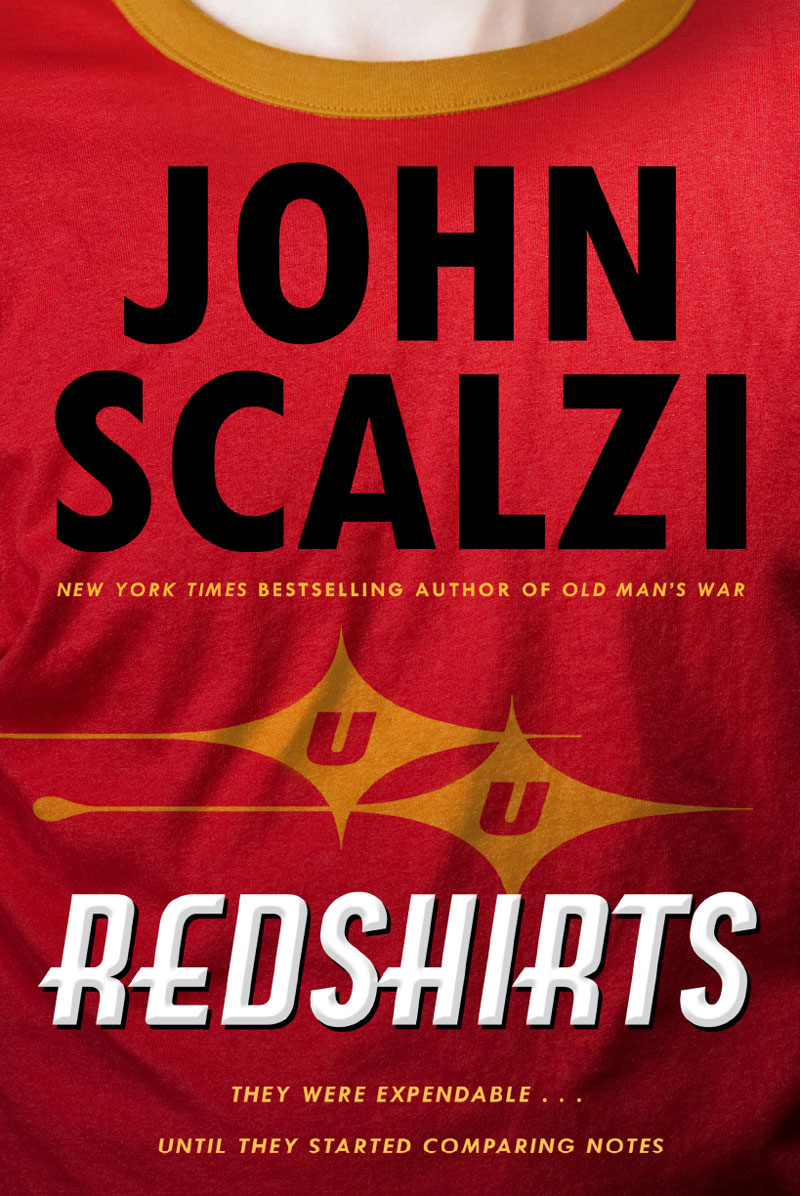
Redshirts by John Scalzi

Redshirts by John Scalzi was this year's Hugo-winning novel. I listened to the audiobook, which was narrated by Wil Wheaton. As you can probably guess from the cover and title, Redshirts pays homage to all the extras who died in Star Trek, usually while wearing a red shirt.
Ensign Andrew Dahl has just been assigned to the Universal Union Capital Ship Intrepid, flagship of the Universal Union since the year 2456. It’s a prestige posting, and Andrew is thrilled all the more to be assigned to the ship’s Xenobiology laboratory.

Life couldn’t be better…until Andrew begins to pick up on the fact that (1) every Away Mission involves some kind of lethal confrontation with alien forces, (2) the ship’s captain, its chief science officer, and the handsome Lieutenant Kerensky always survive these confrontations, and (3) at least one low-ranked crew member is, sadly, always killed.

Not surprisingly, a great deal of energy below decks is expended on avoiding, at all costs, being assigned to an Away Mission. Then Andrew stumbles on information that completely transforms his and his colleagues’ understanding of what the starship Intrepid really is…and offers them a crazy, high-risk chance to save their own lives.
Redshirts turned out to be less flippant and shallow than I had been led to expect. The universe Dahl and his friends live in is, more or less, perfectly sensible. And yet, the events surrounding the Intrepid and its senior officers are not sensible in any way. We are given a sense of this immediately from the prologue, which highlights the way characters are sometimes inexplicably driven to things they would not usually do. As the story develops we learn more about exactly why this is. In a way, the reader already knows why things are silly, but on the other hand, the exposition is not entirely straight forward. This is a more complex story than it seems on the surface.

My favourite thing about it — which should not surprise long-term readers of my blog — was the way Scalzi highlighted the sloppy worldbuilding and nonsensical physics of those sorts of science fiction sci-fi properties. The rules for the Box, which magically quantum computationally solves medical/biological problems in exactly the right amount of time, amused me particularly. So did the logic holes that baffled the characters themselves. Honestly, a novice writer could learn a lot by noting whether they do any of the things Scalzi brings up.

The subtitle of Redshirts is A Novel With Three Codas and I would be remiss if I did not mention them. After a story that puts disposable extras peripheral characters in the spotlight, the codas highlight the stories of characters on the fringes of Dahl's story, who are all touched significantly by the events of the novel, but whose stories don't fit into the main arc at all. The whole thing gets a bit meta.

Despite all the scathing commentary of the sci-fi genre, Scalzi brings a great deal of empathy and emotional significance to the tale. Even before we get to know any of the characters well, we feel bad for them. As we do get to know them better, the possibility of their deaths becomes heart-wrenching (and since they are still redshirts in their universe, it was difficult to predict who would survive a particular situation (except in retrospect). For a story that looks flippant on the surface, it was surprisingly heart-wrenching.

I have not watched much Star Trek (all I remember clearly are the two JJ Abrams movies) but as a geek the concept of a redshirt was in no way foreign to me. I expect that most geeks would enjoy Redshirts — and understand the concept — whether or not they are Trekkies. Highly recommended read/listen. People with little familiarity with sci-fi or science fiction probably won't get as much out of it, however.

4.5 / 5 stars

First published: 2012
Series: No
Format read: Audiobook
Source: Purchased on sale from Audible

Friday, 12 July 2013

The Colours of Space by Marion Zimmer Bradley

The Colours of Space by Marion Zimmer Bradley is not the first book I've read by Bradley, but it is the first I've read in several years. I listened to the LibriVox public domain recording, which is free to download from their website and from Project Gutenberg. On the other hand, compared with audiobooks read by professional voice actors, the quality of the books I've sampled from LibriVox (this one included) leaves somewhat to be desired. I suggest readers decide for themselves how problematic they find the quality (different chapters read by different people with a variety of accents). My review — henceforth — is about the story,  not the quality of the recording.

The Colours of Space was written in 1963. I think if it was written now, it would certainly be counted as YA and would probably have been written with a different tone. I'm not sure it stands up to today's market. As it is, it provides an interesting view of science (fictional) ideas from the 60s including a misconception that the title is based on.

The main character, Bart, is seventeen and has just graduated as an astro(navi)gator. When waiting to meet his father at the spaceport, a different man shows up, claiming to be his father. Bart goes along with it because he doesn't want to put the man's life in danger from the alien Lhari who have a monopoly on interstellar travel. Supposedly, this is because humans can't survive the warp drive without being in suspended animation sleep but as Bart soon learns as he becomes embroiled in interstellar events, this isn't the entire story.

The main thing, I found, which distinguished this book from more modern YA is how stupid the main character was. Of course many YA characters make stupid decisions to drive the plot along and it wasn't really that. It's more that in recent books the characters appear to be cleverer and less... emotionally ignorant. I'm not sure that's the right phrase to use, but ignorant in different ways. By contrast, I was frequently (and incredulously) frustrated by how stupidly Bart was acting. Especially when he embarked on a dangerous saving the world mission without being in possession of very many facts or reasons (to motivate him, I mean). Mind you, his fumblings in the dark were amusing at times, just not intentionally. And he did get a bit smarter and more with it as the book progressed.

An other major source of amusement for me was the outdated science. The title of the novel — The Colours of Space — refers to the stars being much more brightly coloured when seen in space, as compared with when seen from inside the Earth's atmosphere. (There's another reference there to plot elements as well, which I won't spoil, but I read the main reference as being to the multi-coloured stars.) The thing is, the phenomenon, as described in the story, is not entirely real. Yes, stars come in different colours, but those colours range from red to yellow, white and blue. There are no green stars. More on this over at my science in fiction blog.

And then there's the hilarious retro-futuristic technology. The humans of the future frequently travel between planets and, with alien help, between stars, but they can't easily transmit an image. Law enforcement is forced to rely on merely a description to catch a fugitive — not even with a name attached! And they all have papers (as in travel documents) made out of actual paper. Apparently also without photos attached, which is slightly baffling since passports have had photos since before the book was written.

But anyway, I enjoyed The Colours of Space despite its dating flaws. It was a fun story and I always enjoy seeing how science understanding has changed in science fiction. I'm not sure who to recommend it to other than other fans of retro science fiction (I certainly don't regret reading it over another audiobook). As I mentioned earlier, I'm not sure it would be entirely appreciated by a teen used to modern YA.

3.5 / 5 stars

First published: 1963. Edition read: LibriVox, 2007
Series: No.
Format read: Audiobook
Source: LibriVox

Tuesday, 18 June 2013

Breakfast of Champions by Kurt Vonnegut

Breakfast of Champions is not the first of Kurt Vonnegut's books I've read. I suspect if it had been the first book of his I encountered, I would have been rather put off. I should also mention that I listened to the audiobook of this novel and apparently the print edition includes sketches by the author, which, of course, I missed. I imagine they would have improved matters. I also find audiobooks a little tricky to properly pay attention to and I did listen to the start of this on a plane, waxing and waning in and out of consciousness... As far as the audio experience goes, I don't think I lost much, but literarily, eh, probably.

The blurb I found on Goodreads follows.
In Breakfast of Champions, one of Kurt Vonnegut’s most beloved characters, the ageing writer Kilgore Trout, finds to his horror that a Midwest car dealer is taking his fiction as truth. What follows is murderously funny satire, as Vonnegut looks at war, sex, racism, success, politics, and pollution in America and reminds us how to see the truth.
I've enjoyed Vonnegut's books in the past, particularly Cat's Cradle, Mother Night (a favourite), Galapagos, Player Piano and Slaughterhouse Five. A key character in Breakfast of Champions, Kilgore Trout, also appears in Slaughterhouse Five and Galapagos (and several other books I think) so I had a bit of a reference point coming into Breakfast. Which was a good thing because Breakfast of Champions was more self-referential and full of wank than any of his other books I've read.

In true Vonnegut style, there's a lot of philosophising about everything. He often writes in the style of describing everyday artefacts to aliens or people from the distant future. This can be surprisingly helpful on occasion to a reader born more than a decade after the book's publication. He also gives us extraneous information on many of the characters and bit players, focussing particularly on penis sizes and female measurements (as in bust, waist, hips), including the author's own penis, having written himself into the book. Yeah. Did I mention wank?

Speaking of featuring in his own book, I didn't entirely mind that section. The meta idea of author talking to his own characters and interacting with them in his book — both in the sense of "I forced him to do blah" as well as being injured in the fictional bar fight — was amusing.

The blurb claims that Breakfast of Champions is satire dealing with sex(-ism) and racism, among other things, but I disagree. While it's clearly a satire, and I suspect Vonnegut thought he was being the opposite of racist I'm not sure it stands up to time. Of course it could be worse, but readers sensitive to race issues, specifically black American issues, may wish to skip this one. (And to be fair, there are plenty of non -ist reasons to skip it as well.) Pointing out that society is racist is all well and good but then going on to unironically perpetrate some is murky at best. And I'm not sure what he was trying to do with the female characters.

All in all, this isn't the worst book I've ever read, but I don't particularly recommend it. If you're new to Vonnegut, definitely don't start here. If you're a completionist, sure go for it. Otherwise, meh. Personally, I plan to read Sirens of Titan (because I haven't yet and own a paper copy) but after that I'm not sure how much effort I'll bother making to track down more of Vonnegut's works.

3 / 5 stars

First published: 1973
Series: Not as such
Format read: Audiobook
Source: Purchased several years ago via an Audible subscription

Saturday, 12 May 2012

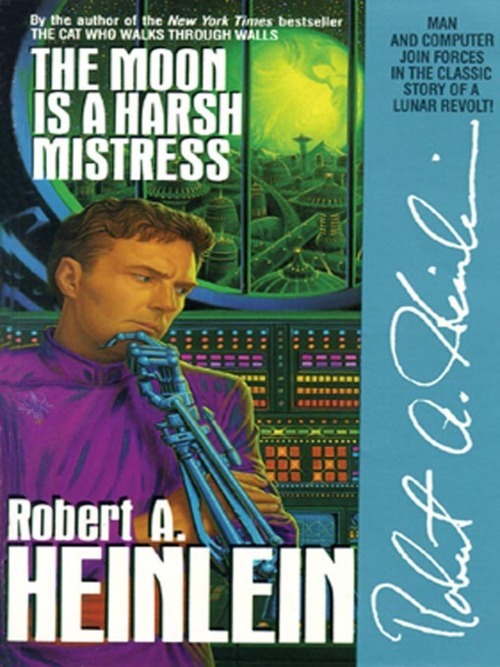
The Moon is a Harsh Mistress by Robert A Heinlein

I listened to the audiobook (from Audible) version The Moon is a Harsh Mistress by Robert A Heinlein. It wasn’t an especially pleasant experience and not just because it was so drawn out now that my commutes are only 25 minutes long.


The narrator had a really terrible accent for the main character (the book is in first person). At first I thought the character was supposed to be Italian, but that didn’t make sense in context and in the end I decided he was probably supposed to be Russian. I was able to tune out the confusing accent eventually (and he wasn’t too bad at the other voices, particularly the American and British men). ETA: Also, assuming he was supposed to be Russian, the grammatical mistakes were the wrong sort. The common mistake Russians make when speaking English is leaving out articles or the verb to be because these don’t exist in Russian. Manuel, however, was written as making different errors, which was just another grating thing I tuned out eventually.


What I had more difficulty tuning out were the casual (unintended) sexism, the politics and part of the underlying premise.


Let’s start with the premise. The moon is a penal colony; this part I don’t object to. While it would take up a lot of resources to send prisoners there, it’s not terribly different to sending them to Australia. That part’s OK. And once there, of course mining ice (for their own consumption) makes sense. What doesn’t make sense is using the moon to grow crops: mostly, but not exclusively, wheat. It’s a problem addressed in the actual story when they have issues with nutrients etc (although where the soil they’re growing in doesn’t come up, I don’t think). But the question of why start growing crops on the moon for any reason other than self-sufficiency is not addressed. Really, there’s no way it’s cheaper for Earth to do it this way.


The other part of the setup — the lunar penal colony being rule with an iron fist by a dictator-warden — I have no problem with. In those circumstances, a revolution seems inevitable sooner or later (and if they’d waited ‘til later, they would’ve run out of water to grow their crops with, among other possible issues).


As for the sexism I mentioned, it’s mostly nothing special, just a lot of “she was pretty good at [whatever] for/despite being a girl/woman”. Which got old. The societal structure of the penal colony was such that there were about twice as many men as women and this made the men more protective than usual of the women. There was no rape because if a man tried (or succeeded) to rape a woman, the other men would gang up on him, beat him, and throw him out an airlock. In a way, women had more power than real 1960s women but this was due to their scarcity rather than any inherent sense of equality of aptitudes. Unfortunate, since I think Heinlein was trying to progressive with this writing. For example, Manuel, the main character, is part of a line marriage. This is a system where more wives and husbands are added into a large family. I don’t remember exactly how big it was, but there were maybe 10 wives and “co-husbands”. (I like how the husbands had to have the co- prefix. You know, just in case they were accused of homesexuality or something, an orientation which was conspicuously absent.) The wives had more say over accepting new members into the family (they voted and in some families husbands didn’t get a say) but were still expected to do things like cook and all the housework, while the husbands had “manly work”, like farming or mining or whatnot.


The beginning of the story centres about the central control computer which has gained sentience, as Manuel discovers during his tech support duties. There are flaws in how the computer works, from a technical point of view, but given the book was published in 1966, I’m happy to ignore that. (And the fact that the physics is pretty good helps. And although some of the physiological effects of acceleration were a bit iffy, that’s another area which hadn’t been fully explored in 1966.)


After an activist peacefully-complain-about-the-warden meeting is interrupted by the warden’s men trying to kill everyone. Manuel, who was there only because the sentient computer was interested in the goings on (being a curious sentient, also interested in dissecting humour), is caught up in the crossfire and, with Wyoh, an activist from the other lunar city, escapes and goes underground. They make contact with the Professor, one of the only teachers in Luna City, and the three of them, with the computer, Mike, begin to mastermind a revolution. It ends up being managed on the line between terrorist and freedom-fighter, in my opinion. In terms of how it’s written, it’s very cerebral, with a lot of revolutionary theory and logistics thrown around.


Politically, I was a bit confused about what they wanted, other than to overthrow the warden. I mean, there was no question about overthrowing the warden, but what they wanted for a replacement government didn’t become apparent until after the revolution (which happens at roughly the half-way point). Afterwards — minor spoilers ahead, but really, not important ones — it transpired that the professor, one of the masterminds, was vehemently opposed to taxation which… yeah. I mean, sure, he was a “rational anarchist” but the whole thing, post-revolution, (not just the tax aspect) was a bit too anti-establishment for my taste. And they were a bit too blasé about bombing the Earth which didn’t seem to me to be the best way to gain recognition as a sovereign nation, but maybe that’s just my modern sensibilities talking.


The ending was kind of poignant, I’ll give it that.


Overall I wouldn’t recommend The Moon is a Harsh Mistress. I found it of interest only as a historic text and it has made me hesitant to read more Heinlein in the future. Perhaps I’ll have more luck with my next foray into new (to me) classic SF than I did with this one.


2 / 5 stars