Showing posts with label science fiction. Show all posts

Tuesday, 27 April 2021

Chaos on CatNet by Naomi Krtizer

Chaos on CatNet by Naomi Krtizer is the sequel to Catfishing on CatNet, which was an excellent book and I recommend reading it first. The short story "Cat Pictures Please", is also set in the same world and makes a nice introduction to one of the characters, though is not necessary to follow the story in the novels. Furthermore, do not be put of by the very generically US YA cover, the book inside is much more unique than the cover makes it seem.

It takes an AI to catch an AI in Chaos on CatNet, the follow-up to Naomi Kritzer's award-winning near future YA thriller.

When a mysterious entity starts hacking into social networks and chat rooms to instigate paranoia and violence in the real world, it’s up to Steph and her new friend, Nell, to find a way to stop it—with the help of their benevolent AI friend, CheshireCat.

Chaos on CatNet was an excellent read. We return to Steph, CheshireCat the AI, and their human friends, plus some newly introduced characters. Steph is now living (permanently) in Minneapolis and makes a new friend at school. Her new friend just so happens to have recently left a cult, which makes more some unexpectedly interesting and ominous reading.

Overall, Chaos on CatNet had higher stakes than the previous book, and the brewing confrontation was very menacing and disconcerting. I don't want to spoil anything, but I found the rising background tension unnerving and, which I think was the intent. It was still a compelling read, but less fluffy and comforting than Catfishing on CatNet (which had more of an isolated climax).

I enjoyed this book a lot and I would definitely read a sequel if one were forthcoming. This series has made for very unputdownable reading. I highly recommend Chaos on CatNet to fans of Catfishing on CatNet and the series generally to people who are intrigued by the concept of a cat-loving AI befriending a bunch of nerdy teenagers.

4.5 / 5 stars

First published: April 2021, Tor Teen
Series: CatNet book 2 of 2 (so far)
Format read: eARC
Source: Publisher via NetGalley

Tuesday, 2 March 2021

A Desolation Called Peace by Arkady Martine

A Desolation Called Peace
by Arkady Martine is the sequel to A Memory Called Empire, which I previously read and reviewed and which was last year's Hugo Award-winning novel. While I enjoyed the first book, I enjoyed the sequel even more.

An alien armada lurks on the edges of Teixcalaanli space. No one can communicate with it, no one can destroy it, and Fleet Captain Nine Hibiscus is running out of options. 

In a desperate attempt at diplomacy with the mysterious invaders, the fleet captain has sent for a diplomatic envoy. Now Mahit Dzmare and Three Seagrass—still reeling from the recent upheaval in the Empire—face the impossible task of trying to communicate with a hostile entity. 

Whether they succeed or fail could change the fate of Teixcalaan forever.

The central plot point is the war brewing between the Empire and mysterious aliens, only a few jump gates from Lsel Station. Our protagonists from the first book drag themselves into the thick of things and find themselves face to face with the aliens. Meanwhile, we are also introduced to two new characters — the senior fleet commander on thee front and the eleven-year-old imperial heir — who are both also excellent. I really enjoyed following all their stories and the way they ended up tying together when it came with dealing with an existential threat to human life.

After having done a lot of the heavy lifting with regards to worldbuilding in A Memory Called Empire, Martine is free, in A Desolation Called Peace, to explore other aspects of the world and characters. Some new concepts are introduced, but more of the focus is on characters and events. And while this book does follow some of the key characters from the first book and hinges on events that were set in motion in book one, both books are complete story arcs. You probably shouldn't read them out of order, but the first didn't leave us on a cliffhanger and the second had a lot more peril and a lot less poetry in it.

I really enjoyed A Desolation Called Peace, even more than A Memory Called Empire and I really hope Martine brings us more stories set in this world, even if no novel-length sequels are currently planned. I highly recommend this book to fans of space opera and space intrigue/diplomacy more generally. If you found the first book a bit slow, I think you'll enjoy this instalment more.

5 / 5 stars 

First published: March 2021, Tor Books
Series: Teixcalaan book 2 of 2 (for now)
Format read: eARC
Source: Publisher via NetGalley

A Desolation Called Peace by Arkady Martine

A Desolation Called Peace
by Arkady Martine is the sequel to A Memory Called Empire, which I previously read and reviewed and which was last year's Hugo Award-winning novel. While I enjoyed the first book, I enjoyed the sequel even more.

An alien armada lurks on the edges of Teixcalaanli space. No one can communicate with it, no one can destroy it, and Fleet Captain Nine Hibiscus is running out of options.

In a desperate attempt at diplomacy with the mysterious invaders, the fleet captain has sent for a diplomatic envoy. Now Mahit Dzmare and Three Seagrass—still reeling from the recent upheaval in the Empire—face the impossible task of trying to communicate with a hostile entity.

Whether they succeed or fail could change the fate of Teixcalaan forever.

The central plot point is the war brewing between the Empire and mysterious aliens, only a few jump gates from Lsel Station. Our protagonists from the first book drag themselves into the thick of things and find themselves face to face with the aliens. Meanwhile, we are also introduced to two new characters — the senior fleet commander on thee front and the eleven-year-old imperial heir — who are both also excellent. I really enjoyed following all their stories and the way they ended up tying together when it came with dealing with an existential threat to human life.

After having done a lot of the heavy lifting with regards to worldbuilding in A Memory Called Empire, Martine is free, in A Desolation Called Peace, to explore other aspects of the world and characters. Some new concepts are introduced, but more of the focus is on characters and events. And while this book does follow some of the key characters from the first book and hinges on events that were set in motion in book one, both books are complete story arcs. You probably shouldn't read them out of order, but the first didn't leave us on a cliffhanger and the second had a lot more peril and a lot less poetry in it.

I really enjoyed A Desolation Called Peace, even more than A Memory Called Empire and I really hope Martine brings us more stories set in this world, even if no novel-length sequels are currently planned. I highly recommend this book to fans of space opera and space intrigue/diplomacy more generally. If you found the first book a bit slow, I think you'll enjoy this instalment more.

5 / 5 stars

First published: March 2021, Tor Books
Series: Teixcalaan book 2 of 2 (for now)
Format read: eARC
Source: Publisher via NetGalley

Sunday, 14 February 2021

A History of What Comes Next by Sylvain Neuvel

A History of What Comes Next by Sylvain Neuvel is a more historic novel than I expected from the title. Most of the book is set during the end of WWII and the immediate aftermath, though there are also flashbacks to moments further back in history.

Always run, never fight.
Preserve the knowledge.
Survive at all costs.
Take them to the stars.


Over 99 identical generations, Mia’s family has shaped human history to push them to the stars, making brutal, wrenching choices and sacrificing countless lives. Her turn comes at the dawn of the age of rocketry. Her mission: to lure Wernher Von Braun away from the Nazi party and into the American rocket program, and secure the future of the space race.

But Mia’s family is not the only group pushing the levers of history: an even more ruthless enemy lurks behind the scenes.

The story here follows a mother and daughter who are from some alien(/semi-magical) line of women whose sacred duty is to make sure humanity develops space travel. So they have historically been nudging people in the appropriate scientific direction. Most recently and in the context of this book, that has involved getting Von Braun out of Nazi Germany at the end of the war and making sure the space race got started. Other plot lines were the Trackers who wanted to kill the women (for reasons that aren't very clear until the end and even then, eh) and a vague worry about climate change.

Overall, this book didn't work for me. I found it a bit dull and tedious and if it hadn't been a review book I would not have finished it. I certainly have no interest in reading the sequels. Although I don't generally mind WWII or the space race/Cold War as topics of books and media, I found their treatment incredibly uninteresting here. There were a few interesting moments but also a lot of somewhat patronising moments (e.g. frequent suggestions that humanity wouldn't get to the appropriate technological level without behind-the-scenes manipulation). The most interesting scenes were the short historic interludes, giving us snippets of history of the line of women.

I found the writing style of A History of What Comes Next to be fairly good; it was mainly the content that didn't work for me. If the above story sounds interesting to you, then I recommend picking up this book. 

3.5 / 5 stars

First published: February 2021, Tor.com
Series: Take Them to the Stars, book 1 of ?
Format read: eARC
Source: Publisher via NetGalley

Monday, 28 December 2020

Defending the Galaxy by Maria V Snyder

Defending the Galaxy
by Maria V Snyder in the third and final book in the YA Sentinels of the Galaxy trilogy. I have previously read and reviewed the first two books: Navigating the Stars and Chasing the Shadows. This is absolutely not a book/series to read out of order because each book builds heavily on discoveries made in the previous books. I strongly recommend starting with book one (Navigating the Stars) if you are new to the series.

Year 2522. Oh. My. Stars.

Junior Officer Ara Lawrence here, reporting for duty. Again. It's situation critical for the security team and everyone in the base - including my parents - with a new attack from the looters imminent, a possible galaxy-wide crime conspiracy and an unstoppable alien threat. But this all pales in the face of my mind-blowing discovery about the Q-net. Of course, no one believes me. I'm not sure I believe me. It could just be a stress-induced delusion. That's what my parents seem to believe...

Their concern for me is hampering my ability to do my job. I know they love me, but with the Q-net in my corner, I'm the only one who can help the security team beat the shadowy aliens from the pits we discovered. We're holding them at bay, for now, but the entire Milky Way Galaxy is in danger of being overrun.

With battles on too many fronts, it's looking dire. But one thing I've learned is when people I love are in jeopardy, I'll never give up trying to save them. Not until my dying breath. Which could very well be today...

Defending the Galaxy finally ties up the story of Ara, the Q-net, and the looters wreaking havoc across multiple planets in the galaxy. The second book ended with a big reveal and this one opens with Ara trying to come to terms with the new information. That really sets the stage for the rest of the book, since there are several major discoveries that shift Ara's world view. As the title suggests, the book culminates in Ara and friends (including plenty of responsible adults) defending the actual galaxy. Or, at least, a handful of planets spread throughout the Milky Way.

I enjoyed this book but it was a lot more focussed on action and railing against bad guys (and against parental restrictions) than the earlier books. Even though there were a lot of discoveries and reveals here, I felt that the mystery was less important than the battle that needed to be fought. Which certainly makes sense from a narrative point of view, but it also means that I personally enjoyed the first book in this series best, though I didn't dislike this concluding volume, to be clear.

I recommend this series to fans of YA science fiction, especially those who like the idea of space travel and galaxy-sized high stakes. If you haven't read the earlier books in the series, I recommend starting with Navigating the Stars to best lead you into the story, which escalates with each book.

4 / 5 stars

First published: December 2020, Harlequin Australia YA
Series: Sentinels of the Galaxy book 3 of 3
Format read: eARC
Source: Publisher via NetGalley

Sunday, 16 August 2020

Short stories 11 to 17 are late and disorderly

This batch of stories is an unusual number because I feel bad for posting them so late. I had plans to do a proper Hugo round-up post as I did for novellas, but for various reasons that didn't happen. So here are some of the short stories and novelettes that were shortlisted for Hugo awards.

~

The Blur in the Corner of Your Eye by Sarah Pinsker — An enjoyable mystery-ish story about a mystery writing a in cabin in the woods. Things inevitably go wrong, but it wasn’t quite the horror scenario I was expecting. I enjoyed it. Source: https://uncannymagazine.com/article/the-blur-in-the-corner-of-your-eye

The Archronology of Love by Caroline M. Yoachim — A long story about interesting far-future alien tech which records history. People interacting with said tech while trying to work out what happened to a failed colony planet. Also a sad love story. It was OK, but it didn’t really grab me. Source: http://www.lightspeedmagazine.com/fiction/the-archronology-of-love/

Omphalos by Ted Chiang — An unexpected story told in an unusual way. Almost an epistolary story, but told through prayers rather than letters. Set in a world a bit less technologically developed than ours, and following a scientist who knows exactly how long ago the world was created. And that it was created by a divine being. I enjoyed it more than I expected. Source: Exhalation by Ted Chiang

Emergency Skin by NK Jemisin — An entertaining read partially depicting a society sitting somewhere between Athos (Bujold, Ethan of Athos) and the alt-right. It’s also told in an unusual way, which works very efficiently to tell the story and highlight the horrors of that particular society. We actually only get half the story, but it’s more than enough. Source: Amazon Forward Collection

As the Last I May Know by SL Huang — An intriguing premise: weapons of mass destruction can only be set off if the president first murders a little girl. I enjoyed the story and was quite taken by both the power play and the moral questions raised. Source: https://www.tor.com/2019/10/23/as-the-last-i-may-know-s-l-huang/

For He Can Creep by Siobhan Carroll — An amusing story about a cat fighting Satan for a poet’s soul. It was not what I expected from the title, and was certainly entertaining enough. Source: https://www.tor.com/2019/07/10/for-he-can-creep-siobhan-carroll/

Blood is Another Word for Hunger by Rivers Solomon — A very weird story. Not sure what to make of it, to be honest. I didn’t hate it, but I also didn’t love it. I'm sorry that I have failed to adequately describe the weirdness of murder resulting in spontaneous births. Source: https://www.tor.com/2019/07/24/blood-is-another-word-for-hunger-rivers-solomon/


Sunday, 26 July 2020

The Relentless Moon by Mary Robinette Kowal

The Relentless Moon by Mary Robinette Kowal is the third novel in the Lady Astronaut universe. I have previously read, reviewed and enjoyed the first two books: The Calculating Stars and The Fated Sky. The Relentless Moon takes place chronologically after the first two books, but follows a different character, so it almost stands alone, aside from spoiling a lot of what went before it.

The Earth is coming to the boiling point as the climate disaster of the Meteor strike becomes more and more clear, but the political situation is already overheated. Riots and sabotage plague the space program. The IAC's goal of getting as many people as possible off Earth before it becomes uninhabitable is being threatened.

Elma York is on her way to Mars, but the Moon colony is still being established. Her friend and fellow Lady Astronaut Nicole Wargin is thrilled to be one of those pioneer settlers, using her considerable flight and political skills to keep the program on track. But she is less happy that her husband, the Governor of Kansas, is considering a run for President. 

I really enjoyed this book. The protagonist is Nicole, who I only vague remember from the earlier books, but that vagueness was not at all a problem in picking up and following this new story. There were also several recurring characters who I had stronger memories of, like Nathaniel (Elma's husband), Eugene and Myrtle, and Helen. We actually got to learn a lot more about the latter three as they became increasingly central to the plot. My absolutely favourite part of the whole book was actually the epilogue, for what it sets up for future books, but of course it is a massive spoiler so I won't say any more about it.

The story follows Nicole, one of the original lady astronauts and now governor's wife as she prepares for and then goes on another mission to the moon. But recently the astronaut programme has been experiencing more failures than usual, even though their various failsafes are keeping people safe. Given reason to believe that sabotage is afoot, Nicole spends a lot of the book investigating, while hampered by a lot of things.

It was a bit sad to see that, still, even 20 years after the first book in the series, a lot of sexist jerks remain, as well as some racist jerks, which are highlighted thanks to the diverse cast in the story. That said, it was also probably fairly realistic, as were the science deniers who don't believe in the future consequences of the meteor from book one. To counteract that, some random little things that I enjoyed about the book: Nicole living anorexia was depicted very sensitively; spies and harking back to the war; a couple of minor background characters called Armstrong and Aldrin; the general scientific/engineering rigour Kowal applies to her worldbuilding.

Overall this was an excellent read and I highly recommend it to fans of the Lady Astronaut books. Especially anyone that was hesitant to pick up a book with a new protagonist, I found Nicole to be just as compelling as Elma. To new readers, I suggest starting with The Calculating Stars to better enjoy the worldbuilding and the deviations from our real-world historical timeline. I am excitedly looking forward to the next book in the series.

5 / 5 stars

First published: July 2020, Tor
Series: Lady Astronaut, book 3 of 3 so far
Format read: eARC
Source: Publisher via NetGalley

Sunday, 21 June 2020

Short Stories #6–10, mostly Hugo shortlisted

I have not "officially" read very many short stories this year. As I think I mentioned in my last short story post, this is in large part because of reading submissions for Rebuilding Tomorrow, my new anthology, coming out by the end of the year if no more apocalypses hit. Since I, of course, can't mention those on the blog, my other reading has been rather slow. This latest batch were partly inspired by the Hugo short list, except for the first one, which just jumped out at me for being a cool story.

I plan to do some proper Hugo round ups when I've read all the relevant things, but for now, here are some of them, in the random order I read them in:


Little Free Library by Naomi Kritzer — A very cute story about a woman who built a tiny community library. It has a nice mystery and a compelling ending. I liked it a lot and I won’t be surprised if it makes next year’s Hugo ballot. Source: https://www.tor.com/2020/04/08/little-free-library-naomi-kritzer/

A Catalogue of Storms by Fran Wilde — A surreal but sweet/sad (sort of) story set in a world where storms have some degrees of sentience and certain people become incorporeal to fight them. I enjoyed it. It felt quite poetic. Source: https://uncannymagazine.com/article/a-catalog-of-storms/

Ten Excerpts from an Annotated Bibliography on the Cannibal Women of Ratnabar Island by Nibedita Sen — An interesting story told in snippets from the points of view of a variety of people. It explores colonialism, diaspora and a few other issues, with an additional off-putting layer of cannibalism. I generally find stories told through snippets interesting, but I’m not sure I can easily like them as much as traditional narratives. Source: http://www.nightmare-magazine.com/fiction/ten-excerpts-from-an-annotated-bibliography-on-the-cannibal-women-of-ratnabar-island/

And Now His Lordship Is Laughing by Shiv Ramdas — A satisfying story of revenge against colonisers, after a detailed description of some of their atrocities. I was not a fan of the narration from the Strange Horizons podcast. Source: http://strangehorizons.com/fiction/and-now-his-lordship-is-laughing/

Away With the Wolves by Sarah Gailey — An engaging enough story about a werewolf who suffers from chronic pain when human. The story was more or less about the idea that one need not torture oneself just to find acceptance in the community. I found it got a little preachy at the very end, but overall it was fine. Source: https://uncannymagazine.com/article/away-with-the-wolves


Saturday, 13 June 2020

To Be Taught, If Fortunate by Becky Chambers

To Be Taught, If Fortunate by Becky Chambers is a novella that I read because it's on the Hugo shortlist. I considered picking it up a few times before (most notably when tempted with a hard cover at Dublin Worldcon) but held back because I didn't enjoy Record of a Spaceborn Few and I thought this novella was set in the same universe. It is not, but if it were, then it would be set much earlier than the Wayfarer books (aside from the one event that distinguishes it as a separate universe).

In her new novella, Sunday Times best-selling author Becky Chambers imagines a future in which, instead of terraforming planets to sustain human life, explorers of the solar system instead transform themselves.

Ariadne is one such explorer. As an astronaut on an extrasolar research vessel, she and her fellow crewmates sleep between worlds and wake up each time with different features. Her experience is one of fluid body and stable mind and of a unique perspective on the passage of time. Back on Earth, society changes dramatically from decade to decade, as it always does.

Ariadne may awaken to find that support for space exploration back home has waned, or that her country of birth no longer exists, or that a cult has arisen around their cosmic findings, only to dissolve once more by the next waking. But the moods of Earth have little bearing on their mission: to explore, to study, and to send their learnings home.

The premie of To Be Taught, If Fortunate is quite straightforward: a small group of scientist-astronauts are on a multi-year mission to investigate four habitable planets and catalogue whatever lifeforms and other interesting things they find. The novella is basically a chronicle of their journey and the main interest in the book is the explanations of science and discovery. The background science did get a little tedious at times — especially at the start when the scene was being set — but overall there was a reasonable balance between duller background and exciting discoveries of weird things.

In coming to write this review I realised what, to me, set it apart from Record of a Spaceborn Few. Both books lack a fast-paced plot but To Be Taught, If Fortunate quickly establishes itself as an exploration log, whereas Record of a Spaceborn Few felt like things were about to happen, but then didn't. My favourite aspect of To Be Taught, If Fortunate is that just as I assumed nothing especially exciting would happen, something unexpected did happen. I wouldn't call it fast-paced, by any stretch of the imagination, but it worked for me. Because of this novella, I will consider reading more books from this author, which was not my stance before reading it.

Overall I enjoyed To Be Taught, If Fortunate, despite a bit of a slow start. I recommend it to readers who enjoy exploration narratives, and slower-paced stories. I think fans of Long Way To a Small Angry Planet will also enjoy To Be Taught, If Fortunate, although they are quite different books when it comes to the depth of characters (since there is less time in a novella to develop and evolve an ensemble of characters). I have not finished reading the Hugo novellas, but I expect this one will rate well.

4 / 5 stars

First published: 2019, Hodder & Stoughton / Harper Voyager
Series: No (not yet?)
Format read: PDF
Source: Hugo voter packet

Tuesday, 12 May 2020

T.I.M.E Stories by Christophe Lambert

A bit of a change of pace for this review. Some time ago, I reviewed a story-based board game called T.I.M.E Stories, or, more accurately, the first scenario in the T.I.M.E Stories series. Since then, my husband and I have played through all the T.I.M.E Stories scenarios as they were released. We liked some more than others and are moderately invested in the overarching story — we would be even more invested if it were better written and plotted. That's theoretically where today's book review comes in. To go with a reboot/upgrade of the game story (the gaming system changed), there is a new novelisation of the story. I was a bit sceptical of it when I first heard about it, since the writing in the games itself has been patchily translated (from French, as has this book). But my husband was very enthused and wanted to read it, so I have let him write the review, which is what you'll find in the rest of this post.

It is the year 2468. Spotted by a recruiter, Tess Haiden passed the many tests required to join a highly secretive organisation with flying colours. But she is in for a shock: T.I.M.E Agency has been sending agents through time for several years. Thanks to considerable resources, they prevent anomalies and paradoxes by dispatching their agents to different eras and places around the world. But over the course of her many missions, Tess learns that they are not the only ones using these time corridors, and she begins to wonder about the true nature of the T.I.M.E agency… 

This book is based on the Time stories series of board games. Some background is necessary here, the games are classic adventure games in a box, where the players travel back in time to a scenario where they have to solve problems with the timeline. A number of adventures have been released and the developers recently changed the system, separating the old games into what they call the white cycle and starting the new white cycle.

The main draw of this book is that it helps bridge the gap between the white cycle and the blue cycle of the board game time stories. It mostly serves to introduce the main characters in the new cycle, while explaining some of the unexplained mysteries. If you want to know who all the new characters are in the new games, read this book. If you haven’t played time stories or don’t care enough about the storyline, probably give this book a pass.

The prose is a little strange, with excessive detail used when setting the scene. This is useful in a game where these details are clues, but just slow down the book. There were often asides that didn’t add anything to either the story or the characters.

When the characters were time travelling, a lot of the pressure came from the arbitrary time limit enforced on time travel missions. This is an important part of the game, but doesn’t work so well in a book. A lot of the first mission in particular had the characters constantly updating each other on how much time was left rather than what they were doing.

I’m happy I read this book to get a better understanding of the time stories setting, but that’s the only reason I have to recommend this book.

2.5 / 5 stars

First published: May 2020, Angry Robot
Series: Not yet
Format read: eARC
Source: Publisher via NetGalley

Sunday, 3 May 2020

Network Effect by Martha Wells

Network Effect by Martha Wells is the first novel about the adventures of Murderbot, who previously appeared in four novellas that I read, enjoyed and reviewed: All Systems Red, Artificial Condition, Rogue Protocol and Exit Strategy. Network Effect follows on from these novellas in a similar vein but in a longer format, meaning there’s even more Muderbot to enjoy in one convenient package. It also has a rather unusual format for its blurb:

You know that feeling when you’re at work, and you’ve had enough of people, and then the boss walks in with yet another job that needs to be done right this second or the world will end, but all you want to do is go home and binge your favorite shows? And you're a sentient murder machine programmed for destruction? Congratulations, you're Murderbot.

Come for the pew-pew space battles, stay for the most relatable A.I. you’ll read this century.


I’m usually alone in my head, and that’s where 90 plus percent of my problems are.

When Murderbot's human associates (not friends, never friends) are captured and another not-friend from its past requires urgent assistance, Murderbot must choose between inertia and drastic action.

Drastic action it is, then.

If you've read any of the Murderbot novellas, you'll have a pretty good idea of what to expect from this book. The biggest difference I found between novel and novellas is the length of the novel. It felt different — in a good way — to have the story just keep going longer than the novellas had trained me to expect. It also made for a meatier story, with a more complex plot and more substantial room for character development. We also got more of a chance to better get to know characters other than Murderbot. In particular, we see a lot more of a subset of the humans from Preservation, where Murderbot went to live at the end of Exit Strategy, and a few others I don't want to spoil. Hearing the humans have all sorts of benign opinions regarding Murderbot was excellent.

I remember reading, around the time that this novel was announced, that it would be continuing the story of Murderbot but would also tie everything up in a conclusive way. It certainly follows on from the novellas — I don't recommend starting with Network Effect, rather go start with All Systems Red — but aside from containing a complete story arc, I didn't really feel like this was a conclusive end to the tales of Murderbot. If anything, it seemed that the end was left nicely open for a sequel featuring Murderbot and some of its new friends. So I hope that happens.

It wouldn't be a Tsana-review if I didn't mention my one physics objection in the book. A lot of the technology and computer/AI stuff is bordering on the fantastical in an expected far-future way, and that stuff doesn't bother me. But there was one "WTF, no, that's not how space elevators work" moment which annoyed me for about five minutes before I was able to move on and pay attention to the story again. At least it was comparatively minor in the scheme of the book.

Network Effect was an excellent book in which Murderbot kicked a lot of arse and got to form/build on meaningful relationships with multiple people. If this sounds like your sort of thing, and if you've read the Murderbot novellas, then I highly recommend picking up this book. If this sounds like your sort of thing and you haven't read the novellas, I suggest starting with All Systems Red. I really hope there will be more Murderbot in the future. I am also planning to reread all the novellas at some point, because reading them as they came out resulted in a lot of memory gaps, though nothing I couldn't work out easily enough in the context of the novel. I'd still like to experience the whole early story in a more continuous way.

5 / 5 stars

First published: May 2020, Tor.com
Series: Yes. Fifth instalment of the Murderbot Diaries, and let's hope there are many more to come.
Format read: eARC
Source: Publisher via NetGalley

Thursday, 23 April 2020

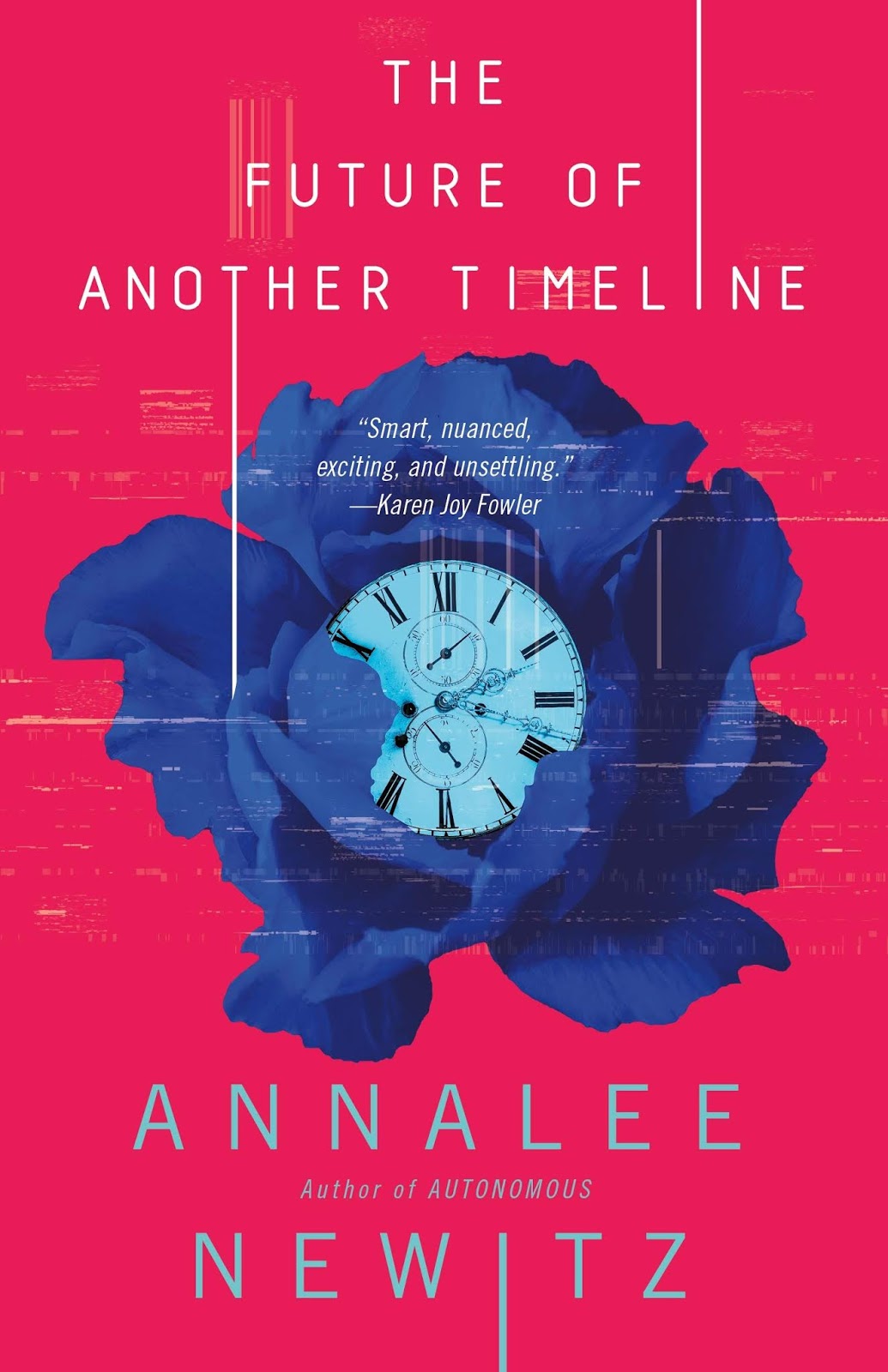
The Future of Another Timeline by Annalee Newitz

The Future of Another Timeline by Annalee Newitz is a time-travelling science fiction novel. I picked it up based on the promise that there would be both time travel and lesbians, though it turned out to be more diverse than just that description implies.

1992: After a confrontation at a riot grrl concert, seventeen-year-old Beth finds herself in a car with her friend's abusive boyfriend dead in the backseat, agreeing to help her friends hide the body. This murder sets Beth and her friends on a path of escalating violence and vengeance as they realize many other young women in the world need protecting too.

2022: Determined to use time travel to create a safer future, Tess has dedicated her life to visiting key moments in history and fighting for change. But rewriting the timeline isn’t as simple as editing one person or event. And just when Tess believes she's found a way to make an edit that actually sticks, she encounters a group of dangerous travelers bent on stopping her at any cost.

Tess and Beth’s lives intertwine as war breaks out across the timeline--a war that threatens to destroy time travel and leave only a small group of elites with the power to shape the past, present, and future. Against the vast and intricate forces of history and humanity, is it possible for a single person’s actions to echo throughout the timeline?

I am still internally screaming about something in this book I can't even talk about here because it is a massive spoiler.
😱 😱 😱
OK, I found some people to talk it over with, so that's out of my system now. Moving on to the actual review.

As you might expect from a book about time travel, there are a couple of story threads in this book, though they get a little more tangled up than non-time travelling flashback sequences tend to. We have Tess, who is from the near future and working with a secret feminist cabal to stop misogynists from editing women's rights out of the timeline (loosely speaking). She travels to various times, with a particular focus on 1892-3 with regards to her research and secret mission. And then in the 1990s we have some punk rock teenage girls living their slightly crappy lives and going to gigs, as seen through the eyes of Beth, one of the teens.

The 1990s storyline serves to highlight the differences between the starting timeline and the parallel world that we, the readers, live in. It also sets up a background for Tess and people like her, especially when Tess starts trying to change her past by illegally travelling to the 1990s. This is tangentially related to my internal screaming above.

But the overarching story is about fighting for rights and the methods by which history is made/changed. An ongoing debate in the book concerns the efficacy of collective action vs the Great Man theory; whether history can be changed incrementally and/or whether killing Hitler actually does anyone any good. But this is more a book about the characters, mostly women, looking out for each other, no matter the time period. If that's your jam, then this may well be the book for you.

Overall I really enjoyed this book. Some parts of it took my by surprise and there was more violence than I expecting going in, but it was violence born out of the anger of the oppressed as much as anything else, and the book was very much in conversation with the justification, or not, of some forms of violence. While there might be a bit of a squick factor associated with some of the violence, I thought it was explored thoughtfully in the book as a whole.

I highly recommend The Future of Another Timeline to fans of time travel and/or feminism. This is the first thing I've read by Annalee Newitz and I am interested in picking up more of their work in the future.

4.5 / 5 stars

First published: 2019, Tor Books
Series: No
Format read: ePub
Source: Purchased from Kobo

Friday, 3 April 2020

Short stories (1–5), a seemingly slow start, amidst much hidden reading


So this is my first #ReadShortStories post of 2020. April might seem a bit late, but in defence of my short story reading consistency, I would like to point out that until the end of March I was reading a large number of stories that were submitted to Rebuilding Tomorrow. So any time I thought about reading a short story that wasn't a submission, I felt guilty. But that's over now. The submissions have all been read and responded to (either with a rejection or a hold request, bending a higher level of global stability — if you submitted something but didn't hear back, feel free to query).

Which brings me to this first batch of stories. Without further ado:

~

Did We Break the End of the World? by Tansy Rayner Roberts — Reread in aid of editing a sequel story that will be appearing in Rebuilding Tomorrow. Source: Defying Doomsday edited by Tsana Dolichva and Holly Kench

The Frost on Jade Buds by Aliette de Bodard — A story of mindships, the threat of war and galactic foreigners. I didn’t get into this story as easily as I have some of the other Xuya stories. Source: The Dragon that Flew Out of the Sun by Aliette de Bodard

Meat Cute by Gail Carriger — A novelette prequel to the novel Soulless. You don’t have to have read Soulless or the Finishing School books to appreciate this story… but I do think it would help a lot. It’s cute and funny, as one expects from Carriger, and follows Alexia on the night of her very first meeting with Connal. Source: Stand-alone purchase

Inheritance by Emma Newman — An emotional slice of a character’s life, set before the events in Planetfall. A good read, but probably not as impactful if you haven’t read Planetfall. Source: Emma Newman’s newsletter

The Generation Gap by Emma Newman — A significant story (not a vignette) about a father who is worried that there’s something wrong with his kid. I loved the reversal and the plausibility of the resolution. I think it’s my favourite story of this series. Source: Emma Newman’s newsletter

Sunday, 9 February 2020

Maternal Instinct by Rebecca Bowyer

Maternal Instinct by Rebecca Bowyer is a near future science fiction novel that examines a future in which the process of having children is highly regulated in Australia. The extreme system could be read as either dystopian or utopian, depending on you point of view, but the plot pushes it towards dystopian.

Australia 2040. No child lives in poverty and every child is safe. But at what cost?

19-year-old Monica never wanted a baby but the laws require her to give birth twice before she can move on with her life.

Now that her first son, Oscar, has arrived she's not so sure she wants to hand him over to be raised by professional parents: the Maters and Paters.

When Monica turns to her birth mother, Alice, for help, she triggers a series of events that force Alice to confront her own dark past. Alice must decide - help her daughter break the law, or persuade her to accept her fate and do what's best for the nation's children?

The two protagonists in this book are Monica, 19 and currently in the breastfeeding for six months portion of her national service, and her biological mother, Alice, who is 40 and just returning to work after time off for cancer treatment. The book alternates between the two women's perspectives, giving us a broad view of the future society. The fact that Alice works for the government department in charge of reproduction and genetic diversity allows us to see a couple of different governmental views on the system. And of course, when things start to go not according to plan, that very same government position is the cause of extra tension.

I found the social worldbuilding presented in this novel interesting but also sort of implausible. All the events that took place in the context of a society where children were raised communally more or less made sense, but I couldn't quite fathom how, in just twenty years, society would get to that point. Also, the book leaned into the horror of having to give up your babies after six months to be raised by professional parents (with biological parents allowed to visit them on Sundays). But for me the more horrific thing was being forced to bear children at 19ish. In the book we see this situation as the status quo, but I cannot imagine that the first set of kids being forced into maternity homes after graduating high school would have gone quietly. On the bright side, young men also had to do baby-related national service with their roles involving doing all the cooking and cleaning for the expectant and young mothers in their maternity homes. That aspect I can get behind. But the rest was a bit off-putting.

Overall, I found aspects of this novel interesting, but found that it was a bit slow to keep me consistently excited about the ideas in it. While the plot definitely engaged with the worldbuilding, it didn't quite go far enough, in some aspects, for my personal tastes. I don't think I've read a dystopian novel where the unusual baby-making practices were due to social pressures only (and not some sort of infertility plague), so it is an interesting concept from that perspective. But of course others might feel differently. I recommend reading this book if the blurb and premise sound interesting.

3.5 / 5 stars

First published: Story Addict, 2019
Series: Don't think so
Format read: eARC
Source: Author via NetGalley

Tuesday, 17 December 2019

Short stories after a long break (111 to 115)

It has been quite some time since I blogged any short story reviews. This is mainly because I stopped reading as much of anything, as you might have noticed from my infrequent blog posts. Part of that is due to reading submissions for Rebuilding Tomorrow, but also because of focussing on other things in my spare time 🤷‍♀️

Anyway, the stories below were read in July, September and December. I am hoping there will be a few more of these review posts before the end of the year, but we'll see.

~

The Fermi paradox Is Our Business Model by Charlie Jane Anders — Aliens come across a mostly destroyed Earth, bicker amongst themselves and make choices their bosses will probably disapprove of. I was entertained and amused. Source: Six Months, Three Days, Five Others by Charlie Jane Anders

The Dangerous Choice by Emma Newman — A vignette about a character from After Atlas. I suspect there’s some interesting nuance I missed because it’s been too long since I read the book. Source: Emma Newman’s newsletter

They Keep Killing Astra by Tansy Rayner Roberts — Another short story set in the Cookie Cutter Superhero universe. I still love the Australianness of the setting. This was an interesting story and addition to the cannon but I wanted more! It ended with more questions than answers. Definitely looking forward to the promised final story in this world, which I’m hoping will provide answers. Source: Tansy Rayner Roberts’s Patreon

I Am Not the Hive Mind of Transetti Prime by Steven Fischer — A particularly poignantly written flash piece. I enjoyed it. Source: https://www.nature.com/articles/d41586-019-02420-y

As Good As New by Charlie Jane Anders — This was a brilliant and somewhat absurd story about the end of the world and the best way to resolve the apocalypse. I really enjoyed it and the many facets that made up the story (I don’t want to be more specific because spoilers). Source: Six Months, Three Days, Five Others by Charlie Jane Anders

Sunday, 15 December 2019

Dragon Pearl by Yoon Ha Lee

Dragon Pearl by Yoon Ha Lee is a space fantasy book aimed at younger readers. It's the first in a series and is entirely unrelated to Yoon Ha Lee's other books, which are adult science fiction. I don't generally read much middle grade, but I picked this one up mainly because of the author. I'd say its also at the older end of the category: the protagonist is thirteen years old, but spends much of the book pretending to be sixteen, so there is a bit of a YA feel to it as well.

THIRTEEN-YEAR-OLD MIN comes from a long line of fox spirits. But you'd never know it by looking at her. To keep the family safe, Min’s mother insists that none of them use any fox-magic, such as Charm or shape-shifting. They must appear human at all times.

Min feels hemmed in by the household rules and resents the endless chores, the cousins who crowd her, and the aunties who judge her. She would like nothing more than to escape Jinju, her neglected, dust-ridden, and impoverished planet. She’s counting the days until she can follow her older brother, Jun, into the Space Forces and see more of the Thousand Worlds.

When word arrives that Jun is suspected of leaving his post to go in search of the Dragon Pearl, Min knows that something is wrong. Jun would never desert his battle cruiser, even for a mystical object rumored to have tremendous power. She decides to run away to find him and clear his name.

Min’s quest will have her meeting gamblers, pirates, and vengeful ghosts. It will involve deception, lies, and sabotage. She will be forced to use more fox-magic than ever before, and to rely on all of her cleverness and bravery. The outcome may not be what she had hoped, but it has the potential to exceed her wildest dreams.

Dragon Pearl follows Min as she sets out on an illicit adventure to find out what really happened to her brother. She sets off with almost nothing other than her fox-based shape-shifting magic and magical Charm, and finds herself very far away from her home planet. It was a fun space adventure involving morally ambiguous adults, new friends and dangerous situations. I enjoyed it a lot and I look forward to any sequels that may be forthcoming. Although the story is quite self-contained, it sets up a possible series and I definitely want to read those other stories.

As well as not being a big middle-grade reader, I also tend to steer away from space fantasy books, having been burned a few times before. To be honest, I wasn't sure how strong the fantasy element would be before I started reading, but I was assuming it would mostly be science fiction. It is set on other planets and in space, so it's science fiction if that's your definition of it. But the world building is very deeply steeped in Korean folklore and the associated magic. The story very prominently involves shapeshifting supernaturals and ghosts, and the titular pearl is a magical terraforming device. This worldbuilding worked for me very well. It felt very consistent — perhaps because it's directly based on real mythology rather than being entirely fictional. (I am trying very hard not to name the authors that previously ruined magic in space for me, can you tell?)

I highly recommend Dragon Pearl to fans of science fiction and fantasy, especially space adventures. Readers who are already fans of Korean folklore, or just want to learn more about it, will also find much to like here. I hope I will have the opportunity to give this book to my niece before she outgrows it.

4.5 / 5 stars

First published: January 2019,  Rick Riordan Presents (Disney)
Series: book 1 of ? (I thought I saw the second book announced, but I am failing to find any info right now)
Format read: ePub
Source: Purchased from Kobo store

Thursday, 28 November 2019

Chasing the Shadows by Maria V Snyder

Chasing the Shadows by Maria V Snyder is the second book in the Sentinels of the Galaxy (I assume) trilogy. I have previously read and reviewed the first book, Navigating the Stars, of this YA SF series. It is the kind of series I discourage reading out of order. Also, the blurb below contains spoilers for the first book.

Year 2522. Lyra Daniels is dead. Okay, so I only died for sixty-six seconds. But when I came back to life, I got a brand new name and a snazzy new uniform. Go me! Seriously, though, it's very important that Lyra Daniels stays dead, at least as far as my ex-friend Jarren, the murdering looter, knows.

While dying is the scariest thing that's happened to me, it morphed my worming skills. I can manipulate the Q-net like never before. But Jarren has blocked us from communicating with the rest of the galaxy and now they believe we've gone silent, like Planet Xinji (where silent really means dead).

A Protector Class spaceship is coming to our rescue, but we still have to survive almost two years before they arrive - if they arrive at all. Until then, we have to figure out how to stop an unstoppable alien threat. And it's only a matter of time before Jarren learns I'm not dead and returns to finish what he started.

There's no way I'm going to let Jarren win. Instead I'll do whatever it takes to save the people I love. But even I'm running out of ideas...

Chasing the Shadows picks up not long after Navigating the Stars left off. Our protagonist, Ara, is now training as part of the security team and the planet Yulin is still cut off from the rest of humanity and still under threat from violent raiders. Ara's job is to learn to spar and shoot, get her fitness up and, most crucially, find a way to communicate with the outside world.

What I enjoyed most about the first book is still present here — interesting worldbuilding and an interesting mystery surrounding the terracotta warriors which have been left on planets throughout the galaxy. We get to learn more about the warriors in Chasing the Shadows, which I enjoyed. That and Ara's explorations of the Q-net (magic quantum internet) were the most interesting. I was less invested in her relationship, which is well-established now and not a significant source of drama. There's nothing wrong with the relationship, per se, I just felt like the bouts of making out were slowing down the story a bit.

I wouldn't be me if I didn't comment on the physics in this, a science fiction novel. It's mostly fine. There was one bit where a basic (high school-level) explanation was not at all up to scratch but, a little confusingly, the implementation of the information was OK. So overall, only one short section annoyed me, which I'll call a win.

I enjoyed Chasing the Shadows and I'm looking forward to reading the next book when it comes out, presumably next year. There's a few fun reveals throughout the latter part of this book, which promise for a high stakes conclusion to the story. I recommend the Sentinels of the Galaxy series to fans of science fiction and YA.

4.5 / 5 stars

First published: November 2019, Harlequin YA (AU)
Series: Sentinels of the Galaxy, book 2 of (I'm guessing) 3
Format read: eARC
Source: Publisher via NetGalley

Tuesday, 19 November 2019

Catfishing on CatNet by Naomi Kritzer

Catfishing on CatNet by Naomi Kritzer is a YA novel set in the world of the short story "Cat Pictures, Please", which does not require previous knowledge of that story to enjoy. This was an excellent book which I accidentally started reading and then didn't put down until 4 am, several months before its release date. Whoops.

My two favorite things to do with my time are helping people and looking at cat pictures. I particularly like helping people who take lots of cat pictures for me. I have a fair amount of time to allocate: I don’t have a body, so I don’t have to sleep or eat. I am not sure whether I think faster than humans think, but reading is a very different experience for me than it is for humans. To put knowledge in their brains, humans have to pull it in through their eyes or ears, whereas I can just access any knowledge that’s stored online.

Admittedly, it is easy to overlook knowledge that I technically have possession of because I’m not thinking about it in the moment. Also, having to access to knowledge doesn’t always mean understanding things.

I do not entirely understand people.

As if an endearing AI wasn't enough, this book's human protagonist also has an excellent voice, turning this book into quite a page-turner. The story mainly focusses on Steph, who moves around a lot with her mother and hence doesn't have much chance to make friends in meatspace, instead forming her closest friendships online. Starting at yet another crappy school, Steph finally does make some friends and this sets off a complicated chain of events which results in a very high-stakes climax.

It's just as well this book is written in an extremely up-beat tone, because it deals with some pretty heavy issues, mostly surrounding domestic violence and the appalling state of the US education system (near-future or not) but also with passing nods to racism. It would have been a very depressing read if it wasn't funny — and if we didn't have the AI as a bit of a wildcard to mix things up.

Catfishing on CatNet is an excellent book and I highly recommend it to all fans of science fiction — especially AI — and YA. If you want to get a feel for the book without committing to it, the short story "Cat Pictures Please" will give you a very good idea of the tone, even if it's about the AI rather than Steph. This is a completely self-contained read but there is potential for sequels or spin-offs. I would be more than happy to read more stories about any of the characters in this book.

5 / 5 stars

First published: November 2019, Tor Teen
Series: Maybe? Same world as "Cat Pictures Please" but a self-contained story with a potential hook for a sequel
Format read: eARC
Source: Publisher via NetGalley

Thursday, 10 October 2019

Before the Coffee Gets Cold by Toshikazu Kawaguchi

Before the Coffee Gets Cold by Toshikazu Kawaguchi is a short-ish novel of time travel, told in four parts. Originally published in Japanese, it was recently translated into English. I picked it up because the time travel aspect interested me.

In a small back alley in Tokyo, there is a café which has been serving carefully brewed coffee for more than one hundred years. But this coffee shop offers its customers a unique experience: the chance to travel back in time.

In Before the Coffee Gets Cold, we meet four visitors, each of whom is hoping to make use of the café’s time-travelling offer, in order to: confront the man who left them, receive a letter from their husband whose memory has been taken by early onset Alzheimer's, to see their sister one last time, and to meet the daughter they never got the chance to know.

But the journey into the past does not come without risks: customers must sit in a particular seat, they cannot leave the café, and finally, they must return to the present before the coffee gets cold . . .

This is one novel but it's divided into four parts, each focussing on a different character, albeit with a lot of overlap. The story is set almost entirely in a cafe with timeless decor that has an urban legend attached to it: time travel is possible inside the cafe. Whenever customers ask about travelling back in time, however, they are quickly put off by the very restrictive rules presented to them. Before the Coffee Gets Cold is about four people who did not let the restrictive rules stop them.

This was a very gentle and character-driven read. In each section, we get to know a particular character and their motivations for wanting to time travel. And, arguably most interestingly, their reasons for accepting the limitation of the cafe's time travel capabilities. The book was written in a nuanced but not overly-dramatic tone. Although I usually prefer plot-driven and/or drama-filled stories, I found myself keen to pick this one up again each evening.

I enjoyed Before the Coffee Gets Cold and I recommend it to anyone looking for a different sort of time travel story. I've heard it has been made into a (Japanese) movie called Cafe Funiculi Funicula and I'm interested in watching it as well, though I'm not sure how easy it will be to get my eyes on.

4 / 5 stars

First published: September 2019, Picador (Japanese version first published in 2015)
Series: No
Format read: eARC
Source: Publisher via NetGalley

Tuesday, 16 July 2019

Memento by Amie Kaufman and Jay Kristoff

Memento by Amie Kaufman and Jay Kristoff is a prequel novella set in the Illuminae Files world. I have previously reviewed the first two books in the series, Illuminae and Gemina. While I have read the third book, Obsidio, I have not reviewed it since I did not get a chance to read the final fancy typeset version, which is now on another continent. (I read an earlier version for science-checking purposes.) The printed booklet version of Memento is the only version I have read and came as a preorder bonus for the authors' new book.

December, 2574. Forty-three days before the BeiTech attack on Kerenza IV.

This is the story of my first friendship.

This is the tale of my first murder?

Some monsters are born.

But I?

< ERROR >

I was made.

I won't say this was a fun read per se, but as with the main books in the series it was presented in a fun way, with transcripts of conversations and a few pages of strange word art. I did not think I remembered the main characters (other than AIDAN) from the main series and, given the series, it was not hard to guess the shape of the ending. I enjoyed the new protagonist, Olivia, who had an interesting story arc.

Memento does not contain any significant spoilers for the series. Being a prequel meant that certain events were set in stone, but we did see them from a new perspective. The events that overlap between the novella and the first book, Illuminae, happen near the very start of Illuminae, so I would not consider them to be spoilers. It's reasonable read for someone wanting a sampler of the series (although it might not be easy to obtain — I'm not entirely sure how broadly it will ultimately be distributed).

This was an interesting read and I recommend it to fans of the Illuminae Files as well as new readers who can get their hands on it. It's a reasonable introduction to the series, and is a quick and self-contained read. I also like the way in which it was presented — although I generally prefer ebooks, the unique formatting of this series lends itself better to print and the staple-bound booklet of Memento was kind of cute.

4.5 / 5 stars

First published: Alfred A Knopf (US), 2019
Series: Illuminae Files, prequel/volume 0.5
Format read: Paper!
Source: Preorder bonus with Aurora Rising