Showing posts with label fairies. Show all posts

Sunday, 4 December 2022

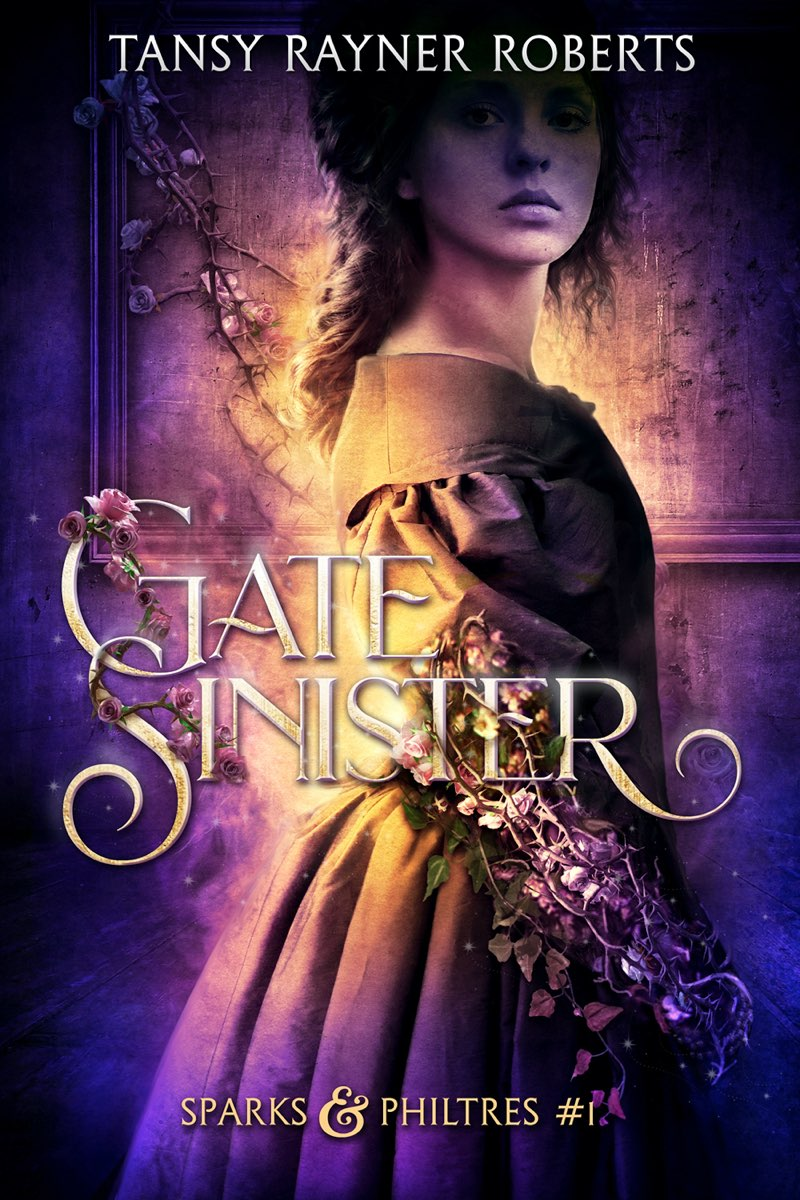
Gate Sinister by Tansy Rayner Roberts

Gate Sinister by Tansy Rayner Roberts is the first in the new novella series, Sparks and Philtres. It's set in a fae and magic secondary world based loosely on Victorian Britain (but with a Queen Isolde instead of Victoria).

Disguised as a governess, the last fairy in Britannia infiltrates the household of the Gloucester family to fulfil a vital mission on behalf of her exiled people.

On the run after offending the Royal family, two infamous magical engineers set out to commit the crime of the century on behalf of a wicked enchantress.

For one night only, the Gate Sinister can be opened between worlds, clearing the way to the long-lost Forest of Arden. For one night only, all things are possible…

This was an enjoyable and reasonably quick read. The story follows two sets of characters and it took me a little bit longer to warm to the second set, as is often the case with any piece of fiction; we get attached to the first characters we meet and then want to get back to their story as soon as possible! Of course, once both threads of the story started to come together, I found myself enjoying both sides of the narrative.

I appreciated that this novella stands alone fairly well. It does a lot of worldbuilding for later stories (I assume), but the story itself is self-contained. While our characters decide at the end to go off to do various things, it's not entirely obvious (to me, anyway) what story or path the next novella in the series will follow. That said, there are a lot of interesting possibilities and I am up for reading a story about any of them and curious about where the author will take the series.

Gate Sinister is an interesting start to what promises to be an enjoyable series. It is generally lighthearted but contains some darker themes and choices for the characters. It's a case of things getting darker the more you dwell on them, so there are some layers to the story and worldbuilding. I recommend Gate Sinister to fans of fairies, the ethics of love spells and novellas.

4 / 5 stars

First published: January, 2023
Series: Sparks and Philres, book 1
Format read: eARC
Source: the author
Disclaimer: Although the author is a friend, I have endevoured to write an unbiased review.

Thursday, 12 April 2018

Under the Pendulum Sun by Jeannette Ng

Under the Pendulum Sun by Jeannette Ng is the author's debut novel and a somewhat strange read on a few fronts. It's a gothic Victorian novel about missionaries sent to fairyland. Content warning for the book: non-coercive incest (but it's not mentioned again in this review because spoilers).

Catherine Helstone's brother, Laon, has disappeared in Arcadia, legendary land of the magical fae. Desperate for news of him, she makes the perilous journey, but once there, she finds herself alone and isolated in the sinister house of Gethsemane. At last there comes news: her beloved brother is riding to be reunited with her soon - but the Queen of the Fae and her insane court are hard on his heels.

I have to admit when this book first came to my attention I wasn't sure that I would enjoy it. I'm not a huge fan of non-humorous Victorian books and I've recently been drawn more to science fiction, so I did not immediately jump on the book. Instead I picked it up when it was on sale. As it turned out, I mostly enjoyed Under the Pendulum Sun, but "weird" is certainly a primary descriptor for it.

The story follows Catherine, who convinces the mission organisation that sent her brother as a missionary to Arcadia, the land of the fae, to send her after him when he hasn't been heard from for a while. We follow Catherine as she makes the journey to Arcadia (which requires getting lost along the way — and, to my amusement, is a land discovered by Captain James Cook, who also died there — and the weirdness she finds there. I particularly liked the titular pendulum sun: the sun in Arcadia is not the ordinary Earthly sun but rather a lantern on a pendulum that swings back and forth across the land. Distance isn't measured in the time taken to complete a journey, but rather the number of revelations or childhood memories one experiences along the way. And of course, the fae are not terribly nice people, but this last assertion is hardly unique.

Seeing a dark fairyland through the lens of devout christianity, and especially from the angle of trying to convert people, was really interesting. I'm not particularly into religion, but this was an aspect that really worked for me. Overall, I mostly enjoyed this book, but I found the various quotes at the starts of chapters slowed down the pacing of the story a little bit too much for me. The quotes themselves were often interesting in how they twisted real-world ideas or developed the world, but a lot of the time I also felt like the bogged down the main story too much. I was tempted to skip them, but they did add to the book overall (and there were a few particularly important ones near the end). I found myself enjoying the main prose sections a lot more although I did wonder at times where the story was going. The answer to that became a bit less mysterious once I realised that this was actually a character-driven book rather than a plot-driven one as I had originally assumed. The story is not in the sequence of events, per se, but in the characters internal journeys over a period of time (and the external journeys are very much a manifestation of the internal).

I would highly recommend Under the Pendulum Sun to fans of fantasy who enjoy having religious ideas entwined in their fiction. As the book itself proclaims a lot (notably in the dedication), it deals with apocrypha and as well as the fraught task of trying to convert fae to Christianity. I also recommend it to fans of gothic fantasy. I still have complicated feelings about this book but I am at least interested to see what else the author comes up with. (I'm not sure how eagerly I'd jump at a sequel, though.)

4 / 5 stars

First published: 2017, Angry Robot
Series: No
Format read: ePub
Source: Purchased from Kobo

Sunday, 25 June 2017

Rosemary and Rue by Seanan McGuire

Rosemary and Rue by Seanan McGuire is the first book in the rather long (ten books and counting, not to mention a large pile of short fiction) October Daye series. I picked it up because the series has been shortlisted for the inaugural Best Series Hugo Award, and because I've been wanting to read more of McGuire's back catalogue.

October "Toby" Daye, a changeling who is half human and half fae, has been an outsider from birth. After getting burned by both sides of her heritage, Toby has denied the Faerie world, retreating to a "normal" life. Unfortunately for her, the Faerie world has other ideas...

The murder of Countess Evening Winterrose pulls Toby back into the fae world. Unable to resist Evening's dying curse, which binds her to investigate, Toby must resume her former position as knight errant and renew old alliances. As she steps back into fae society, dealing with a cast of characters not entirely good or evil, she realizes that more than her own life will be forfeited if she cannot find Evening's killer.

In many ways, this is a pretty standard kind of urban fantasy book; set in modern times, with a slightly but not too magical heroine who is (was) a private investigator and has to solve a supernatural murder. That doesn't mean it's a bad read and many of the details made this quite an enjoyable read for me. For one thing, there wasn't much of a romantic plot line, always a plus. (I still remember an urban fantasy I read where the hero apparently smelled of pine air-freshener and I am still not over the grossness.) It deals sensibly with themes of abuse and incorporates lots of different mythologies in the worldbuilding. I can see how there would be a lot of fodder for many more books in the series.

I also found it interesting that Toby isn't actually very young. It seems to me that these sorts of heroines often are, but although Toby looks relatively young, because of her half-faerie blood, she is past what would be middle-age for a human. That gives mer more scope in life experiences and allows her to take a more mature retrospective view of her past, and choices she made that other kids may now be making. She speaks frankly about negative aspects of her past, which I thought was good (introspection, etc) but which might also come off as heavy handed. I'm a little undecided, but I think it's ultimately better not to be too subtle about some of the issues involved.

Rosemary and Rue was a complete story but, of course, leaves the story open for Toby to have a lot more adventures because there will always be more problems in Faerie that need solving. I am keen to read more of the series but I expect I will end up spacing them out a bit due to too-many-books-too-little-time syndrome. (I have also been told by a couple of people that they really pick up from around book three, so hmm.)

4 / 5 stars

First published: 2009, DAW Books
Series: October Daye book 1 of ? (11 comes out later this year)
Format read: omnibus ePub
Source: Hugo voter packet

Monday, 28 October 2013

The Iron Traitor by Julie Kagawa

The Iron Traitor is the second in Julie Kagawa's Iron Fey: Call of the Forgotten series, itself a sequel series to The Iron Fey. You can read my review of the previous book, The Lost Prince, but I have not read the earlier series which will inevitably have an impact on my reaction to this sequel series. Also, I should note that this review contains spoilers for book one.

In the real world, when you vanish into thin air for a week, people tend to notice.

After his unexpected journey into the lands of the fey, Ethan Chase just wants to get back to normal. Well, as "normal" as you can be when you see faeries every day of your life. Suddenly the former loner with the bad reputation has someone to try for-his girlfriend, Kenzie. Never mind that he's forbidden to see her again.

But when your name is Ethan Chase and your sister is one of the most powerful faeries in the Nevernever, "normal" simply isn't to be. For Ethan's nephew, Keirran, is missing, and may be on the verge of doing something unthinkable in the name of saving his own love. Something that will fracture the human and faery worlds forever, and give rise to the dangerous fey known as the Forgotten. As Ethan's and Keirran's fates entwine and Keirran slips further into darkness, Ethan's next choice may decide the fate of them all.

Much like the previous book, The Iron Traitor is a quick, fun read. There was a bit less Kali fighting — to my disappointment — and more varied interactions with the fey. The same characters from The Lost Prince appear again in The Iron Traitor. It's again narrated by Ethan and the character-based part of the plot centres about his blooming relationship with Kenzie.

We also revisit Keirran, Ethan's nephew, and his illicit summer fey girlfriend, Annwyl, who is dying after being banished to the human realm. The action part of the story is based around everyone trying to stop Annwyl's fade from existence. Ethan and Kenzie are dragged into Annwyl's and Keirran's problems, facing faery dangers and dealing with crazy faeries. Other than the ending (which I did not see coming), there wasn't an awful lot here that was surprising. But I'm not saying that's a bad thing. It was the kind of book I was in the mood for: easy to read.

The most interesting thing Kagawa does is juxtapose Keirran and Annwyl's relationship with Ethan and Kenzie's. Both boys are in similar positions in that their girlfriend's are dying, Annwyl of fey banishment and Kenzie of cancer. While Keirran does everything in his power to keep Annwyl alive, Ethan accepts that Kenzie is going to die and that trying to keep her alive with faery magic is only going to end badly. At times it was a bit heavy-handed in the delivery of that moral (keeping Annwyl alive is to everyone's detriment) but it mostly worked for me.

And did I mention I didn't see the end coming? I am eager to see how Kagawa deals with it in the next book. Personally I'm expecting some amount of backtracking, but maybe it will shift to Kenzie as the protagonist. Time will tell.

All in all, The Iron Traitor was a pleasant read. It was exactly what I expected (well, with less Kali fighting and a surprising ending) and I will definitely be getting a hold of the next book in the series. Coming from the perspective of someone who hasn't read the earlier Iron Fey books, I'd say it's not necessary. I would recommend reading the Lost Prince first, however, mainly to get to know the characters and backstory.

4 / 5 stars

First published: November 2013, Harlequin Teen (world wide, I believe)
Series: Yes! Book 2 of The Iron Fey: Call of the Forgotten, itself a sequel series to The Iron Fey
Format read: eARC
Source: publisher via NetGalley

Sunday, 6 October 2013

Reunion by Jennifer Fallon

Reunion by Jennifer Fallon is the third book in the Rift Runners trilogy. You can read my review of the second book, The Dark Divide, but unfortunately I read the first book, The Undivided, before I started blogging. This review, by the way, contains only minor spoilers for the earlier books.

Jennifer Fallon has long been one of my favourite authors, a fact that I was strongly reminded of as I read Reunion. There is a certain amount of snarky wit to her writing that I didn't realise I had missed until I came back to it. A small example:
 ...in prison, as in great literature, it is much more effective to show than tell.
Clearly, I should read Jennifer Fallon books more often; they used to be on my re-read rotation, before I moved to a different continent to most of my books and also became a book-blogger.

Whereas The Dark Divide picked up quite soon after The Undivided left of, Reunion starts after a three year gap. That and the real-world eighteen month gap since I read the previous book left me slightly disoriented at first, but I quickly remembered who everyone was and why, and was soon able to get on with enjoying the book.

The main thrust of the story in Reunion deals with Ren and friends trying to stop the Matrachaí from killing all the magical creatures in all the parallel dimensions and worse. Of course, as soon as they think they know how to fix everything, something else goes horribly wrong. It's hard to get more specific about the plot without spoilers, unfortunately.

One of the things I've always thought Fallon did quite well is write complexly motivated characters. Not only that, but the way she weaves their story lines together to form an intricate web is masterful. At every turn each character does the thing that absolutely seems most right to them in the situation but that has ramifications they could not have predicted. Generally rather entertaining ones.

The ending of Reunion was satisfying but left some threads open to follow on in a potential subsequent series (but not a cliff-hanger, fear not). I hope there will be more books at some point, but I don't mind waiting (especially since the next Fallon series coming is a sequel to the Demonchild Trilogy and Hythrun Chronicles).

In short, Reunion was an excellent read, as has been the entire Rift Runners series. It's not the kind of series you can read out of order, so if you haven't read the other books, I strongly suggest starting with The Undivided. To readers who have enjoyed the earlier books, this is a no brainer. Readers new to Fallon's work will find this series a less epic fantasy introduction to her works, since it's set partly in our world.

5 / 5 stars

First published: October 2013, Haper Voyager AU
Series: Rift Runners book 3 of 3 (for now...)
Format read: ePub
Source: Publisher thanks to the author
Challenges: Australian Women Writers Challenge

Thursday, 3 October 2013

All is Fair by Emma Newman

All is Fair by Emma Newman is the third novel in the Split Worlds series. It is the kind of series you should read in order, so let me direct you to my reviews of the first two books, Between Two Thorns and Any Other Name. I'm including the blurb with the warning that it contains spoilers for the earlier books. That said, this review is also going to contain minor spoilers for the previous books, so consider yourselves warned. I should also add that I assumed from the start that this was going to be a trilogy, but Newman leaves the ending open to future books, albeit while more or less tying up the biggest plot-lines of the series.

William Iris struggles to keep the throne of Londinium whilst hated by his own court and beset by outsiders, while Cathy discovers the legacy of her former governess. But those who dare to speak out about Society are always silenced. Sometimes for good.

While trying to avoid further torments from the mercurial fae, Sam finds himself getting tangled in the affairs of the Elemental Court. But an unexpected offer from the powerful and enigmatic Lord Iron turns out to be far more than Sam bargained for.

Max and the gargoyle are getting closer to uncovering who is behind the murder of the Bath Chapter and the corruption in London and Max finds the gargoyle’s controversial ideas harder to ignore. Can he stay true to his sworn duty without being destroyed by his own master, whose insanity threatens to unravel them all?

I quite liked the first two books, but I think in All is Fair, Newman's writing has come into itself and I found it better written than the first two. Part of that, I suspect, comes from the characters also coming into their own in their various situations. After struggling to escape and being forced into an arranged marriage, Cathy sets her mind to trying to change the Society (of Fae-touched) from the inside. I quite enjoyed reading about Cathy actively working towards change (where she didn't get much of a chance in the previous book) taking charge of her situation.

I remain not a fan of Will, her husband. He's an interesting character in many ways, walking the line between being a good person and being part of the problem. His trajectory over the three books is kind of wobbly (not in a bad way!), with glimmers of potential obscured by a combination of manipulation (some of it magical and not his fault) and poor decisions (his fault). Although he has redeemable qualities and more of those are evident in All is Fair, I still thought he was a bit of a twat and took pleasure from certain instances of discomfort and impotent outrage he endured. Hehe.

The other two main story lines took slightly unexpected turns. Max, the Arbiter, continues trying to find out who killed all his fellow Arbiters and the sorcerers. The answer was not entirely what I was expecting, although it fits in beautifully with the themes of the other plot lines. When I finished, I wanted to read more about all the main characters, but I was surprised at how much I ended up wanting to keep reading about Max and the gargoyle, since I'd found his plot the least exciting in the earlier books. We also meet one of the other sorcerers and he is definitely a character I want to see more of.

Finally there's Sam, whose metaphorical rags-to-riches story is the most extreme and kind of awesomest. I don't think I can properly comment without spoilers, but I always liked Sam and after all the crap he goes through due, mostly, to being in the wrong place at the wrong time, I was glad to see something nice happening to him.

The Split Worlds series, as well as being fairly character-driven, explores strong themes of feminism and women's liberation, societal expectations and constraints, and breaking away from oppression and tradition. Although the earlier books build up to the ending of All is Fair, it's not until this latest book that the characters finally reach the full potential of who they are and what they're fighting for. It was a very satisfying conclusion, albeit one that I hope isn't final (not least because there are some minor threads which are not conclusively dealt with).

I strongly recommend the Split Worlds series to fantasy fans, particularly to readers looking for fantasy in an urban (half contemporary, British) setting which doesn't fall into the usual classification of urban fantasy. Also with fairies (well, fae) and a society existing in parallel to the human world. I've enjoyed this series a lot and I hope Newman writes more books following on from All is Fair.

4.5 / 5 stars

First published: October 2013, Angry Robot
Series: Yes. Split World book 3 (of 3 so far...)
Format read: eARC
Source: Publisher via NetGalley

Friday, 31 May 2013

Any Other Name by Emma Newman

Any Other Name by Emma Newman is the sequel to Between Two Thorns, which I reviewed earlier this year. Any Other Name picks up very soon after Between Two Thorns left off and depends very heavily on the first book. This review contains spoilers for Between Two Thorns but not for Any Other Name. I recommend not reading on if you haven't read book one.

You were warned.

Any Other Name opens on the day of Cathy's wedding to Will. She has been drugged by her family to prevent her doing anything crazy, like trying to run away and have a say in her own life. A lot of terrible things happen to Cathy throughout the book (but at least most of them aren't violent!) and I deeply sympathised with her predicament. Although I had hoped at the end of book one that Cathy and Will might realise they have more in common than each saw on the surface of the other, any desire I had to ship them quickly evaporated with Will's behaviour. Made worse, I think, because he often meant well and then utterly failed to do the "right" thing (scare quotes because of generalised moral ambiguity). Really, Cathy was the only Netherworld character in more than two or three scenes that I didn't end up hating for one reason or another. I enjoyed Cathy as a character and there were some promising things set up with her which I look forward to reading about in the next book.

The other major set of characters included Sam, the human who accidentally got caught up in the action in book one, Max, the arbiter, and the sorcerer. Mostly they plod along trying to solve the mass murders and associated issues from book one. There were some interesting revelations, particularly with Sam that I totally saw coming, but overall, while their story progressed the trilogy story arc, it was less exciting than what Cathy and Will were up to. (Apart from their ending.) I look forward to seeing how it all plays out — because right now it seems there are too many mysteries to be able to guess everything reliably — but I wouldn't have been disappointed if their sections had been fewer.

The last quarter or so of the book was a bit of an exercise in frustration for me. The reader knows what various factions are up to and then gets to watch as the wrong ones communicate and characters are manipulated into making matters worse. I'm not sure I was entirely in the mood for that kind of heckling-at-the-page-inducing writing, but that was for external reasons. Whether or not that's the sort of thing you like (I generally do) will mean your mileage will vary. (And if you're the kind to exclaim aloud or shake your fist at a book, maybe don't read it on public transport.)

On a non-literary note, I really love the covers for this series. Not only are they attractive (incidentally, it's the same artist as Cassandra Rose Clarke's Assassin's Curse books), but if you look closely you can see a lot of elements that pop up in the books. There's the more obvious things like the flowers and London, but if you look closely, every detail makes sense once you've read the book.

On the whole, this was a solid continuation of the series that brought more or less what I expected (after the slight shock of the opening), and not in a bad way. If you enjoyed Between Two Thorns, I definitely suggest reading Any Other Name. If you didn't, probably give this one a miss. It's also not the kind of sequel that can be read out of order. If you read this whole review without reading the first book, and you're a fantasy fan looking for something a little off the beaten track, I recommend giving this series a go.

4 / 5 stars

First published: June 2013, Angry Robot
Series: yes. Split Worlds, book 2 of 3
Format read: eARC on Kobo
Source: the publisher via NetGalley

Monday, 18 March 2013

Ash by Malinda Lo

Ash by Malinda Lo is a retelling of the Cinderella story. It's not a straight retelling of the fairytale (pun rather intended) with some variations on the theme, but I think it will appeal most to people who enjoy fairytale fantasy.

Ash opens with the titular character's mother's death and the story takes us through her father's remarriage, death and Ash's subsequent indentured servitude to her stepmother. (Gosh, it's nice to be able to just lay out the plot like that because everyone knows it — very liberating!) As well as the Cinderella framework, Ash brings a fairly traditional view of fairies to the table — by traditional, I don't mean "the same as in the Disney version of Cinderella" at all — and a dose of female empowerment in the form of the office of the King's Huntress.

In fact, the Huntress was my favourite secondary character. For reasons we're not told because they don't matter to Ash (but I hope we find out in the sequel), the person in charge of the Royal Hunt, who also acts as a sort of mediator between what's best for the forest and the meat the king requires, is the Huntress. Her job is to lead the hunt in the Woods and she has a team of mostly male hunters that follow her. I am quite intrigued to learn more about her and the office and this will be my main motivation for reading the prequel, I think.

At first I found Ash a little slow and was disappointed at how closely it stuck to the framework of Cinderella. However, I liked Ash as a character and at no point did I want to stop reading about her. Once the Huntress became more of a prominent character — and the hunt and fairyland important plot elements — I was sold.

The story is quite self-contained with the requisite fairytale happy ending (happier than I expected, but not quite a traditional sort of ending either) and I didn't feel a plot-related burning desire to read the prequel (which I initially thought would be a sequel).

I enjoyed Ash overall and I recommend it to fans of fairytales and the sort of fantasy heavy in fairies and enchanted forests. It is technically a YA book, but I see no reason for adult readers not to enjoy it. I will be picking up the prequel when I get a chance (sadly, probably not very soon).

4 / 5 stars

First published: 2009, Little Brown & Company (US) but the 2010, Hodder Children's Book (UK) edition is reviewed and pictured (with actual British spelling most of the time ZOMG)
Series: Yes. I don't think there's a series name but the prequel is Huntress.
Format read: Real life paper book *gasp!*
Source: Christmas present

Thursday, 14 March 2013

Between Two Thorns by Emma Newman

Between Two Thorns by Emma Newman is a difficult book to put into a single category. It's been called urban fantasy by the publisher and while that is technically correct — it is fantasy and some of it takes place in a modern urban setting — the image generally conjured up by that label bears little resemblance to Between Two Thorns.

The split worlds if the series title are the normal world (called Mundanus), Exilium, which is where the Fae live and follows usual fairyland rules, and the Nether, which is a semi-magical place between the other two worlds. Certain families of humans live in the Nether and are able to wield limited magic and age very slowly. Their society is old fashioned and vaguely Victorian.

Cathy is a scion of one of these families but she ran away to avoid being forced into an arranged marriage and generally treated like chattel. She was living in real world Manchester until events conspired, near the start of the novel, to drag her back into the Nether. I liked Cathy, mostly because she's quite practical (flushing toilets are useful!) in her approach to both worlds and her place in them. Her main goal is always to escape, but it never felt at all selfish as it could have in another book.

I also liked how all the men living in the society had similar views and her (and everyone's) place in life, even the nice ones. A common trap is making the sympathetic make characters implausibly feminist in a society which doesn't really have the appropriate frame work in place. While I didn't exactly enjoy the character's I liked holding old-fashioned views, it made sense, and I enjoyed that and the accompanying conflicting emotions.

There are three of four (depending on how you count) story lines in Between Two Thorns and I found myself enjoying reading about each of the characters. My favourite was Cathy, but I also liked Max, the sort of soulless, sort of policeman who became embroiled in the main dramatic problem that arose. I had no idea how Cathy's plot would intertwine with his until it came to pass.

My only complaint is that Between Two Thorns is very much book one of a series. Once the main action had passed and the mystery solved (with some questions left unanswered and some hints of deeper conspiracies yet to be addressed), I wasn't quite sure exactly where the book would end. Unfortunately, it was on a cliffhanger. Not a particularly dramatic one (no actual cliffs), but bad enough to make me try to turn the page thinking there was more. It was an excellent book, but I wished it had ended in a slightly different spot. I will definitely be reading the next book to find out what happens.

Between Two Thorns is an excellent read and I highly recommend it to fantasy fans looking for something a bit different, particularly in the form of merging modern day settings with fantasy worlds. It's a concept that's been done on paper, but Newman does it differently. I keenly await the next instalment.

4.5 / 5 stars

First published: March 2013, Angry Robot
Series: The Split Worlds, book 1 of 3
Format read: eARC on my iThings
Source: The publisher via NetGalley