Showing posts with label sean williams. Show all posts

Thursday, 26 April 2018

#ReadShortStories (71 to 75)

This batch is characterised by a bit of random reading and a hankering for some flash after reading some longer things. I am continuing to read my review copy of The Underwater Ballroom Society, so I expect those longer stories (it's a novella anthology) will continue to inspire me to read shorter stories in between.

Notable in this batch, "A Series of Steaks" has become one of my favourite stories that I've read this year (it was published last year though) and I particularly enjoyed "Astrofuturist 419" as well.


A Series Of Steaks by Vina Jie-Min Prasad  — An excellent story about 3D printing forgeries of beef. It was a delightful read that made me giggle and also marvel at the level of details included. If the author wasn’t already on my list of short story writers I like, this story would have put her there. Source: http://clarkesworldmagazine.com/prasad_01_17/

Twelve Sisters by Y S Lee — I like subverted fairytales and sequels to fairytales, as this one is. After the events in The Twelve Dancing Princesses (which I haven’t read and that made no difference to my enjoyment of this story), the youngest princess endeavours to save her oldest sister from an abusive relationship and also, as their father lies on his deathbed, to save the country from a malicious king. A great read. Source: The Underwater Ballroom Society edited by Stephanie Burgis and Tiffany Trent

Murdering Miss Deboo by Sean Williams — An story featuring the d-mat (replicator/teleport) technology that has featured in some of Williams’ other stories and novels. An interesting premise for a very short story, but I felt like it could have been a slightly smoother read. I’ve enjoyed some of his other stories more. Source: https://cosmosmagazine.com/the-future/murdering-miss-deboo

Shovelware  by Bogi Takács — Flash. Lucid dreaming games as a quick way of generating art assets is a cool idea. The depressing Hungarian art aspect could have done with a slightly meatier exploration. Source: https://www.nature.com/articles/531268a

Astrofuturist 419 by Nnedi Okorafor  — A “Nigerian scam” that wasn’t a scam: a Nigerian astronaut really was left stranded in space for 14 years and now his family is trying to get him home. Flash. I liked it a lot. Source: http://clarkesworldmagazine.com/okorafor_11_16/

Saturday, 26 December 2015

Fall by Sean Williams

Fall by Sean Williams (also called Hollowgirl in the US) is the final book in the YA science fiction Twinmaker trilogy. It follows on from Jump and Crash. Because of certain crucial events at the end of book two, which set up the premise for book three, this review, including the blurb, will contain some spoilers of the earlier books.

Clair’s world has been destroyed – again. The only remaining hope of survival is for her and Q to enter the Yard, a simulation as detailed – and as real – as the home they have lost. But in the Yard there are two Clair Hills. The other Clair is headstrong, impulsive, suspicious – just like Clair herself used to be, and their very existence is causing cracks.

As Clair searches for a solution, a surprising new ally emerges from the ashes. Together they fight their way through the digital and political minefield in the hope of saving Jesse, her friends and the whole of humanity.

In the rather dramatic conclusion to Crash, in which Clair and Q/Kari uploaded themselves to the Yard to escape the destruction of all d-mat processed matter on Earth. The story of Fall opens inside the Yard simulation where Clair and Kari run into Clair's friends, who were uploaded two weeks earlier near the start of book one. An earlier version of Clair is also with them. This allows a very interesting contrast between the Clair we had gotten to know and the Clair from before two books' worth of traumatic events. It's easy to side with Clair Two, whose experiences we had just spent a book reading about, but I also enjoyed the way in which Clair Two can almost always see Clair One's point of view. Clair One, however, has fewer reference points for understanding Clair Two, which becomes a source of friction between them.

I enjoyed Fall more than Crash, overall. Among other things, there were fewer piles of bodies and, if I'm remembering correctly, more exploration of philosophical problems. The only real let-down for me was the obviousness of the ending. Exactly how the characters got to the final resolution was the main story, of course, but for me as a reader, the general nature of the ending was never in question. That's not to say it was a bad ending, just an inevitable one. And I think that Williams did a good job of throwing sufficient obstacles at Clair and friends to make the journey an exciting and entertaining one.

The other thing that struck me as I neared the end of Fall was just how much more accessible this series was compared with, for example, Astropolis, Williams's adult SF series (beginning with Saturn Returns, all read pre-blog). Most of that is probably because Twinmaker is YA and not necessarily aimed at people who already know they like hard SF. Possibly making it a good gateway series. I think it's fair to say that if you enjoyed this series, you will probably enjoy other hard science fiction books (assuming the next hard SF you try reading doesn't offend you in some way, which is unfortunately not unlikely).

Ultimately, this series is a detailed exploration of the uses and dangers of teleportation (and fabrication) technology, in what is initially a post-scarcity society. And I'm pretty sure that's more or less what it set out to be. With characters and plot drama added in, of course. I enjoyed it a lot and I would recommend it to all fans of SF and YA and YA SF.

4 / 5 stars

First published: November 2015, Balzer + Bray (US) / Allen & Unwin (Aus)
Series: Twinmaker book 3 of 3
Format read: eARC
Source: Edelweiss courtesy of the US publisher
Challenges: Australian Science Fiction Reading Challenge

Wednesday, 15 July 2015

Crash by Sean Williams

Crash by Sean Williams is the sequel to Jump, which I read a year and a half ago. The long gap between reading was a bit annoying because the events of book one had become a bit of a hazy memory. While I remembered the key characters, some of the details had become rather vague. However, I didn't find this an impediment to getting back into the story. There wasn't a huge amount of recapping, but there was enough to know what was going on. I'm pretty sure this review will contain spoilers for the first book.

If you betrayed a friend, how far would you go to earn their forgiveness?

If someone had saved your life, would you risk your life to save them?

If you could bring someone back from the dead, who would you choose?

Clair and Jesse have barely been reunited when the world is plunged into crisis - the d-mat network is broken. People are trapped, injured and dying, and it's partly Clair's fault.

Peacekeepers enlist Clair to track down Q, the rogue AI - artificial intelligence - who saved her life and is the key to fixing the system. Targeted by dupes and abandoned by her friends, Clair finds powerful allies in the most unlikely places. But who can she trust? Q won't respond to her calls for help, and if Clair finds her, will she be trapping her friend in a life of servitude or sending her to death by erasure?

Caught between pro- and anti-d-mat philosophies, in a world on the brink of all-out war, Clair must decide where she stands - and who she stands with - at the end.

This middle instalment of the trilogy follows Clair and her unusual band of friends as they mostly run away from things and try to survive. D-mat is broken and the world is in chaos from their sudden inability to travel anywhere further than walking distance (more or less). Clair, having contributed to the developing apocalypse, wants to do something about it. In particular, she wants to find Q who has disappeared and, with increasing urgency, deal with the new problems that arise like all the people trying to kill her.

This was actually a surprisingly violent book. It fit and made sense in the context, but a lot of people died, many of them off-page, but a lot of them also in proximity to Clair. Admittedly, many of these people weren't "proper" people, being dupes — clones controlled by someone else, loosely speaking — but there were still a lot of blood and guts. A warning for those who may not be in the mood for such things.

For Clair and friends the story was a string of disasters, moving from the frying pan into the fire and then the next frying pan several times. It was an entertaining read that had me keen to return to it every time I put the book down. I might have guessed one of the twists before it was revealed, but unlike with some other books I've read, it didn't annoy me that Clair didn't make the same connection until much later. There was a lot of evidence pointing both ways and I wasn't completely sure until it was confirmed.

If you enjoyed Jump (or Twinmaker in the US) I definitely recommend reading Crash (or Crashland in the US). If you haven't read any of this series, this is not the book to start with. It's very much a continuation of the story started in Jump. In general, I would definitely recommend this series to fans of YA and SF, especially to anyone that likes philosophical questions brought into their stories.

4.5 / 5 stars

First published: 2014, Allen & Unwin
Series: Twinmaker book 2 of 3
Format read: ePub
Source: Purchased on iBooks
Challenges: Australian Science Fiction Reading Challenge

Friday, 10 January 2014

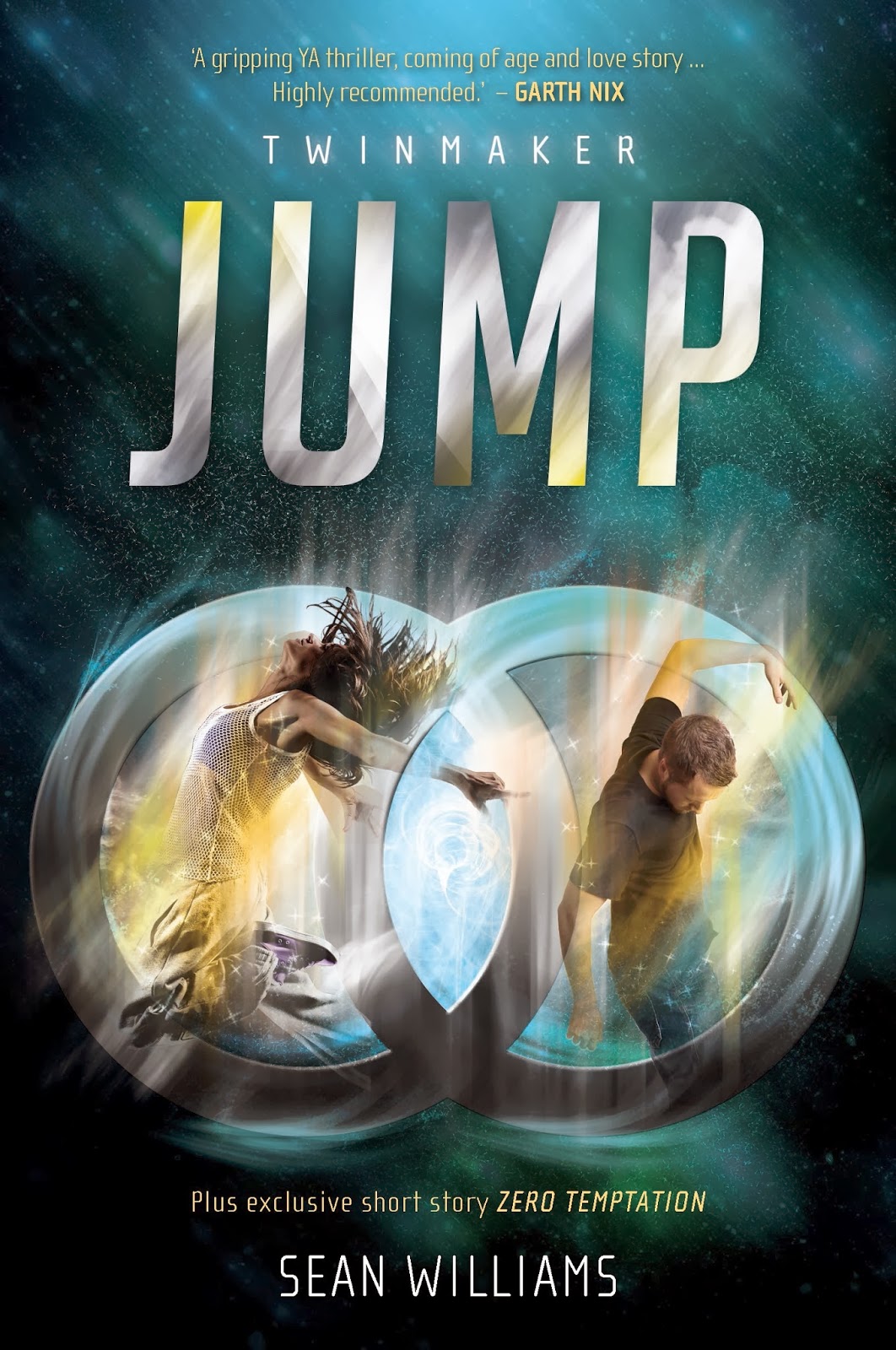
Jump by Sean Williams

Jump by Sean Williams is the first book in the Twinmaker trilogy from the veteran Australian SF writer. It's set in a post-scarcity future where everyone can teleport to wherever they want and fabricate all the food, clothes, etc that they need for free.
Clair lives in a world revolutionised by d-mat, a global teleport system that allows people to transport themselves instantaneously around the world. When a coded note promises improvement – the chance to change your body any way you want, making it stronger, taller, more beautiful – Clair thinks it’s too good to be true, but her best friend, Libby, is determined to give it a try.

What starts as Libby’s dream turns into Clair’s nightmare when Libby falls foul of a deadly trap. With the help of Jesse, the school freak, and a mysterious online friend called Q, Clair’s attempt to protect Libby leads her to an unimagined world of conspiracies and cover-ups. Soon her own life is at risk, and Clair is chased across the world in a desperate race against time.
One of the basic tenets of the d-mat system is conservation of information. People going in have to come out in exactly the same state. As the blurb hints, someone starts suggesting that people can "improve" themselves (get rid of an ugly birthmark or shrink a large nose) using d-mat. Obviously, this isn't the sort of thing that can end well and a lot of the plot revolves around Clair trying to save Libby after the latter attempts improvement.

The main strength of Jump is the worldbuilding. It doesn't come as a surprise, since Williams has written many a hard science fiction novel in the past, but the worldbuilding is rigorous and well thought-out. For example, in a post-scarcity society, why isn't overpopulation a problem? Well, it's not directly addressed but the Water Wars, fought over rising sea levels a generation ago, would contribute to a lowered present population. The rules governing d-mat are explained in a clear (albeit mostly metaphoric) manner so that it's easy to follow the parts of the plot which hinge upon them. It makes for an engaging story which doesn't get bogged down in technical details.

As someone who has read a lot of science fiction in the past, there was one aspect of the plot which came with a later reveal that struck me as obvious from the get-go. Although the reveal was done quite well and was not in anyway frustrating, even though I saw it coming. On the other hand, I suspect less experienced readers (for example teenagers who haven't been exposed to as much science fiction) would not necessarily see that aspect as obvious like I did. And of course this paragraph is a bit ambiguous because spoilers. But it had to be said.

I enjoyed reading about Clair and her plight. When thrown into a shitty situation she quickly steps up to the challenge — sometimes without necessarily realising that she's doing so — and propels the story forwards. Williams doesn't pull any punches as to the sorts of situations she finds herself in either.

Also, given that it's trivial to travel around the world, the main cast is pleasingly diverse. Clair is black, Zep is Asian, Libby lives in Scandinavia and Jesse is a white American. I'm pretty sure that's meant to be Clair and Jesse on the cover, although I'm not sure Clair wore anything like that for most of the story.

Jump was an enjoyable read from a writer whose work I've enjoyed in the past (albeit pre-blog, so there's less evidence ;-p ). I am looking forward to reading the sequel, which I hope won't be too long coming (pretty sure the release is some time in 2014, just not sure when). I recommend it to fans of science fiction and to fans of YA looking for something a bit meatier than most YA SF.

4.5 / 5 stars

First published: November 2013, Allen & Unwin (AU version)
Series: Twinmaker book 1 of 3
Format read: Paper!
Source: Won in a competition hosted on Vegan YA Nerds
Challenges: Australian Science Fiction Reading Challenge