Showing posts with label epic fantasy. Show all posts

Monday, 19 July 2021

She Who Became the Sun by Shelley Parker-Chan

She Who Became the Sun by Shelley Parker-Chan is the first book in the Radiant Emperor series. Since I try not to remember blurbs, I did not realise until partway through that it was based on a historical person. This does mean that Wiki can tell you where the story is going, but this isn't much of a spoiler since the journey is very open to interpretation, as Parker-Chan shows us.

She’ll change the world to survive her fate . . .

In Mongol-occupied imperial China, a peasant girl refuses her fate of an early death. Stealing her dead brother’s identity to survive, she rises from monk to soldier, then to rebel commander. Zhu’s pursuing the destiny her brother somehow failed to attain: greatness. But all the while, she feels Heaven is watching.

Can anyone fool Heaven indefinitely, escaping what’s written in the stars? Or can Zhu claim her own future, burn all the rules and rise as high as she can dream?

I enjoyed this book a lot. Set shortly before the fall of the Yuan Dynasty, it follows a peasant girl, Zhu, who grew up in a famine and extreme poverty. Her sheer determination to survive and not  have an insignificant "nothing" destiny, sees her take on her brother's identity and join a monastery. Unlike many stories with the girl-dresses-as-boy trope, it does not involve a romance with her best monk friend but rather takes a more complicated and queer direction. I really enjoyed reading about Zhu and I appreciated the lengths she was willing to go to for her goal/dream/destiny.

The other protagonist is a eunuch general on the Yuan side (as opposed to the people who are sick of being ruled over by the Yuan, which is the side Zhu is on). He is bitter and vengeful against the Yuan but in an interesting position, since he genuinely likes the Prince he serves. He and Zhu have a few run-ins, which were quite dramatic, despite the fact that they both want similar things. I didn't enjoy his point of view sections as much, especially in the first part of the book, but they got more interesting as we learnt more about him and as events progressed. In any case, he was a good foil for Zhu.

I highly recommend this book to people who enjoy historic fantasy, especially people looking for books set in Asia. She Who Became the Sun did not end on a cliffhanger, but did leave the story unfinished, so I am very much looking forward to reading the next book, when it comes out.

5 / 5 stars

First published: July 2021, Tor Books
Series: The Radiant Emperor book 1 of ?
Format read: eARC
Source: Publisher via Netgalley

Sunday, 28 October 2018

Retribution by Jennifer Fallon

Retribution by Jennifer Fallon is the second book in the War of the Gods trilogy, preceded by The Lyre Thief which I have also read and reviewed. As you might guess from the series title, this is a big fat fantasy book. And, being the second in the series, is not a good place to start reading. I definitely recommend starting with The Lyre Thief, or even the earlier two series: The Hythrun Chronicles and the Demon Child Trilogy.

Since fleeing Winternest to avoid King Hablet's wrath when he discovers the truth about her parentage, leaving her slave, Charisee, to take her place, Rakaia has been on quite an adventure. She has met the demon child, traveled the continent with the charming minstrel, Mica the Magnificent, enjoying more freedom than she ever imagined trapped in the harem in Talabar.

But her freedom has come at a cost. Mica has committed an unthinkable crime, worse even, than stealing the golden lyre, and she is now his unwilling accomplice, sailing the high seas on a Tri-lander pirate ship, doing everything she can to avoid upsetting the man she once thought she loved, but has now realised is quite insane.

Meanwhile, Charisee, still pretending to be Rakaia, is trying to make the best of her new life as the Lady of Highcastle. But Rakaia's past will catch up with her, even as her own lies are in danger of being exposed.

As Adrina struggles to hold Hythria together, and Marla tries to deal with the fallout from the shocking events that take place in the Citadel during the treaty negotiations, Wrayan Lightfinger and the apprentice sorcerer, Julika Hawksword, must travel to Sanctuary to find out why the fortress is back. What they will discover is shocking and will affect the entire world, even though they don't realize it.

I have been a fan of Fallon's writing for many years now (much longer than this blog has been in existence) and this latest instalment set in her longest-running universe does not disappoint. Fallon continues to masterfully connect the plot threads of many characters in ways that feel organic rather than contrived. There's a lot going on in this book and each set of characters have their own motivations for following their own paths. To the point where events that are genuinely coincidental (from the reader's relatively omniscient perspective) seems suspicious to characters inside the story.

The complexity of the intertwining storylines is something I have always enjoyed in Fallon's writing. Retribution picks up the same groups of characters that we came to know in The Lyre Thief and continues their stories. I would not expect this book to make sense without having read the previous volume. I imagine that having read the earlier series is also helpful since there are some references to earlier events and some minor characters in Retribution who were central to the stories in the Demon Child Trilogy and/or the Hythrun Chronicles. Although The War of the Gods is a separate series it is also a continuation of ideas and characters introduced earlier.

I really enjoyed Retribution and am looking forward to the next book in the series (although I fear it will be a longer wait than I would like). I recommend this series to fans of intrigue and fantasy books with large casts of characters. And especially to fans of Fallon's earlier works, especially the two series set in the same universe.

4.5 / 5 stars

First published: 2017, HarperVoyager
Series: War of the Gods, book 2 of 3
Format read: eARC
Source: Publisher via NetGalley

Wednesday, 18 July 2018

City of Lies by Sam Hawke

City of Lies by Sam Hawke is a debut novel and the first in a new fantasy series by the Australian author. I picked it up mainly for its Australian-ness: to show support and because I’ve historically enjoyed many big fat fantasy (BFF) books written by Australian women.

Jovan wears two faces. Outwardly, he is the lifelong friend of the Chancellor’s charming, irresponsible Heir. Quiet. Forgettable. In secret, Jovan is a master of poisons and chemicals, trained to protect the Chancellor’s family from treachery.

His sister, Kalina, hides her frustrations behind a mask of calm. While other women of the city hold positions of power and responsibility, her own path is one of secrets and lies— hidden even from her own brother.

When the Chancellor succumbs to an unknown poison and a revolutionary army lays siege to the city, Jovan and Kalina’s structured world unravels. Trapped and desperate, they soon discover their civilized country also has two faces; behind the beauty and sophistication is an ugly past built on oppression and treachery…

City of Lies takes place in a capital city that sits in the middle of the country, surrounded by estates with farms and a few other cities closer to the foreign borders. The city is run by a chancellor and a council and out protagonists are the legal children (actually nephew and niece) of the Chancellor’s most trusted advisor. The story is told through their (first person) points of view in alternating chapters.

Jovan is the closest friend, advisor and protector of the Chancellor’s heir. His main ancestral job is to check the heir’s food for poison. Not because he’s a disposable food taster, but because he’s been trained to detect poison in even small amounts of food and is immune (or at least resistant to) many poisons, and always has antidotes on hand. Coincidentally, he also has something like OCD (it’s not named in the context of the fantasy world), which stops some people from taking him seriously and, to some degree, hampers his political career. It’s also just something he has to work around. From his point of view we see a lot of the inner politics and problems of the city, as he sticks pretty close to Tain, the heir.

Jovan’s sister, Kalina, is the other point of view character. Having been barred from the family profession due to ill health (in this fantasy world where men and women are treated equally), Kalina still finds ways to help her brother and Tain. Most people dismiss her because they see her as physically weak and hence consequential, but she’s smart and has hidden reserves of determination that not even her brother realised were there. Kalina is written as a very convincing example of chronic illness and the way it’s perceived and engaged with by society. She comes from a privileged family, so has the benefit of the best available medical care (in a pre-industrial society) but still has to contend with people underestimating her. Basically, not only is she a well written character but she kicks arse (but not literally) and I really enjoyed reading the story from her point of view. I highly recommend this book for the disability/chronic illness representation alone.

Of course, there’s more to City of Lies than just good characterisation. The story itself is gripping and kept me interested the whole way. It opens with poisoning throwing the young main characters (who I guessed to be in their 20s maybe?) into the spotlight and positions of power and quickly moves on to a siege of the city. As well as the practical wartime concerns of defence and food distribution, the traitor in their midst hangs over their heads, lowering their trust in everyone else.

I have to say, I was impressed with how this book didn’t drop too many hints as to the source of the treachery. I didn’t see the reveal coming, which is unusual for me these days. And the answer to the question of why the city was being attacked was meted out gradually so that we didn’t understand the whole picture until near the very end of the book. I found it an effective way to keep my interest up through this long tome. (All those short stories I’ve been reading just emphasised the length of this novel, lol.)

This was an excellent read and I highly recommend it to fans of fantasy (especially BFF) and to specific fans who are interested in seeing a society with gender equality with some disability/chronic illness representation thrown into the mix. (Note that the society is, of course, not perfect. If nothing else, there has to be a reason for the war at the heart of the plot.) I’m told there’s a sequel coming, and I look forward to reading more about these characters. On the other hand, the story in this first book is self-contained with no cliffhangers at the end. The overarching problems aren’t resolved at the end, but most of the open plot threads are tied up, making me keen, but not desperate, for the next book.

4.5 / 5 stars

First published: July 2018, Tor (US) and August 2018, Transworld/Penguin Random House (UKANZ)
Series: Yes. Book 1 of Poison Wars series
Format read: ePub ARC
Source: (US) publisher via NetGalley

Friday, 2 February 2018

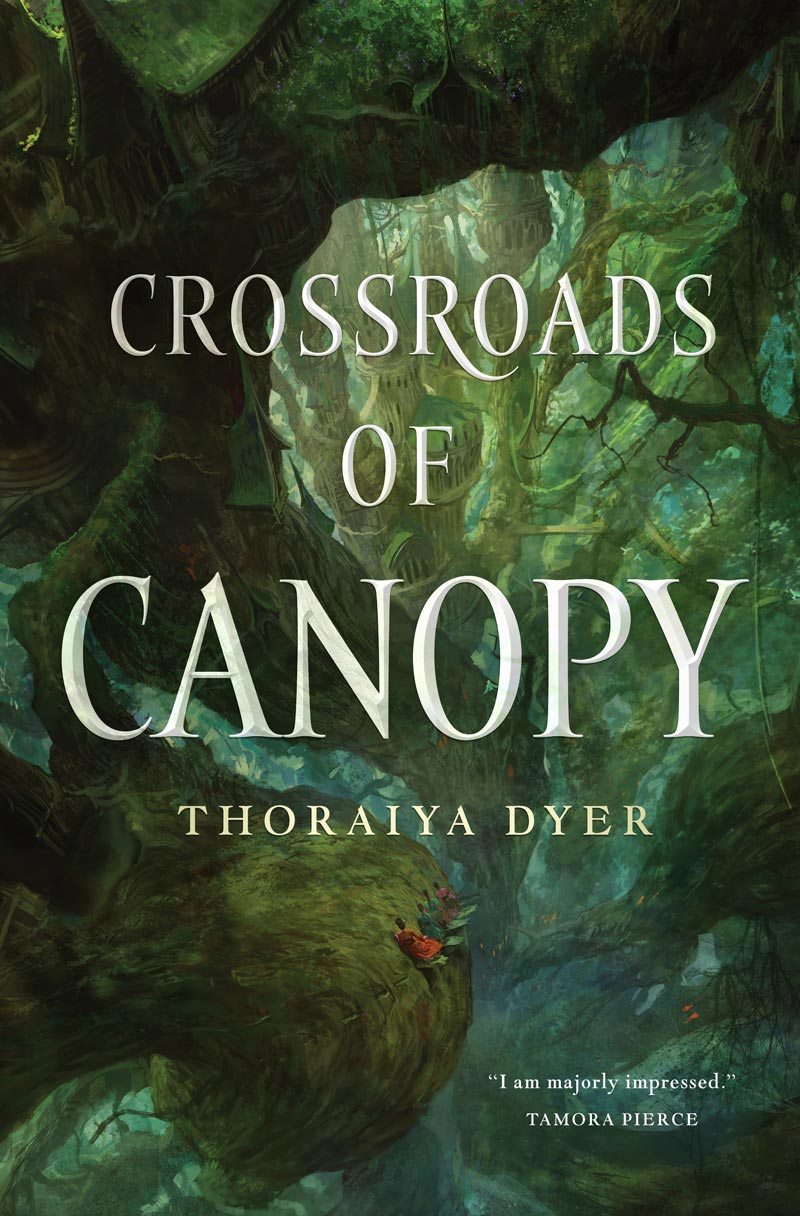
Crossroads of Canopy by Thoraiya Dyer

Crossroads of Canopy by Thoraiya Dyer is an epic fantasy novel set in a world built on trees in a mighty, magical forest. It’s her debut novel and the first of the Titan's Forest series. Until the release of this book last year, Dyer was primarily known as an award-winning short story writer and I have read several of her short stories in the past.

At the highest level of a giant forest, thirteen kingdoms fit seamlessly together to form the great city of Canopy. Thirteen goddesses and gods rule this realm and are continuously reincarnated into human bodies. Canopy’s position in the sun, however, is not without its dark side. The nation’s opulence comes from the labor of slaves, and below its fruitful boughs are two other realms: Understorey and Floor, whose deprived citizens yearn for Canopy’s splendor.

Unar, a determined but destitute young woman, escapes her parents’ plot to sell her into slavery by being selected to serve in the Garden under the goddess Audblayin, ruler of growth and fertility. As a Gardener, she yearns to become Audblayin’s next Bodyguard while also growing sympathetic towards Canopy's slaves.

When Audblayin dies, Unar sees her opportunity for glory – at the risk of descending into the unknown dangers of Understorey to look for a newborn god. In its depths, she discovers new forms of magic, lost family connections, and murmurs of a revolution that could cost Unar her chance…or grant it by destroying the home she loves.

The setting and world building in this book were great, but it was the characterisation of the protagonist, Unar, that really sold it for me. Unar first comes to a goddess’s magical garden to avoid being sold as a slave by her parents. She quickly takes to learning magic and becomes convinced that she is destined for great things. And she is, that’s why she’s the protagonist, they’re just not quite the great things she was hoping for. Her arrogance leads her into a lot of trouble and a lot of things go wrong for her.

There were quite a few cringe-worthy occurrences — horrible things happening to not-horrible people — and occasionally I got annoyed at Unar doing something stupid, but for the most part this was a very enjoyable read. (And if Unar never did anything stupid, what room would there be for her to grow?)

Back to the world building, this isn’t a world living on a single giant tree, as I had first expected before I started reading. This is a whole forest made up of a wide variety of trees. A lot of them are distinctly Australian in flavour, which was a nice touch. The better-off people live in the canopy with the gods, while others eke out a less prosperous existence lower down, where there’s less sun and scary predators. There is also clearly a lot more to the god and magic stuff than has been revealed in this first book. I look forward to learning more about it in the sequel.

This was a very good read and I highly recommend it to all fans of fantasy. Readers looking for a different setting, that is very much not Medieval European, will find much to appreciate here. I am definitely planning to read the sequel very soon and I look forward to learning more about the world as we discover what comes next for the characters.

4.5 / 5 stars

First published: 2017, Tor
Series: Titan's Forest
Format read: ePub
Source: Purchased from iBooks

Tuesday, 12 December 2017

Preview chapter: The Last Guard by KJ Taylor

Following up on my review of The Last Guard by KJ Taylor, the first book in a new series set in the author's griffin universe (The Fallen Moon Trilogy and The Risen Sun trilogy are set in the same world), I have a sample chapter to share with you all. First, in case you don't feel like clicking through to my review, the blurb and then the sample is under the cut. And just so you're not surprised, note that it isn't from the first chapter...


Southerner Sergeant Kearney "Red" Redguard is the last of a disgraced family, and a loyal guardsman. And with a murderer stalking the streets, the city guard is his city's best defense.
But in the North, King Caedmon Taranisäii is gathering his army, and the cruel Night God prepares for the downfall of the South. A new dark griffin roams the land, warning of the war to come.
Betrayed and sent on the run, Red must fight to save his homeland.
But it may already be too late...


Monday, 27 November 2017

The Last Guard by KJ Taylor

The Last Guard by KJ Taylor is the first in a new trilogy, The Southern Star, set in the same universe as The Fallen Moon trilogy, which I reviewed on this blog — The Dark Griffin, Griffin's Flight and Griffin's War. There is also a second trilogy, The Risen Sun, which falls between The Fallen Moon and  The Southern Star, which I haven't (yet) read.

Southerner Sergeant Kearney "Red" Redguard is the last of a disgraced family, and a loyal guardsman. And with a murderer stalking the streets, the city guard is his city's best defense.

But in the North, King Caedmon Taranisäii is gathering his army, and the cruel Night God prepares for the downfall of the South. A new dark griffin roams the land, warning of the war to come.

Betrayed and sent on the run, Red must fight to save his homeland. But it may already be too late...

The Last Guard features new protagonists, as far as I know, and a new story arc. It follows on from the events in the first two trilogies, but a lot of those events are now considered (recent) history. To explain context, some of the key events of the Fallen Moon trilogy were mentioned and I think the same is true of the Risen Sun trilogy, although that was, of course, harder for me to spot. I felt like there were enough hints about the earlier events that I wanted to go back and read the missing trilogy to fill in the gaps. However, no crucial information was missing from The Last Guard and the book worked by itself as a story. My verdict is: you don't have to have read the earlier books/series to enjoy The Last Guard, but there will be extra layers of significance (or more quickly apparent significance) if you have.

On to the actual story! The bulk of the book follows Red, a city guard who is very good at his job and takes pride in it. The story starts with a few strange crimes in the city that draw Red's attention and soon escalates to something a bit more extreme, as hinted in the blurb. Red is soon fighting for his life, his city and his country as everything he'd gotten used to in life comes crashing down around him.

I liked Red as a character and the few times the point of view shifted to other characters I always felt a bit impatient to get back to Red. Not that the other characters were boring or anything, but the main story very much moved with Red. I wouldn't be surprised if that balance shifted a bit in the next book, though I won't spoil why I think that. We also get to know a few of the griffin characters on both sides of the growing conflict. I found it interesting to compare the griffin-human relationships with, for example, the dragon-human relationships in other books like the Temeraire series by Naomi Novik. I think the idea of griffins would appeal to fans of dragons, but they come with a different background and, of course, less mythological baggage.

I recommend this book to fans of epic fantasy and of the author's earlier griffin series (The Fallen Moon and The Risen Sun trilogies). It's certainly in a similar vein to the first series and fans of Taylor's other books will find much to enjoy in the continuing events taking place in that world. That said, this first book stands alone as an introduction to a new series without requiring the earlier books to make sense. It's not a bad place to start and if you read The Last Guard and find yourself wanting to know more about the world, you can always go back and read the earlier books without having to wait for the second Southern Star book to come out.

3.5 / 5 stars

First published: December 2017, Black Phoenix Publishing Collective
Series: The Souther Star trilogy, book 1 of 3 (with the series itself being the third of three so far, following the Fallen Moon trilogy and the Risen Sun trilogy)
Format read: eARC (PDF)
Source: provided by the publisher
Challenges: Australian Women Writers Challenge

Tuesday, 19 September 2017

The Tiger's Daughter by K Arsenault Rivera

The Tiger's Daughter by K Arsenault Rivera is the first in a new and debut secondary World Series. It's set in a mostly historical Japanese- and Mongolian-inspired secondary world with magic and supernatural beings.

The Hokkaran empire has conquered every land within their bold reach―but failed to notice a lurking darkness festering within the people. Now, their border walls begin to crumble, and villages fall to demons swarming out of the forests.

Away on the silver steppes, the remaining tribes of nomadic Qorin retreat and protect their own, having bartered a treaty with the empire, exchanging inheritance through the dynasties. It is up to two young warriors, raised together across borders since their prophesied birth, to save the world from the encroaching demons.

This is the story of an infamous Qorin warrior, Barsalayaa Shefali, a spoiled divine warrior empress, O-Shizuka, and a power that can reach through time and space to save a land from a truly insidious evil.

The Tiger's Daughter is told through a very long letter from one main character, Shefali, to the other, Shizuka, with the framing narrative occasionally showing us what Shizuka is doing while reading the book-length letter over a few days. Shefali is, to over-summarise, the daughter of the leader of the nomadic Qorin and intended to eventually take her mother's place as ruler (spoilery events notwithstanding). Shizuka is the niece of the Hokkaran Emperor and by the time of the framing narrative has already become Empress. The main story (of the letter) follows a large chunk of their childhood, from Shefali's point of view, and culminates in some significant events in their late teens. The conclusion sets up what I assume will be the second book so well I am kind of annoyed at how much I want to read it (and how long I'll have to wait).

This book was a good read overall but I had a few minor(ish) issues with it. The first was that my copy — a very early ARC, so this might not be the case in the final version — did not come with a map. I wouldn't usually think of this as a problem, but since the fantasy realms were very clearly based on the Japanese Empire and the inhabitants of the Mongolian steppes, my mind naturally jumped to something approximating the real-world geography of historical Asia. About halfway through the book someone mentioned that the Hokkaran empire lay to the west, and the steppes to the east and I realised the geography wasn't at all how I'd assumed, distinctly marking it as a secondary world rather than an alternate reality. I had some hints of this from the inferred relationship between the Hokkaran empire and the conquered Xianese based on the etymology of people and place names, but that aspect also wasn't made entirely clear until near the end of the book (and isn't really relevant to the story, for all that I was curious). Having the pseudo-Japanese empire be dominant in pseudo-Asia, including ruling over the pseudo-Chinese, is a potentially interesting choice, but not one which is explored in very much detail.

On the topic of the different races and so forth in the book, I should mention that there is a lot of casual racism on the part of the characters, particularly in terms of slurs thrown at other races. The main characters aren't racist, but they do encounter it often. Especially Shefali since she looks different to the dominant/ruling Hokkarans and also is mixed race. Although the various slurs are likely to upset some readers, I thought it was clear that it was various peripheral characters being racist, not the protagonists or the narrative itself.

There is also a bit of interesting discussion of language, which was examined a little. Shefali speaks Hokkaran as well as Qorin, but she cannot read Hokkaran script, only Qorin letters. The weird thing there was the way Shefali's failure to learn Hokkaran writing sounded a lot like dyslexia — with the characters moving around in her eyes — but then she had no issue with Qorin script. Shizuka, on the other hand, doesn't speak Qorin and, while she does learn the Qorin letters to better communicate with Shefali, she's never criticised for not bothering to learn the language despite how much time she spends among the Qorin. It was clear that a general Hokkaran haughtiness towards lesser peoples was why most Hokkarans didn't bother learning Qorin, but that doesn't at all explain why Shizuka never learnt. Something I would have expected Shefali to be at least a little bit critical of.

Another thing that bothered me was some of the descriptions of lesbian sex. There were altogether too many long nails, some mentioned during the sex scene, which made me cringe. There was also an issue with <spoiler redacted> which must have made it even harder/slasherier to have sex, and yet? *sigh* I spent a lot of time wondering whether <spoiler redacted> was a "not all the time" thing, and from unrelated scenes I don't think so but I couldn't be sure. I also don't think this is a letter I should've been forced to wonder about. So if you're only interested in good lesbian sex scenes, this is not the book for you (also, there was only one particularly explicit scene, FYI).

Back to the main aspects of the narrative. This is not a short book and it is a little on the slow side. I was never bored while reading, but there were only a few sections that made me want to keep reading instead of sleeping. Because the story spans such a long space of time, I was often not really sure where it was going to go next. Having gotten to the end, I think I know what the next book will be about — and I will be disappointed if I'm wrong — but I can't be sure.

For all that my review contains several criticism, I did ultimately enjoy The Tiger's Daughter and after the ending I definitely want to read the sequel. I recommend it to fans of BFF (big fat fantasy), especially people looking for non-European fantasy worlds. It's nice to have so many prominent and empowered female characters with a lot of agency, and while the story isn't cheerful by a long shot, it isn't tragic in the fridged lesbian sense either. (I don't want to spoil the end, but I feel that's important. There's also the part where you know both characters have to live long enough to a) write the book and b) be reading it.) As I said, I intend to read the sequel, whenever it comes out.

4 / 5 stars

First published: October 2017, Tor Books
Series: Yes, book 1 of 3 in the series: Their Bright Ascendency
Format read: eARC
Source: Publisher via NetGalley

Friday, 7 July 2017

Penric and the Shaman by Lois McMaster Bujold

Penric and the Shaman by Lois McMaster Bujold is the second novella in the Penric and Desdemona series, set in the World of the Five Gods, which is also home to a series of novels which I haven't read. I have read the earlier Penric novella, however, Penric's Demon. The main reason I picked up this series at all is because Penric and the Shaman is shortlisted for a Hugo Award this year.

In this novella set in The World of the Five Gods and four years after the events in “Penric’s Demon”, Penric is a divine of the Bastard’s Order as well as a sorcerer and scholar, living in the palace where the Princess-Archdivine holds court. His scholarly work is interrupted when the Archdivine agrees to send Penric, in his role as sorcerer, to accompany a “Locator" of the Father’s Order, assigned to capture Inglis, a runaway shaman charged with the murder of his best friend. However, the situation they discover in the mountains is far more complex than expected. Penric’s roles as sorcerer, strategist, and counselor are all called upon before the end.

While I enjoyed Penric's Demon, I didn't love it and wasn't sure that I'd bother reading more Penric books after Penric and the Shaman. However, I enjoyed Penric and the Shaman rather more than the introductory novella and found myself laughing out loud more often. I'm not sure to what extent that's due to my state of mind when reading (I was more tired and on night shift up a mountain when I read Penric's Demon) or the intrinsic quality of the writing itself. Probably a bit of both.

Penric and the Shaman tells the story of Penric's encounter with a shaman (loosely speaking) from three points of view: Penric's, the shaman's and the Locator sent to capture the (sort of rogue) shaman. I wasn't sure how much I'd like the split points of view, since I came in attached to Penric and Desdemona, but it worked very well. I should not have doubted Bujold's ability to make me care about other characters. The introduction of the concept of shamans also added to the worldbuilding that we were first introduced to in Penric's Demon (speaking as someone who hasn't read any of the novels), making it a deeper world.

I highly recommend Penric and the Shaman to fans of Penric's Demon and fantasy in general. I think the worldbuilding and jokes work better having read the prequel, but it's not absolutely necessary, especially since four years have passed in the interim. I expect I will read the sequels at some point (when I am less drowning in other books).

4.5 / 5 stars

First published: 2016, self-published
Series: Penric and Desdemona, book 2 of 4 so far (I think)
Format read: ePub
Source: Hugo Voter Packet

Monday, 29 May 2017

Assassin's Fate by Robin Hobb

Assassin's Fate by Robin Hobb is the final book in The Fitz and the Fool trilogy, itself the third trilogy of trilogies about Fitz. It's book nine, is what I'm saying, or book twelve or sixteen if you count the Liveship books and the Dragon books, which aren't about Fitz but are related. Those two series aren't strictly necessary to understand the events of Assassin's Fate, but I dare say they help, which was not the case for Fool's Assassin or Fool's Quest. I haven't read any of the dragon books nor the final Liveship book and I felt a very small lack. On the other hand, the previous Fitz books — The Farseer Trilogy and the Tawny Man Trilogy as well as the preceding volumes of the Fitz and the Fool trilogy — are definitely necessary to make sense of the assassin's fate. This review will contain spoilers for the earlier Fitz books. The blurb also contains spoilers for the earlier books in this series.

Prince FitzChivalry Farseer’s daughter Bee was violently abducted from Withywoods by Servants of the Four in their search for the Unexpected Son, foretold to wield great power. With Fitz in pursuit, the Servants fled through a Skill-pillar, leaving no trace. It seems certain that they and their young hostage have perished in the Skill-river.

Clerres, where White Prophets were trained by the Servants to set the world on a better path, has been corrupted by greed. Fitz is determined to reach the city and take vengeance on the Four, not only for the loss of Bee but also for their torture of the Fool. Accompanied by FitzVigilant, son of the assassin Chade, Chade’s protégé Spark and the stableboy Perseverance, Bee's only friend, their journey will take them from the Elderling city of Kelsingra, down the perilous Rain Wild River, and on to the Pirate Isles.

Their mission for revenge will become a voyage of discovery, as well as of reunions, transformations and heartrending shocks. Startling answers to old mysteries are revealed. What became of the liveships Paragon and Vivacia and their crews? What is the origin of the Others and their eerie beach? How are liveships and dragons connected?

But Fitz and his followers are not the only ones with a deadly grudge against the Four. An ancient wrong will bring them unlikely and dangerous allies in their quest. And if the corrupt society of Clerres is to be brought down, Fitz and the Fool will have to make a series of profound and fateful sacrifices.

When I started reading Assassin's Fate, my recollections of the previous book were a little vague. I remembered the gist but not the precise ending, which turned out to be a little bit of a problem since Assassin's Fate picks up very soon after Fool's Quest left off, especially from Bee's point of view. It is took me longer than I think it should have to work out why Fitz was so convinced Bee was dead because I'd forgotten the events at the very end of Fool's Quest. I don't think this would be an issue if I'd read them closer together. This contributed to me not getting into the book as quickly as I would have liked. The start of the book felt a bit slow and while I wasn't bored I also wasn't as gripped as I am accustomed to being by Hobb books. As a result, it took me about three weeks to get through it, since I got distracted by several Hugo-shortlisted things (mainly short fiction) along the way. On the other hand, it took me only a couple of days to read the second half of the book, in large part because that's when things got really interesting and difficult to step away from. So I suppose it's fair to say the pacing is a little bit off. This is a pretty long book (around 850 pages according to Goodreads for both the US and UK editions) and, in my opinion, that means it can't afford to waste too many pages on less exciting events, even if they needed to happen.

One of the things I really liked about this book was how it tied together all the other series set in the same Realm of the Elderlings universe. As I mentioned at the start, it's not completely necessary to read the Liveship books before reading Assassin's Fate, but we do get a kind of extra Liveship-centric epilogue,  which I think fans of that series will appreciate (and those who haven't read any Liveship books will feel as confused by as Fitz was). I also think Hobb ended Fitz's story in a nice way, although the ending took a bit of time to process and gave me rather a lot of feelings. Not to mention, the book is called Assassin's Fate, which should give you some hints about what might happen in it, but by golly Fitz sure has a lot of fates. The latter parts of the book were a bit of an emotional rollercoaster. The end was an ending for all the Fitz and Fool books.

It's hard to say anything very concrete because of wanting to avoid spoilers, but Bee's story was interesting — although she got more than her share of slow bits before the story picked up. I enjoyed learning more about Cleres and where the Fool came from. I also enjoyed reading the start-of-chapter extracts from Bee's dreams, especially once they started happening and we were able to retrospectively join the dots to the events they predicted. There were a few parallels between Bee's life and Fitz's which, towards the end, really emphasised how she was his child more so than Nettle had been, and not just because Fitz was more present in Bee's childhood. But I don't want to venture into spoiler territory.

So, if you've read the other Fitz books, then I strongly recommend finishing off the story with Assassin's Fate. If you haven't also read the Liveship books, then I recommend doing so before Assassin's Fate, especially if you had any general plans to read them at some point. Assassin's Fate contains some critical spoilers for those books and also contributes to their story in its own right. If you haven't read anything by Robin Hobb before, this is pretty much the worst possible place to start. Go back and start with Assassin's Apprentice. This is one of my favourite fantasy series and has been with me for a significant chunk of my life. It was bittersweet to say a final goodbye to the characters and the world.

4.5 / 5 stars

First published: May 2017, Del Rey (US) / Harper Voyager (UKANZ)
Series: Fitz and the Fool book 3 of 3
Format read: eARC
Source: Publisher via NetGalley

Tuesday, 3 January 2017

Daughters of the Storm by Kim Wilkins

Daughters of the Storm by Kim Wilkins is a book I've been meaning to read since it first came out. It's a BFF (big fat fantasy) book about five royal sisters who could not be more different from each other. It's also set in the same world as "The Crown of Rowan"  a novella in the Year of Ancient Ghosts collection which I reviewed here.
Lying in a magic-induced coma, the King of Thyrsland is on the brink of death: if his enemies knew, chaos would reign. In fear for his life and his kingdom, his five daughters set out on a perilous journey to try to save him, their only hope an aunt they have yet to meet, a shadowy practitioner of undermagic who lives on the wild northern borders.

No-one can stand before the fierce tattooed soldier and eldest daughter Bluebell, an army commander who is rumoured to be unkillable, but her sisters, the loyal and mystical Ash, beautiful but unhappily married Rose, pious Willow and uncertain Ivy all have their own secrets to keep from her — the kind of secrets that if revealed could bring disaster down upon not only them, but the entire kingdom.

Waiting in the wings is stepbrother Wylm whose dealings with Bluebell's greatest enemy, Hakon the Raven King, would end Bluebell's dreams of revenge on his mother and propel his own desperate grasp for power.

My reading has been patchy at best, of late, and this was a good book to get back into it with since BFF is one of my first reading loves. The novella, which was my introduction to this world, focussed on Rose, one of the middle sisters, and only gave us a taste of the other characters. Daughters of the Storm, however, splits the perspective between all five sisters, with a strong focus on the oldest three. We get to know them all individually and as unique and very different characters. It's hard to go past Bluebell, the future warrior queen, but even the two youngest (and most annoying in their actions) sisters were interestingly written, even if I mainly wanted to slap them.

The main premise of the story is the king is sick and finding out how and why and curing him is Bluebell's main goal. The other sisters are dragged along with Bluebell's plans but have their own problems on their minds and their own motivations. The conflicting goals made for compelling reading, even though there weren't many layers of intrigue or an epic battle. I have to admit I was wondering where a sequel would be able to go, since it seems like everything would be resolved in the one book, but the ending made at least part of the direction of the second book clear.

I enjoyed Daughters of the Storm and I recommend it to anyone who enjoys character driven historical fantasy. The historical period the world building is based on is pre-medieval and much earlier than many other fantasy books I've come across. I highly recommend this novel to any readers who enjoyed "Crown of Rowan". I have already bought the second book in the series, Sisters of the Fire, and hope to get to it soon.

4.5 / 5 stars

First published: 2014, Harlequin Australia
Series: Blood and Gold book 1 of ? (3?)
Format read: ePub
Source: Purchased... from iBooks, I think
Challenges: Australian Women Writers Challenge

Wednesday, 24 August 2016

The Bloody Quarrel by Duncan Lay

The Bloody Quarrel by Duncan Lay is the second book in the Alabaster Trilogy, following on from The Last Quarrel which I read and reviewed last year. The first line of the blurb is a major spoiler for book 1, and my review will also contain other spoilers for the first book. A lot of significant things happened in the latter part of book 1, so if you want to be surprised and unspoiled, don't read this review. Really. Leave now. Don't even read the next sentence.

The prince is dead.

Fooled by the treacherous King Aidan, Fallon has shot down the one man he trusted to save his beloved nation of Gaelland. And yet, when the King could grind Fallon underfoot, he draws the simple farmer and fighter closer, making a hero of him.

Embroiled in plots beyond his comprehension and weighted with the guilt of the prince's murder, Fallon must tread carefully if he is to accomplish the task that first brought him to the cursed capital: rescue his wife, Bridgit, and the rest of his village from Kottermani slavery. If he and his hopelessly ensnared men can survive, they may yet find redemption.

Meanwhile, across the ocean, Bridgit is rallying those around her to spring an escape. But who can be trusted? The ever-present danger of traitors and liars among the slaves, and even among her fellow Gaelish, is poison to her plans.

With an ocean between them and fouler nightmares looming, Fallon and Bridgit will be driven to their very limits to escape their prisons, find each other, and bring justice to Gaelland.

Somewhat unusually for my recent reading habits, I took a long time to read this book. (Goodreads tells me it was just under seven weeks, wow.) This is mainly because of other things going on in my life at the time, and also because, well, the book is kinda long. I didn't put it down because I was bored or annoyed at it, more because I needed something else — mostly something happier — in my life at the time. The Poisoned Quarrel is not a cheerful book, by and large. That's not to say that nothing good happens, but the overwhelming theme of the story is betrayal.

I'm sure I've said before that one of the themes Lay tackles well and consistently in his book is father-child relationships. This was true in the first book of this trilogy as well, but seems to be a bit less prominent in the second book. Fallon still has a relationship with his son who is around for a lot of the book, but that relationship is a bit less central that it was in the previous book. Mostly, I'd say, because the father and son settled into a rhythm and roles that weren't overly disrupted by the plot. I suspect there will be some more disruptions in book three.

The Poisoned Quarrel was also fairly gory, not that that's new for Lay. But right from where it picked up after the cliffhanger at the end of book one, there was a lot of opportunity for violence and descriptions of said violence. It was all relevant to the plot but if you don't want to read about people's head's being caved in (to give a mild example), well, you've been warned. (Minimal sexual violence, though.)

I especially enjoyed watching Bridgit develop as a person while enslaved by the Kottermanis. Since the characters around Fallon were mostly male, with only a few relevant exceptions, it was nice to have the second storyline following a set of characters that were mostly female. That they kicked arse was also a bonus.

I am definitely going to read the last book in this trilogy (The Poisoned Quarrel, already out), but after a short break from epic fantasy. I definitely recommend this book to anyone who's read the first book. And how could you not want to read it after the cliffhanger book 1 left us on? On the other hand, if you hate cliffhangers, this didn't actually have one (I'm as shocked as you are). Most plot elements are left unresolved, but no one is in the middle of being shot of hearing a deeply significant reveal, to pick two examples at random. If you haven't read any Duncan Lay before, then a) I recommend his books if you like epic fantasy, father-child relationships and apparently grimdark (although I wouldn't've called his other books that) and b) definitely start with book one.

4 / 5 stars

First published: February 2016, Momentum
Series: The Alabaster Trilogy book 2 of 3
Format read: eARC
Source: publisher

Thursday, 26 May 2016

The Beatriceid by Kate Elliott

The Beatriceid by Kate Elliott is an epic poem written in the style of The Aeneid but about girls at school and a prank. It is set in the world of Elliott's Spiritwalker books, which start with Cold Magic and which I haven't read.

Before Andevai, the waking of dreaming dragons, the war for Europa, and the cruel treachery of the Wild Hunt, cousins Catherine and Beatrice Hassi Barahal were novice students at the Academy. Here, Cat and Bee learned of mathematics and politics, history and storytelling. But not all stories are told or remembered in the same way--particularly where the tale of Dido and Aeneas, and the fate of Carthage and Rome are concerned.

To the victors go the spoils--only this time, it is the gilded-tongued Bee and the quick-footed Cat who will collect the winnings.

Set before the start of Cold Magic, The Beatriceid is a brand new, standalone short story written in Iambic Pentameter that reimagines The Aeneid in a feminist, Phonecian light.

This poem was shorter than I expected it to be, with the poem itself only taking up about half the ebook pages. The rest of the book was filled with an afterword explaining the reasoning behind the poem, an essay about self-rejection, and an interview with Kate Elliot conducted by the Book Smugglers. I generally wouldn't go out of my way to buy this sort of extra content in ebook form, but I didn't mind reading it after the main event.

The poem was quite amusing, featuring school girls' retellings of the story of Dido and Aeneas — modified to fit into the alternate history of the fantasy universe — framed by a school girl prank. I quite enjoyed reading the epic poetic style employed to speak of school shenanigans. And the actual prank itself. I suspect there were also several references to the source material that went over my head, but that didn't spoil my enjoyment of the poem.

I am, at this point, wondering why I haven't already read Cold Magic. From the description in the afterword, it sounds like a fantasy book I would enjoy. It was a little strange, perhaps, to read the Beatriceid without having read any other books set in the same world, but after Tansy raved about it on Galactic Suburbia, I couldn't resist. I don't think there are any issues reading it without the wider context, but I suspect people already familiar with the characters will get more out of it.

4 / 5 stars

First published: 2015, Book Smugglers Publishing
Series: Set in the Spiritwalker universe. Goodreads has it listed as book "3.5"
Format read: ePub
Source: purchased from Kobo store

Wednesday, 4 May 2016

The Fall of the Dagger by Glenda Larke

The Fall of the Dagger by Glenda Larke is the final book in the Forsaken Lands trilogy. I have previously read and reviewed the first two books, The Lascar's Dagger and The Dagger's Path. I should warn you, the very blurb for The Fall of the Dagger contains spoilers for the earlier two books, as will my review.

A king corrupted, a sorcerer on the throne, a land in peril…

Excommunicated cleric Saker returns from exile in the Spice Islands to find his homeland in chaos.

A dark sorcerer controls the ear of the King, turning him against his own son and heir, while a corrupted army gathers in the shadows.

With the illusionist Sorrel and islander Ardhi, armed with magic from Ardhi’s homeland, Saker now must stand between his city and the corruption that threatens to cripple it, before it is too late . . .

I have always enjoyed Glenda Larke's work and The Forsaken Lands trilogy has been no exception. I definitely see myself rereading it at some point, especially since I expect the trilogy will be even more enjoyable if read in quick succession, rather than with a year-long gap in between books.

Nevertheless, picking up The Fall of the Dagger a year after the previous instalment was not difficult to get back into. The three main characters, Saker, Sorrel and Ardhi, return to the Va-cherished hemisphere with some idea of how to defeat the evil sorcery that has taken over the land. Saving the world, however, is never easy and the three of them can't do it alone.

I quite liked that it actually took a lot of people working together to win the day, and not just the chosen three, so to speak. Also, I enjoyed the post-climax action. Usually, the world is saved and that's the end of it, but Larke bothered to show that it's not quite that clean and easy to resolve everything when the bad stuff has been building up for several years. And I think that's as much as I can say without spoilers, really.

I really enjoyed this series and highly recommend it to all fans of BFF (big fat fantasy) books, especially anyone looking for worlds beyond the standard medieval Europe setting. This is also not the kind of series where you can pick up the later books without having read the earlier books, so I definitely recommend starting with the multi-award-winning The Lascar's Dagger if you are new to this series. If you've already read the earlier books, why wouldn't you pick up this one? Go on— don't you want to see how it all ends?

4.5 / 5 stars

First published: April 2016, Orbit
Series: Book 3 of 3 of The Forsaken Lands trilogy
Format read: ePub
Source: Purchased from Google Play
Challenges: Australian Women Writers Challenge

Wednesday, 2 March 2016

The Lyre Thief by Jennifer Fallon

The Lyre Thief by Jennifer Fallon is the first book in a new series, The War of the Gods, set in the same world as the Hythrun Chronicles and the Demon Child Trilogy. It is set about ten years after the events in the Demon Child Trilogy and features many characters from both older series, as well as several new characters.

Her Serene Highness, Rakaia, Princess of Fardohnya, is off to Hythria, where her eldest sister is now the High Princess, to find herself a husband, and escape the inevitable bloodbath in the harem when her brother takes the throne.

Rakaia is not interested in marrying anyone, least of all some brute of a Hythrun Warlord she's never met, but she has a plan to save herself from that, too. If she can just convince her baseborn sister, Charisee, to play along, she might actually get away with it.

But there is trouble brewing across the continent. High Prince of Hythria, Damin Wolfblade, must head north to save the peace negotiated a decade ago between the Harshini, Hythria, Fardohnya, Medalon and Karien. He must leave behind an even more dangerous conflict brewing between his wife and his powerful mother, Princess Marla.

...And in far off Medalon, someone has stolen the music.

Their quest for the tiny stolen lyre containing the essence of the God of Music will eventually touch all their lives, threaten everything they hold dear and prove to be far more personal than any of them can imagine.

I have always been a fan of Fallon's books, since I first read the Second Sons trilogy, and my enjoyment of her writing has not wavered with this new addition. If you are familiar with the Hythrun Chronicles, that's the Fallon series this book most reminded me of. Furthermore, while this first book in a new series provides a reasonable jumping-on point, I don't particularly recommend starting here. It's not completely necessary, but I do recommend reading the Demon Child series and the Hythrun Chronicles to understand more about the recurring characters' back stories. About half the main point of view characters are recurring and half are new (this is out of I think five point of view characters, one of whom I don't think was very prominent in the earlier books.

Having said all that, it's been rather a while since I read the earlier two series. I think I last reread the Hythrun chronicles six or seven years ago, so my memory of the minutiae was hazy at best. While I had no trouble following the story in The Lyre Thief, giving this, I would have enjoyed it even more, I think, if the memory of "wait, who's that again? The name seems familiar" had been fresher in my mind.

As I said, there were five point of view characters in this book. There's Rakaia and Charisee, royal and baseborn sisters, respectively, whose shenanigans after Rakaia is promised to an old Hythrun lord attract the attention of the God of Liars. There's High Princess Adrina, sister of the aforementioned two and wife of Damin Wolfblade. There's an assassin, the Demon Child (which, actually, wasn't capitalised in the book, which kind of bothered me), a Fardohnyan seneschel... All of whom get entangled in interweaving plots and schemes.

One of the things I love about Fallon's work is how she writes intrigue with several characters having independent goals and schemes which just happen to overlap in entertaining ways. Most of the time, characters are just doing their thing without particularly considering how it might be affecting other people (especially when it's other people they don't even know well).

This is a long book with many characters, but one that I found difficult to put down. Aside from forgetting details from the earlier books about recurring minor characters, I had absolutely no trouble filling the story in The Lyre Thief. Even though there were long gaps between scenes for some of the characters (one in particular, but I don't want to spoil things), Fallon made everything memorable enough that I had no trouble remembering what they were up to.

I enjoyed The Lyre Thief a lot and the only disappointing thing is that I now have to wait a while for the next book! It didn't end on a huge cliffhanger or anything (well, maybe a small one? It was more of a hook for the next book. What constitutes a cliffhanger these days?) but most of the plot lines are unresolved and I want to know what happens next to all the characters! Very much looking forward to book two (which I think is still a year away :-/ ).

I highly recommend The Lyre Thief, especially to fans of The Hythrun Chronicles and The Demon Child Trilogy. You don't have to have read those two earlier series before you read this one, but I think that it would help. For those unfamiliar with Fallon's work, she writes excellent action and political intrigue focussed fantasy. Mostly the intrigue with many intertwining threads.

4.5 / 5 stars

First published: March 2016, Harper Voyager AU
Series: The War of the Gods book 1 of 3
Format read: ePub
Source: Purchased on iBooks
Challenges: Australian Women Writers Challenge

Wednesday, 20 January 2016

Fool's Quest by Robin Hobb

Fool's Quest by Robin Hobb is the second book in The Fitz and The Fool trilogy, which itself is the third trilogy about those two characters (following the Farseer Trilogy and the Tawny Man trilogy). I previously reviewed the immediate prequel, Fool's Assassin, but the other related books were all read long before I started this blog. This review, and the blurb, inevitably contain spoilers for the first book in the series.

After nearly killing his oldest friend, the Fool, and finding his daughter stolen away by those who were once targeting the Fool, FitzChivarly Farseer is out for blood. And who better to wreak havoc than a highly trained and deadly former royal assassin? Fitz might have let his skills go fallow over his years of peace, but such things, once learned, are not so easily forgotten. And nothing is more dangerous than a man who has nothing left to lose…

This is not a book to read without having read the previous volume. I'm not sure it's a book to read without having read the two main previous trilogies, either. Unlike Fool's Assassin, which started out more self-contained, Fool's Quest relies not only on its immediate prequel but also on more background knowledge than I think a reader who had only read the prequel would have. A large portion of the book is set at Buckkeep Castle and Fitz spends a lot of time remembering events from both earlier trilogies. I read those six books long enough ago that my memory is quite hazy and I wouldn't've objected to a refresher. The narrative did remind us of the relevant events pretty explicitly, so it wasn't a big problem for me, but I imagine it would be a bigger problem for a new Hobb reader.

The only frustrating thing about this book was Fitz not bothering to tell people things. I was shaking my fist at him several times. In a case of "the reader knows more than the characters", it was abundantly clear that if Fitz had just spent a few minutes filling people in on some details (mostly the Fool), then he could have put certain pieces of the puzzle together sooner. Of course, that would probably have made the story much shorter, but it was annoying.

On the other hand, this book made it more clear than the previous one that Fitz has grown as a person since he was a teenager and younger adult. He is sixty now, so that's hardly unexpected, but there were a lot of parallels to his earlier adventures and instances where he would once have run off without thinking but doesn't now. As much. Mostly.

The thing I thought was particularly well-handled in this book was the discussion of rape and other atrocities. Firstly, it's always called rape not "forced himself on her" or any other euphemisms and the perpetrators are immediately referred to as rapists. One character is even called "the handsome rapist" for a long time before we know his name. The consequences of rape on the victims and bystanders is also explored. I don't actually remember if there was much/any rape in Hobb's earlier Fitz books but the way it was treated in this one was appropriate and felt in touch with modern discourse. It also wasn't gratuitous or very on the page; the consequences were much more present. Whether or not there was rape in the earlier books, I feel sure that a younger Fitz would not have been able to comprehend the situation as well as he now can, which allows for this thoughtful portrayal.

All that said, this story is really about Fitz, Bee and the Fool. At the end of the previous book we see Bee kidnapped and getting her back is obviously a central focus of this book. Just not quite in the way you might initially expect. (No spoilers.) The Fool's situation is also very central to the book. And people who adore the Fitz/Fool relationship will not be disappointed.

As with most of Hobb's books, this was an excellent read. If you're a fan and are otherwise up to date, definitely pick up this latest instalment. If you're new to Hobb and have read this far down in my review anyway, I suggest starting with Assassin's Apprentice. I am looking forward to the concluding volume as I wonder how it will all pan out.

4.5 / 5 stars

First published: 2015, HarperCollins
Series: book 2 of 3 in Fitz and the Fool trilogy, which follows directly on from the Farseer Trilogy and the Tawny Man Trilogy and the Liveship Traders trilogy (and probably less directly on from the Rain Wild Chronicles, but I haven't read those and didn't feel lost as a result)
Format read: ePub
Source: Purchased from Kobo store

Monday, 14 December 2015

Drachengott: Water by KJ Taylor

Drachengott: Water by KJ Taylor is the fourth and final book in the Drachengott series. This is very much a series that needs to be read in order and this last book ties everything up and resolves the major conflict of the series (and brings in some of its own conflicts).

The time has come. Rutger, Elynor, Theodor and Syn set out on their final journey - to find the fourth member of their group, the one they need to destroy the Drachengott once and for all. 

But war has come to Wendland, and with three neighbouring countries now intent on destroying its people, it could be that the Drachengott is the only defence Wendland has.

But one final weapon remains to be found, though only its name is known: the Peace Bringer ...

To begin with, Water follows the pattern of the earlier three books by introducing us to the fourth "chosen one" character. It quickly deviates from the formula by throwing disaster into the mix and switching to the points of view of the other three chosen characters. But before we get to that, the reader — or at least, this reader — has enough time to not particularly like Karmain, the new character. Part of it is the situation she's quickly thrust into and part of it is her naïveté. But, since we learnt in the third book (and are reminded at the start of this book) that her weapon is called the Peace Bringer, perhaps naïveté makes sense. But I still wanted to slap her.

When the points of view split up between the four main characters, there was some added tension, especially when we still didn't know what had happened to the others at various points. However, from the readers' point of view it was pretty clear that the chosen four couldn't die, which detracted from some of the tension. The author used this mainly to motivate some of the characters and to add some "where is everyone" mystery for the reader.

It's kind of hard to say more without spoilers because almost this entire book is one drastic conflict or another. But if you've read the first three Drachengott books, I don't see why you wouldn't pick up this last one to find out what happens. I mentioned in my review of book three that it became more complex and less linear in plot than the first two books. The same is true of this concluding volume, even more so. The switching around of points of view alone would mix things up, as would the final confrontation. But there are more obstacles standing in the path of the chosen four and their friends than they may have originally anticipated.

I enjoyed this series, especially the second half of it. Each book is quite short and together they make up a single interesting story. As I've said in my reviews of the earlier books, I really do think this series would work best as an omnibus edition. Each book is a self-contained story but does not really stand alone. Omnibus or not, I recommend this series to fantasy fans, especially those who might be interested in consuming their fantasy in smallish chunks.

4.5 / 5 stars


First published: August 2016, Harper Collins Aus
Series: Drachengott, book 4 of 4
Format read: eARC
Source: Publisher via NetGalley
Challenges: Australian Women Writers Challenge

Saturday, 5 December 2015

Drachengott: Fire by KJ Taylor

Drachengott: Fire by KJ Taylor is the third book in the Drachengott series, of four. I have previously reviewed the first two books: Drachengott: Wind and Drachengott: Earth. Fire is another short read and it continues the story in a similar vein to the earlier books.

Nils doesn't know how old he is, or where he came from. Raised to worship the Drachengott, he will soon be granted the gift of magic at his initiation - but why does he dream of flying? And why, at his journey to the mountain of the Drachengott, does he feel compelled to steal something from the giant dragon - a strange stone with hidden power locked inside it? All Nils knows is what the Drachengott promises him on that day: that one day, he will live to curse his own name: Nils Schacher. Nils the Thief...

As with the two earlier books in the series, Fire closely follows the third "chosen one" character as he acquires magic and learns about his powers and his special weapon. But unlike the earlier books, things in the wider world are heating up now and Nils's story is less linear or straightforward. And the characters from the earlier books play a larger role in Fire.

By the latter half of this book I was more excited about the plot and characters (especially the overarching plot) than I had been in the first two books. Things get more complicated and the story started to deviate from the most obvious path. And the characters finally figured out something that had been obvious to the reader from the start (but which they couldn't've known earlier), so that was nice. I am going to pick up the last book straight away, to see how it all shakes out.

I still thing this whole series would be better read in a single omnibus edition. But in the meantime, if you enjoyed the first two books, definitely pick this one up. If you thought Wind or Earth were a bit slow or too uncomplicated, then I recommend giving Fire a go because it really does pick up. I am looking forward to starting the last book in the series this evening. If you're new to the series, definitely start with the first book because the overarching plot builds up book by book. They're also all quite quick reads (especially for fantasy books), if that aspect is appealing.

4.5 / 5 stars

First published: July 2015, HarperCollins Aus
Series: Drachengott series, book 3 of 4
Format read: eARC
Source: Publisher via NetGalley
Challenges: Australian Women Writers Challenge

Friday, 3 July 2015

Drachengott: Wind by KJ Taylor

Drachengott: Wind by KJ Taylor is the first book in a new fantasy series which I believe is being released only digitally. But on the up side, the four instalments are being released one a month, so by the time you read this book 3 will already be in the wild. And if the first book is anything to go by, they're pretty short instalments, by fantasy book standards. Perhaps in another time, they would have been published as parts one through four of the one printed book (although that's not how the author wrote it, as she mentions in this interview from last year).

Rutger has always been a bit different. Wanting more than his current provincial life holds, he practices swordfighting, ensuring he's ready for ... he's not quite sure what. Until he meets Swanhild, an enigmatic young woman who knows exactly what she's training for - war. The two meet every day in the forest to practice magic and Rutger feels like he finally belongs somewhere. But Swanhild is hiding something. Will Rugter find out her secret before it's too late? Or will the battle they've been waiting for render secrets irrelevant?

Wind starts with a few chapters of what is, structurally, a prolonged prologue. We're introduced to a confused dragon who doesn't really know what's going on or why, but whose story turns out to be quite important to the over arching plot of the series. We also get our first glimpse of Rutger, the main protagonist. The main story, however, starts several years later with Rutger determined to avenge his brother, who died in the prologue, but lacking direction. He trains for war but has no immediate battles to fight. That is until he meets Swanhild, who introduces him to the world of magic.

Swanhild was probably a more interesting character than Rutger (not that there was anything wrong with Rutger) with her mysterious past and unknown motivations. She propels the plot along and Rutger through it. Basically, nothing much would have happened in the book if it were not for her, but she's not the main character. From the ending (no spoilers) I get the feeling the next book will have a different main character but that Swanhild will still make an appearance.

I am interested to see how the overall structure of the series plays out. Being much shorter than what I would normally call Big Fat Fantasy (BFF), Wind nevertheless shares some characteristics with those sorts of books. Although Wind told a complete story, the overarching plot is only just beginning and I am looking forward to seeing where it goes in the following books. On the other, being quite short for a fantasy book it does have a little bit less depth (and only the one main character whose point of view we don't stray from after the very beginning). The worldbuilding, however, is sufficiently present to paint a picture of the world. It's Germanic, with some obvious differences to our world like the existence of dragons and magic, and also deer as the primary mounts. (Maybe the dragons ate all the horses? ;-p ) Also giant spiders in the forest, which really had me questioning why anyone ever went into the forest if person-eating spiders were a thing they could run into. (If you're arachnophobic, don't worry, they only appear briefly.)

Anyway, Wind was a short read that had me wanting to know what happens next. I look forward to continuing the series in the near future. I would recommend it to fans of fantasy after a quick fix and/or something that they won't spend days lost in (because of the short length). Fans of Taylor's other work will find a less complex story, but still, in my opinion, an enjoyable one.

4 / 5 stars

First published: May 2015, Harper Collins Impulse
Series: Drachengott book 1 of 4
Format read: eARC
Source: Publisher via NetGalley
Challenges: Australian Women Writers Challenge

Saturday, 16 May 2015

Rat Queens Vol 2: The Far Reaching Tentacles of N'rygoth by Kurtis J. Wiebe

Rat Queens Vol 2: The Far Reaching Tentacles of N'rygoth written by Kurtis J. Wiebe and illustrated by Roc Upchurch and Stjepan Sejic is the second collected volume of Rat Queens, containing issues #6-10. I previously reviewed the first volume here, and questioned whether I was sufficiently interested in the story to continue. Part of what convinced me to read on was the fact that the artist changed over part way through Volume 2.

This booze-soaked second volume of RAT QUEENS reveals a growing menace within the very walls of Palisade. And while Dee may have run from her past, the bloated, blood-feasting sky god N’rygoth never really lets his children stray too far.

This volume picks up right where the previous one left off, with the Rat Queens and friends waking up after their celebratory "we won a fight" orgy. They're sent on another, fairly easy mission, while trouble brews in the background. It isn't long before trouble catches up to them. And it's pretty apocalyptic trouble, on a city-scale at least.

While I did find Rat Queens faintly amusing, I thought the volume started a little boringly and ended a bit confusingly (a monster causing hallucinations didn't help on that last point). We did learn more about the backgrounds of the main characters, which was my favourite part, but it didn't make up for my general meh feeling about the whole thing.

Overall, I didn't hate Rat Queens, but I also didn't love it. I felt more ambivalent about this second instalment than I did the first and I don't think I'll be continuing with it. It's just not for me. That said, I don't think there's anything actually bad about it, so I'm sure others will enjoy it, if the jokes and subgenre are more to their tastes.

3.5 / 5 stars

First published: May 2015, Image Comics
Series: Rat Queens Volume 2 (issues #6-10) of ongoing series.
Format read: eARC
Source: Publisher via NetGalley

Saturday, 27 December 2014

City of Masks by Ashley Capes

City of Masks by Ashley Capes is the first in an epic fantasy series and the author's debut novel. Before I get to the review part, I'd like to draw your attention to the cover. I did not notice the city in the eye and nose holes until just now. How cool does that look? It's also more pertinent to the story since the skull (/mask) by itself struck me as horror or dark fantasy, which is not what the book is, in my opinion.
Waking in Anaskar Prison, covered in blood and accused of murder, nobody will listen to Notch’s claims of innocence until he meets the future Protector of the Monarchy, Sofia Falco.

But Sofia has her own burdens. The first female Protector in a hundred years, her House is under threat from enemies within, the prince has made it clear he does not want her services and worst of all, she cannot communicate with her father’s sentient mask of bone, the centuries-old Argeon. Without the bone mask she cannot help anyone — not herself, and certainly not a mercenary with no powerful House to protect him.

Meanwhile, far across the western desert, Ain, a young Pathfinder, is thrust into the role of Seeker. Before winter storms close the way, he must leave his home on a quest to locate the Sea Shrine and take revenge on the people who drove his ancestors from Anaskar, the city ruled by the prince Sofia and Notch are sworn to protect, whether he wants their help or not.
I tend to approach fantasy books by new authors (and new to me authors) with some degree of trepidation. I'm very particular about what kind of fantasy I enjoy and there are a lot of ways in which a fantasy book can disappoint me. Luckily, I need not have worried when it came to City of Masks. It's an entertaining read which kept me interested and turning pages. I would go so far as to say that it's the best début fantasy I read this year.

There are two and a half storylines running through City of Masks. There are the events in the titular city including a youngish noblewoman on the run after a coup and a group of (ex-) mercenaries (sort of). Sofia, the noblewoman, was a strong character who kept fighting back as much as she could and didn't make any stupid mistakes (a pet peeve of mine). Notch and Flir, two of the mercenary types were enjoyable to read about. Flir particularly struck me as a good character. I suspect we're going to learn more about her in future books, but for now an almost inhumanly strong female character was sufficiently interesting to really add something to the group dynamic of the mercenaries. For example, she was always the one to do the heavy lifting etc. There are other elements of city life which are a bit unusual, like monsters appearing in the sewers, and which are only partially addressed in this first book. Again, I think this is something which will be explored further in sequels which I look forward to reading.

The other, almost entirely separate, storyline is about the desert people and, specifically, Ain a "Pathfinder" who can sense paths where other people have been before (a useful skill in the desert with shifting sands). He is sent on a mission to find a sacred temple outside of the desert. His story is quite separate from the other characters' until the very end when they converge amusingly and a bit unusually. Quite where his story is going in future books I'm not sure, but I look forward to finding out.

City of Masks was an entertaining read that I would recommend to all fantasy readers. Unfortunately it's only available in paper and Kindle formats from Amazon at the moment (the author sent me a special version for review), but if that doesn't present a problem to you, I would definitely recommend giving it a go. Hopefully this will change soon and, in any case, I look forward to reading the second book when it becomes available.

4 / 5 stars

First published: May 2014, Snapping Turtle Books
Series: The Bone Mask Trilogy book 1
Format read: ebook
Source: Courtesy of the author
Disclaimer: The author is a friend, but I have, as always, endeavoured to write an unbiased review