

Phousita is a slum girl in a future country/region that doesn't exist at present but which I read as being in southern Asia (I don't think anything specific was mentioned though, and it's possible I missed a reference). Her country isn't part of the Commonwealth, meaning that nanotechnology is less present and when present unregulated. The Commonwealth enjoys sticking its nose into other countries affairs and takes it upon itself to police everyone's nanotechnology. But it doesn't care about minor offences, only major ones which could threaten its way of life. So when Phousita is poisoned with nanotech that stunts her growth, or when her friend has his face disfigured no one cares. But as soon as an Important Person inadvertently infects Phousita with the potentially dangerous Bohr Maker (the general term for a nanotech system), the Commonwealth is all over it and Phousita is in different trouble to anything she could have imagined.
There was a lot to like about The Bohr Maker. I very much enjoyed the worldbuilding; one of my favourite things was the nanotech introduced into the river running through the slum (which was downriver of the rest of the city) which changed the water from foetid to clear with edible "fluff" floating on top of it that some of the poorest residents of the city collect to eat. Obviously, it sucks to have to eat river fluff, but how neat is the technology? It would be an awesome invention to carry through to the real world.
I liked the juxtaposition of the high technology belonging to rich people — including space stations, a sort of brain-to-brain communication system, and of course the nanotech — and the very low-tech world in the poorest regions on Earth. Phousita and her cohorts don't know what nanotechnology is and interpret as magic and curses. When Phousita is infected by and gains control of the very advanced Bohr Maker, she thinks she's possessed by a sorcerer and is becoming a witch. When she heals people with the technology, they see it as a spell. All of which makes perfect sense given the context.
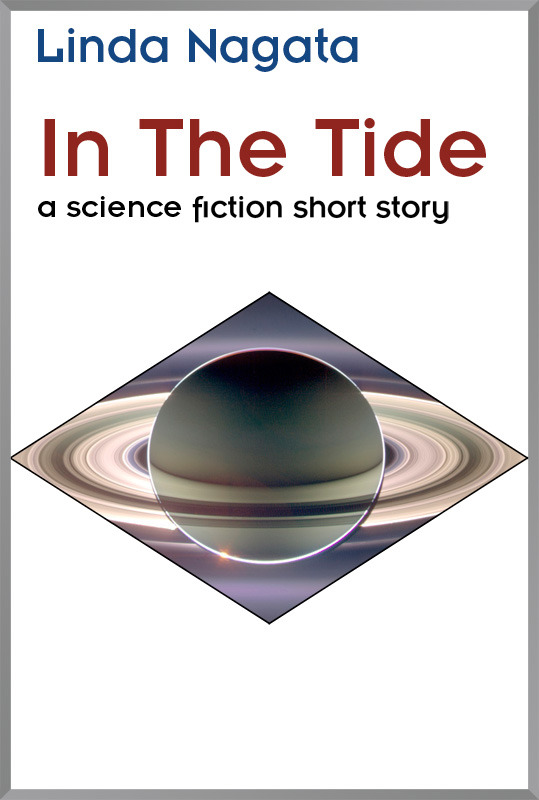
What I didn't like about this book, was many of the characters. I liked Phousita, who was genuinely a nice person, and I didn't mind her friend Arif, who wasn't a nice person but understandably so, given his circumstances (actually, I thought he was OK until Phousita started getting more power and threatening his power in their little family). Nikko, a genetically engineered human designed to survive vacuum (a character like him features in Nagata's short story In The Tide, briefly reviewed here), was the other main protagonist and I liked him too. He finds himself in the rather intolerable position of having a fast-approaching expiration date on his genome. When his father created him, the Commonwealth forced him to put in the expiration date 30 years in the future, which he agreed to under the assumption that by then the law would have caught up and he could remove the fail-safe. It didn't. Nikko sets out to try to steal the Bohr Maker (before it's passed onto Phousita) to try to save himself. In the course of events he gets caught up with Phousita (and gets his brother caught up in the trouble as well).
The central character I really hated was Kirsten, the Chief of the Commonwealth police force. She was a horrible person and an unnecessarily large part of the narrative was told from her point of view. I say unnecessarily because while I acknowledge that she instigated a lot of plot-relevant things (she was the one trying to track down the Bohr Maker and get both Nikko and Phousita executed), there were also chunks of worldbuilding exposition filtered through her point of view. And really, it was her point of view that repulsed me. She didn't see Nikko as a person, but as an animal (despite, prior to the opening, conducting an affair with him) and had zero compassion for anyone. She righteously upholds the spirit of the law (not the letter) by any means necessary, with her convictions reinforced by a zealous religious belief that the Bohr Maker and any other unsanctioned nanotech threatened the sanctity of natural life on Earth (unless it was minor nanotech making lives harder in the slums). I simply could not stand the religious zealotry. I'm not sure if she was supposed to be a partially sympathetic character, but she wasn't and I felt I was inside her head too often. She wasn't the sort of antagonist I love to hate either. At one point I had to put the book down for the evening because I couldn't bring myself to finish the current chapter and get back to her sections. However, depending on your particular set of prejudices, your mileage may vary.
The only other thing that bothered me a little bit were a few slow points throughout the book. It wasn't a particularly long book but there were a few bits when I wished the plot would hurry up because I wanted to know what happened next. However, they weren't enough to ruin my enjoyment
In all, there is a lot to like about The Bohr Maker. Particularly notable is that almost ten years later, this book didn't feel at all dated. I will definitely be picking up the next book in the series (or indeed any other science fiction of Nagata's that crosses my path). I've now read her debut novel as well as her most recent novel (which I loved, and which was rather more fast-paced), and I see no reason not to fill in the blanks. I strongly recommend The Bohr Maker to fans of reasonably hard science fiction (although the technical details aren't discussed in detail) as well as fans of sociological science fiction.
4 / 5 stars
Published: 1995, Bantam Spectra
Series: The Nanotech Succession, book 1 of 3 (not counting a prequel)
Format read: ebook
Source: purchased myself (rather a while ago) from Mythic Island Press, the author's small press for reprinting her out of print books.


 I received