Monday, 25 May 2020

The Enigma Game by Elizabeth Wein

The Enigma Game by Elizabeth Wein is another World War II YA thriller, following some of the same (fictional) characters as Code Name Verity, Rose Under Fire, and the pre-war prequel, The Pearl Thief. I enjoyed and reviewed all of the previous books, as well as the companion Black Dove, White Raven, which followed unrelated characters in Ethiopia. It is not an exaggeration to say that this is my favourite non-SF series of all time.

Windyedge Airfield, Scotland. World War II.

Louisa Adair, newly orphaned and shunned for her mixed-race heritage, has come here to the edge of the world to look after an old lady with a dark past. Jamie Beaufort-Stuart is a flight lieutenant whose squadron is posted to the airfield over winter. Ellen McEwan is a young woman held hostage by the German pilot who lands at Windyedge one wild stormy night carrying a terrible secret.

Three young people desperate to make a difference in a war that has decimated their families, friends and country. When the means to change the course of history falls into their hands, how will they use it? And when the enemy comes looking for them, who will have the courage to strike back?

The Enigma Game is not set at Bletchley Park, which I thought it might be when I first saw the title. It is set near the start of the war, 1940-41, and mostly in the vicinity of an airbase in Scotland. Our in to the story is Louisa, a half-English, half-Jamaican girl, that takes a job looking after an elderly lady near the airbase after both her parents are killed. There she meets female enlistees and the squadron and accidentally gets caught up in wartime secrets concerning an Enigma machine.

My favourite thing about this book was the way in which it addressed identity and perception. Three of the characters do not fit in because of their backgrounds, but only Louisa, the half-Jamaican, is unable to hide it, thanks to her skin colour. The other two — Ellen the Scottish Traveller and Jane the elderly German woman — can pass as British without having to try too hard. And yet, they are both constantly terrified that others will find out their secret (they're not spies, so it's not secret to everyone) and ostracise them for it. Meanwhile, the only reason Louisa got her job near the start of the book was because she was hired over the telephone and her new employer couldn't tell the colour of her skin from her posh English accent. And even better than just having these characters with similar problems in the book is that they all recognised the similarities in each other, which I really appreciated.

The point of view in The Enigma Game is split fairly evenly between Louisa, Ellen and Jamie, the pilot/flight lieutenant. Jamie was a minor character in Code Name Verity and appeared in The Pearl Thief, and Ellen was a minor character in the latter. But all the books stand alone and you don't have to have read any of the others to enjoy The Enigma Game. In fact, since The Enigma Game is set before Code Name Verity, most of the time I was reading, I was dreading/anticipating a crucial event that's mentioned in passing in Code Name Verity. But unlike some prequels which lose tension through predictability, Wein maintained a tense atmosphere throughout basically all the flights we saw the squadron undertake. Especially the climactic part near the end. One bit was so ridiculously tragic that I just knew it had to be based on something that really happened (and the afterword confirmed that it was).  A lot of the book is upbeat and there are even some funny bits, but Wein sure knows how to punch a reader in the feels.

I highly recommend The Enigma Game if you enjoyed any of Wein's other WWII books. If you haven't read them but the description and premise sound appealing, then you can absolutely jump right in with this one. And if you do and enjoy it, there are several more books waiting for you! Sucker for punishment that I am, I hope we get more books set in this "world".

5 / 5 stars

First published: May 2020, Bloomsbury / Little, Brown Books
Series: Code Name Verity series. Set between The Pearl Thief and Code Name Verity.
Format read: ePub
Source: Purchased from Kobo

Saturday, 16 May 2020

Defy or Defend by Gail Carriger

Defy or Defend by Gail Carriger is a novel in her "Delightfully Deadly" novella/novel line, which feature (adult version of) characters from the Finishing School series, which started with Etiquette and Espionage. If you've read the Finishing School books, you'll remember Dimity from her school days. That said, this novel stands alone fairly well, with the few references to the past adding flavour rather than crucial plot elements. I originally thought it was a novella and was confused by the length, but clearly, I misread the cover.

A vampire hive descending into madness. A beautiful spy with a sparkly plan. The bodyguard who must keep them from killing each other.

SPY

Dimity Plumleigh-Teignmott, code name Honey Bee, is the War Office's best and most decorative fixer. She's sweet and chipper, but oddly stealthy, and surprisingly effective given the right incentives.

VERSUS KNIGHT

Sir Crispin Bontwee was knighted for his military service, but instead of retiring, he secretly went to work for the War Office. Mostly he enjoys his job, except when he must safeguard the Honey Bee.

Neither one is a vampire expert, but when the Nottingham Hive goes badly Goth, only Dimity can stop their darkness from turning bloody. And only Crispin can stop an enthusiastic Dimity from death by vampire.

In a battle for survival (and wallpaper), Dimity must learn that not all that sparkles is good, while Cris discovers he likes honey a lot more than he thought.

Defy or Defend features the "have to pretend to be married" romance trope and the "in love with each other but convinced the other doesn't like them" romance trope, neither of which were played for as many laughs as I would have expected from Carriger. Not to say that the book wasn't funny at all, but I've read funnier Carrigers. So that was unexpected and a little disappointing. But even without much laughing out loud, I still enjoyed the book.

The main (non-romance) plot is about Dimity trying to rescue a vampire hive from a particular type of maudlin madness through sheer force of redecorating. Also some social manipulation. And with the object of her affections, Sir Crispin, there as backup. Tight-fitting male dance costumes are involved. The length of the book gives plenty of room to get to know the hive members as well as the protagonists. I was pleased to come fully to grips with each vampire's eccentricity, for example, and that made the final resolution all the more satisfying.

All in all, I quite enjoyed Defy or Defend, my only complaint is that it wasn't as funny as I hoped. I recommend the book to fans of Gail Carriger's other supernatural Victoriana books. I also suggest it's a pretty good place for a new reader to dip their toes in, since the book stands alone well and introduces the particular flavour of Carriger vampires (and werewolves, but less so). It is being sold as a romance book and it's not that there's no romance in it, but it's actually pretty light and more secondary to the other plot than I expected.

4 / 5 stars

First published: May 2020, self-published
Series: Yes! Delightfully Deadly series (order agnostic) and set after the end of the Finishing School series
Format read: ePub
Source: Purchased from Kobo

Tuesday, 12 May 2020

T.I.M.E Stories by Christophe Lambert

A bit of a change of pace for this review. Some time ago, I reviewed a story-based board game called T.I.M.E Stories, or, more accurately, the first scenario in the T.I.M.E Stories series. Since then, my husband and I have played through all the T.I.M.E Stories scenarios as they were released. We liked some more than others and are moderately invested in the overarching story — we would be even more invested if it were better written and plotted. That's theoretically where today's book review comes in. To go with a reboot/upgrade of the game story (the gaming system changed), there is a new novelisation of the story. I was a bit sceptical of it when I first heard about it, since the writing in the games itself has been patchily translated (from French, as has this book). But my husband was very enthused and wanted to read it, so I have let him write the review, which is what you'll find in the rest of this post.

It is the year 2468. Spotted by a recruiter, Tess Haiden passed the many tests required to join a highly secretive organisation with flying colours. But she is in for a shock: T.I.M.E Agency has been sending agents through time for several years. Thanks to considerable resources, they prevent anomalies and paradoxes by dispatching their agents to different eras and places around the world. But over the course of her many missions, Tess learns that they are not the only ones using these time corridors, and she begins to wonder about the true nature of the T.I.M.E agency… 

This book is based on the Time stories series of board games. Some background is necessary here, the games are classic adventure games in a box, where the players travel back in time to a scenario where they have to solve problems with the timeline. A number of adventures have been released and the developers recently changed the system, separating the old games into what they call the white cycle and starting the new white cycle.

The main draw of this book is that it helps bridge the gap between the white cycle and the blue cycle of the board game time stories. It mostly serves to introduce the main characters in the new cycle, while explaining some of the unexplained mysteries. If you want to know who all the new characters are in the new games, read this book. If you haven’t played time stories or don’t care enough about the storyline, probably give this book a pass.

The prose is a little strange, with excessive detail used when setting the scene. This is useful in a game where these details are clues, but just slow down the book. There were often asides that didn’t add anything to either the story or the characters.

When the characters were time travelling, a lot of the pressure came from the arbitrary time limit enforced on time travel missions. This is an important part of the game, but doesn’t work so well in a book. A lot of the first mission in particular had the characters constantly updating each other on how much time was left rather than what they were doing.

I’m happy I read this book to get a better understanding of the time stories setting, but that’s the only reason I have to recommend this book.

2.5 / 5 stars

First published: May 2020, Angry Robot
Series: Not yet
Format read: eARC
Source: Publisher via NetGalley

Sunday, 3 May 2020

Network Effect by Martha Wells

Network Effect by Martha Wells is the first novel about the adventures of Murderbot, who previously appeared in four novellas that I read, enjoyed and reviewed: All Systems Red, Artificial Condition, Rogue Protocol and Exit Strategy. Network Effect follows on from these novellas in a similar vein but in a longer format, meaning there’s even more Muderbot to enjoy in one convenient package. It also has a rather unusual format for its blurb:

You know that feeling when you’re at work, and you’ve had enough of people, and then the boss walks in with yet another job that needs to be done right this second or the world will end, but all you want to do is go home and binge your favorite shows? And you're a sentient murder machine programmed for destruction? Congratulations, you're Murderbot.

Come for the pew-pew space battles, stay for the most relatable A.I. you’ll read this century.


I’m usually alone in my head, and that’s where 90 plus percent of my problems are.

When Murderbot's human associates (not friends, never friends) are captured and another not-friend from its past requires urgent assistance, Murderbot must choose between inertia and drastic action.

Drastic action it is, then.

If you've read any of the Murderbot novellas, you'll have a pretty good idea of what to expect from this book. The biggest difference I found between novel and novellas is the length of the novel. It felt different — in a good way — to have the story just keep going longer than the novellas had trained me to expect. It also made for a meatier story, with a more complex plot and more substantial room for character development. We also got more of a chance to better get to know characters other than Murderbot. In particular, we see a lot more of a subset of the humans from Preservation, where Murderbot went to live at the end of Exit Strategy, and a few others I don't want to spoil. Hearing the humans have all sorts of benign opinions regarding Murderbot was excellent.

I remember reading, around the time that this novel was announced, that it would be continuing the story of Murderbot but would also tie everything up in a conclusive way. It certainly follows on from the novellas — I don't recommend starting with Network Effect, rather go start with All Systems Red — but aside from containing a complete story arc, I didn't really feel like this was a conclusive end to the tales of Murderbot. If anything, it seemed that the end was left nicely open for a sequel featuring Murderbot and some of its new friends. So I hope that happens.

It wouldn't be a Tsana-review if I didn't mention my one physics objection in the book. A lot of the technology and computer/AI stuff is bordering on the fantastical in an expected far-future way, and that stuff doesn't bother me. But there was one "WTF, no, that's not how space elevators work" moment which annoyed me for about five minutes before I was able to move on and pay attention to the story again. At least it was comparatively minor in the scheme of the book.

Network Effect was an excellent book in which Murderbot kicked a lot of arse and got to form/build on meaningful relationships with multiple people. If this sounds like your sort of thing, and if you've read the Murderbot novellas, then I highly recommend picking up this book. If this sounds like your sort of thing and you haven't read the novellas, I suggest starting with All Systems Red. I really hope there will be more Murderbot in the future. I am also planning to reread all the novellas at some point, because reading them as they came out resulted in a lot of memory gaps, though nothing I couldn't work out easily enough in the context of the novel. I'd still like to experience the whole early story in a more continuous way.

5 / 5 stars

First published: May 2020, Tor.com
Series: Yes. Fifth instalment of the Murderbot Diaries, and let's hope there are many more to come.
Format read: eARC
Source: Publisher via NetGalley

Thursday, 23 April 2020

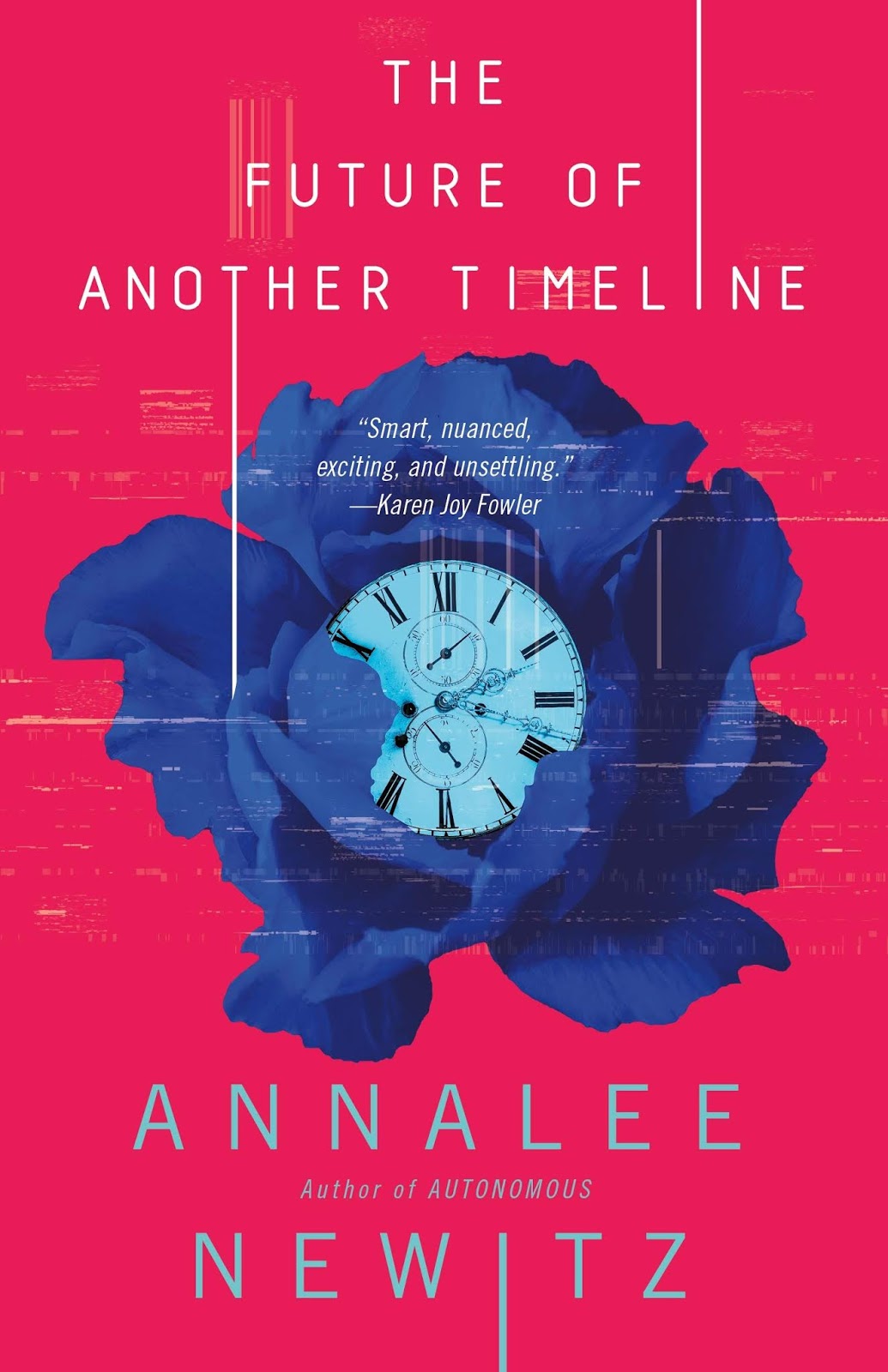
The Future of Another Timeline by Annalee Newitz

The Future of Another Timeline by Annalee Newitz is a time-travelling science fiction novel. I picked it up based on the promise that there would be both time travel and lesbians, though it turned out to be more diverse than just that description implies.

1992: After a confrontation at a riot grrl concert, seventeen-year-old Beth finds herself in a car with her friend's abusive boyfriend dead in the backseat, agreeing to help her friends hide the body. This murder sets Beth and her friends on a path of escalating violence and vengeance as they realize many other young women in the world need protecting too.

2022: Determined to use time travel to create a safer future, Tess has dedicated her life to visiting key moments in history and fighting for change. But rewriting the timeline isn’t as simple as editing one person or event. And just when Tess believes she's found a way to make an edit that actually sticks, she encounters a group of dangerous travelers bent on stopping her at any cost.

Tess and Beth’s lives intertwine as war breaks out across the timeline--a war that threatens to destroy time travel and leave only a small group of elites with the power to shape the past, present, and future. Against the vast and intricate forces of history and humanity, is it possible for a single person’s actions to echo throughout the timeline?

I am still internally screaming about something in this book I can't even talk about here because it is a massive spoiler.
😱 😱 😱
OK, I found some people to talk it over with, so that's out of my system now. Moving on to the actual review.

As you might expect from a book about time travel, there are a couple of story threads in this book, though they get a little more tangled up than non-time travelling flashback sequences tend to. We have Tess, who is from the near future and working with a secret feminist cabal to stop misogynists from editing women's rights out of the timeline (loosely speaking). She travels to various times, with a particular focus on 1892-3 with regards to her research and secret mission. And then in the 1990s we have some punk rock teenage girls living their slightly crappy lives and going to gigs, as seen through the eyes of Beth, one of the teens.

The 1990s storyline serves to highlight the differences between the starting timeline and the parallel world that we, the readers, live in. It also sets up a background for Tess and people like her, especially when Tess starts trying to change her past by illegally travelling to the 1990s. This is tangentially related to my internal screaming above.

But the overarching story is about fighting for rights and the methods by which history is made/changed. An ongoing debate in the book concerns the efficacy of collective action vs the Great Man theory; whether history can be changed incrementally and/or whether killing Hitler actually does anyone any good. But this is more a book about the characters, mostly women, looking out for each other, no matter the time period. If that's your jam, then this may well be the book for you.

Overall I really enjoyed this book. Some parts of it took my by surprise and there was more violence than I expecting going in, but it was violence born out of the anger of the oppressed as much as anything else, and the book was very much in conversation with the justification, or not, of some forms of violence. While there might be a bit of a squick factor associated with some of the violence, I thought it was explored thoughtfully in the book as a whole.

I highly recommend The Future of Another Timeline to fans of time travel and/or feminism. This is the first thing I've read by Annalee Newitz and I am interested in picking up more of their work in the future.

4.5 / 5 stars

First published: 2019, Tor Books
Series: No
Format read: ePub
Source: Purchased from Kobo

Friday, 3 April 2020

Short stories (1–5), a seemingly slow start, amidst much hidden reading


So this is my first #ReadShortStories post of 2020. April might seem a bit late, but in defence of my short story reading consistency, I would like to point out that until the end of March I was reading a large number of stories that were submitted to Rebuilding Tomorrow. So any time I thought about reading a short story that wasn't a submission, I felt guilty. But that's over now. The submissions have all been read and responded to (either with a rejection or a hold request, bending a higher level of global stability — if you submitted something but didn't hear back, feel free to query).

Which brings me to this first batch of stories. Without further ado:

~

Did We Break the End of the World? by Tansy Rayner Roberts — Reread in aid of editing a sequel story that will be appearing in Rebuilding Tomorrow. Source: Defying Doomsday edited by Tsana Dolichva and Holly Kench

The Frost on Jade Buds by Aliette de Bodard — A story of mindships, the threat of war and galactic foreigners. I didn’t get into this story as easily as I have some of the other Xuya stories. Source: The Dragon that Flew Out of the Sun by Aliette de Bodard

Meat Cute by Gail Carriger — A novelette prequel to the novel Soulless. You don’t have to have read Soulless or the Finishing School books to appreciate this story… but I do think it would help a lot. It’s cute and funny, as one expects from Carriger, and follows Alexia on the night of her very first meeting with Connal. Source: Stand-alone purchase

Inheritance by Emma Newman — An emotional slice of a character’s life, set before the events in Planetfall. A good read, but probably not as impactful if you haven’t read Planetfall. Source: Emma Newman’s newsletter

The Generation Gap by Emma Newman — A significant story (not a vignette) about a father who is worried that there’s something wrong with his kid. I loved the reversal and the plausibility of the resolution. I think it’s my favourite story of this series. Source: Emma Newman’s newsletter

Thursday, 26 March 2020

The Empress of Salt and Fortune by Nghi Vo

The Empress of Salt and Fortune by Nghi Vo is a standalone novella set in a fantasy-tinged world based on imperial China. I picked it up because the blurb seemed interesting and also because it was a novella.

A young royal from the far north, is sent south for a political marriage in an empire reminiscent of imperial China. Her brothers are dead, her armies and their war mammoths long defeated and caged behind their borders. Alone and sometimes reviled, she must choose her allies carefully.

Rabbit, a handmaiden, sold by her parents to the palace for the lack of five baskets of dye, befriends the emperor's lonely new wife and gets more than she bargained for.

At once feminist high fantasy and an indictment of monarchy, this evocative debut follows the rise of the empress In-yo, who has few resources and fewer friends. She's a northern daughter in a mage-made summer exile, but she will bend history to her will and bring down her enemies, piece by piece.

This story is told in two timelines: a framing narrative set in the "present", in which a cleric, Chih, is investigating the titular Empress, and a series of flashbacks as Rabbit tells Chih about slices of her life with the Empress. As we gradually learn throughout the story, the Empress was pretty awesome, as were the people she chose to associate with. I liked the way in which the story was revealed in discrete chunks that furthered our understanding of the underlying story and the worldbuilding.

Honestly, the only negative thing I have to say about this novella is that I read it during the initial intensifying part of the pandemic (for where I'm living) and as a result I found it very hard to concentrate on it properly. I am pretty sure this wasn't the book's fault, since I very much enjoyed it when I was able to focus on it better. I think this will be one I'll have to reread at some point in the future. I feel confident that I'll enjoy it even more the second time around, for spotting the foreshadowing as well as my improved concentration.

I recommend The Empress of Salt and Fortune to readers who enjoy intrigue but don't feel like reading an entire epic fantasy trilogy for their fix. Also to readers who enjoy Chinese-inspired fantasy settings and/or framing narratives and/or are excited by the idea of war mammoths. I will definitely be keeping an eye out for Vo's future work.

4.5 / 5 stars

First published: March 2020, Tor.com
Series: No
Format read: eARC
Source: Publisher via NetGalley

Sunday, 15 March 2020

Songwoman by Ilka Tampke

Songwoman by Ilka Tampke is set during the time of the Roman invasion of Britain, around the 40s AD. It is technically a sequel to Skin, but actually both books stand alone fairly well. They follow the same protagonist, but the two stories are separate, if sequential. I read Skin during a blog hiatus, so there is only a mini review of it, alas.

Haunted by the Roman attack that destroyed her home, Ailia flees to the remote Welsh mountains in search of the charismatic war king, Caradog, who is leading a guerrilla campaign against the encroaching army.

Ailia proves herself an indispensable advisor to the war king, but as the bond between them deepens, she realises the terrible role she must play to save the soul of her country.

Set in Iron-Age Britain, Songwoman is a powerful exploration of the ties between people and their land and what happens when they are broken.

I started reading Songwoman after a day trip to northern Wales, during which a friend and I visited a few castles (built more than a millennium after this book was set), and drove through Snowdonia with some breathtaking views, even in winter. So I was excited to start reading a book set in roughly the same area. The setting of Songwoman did not disappoint. The plot, however, was a little slow.

The bulk of the story involves Ailia being part of the inner circle of Caradog's resistance army. Her personal journey is split between learning the mystical arts, her relationship with Caradog, conflict with some of Caradog's other advisors, and the actual war. The war is mostly a series of small skirmishes and recruitment negotiations, and hence felt like it moved slowly, but in a realistic way. I actually found the relationship with Caradog the most drawn out. I don't want to spoil too much, but I will say that it was interesting that he was portrayed in a way that could be read as bipolar, but that was the most interesting thing about him. I did not quite understand Ailia's emotional attachment to him, especially since I spent a chunk of the start of the book hoping a key character from Skin would make an appearance (he did not).

So on the one hand, Songwoman was a little slow — though not unpleasant to read, aside from a few brief atrocities — but on the other hand, I was actually surprised at how little time was covered in the book. Near the end, there's a scene in which Ailia returns somewhere and notes that it's been a year since she was last there, at the start of the book. I was honestly shocked that only a year was supposed to have passed. This is maybe because, as the author mentions in the afterword, a few years of historical events were compressed  into one year for expediency. However, given my other reaction, I'm wondering whether that was the best choice. That said, I actually liked certain events around the ending a lot. (Being vague to avoid spoilers.) It added an extra dimension to the story, confusing timing aside.

Anyway, I mostly enjoyed Songwoman, even though it took me a while to get through. I recommend it to fans of historical fantasy and, particularly, Welsh settings. While it makes sense to read after Skin, it's not entirely necessary. While I don't expect a sequel, I am broadly interested in the author's future works.

4 / 5 stars

First published: 2018 Text Publishing, with US edition March 2020
Series: sequel to Skin
Format read: eARC
Source: Publisher via Edelweiss

Sunday, 8 March 2020

The Prisoner of Limnos by Lois McMaster Bujold

The Prisoner of Limnos by Lois McMaster Bujold is another Penric and Desdemona novella, this time directly following on from Mira's Last Dance. This review and the blurb contains minor spoilers for Mira's Last Dance and possibly also Penric's Mission, which is the start of this little subgroup of novellas.

In this sequel novella to “Mira’s Last Dance”, Temple sorcerer Penric and the widow Nikys have reached safety in the duchy of Orbas when a secret letter from a friend brings frightening news: Nikys’s mother has been taken hostage by her brother’s enemies at the Cedonian imperial court, and confined in a precarious island sanctuary.

Their own romance still unresolved, Nikys, Penric, and of course Desdemona must infiltrate the hostile country once more, finding along the way that family relationships can be as unexpectedly challenging as any rescue scheme

This was another fun read. I enjoyed the story, which sees Penric hatching an elaborate rescue mission to rescue Nikys's mother, while continuing to woo Nikys. The point of view switches between Penric and Nikys, so we get some interesting scenes between Nikys and her mother, as well as the usual conversations between Penric and Desdemona (also a great scene between Nikys and Desdemona).

Overall, this was a fun read and pretty much the sort of thing I've come to expect from Penric novellas. I don't especially recommend this as a starting point to the series, though I think it works better that way than Mira's Last Dance did. My general recommendation from my previous review stands: I recommend reading Penric's Mission and Mira's Last Dance before The Prisoner of Limnos, and probably also Penric's Demon to introduce Penric and Desdemona's unique relationship. There's still one more novella I haven't read, which I plan to get to at some point soon, and hopefully more to come in the future.

4.5 / 5 stars

First published: 2017, Self-published
Series: Penric & Desdemona book 6 of 7 in publication order
Format read: ePub
Source: Purchased from Apple Books

Tuesday, 25 February 2020

Mira's Last Dance by Lois McMaster Bujold

Mira's Last Dance by Lois McMaster Bujold is a Penric and Desdemona novella set in the World of the Five Gods. It is a direct sequel to Penric's Mission, which I have previously read and reviewed, and hence the blurb below contains spoilers for that earlier story.

In this sequel to the novella “Penric’s Mission”, the injured Penric, a Temple sorcerer and learned divine, tries to guide the betrayed General Arisaydia and his widowed sister Nikys across the last hundred miles of hostile Cedonia to safety in the Duchy of Orbas. In the town of Sosie the fugitive party encounters unexpected delays, and even more unexpected opportunities and hazards, as the courtesan Mira of Adria, one of the ten dead women whose imprints make up the personality of the chaos demon Desdemona, comes to the fore with her own special expertise.

I bought Mira's Last Dance during a book slump and devoured it in less than 24 hours. Since it has been more than two years since I read the immediate prequel, Penric's Mission, it took me a little while to remember who the persisting side characters were. But it came back to me soon enough and the book was an entertaining read even before that. I do, generally speaking, recommend reading Penric's Mission before Mira's Last Dance, and probably also Penric's Demon, which sets up the whole concept of the novella series. However, you do not need to have read any of the novels in the World of the Five Gods — indeed, I haven't and I've been enjoying the Penric and Desdemona books just fine.

In this story, we see Penric escorting/delivering the two people we met in the previous novella to the city they were trying to reach. Of course, they run into troubles along the way, the most memorable of which requires Penric to call on the skills of one of Desdemona's previous possessed humans, Mira. Hence the title.

Mira's Last Dance was entertaining, a bit introspective and overall a good diversion. I recommend it to fans of Bujold's work and the other Penric and Desdemona books, with the prequel-reading caveat above. I plan to pick up the direct sequel, The Prisoner of Limnos, immediately.

4.5 / 5 stars

First published: Self-published, 2017
Series: Penric and Desdemona book 4 in publication order, but 5 in current chronological order, of 7 so far
Format read: ePub
Source: Purchased through Apple Books